The year 70
In Rome there is the Arch of Titus, built around 81 CE. On the inside of the arch is a relief: a line of Roman soldiers carrying a seven-branched menorah, returning in triumph from Jerusalem.
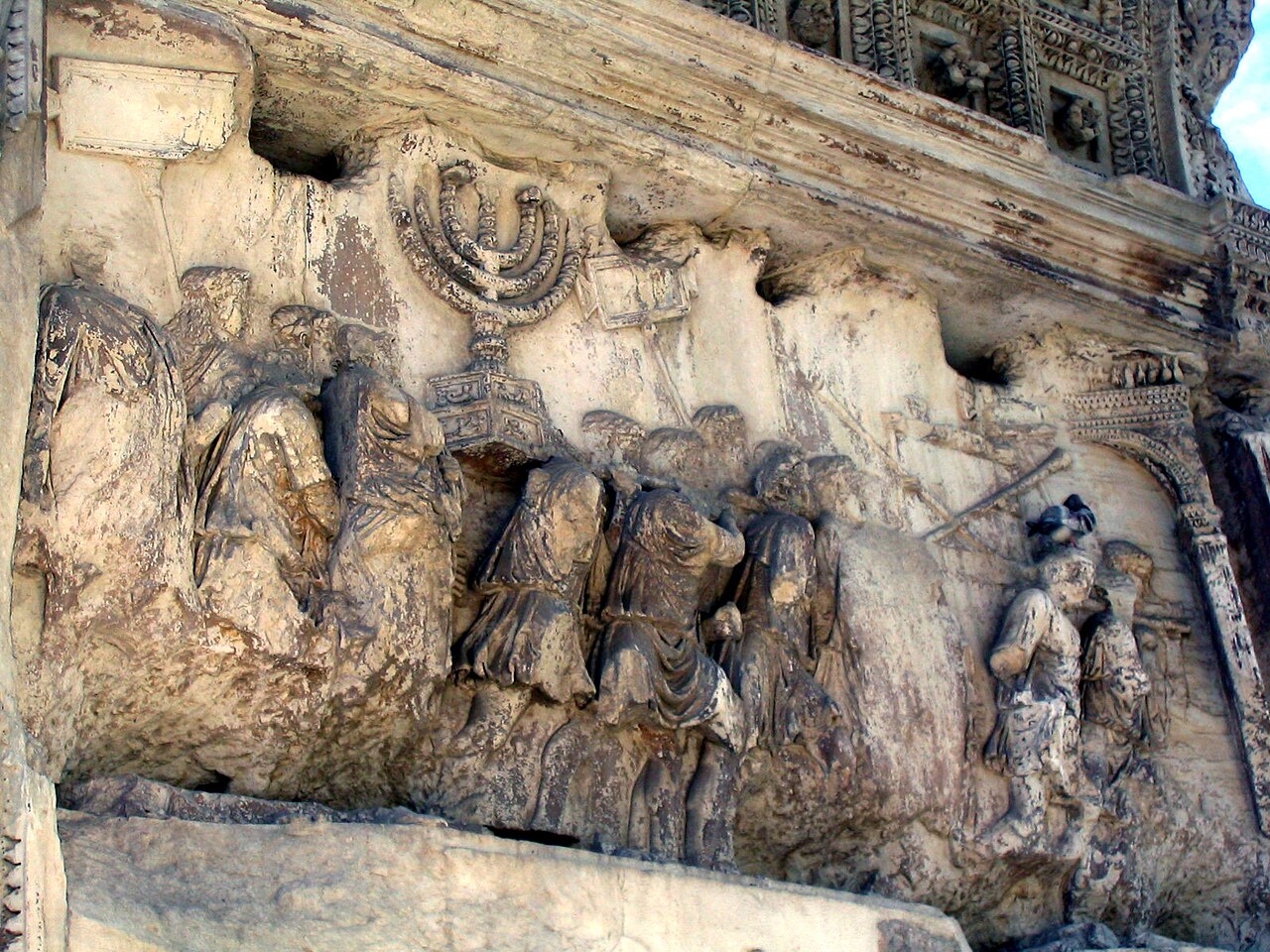
The relief inside the Arch of Titus: Roman soldiers carrying in procession the menorah from the Temple in Jerusalem. The winning side carved this scene in stone, and two thousand years later it has become the picture most often quoted by the losing side. Source: Wikimedia Commons, photographed by Anthony M., CC BY 2.0

That menorah came from the Second Temple in Jerusalem. In 70 CE, the Roman army broke into Jerusalem, and the Temple was burned.
For Judaism of the time, this was nearly like having the heart removed. Sacrifices had to be offered in the Temple; the priests revolved around the Temple; the pilgrimages of the year all ended at the Temple. With the Temple gone, the whole of religious life lost its centre.
What usually happens when a religion's centre is destroyed? Look at the other temples in that same Mediterranean world: the gates close, the priests scatter, and within a few generations the faith is left as ruins.
Judaism did not go that way.
The rabbis took over
There is a legend in the rabbinic literature: when Jerusalem was under siege, a teacher named Yohanan ben Zakkai had his students put him in a coffin and carry him out of the city, to see the Roman general and ask for just one thing: to be allowed to set up a school in the little coastal town of Yavne.
Whether that is true, we can't check. But what the legend wants to say is: it doesn't matter if the city is lost; the book mustn't be broken.
After the Temple fell, what slowly became the core of Jewish society was the rabbis, those who study and expound the law. They did something of enormous consequence: they systematically wrote down the law that had been passed on by word of mouth. Around 200 CE the Mishnah was compiled; later the discussions of it and commentaries on it were gathered into the Talmud.
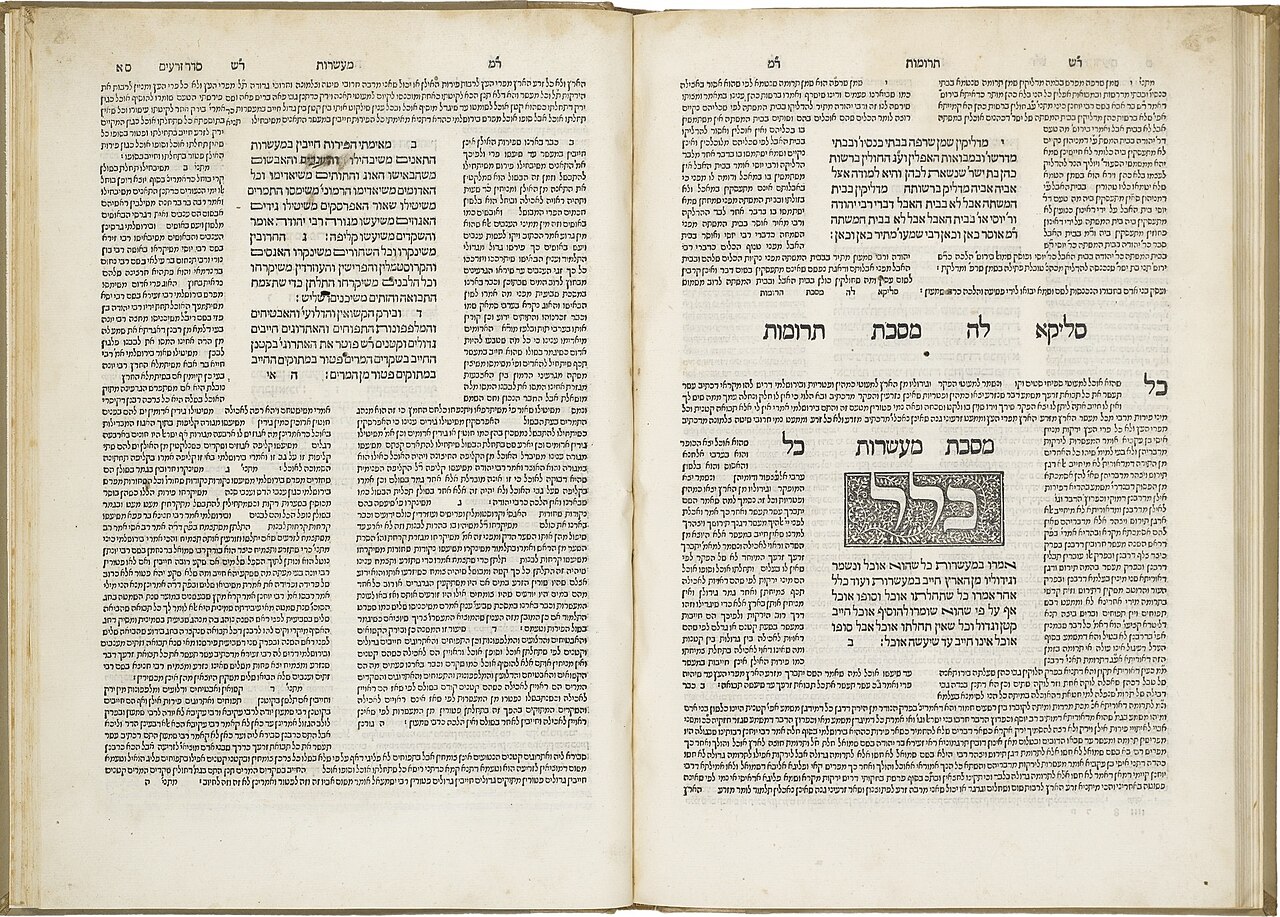
The Babylonian Talmud, Seder Zeraim, Bomberg's Venice printing, 1543–1544. The central column is the main text; around it, ring after ring of commentary from every age. A single book to which generation after generation added words. Source: Wikimedia Commons, public domain

In this way the centre of the religion moved from a building to a text and a way of living. How to keep the Sabbath, what may and may not be eaten, what to do about marriage and property: it was all in the book, and could be followed wherever you went. By tradition, ten adult men are enough for communal prayer; no Temple, and no priest, is needed.
Hebrew also found another way to live. For two thousand years it was no longer the everyday spoken language of the Jews, but it stayed the language of prayer and Scripture. In the late nineteenth century, people like Ben-Yehuda made it a language of daily speech again; in 1922 it became one of the official languages of British-ruled Palestine.
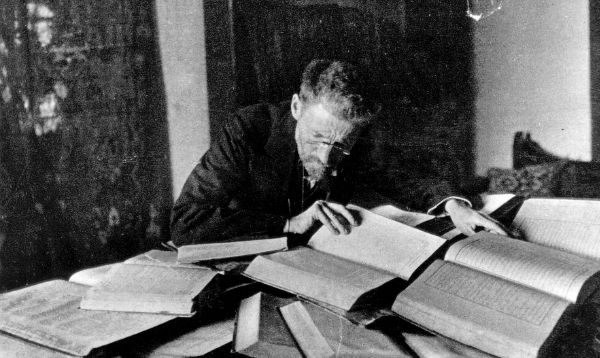
Ben-Yehuda at his desk in Jerusalem, about 1912. He compiled a great dictionary of modern Hebrew, kept at it until his death, and never finished it. Source: Wikimedia Commons, photographed by Shlomo Narinsky, public domain

Judaism had found a "portable" way to live: as long as there is a book, and people who gather, the core of the civilization can travel with its people.
This story is too smooth
At this point many people reach a neat conclusion without thinking: a book saved a people.
The economic historians Maristella Botticini and Zvi Eckstein, in The Chosen Few (2012), add a very jarring footnote to this conclusion.
They noticed that after the Temple was destroyed, the rabbis pushed a new rule: every Jewish man had to be able to read the Scripture, and had to send his sons to study. In an age when the vast majority farmed and very few could read, this was a heavy burden: a child sent to study was one fewer pair of hands at home, and there were fees to pay. A faith that charges tuition is unpopular in any age.
They estimate that around 70 CE there were about five million Jews in the world; by 650 CE, only about one million. War, massacre and plague all played a part, but they argue that another important cause was that many people found the rules too expensive and left Judaism one after another; quite a few became Christians.
Those who stayed were those who were willing, and able to carry, those rules. They were literate, and later found it easier to move into cities, to take up crafts and trade.
Looking the other way
This explanation is debated among scholars. The population numbers are estimates, and there is more than one reason people left. But it reminds us of something:
When we say "Jewish civilization has not died in two thousand years," what we see is the line that survived. Those who could not, or would not, carry this book forward did not vanish from history; they became part of other peoples, and became other people's ancestors. At their own dinner tables, they made a very ordinary decision: we won't study any more, we won't keep it any more, we have to get on with life. I don't think that was betrayal.
The price of "portability" is a threshold. The threshold kept the civilization safe, and also shut part of its people outside.
Can Chinese culture only live on a state?
A common comparison online says: Judaism survived through a text; Confucianism depended on the state and the land, and when the state fell it scattered.
That comparison draws Confucianism too narrowly. For centuries the Chinese of Southeast Asia, through huiguan (native-place halls), ancestral halls, fellow-townsman associations, and qiaopi (the letters and remittances that overseas people sent home through remittance houses), kept their language, their ancestral rites and their mutual aid going without any home-state regime behind them. That too was a kind of "portability"; what it carried was not a book of law but a web woven of people and credit.
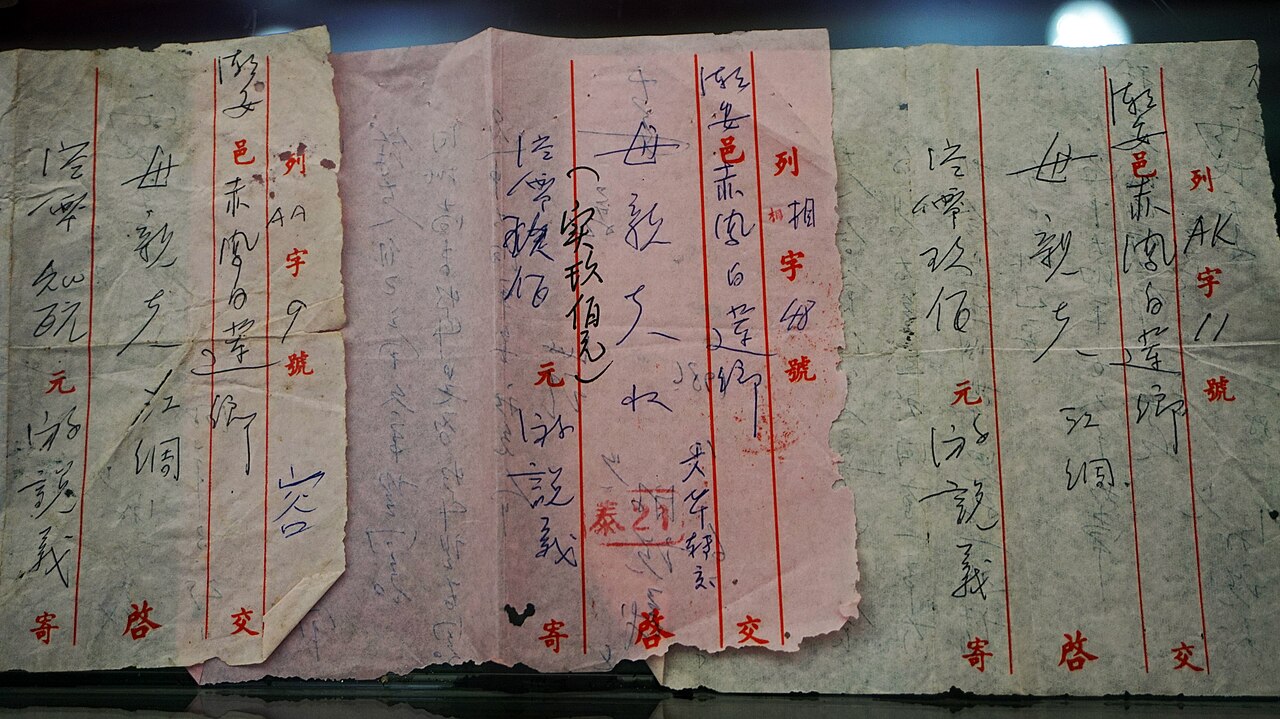
A Chaoshan qiaopi, with "To Mother" written on the envelope, enclosing some Hong Kong dollars. A sheet of paper, a sum of money, a greeting, linking Nanyang and Chaoshan at either end. The qiaopi archives were inscribed on UNESCO's Memory of the World Register in 2013. Source: Wikimedia Commons, photographed by Sanlie, CC BY-SA 4.0

What became of the web on the Chinese side
Interestingly, this web lived on overseas, and was cut several times at home.
After 1949, the qiaopi trade was first brought under control; in 1972 the State Council issued a document abolishing the private qiaopi trade at home (as reported in local histories such as Hainan's; I have not found the original document), and by the end of the 1970s, the remittance houses everywhere had been absorbed into state banks, and the private houses were gone. In the "Smash the Four Olds" years from 1966, in many places ancestral halls were torn down or put to other uses, genealogies were burned and ancestral tablets smashed.
In other words, the half that relied on the state was taken apart by the state itself; the half that relied on the web went to places the state could not reach, and so survived. Today, if you want to see a well-preserved Chaoshan-style ancestral hall, or an ancestral sacrifice held by the old rules, it is often easier to go to Penang or Singapore than to Chaozhou.
I'd rather have a web
The Jewish road, I admire, but I don't plan to copy it. One book of law, one literacy threshold: it sifted the people, and I feel for those several million who fell through the sieve.
What I'd rather have is to put together the web of the Southeast Asian Chinese and the book of the Jews: characters and a few shared scriptures that everyone can read; rites such as ancestral sacrifice and Qingming; places like huiguan and ancestral halls; something you can take with you, and that doesn't depend on any regime to keep it. What is brought together is one set of culture and belief, not an ethnic identity. There must be a threshold, but a lower one, so that those who have drifted away can still find their way back.
If your culture could take only one thing with it, what would you take?
References
- Maristella Botticini & Zvi Eckstein, The Chosen Few: How Education Shaped Jewish History, 70–1492, Princeton UP, 2012
- UNESCO Memory of the World Register, "Qiaopi and Yinxin: Overseas Chinese Letters and Remittances from Fujian and Guangdong" (2013)
- Yohanan ben Zakkai and Yavne: the legend in the Babylonian Talmud, Gittin 56a–b; its historicity is disputed
- The Arch of Titus, the destruction of the Second Temple, the compilation of the Mishnah, the revival of Hebrew: standard history
- Jewish population of about five million (70 CE) falling to about one million (650 CE): Botticini & Eckstein's estimate, as presented in the EH.Net book review and in Slate's account of the book (🟡, second-hand; the book itself says war and famine explain at most half)
- Nationalisation of the qiaopi trade: Chen Chunsheng, Modern Overseas Chinese Remittances and the Qiaopi Trade — a Study Centred on the Chaoshan Region, Research on Chinese Social and Economic History 2000, no. 4 (the Shantou houses Youxinzhuang and Zhenshengxing ran until 1977, "until qiaopi business was handled solely by state banks"); Jiemian News, Inside and Outside the Play: The Yinxin Bureaus, Currency and Finance behind Love Letters to Grandma (1972 State Council document abolishing the private qiaopi trade at home; from January 1976 Fujian qiaopi business taken over by banks; in 1979 Xiamen's qiaopi trade fully brought under the Bank of China); Yangcheng Evening News, 27 May 2026, quoting the Guangdong Provincial Archives: "In 1979, qiaopi business was formally brought under the Bank of China" 🟡
- "Smash the Four Olds": a commonly given second-hand account, to be checked place by place
- Image sources are given in each caption