On the wall of Philae
On the upper Nile there is a small island, and on the island the Temple of Isis at Philae.
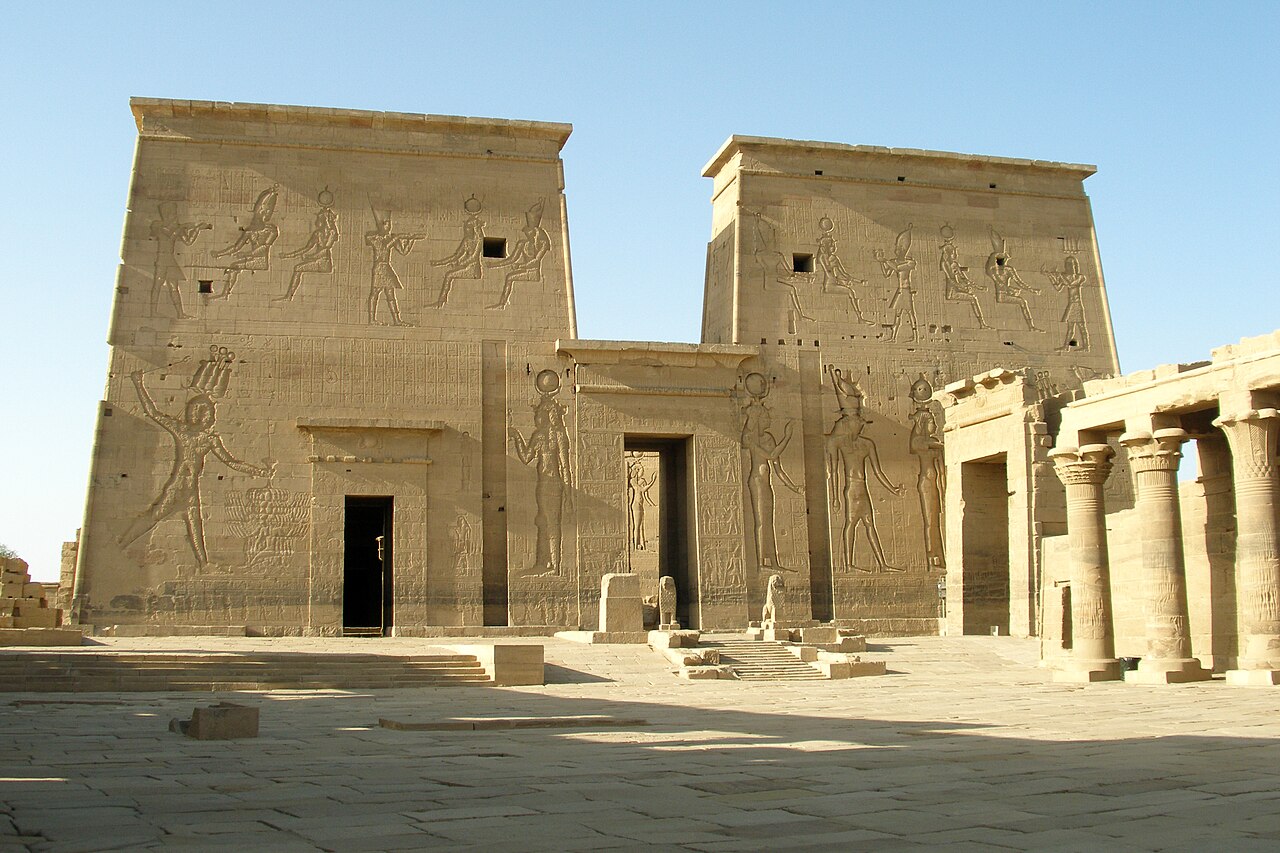
The Temple of Isis at Philae, first pylon. In the twentieth century, when the Aswan dam was built, the whole temple was taken apart and moved to a higher island nearby. Source: Wikimedia Commons, photographed by Vyacheslav Argenberg, CC BY 4.0

On 24 August 394 CE, a priest named Esmet-Akhom carved an image of a god on the temple wall, and beside it a short inscription, praying that the inscription would "last for ever."
He probably didn't know he was the last.
This is the last known inscription in Egyptian hieroglyphs.
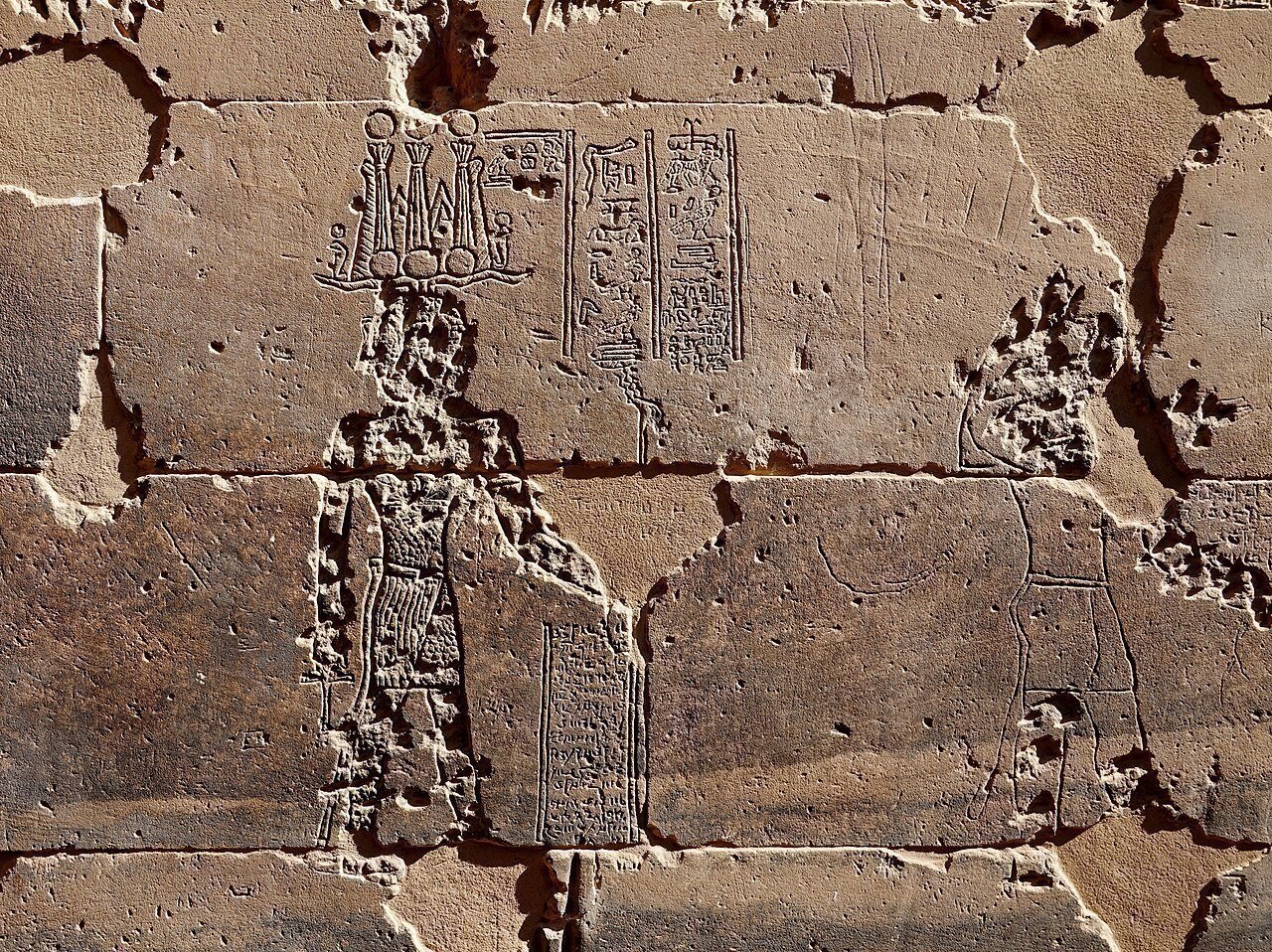
On Hadrian's Gate, the god figure and the hieroglyphs beside it carved by Esmet-Akhom, 394 CE. It is not finely done, as if an old man were writing once more, from memory, the script he knew. Source: Wikimedia Commons, photographed by Olaf Tausch, CC BY 3.0

After that, graffiti in the simpler "demotic" script continued for a few decades; the latest known one was carved in December 452. After that, no one in the world could read these signs. Until 1822: fourteen hundred years and more.
Those who wrote it were gone
Why did hieroglyphs break off?
The most direct cause came just a few years before the Philae inscription. In 391 to 392, the Roman emperor Theodosius I issued one decree after another banning pagan sacrifice.
In ancient Egypt, those who could read and write hieroglyphs were few from the start, mostly priests in the temples. Hieroglyphs were sacred writing, carved on temples, in tombs, on monuments. Once the temples shut and the priests stopped passing it on, the craft had no heirs.
Philae lay at the empire's far southern edge, and because of an agreement with the southern tribes, pagan worship held out there somewhat longer than elsewhere. That is why the last inscription appears here.
Three layers of writing on one column
There is a column in the Philae temple that carries all of what came afterwards on its body.
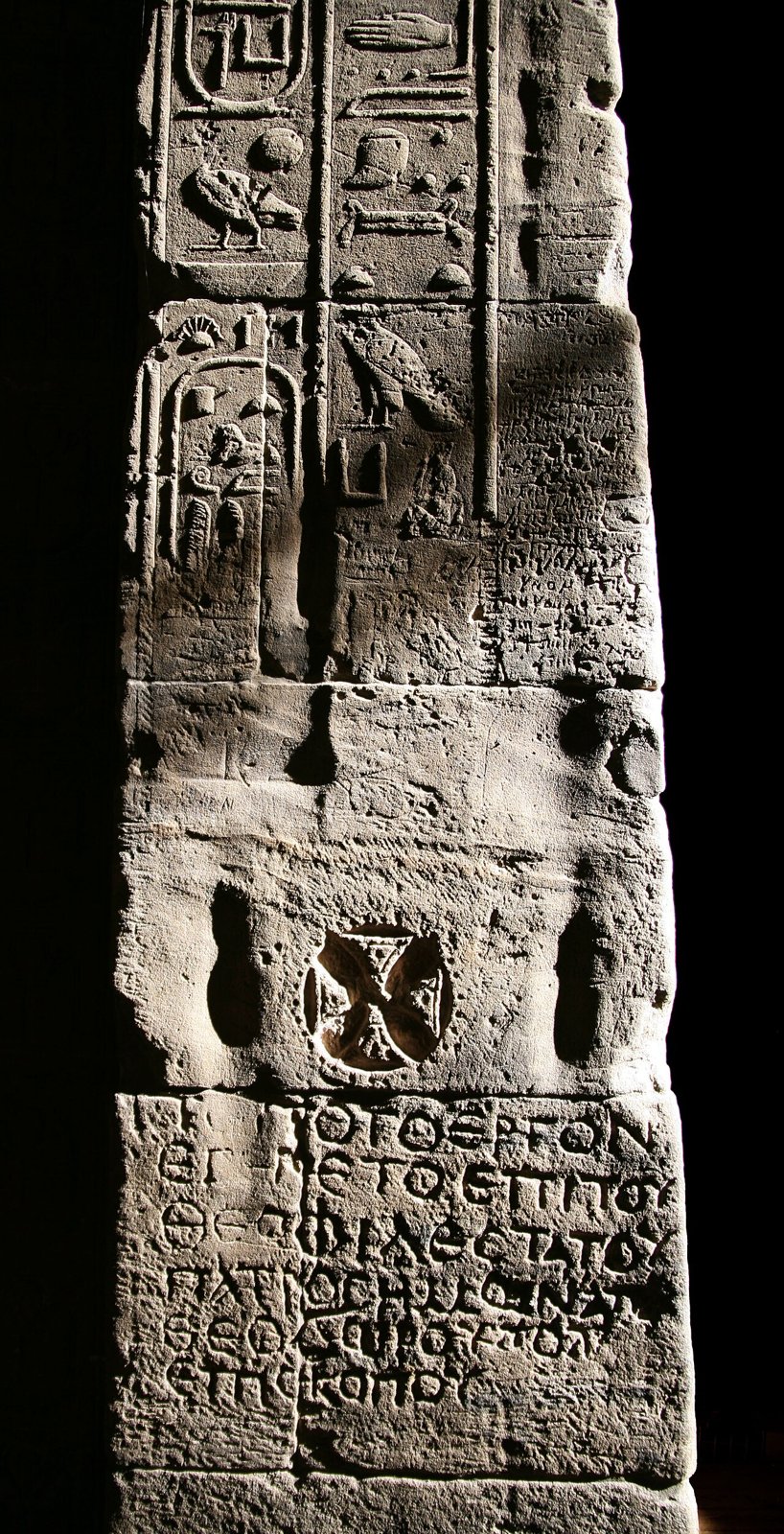
A column of the Temple of Isis at Philae: at the top, Egyptian hieroglyphs; in the middle, graffiti carved by later people in Greek letters; further down, Christians cut a cross into the stone, and below it a Greek Christian inscription. Source: Wikimedia Commons, photographed by Till Niermann, CC BY-SA 3.0

Read it from top to bottom and it is a very short history of Egyptian religion: at the top, the gods of the pharaohs; in the middle, the writing left by Greeks and Romans; at the bottom, the new cross. No one scraped off the layer above. They simply carried on carving below.
In the sixth century, this temple was turned into a church.
It wasn't "pictographs" losing to "the alphabet"
Many people have an intuition about this history: hieroglyphs were too primitive, and were replaced by the more advanced alphabet.
That intuition is wrong in two ways.
First, Egyptian hieroglyphs were never just "reading pictures." They mix meaning-signs and sound-signs: draw an owl, and it can mean an owl, or it can simply stand for the sound /m/. The script could spell sounds on its own.
Second, the type of a script has no such direct bearing on whether a civilization continues. The sinologist John DeFrancis, in his 1984 book, specifically criticised the claim that Chinese characters are a "purely ideographic" script: there are also many sound components in Chinese characters; that Chinese characters have lasted owes more to a bureaucracy and an education system that keeps producing literate people than to any magic in the shape of the characters themselves.
Egypt is exactly the reverse: the group who could read and write was cut off in one stroke by a policy. Hieroglyphs were not beaten by a better script; the people who wrote them were gone.
The Egyptians were still there, and so was Egyptian
And the Egyptians did not disappear, nor did the Egyptian language disappear at once.
Even before hieroglyphs broke off, Egyptian Christians had begun using Greek letters, plus a few signs borrowed from demotic, to write their own speech. This is Coptic. The Bible was translated into Coptic, and the Church used it for worship, preaching and copying scripture.
In the middle of the seventh century, Arab armies entered Egypt. Over the next few centuries, Arabic slowly became the language of office, of trade and of daily life, and most Egyptians slowly converted to Islam. Coptic withdrew from the street into the church, and finally survived only as a language chanted in liturgy.
So if you ask "when did ancient Egyptian civilization die?", it depends which layer you ask about: hieroglyphs, the end of the fourth century; the old religion, about the same time; the Egyptian language as everyday speech, another thousand years later; as a language of worship, it is still here today.
The key was in the church
In 1799, French soldiers dug out a stone stele near Rosetta at the mouth of the Nile, with the same text carved three times in three scripts: hieroglyphic, demotic and ancient Greek.
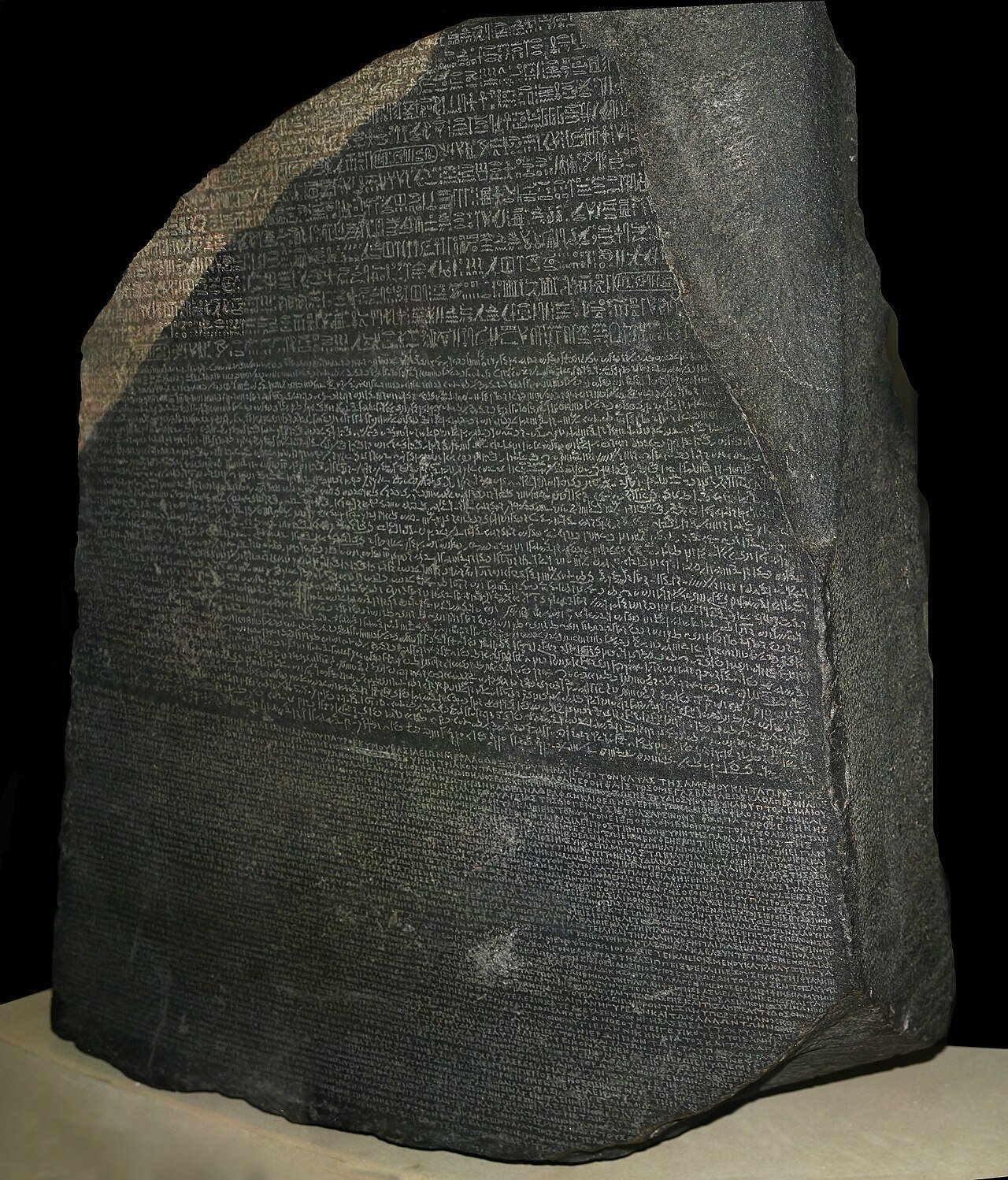
The Rosetta Stone, now in the British Museum. Hieroglyphs above, demotic in the middle, ancient Greek below. The content is actually quite ordinary: a decree in praise of Ptolemy V by the priests, 196 BCE. Source: Wikimedia Commons, photographed by Hans Hillewaert, CC BY-SA 4.0

With the Greek for comparison, decipherment had something to hold on to, but the real breakthrough still lacked one thing: knowing the language itself. The French scholar Champollion had been learning Coptic since his youth. He realised that the language behind hieroglyphs was the ancestor of Coptic.
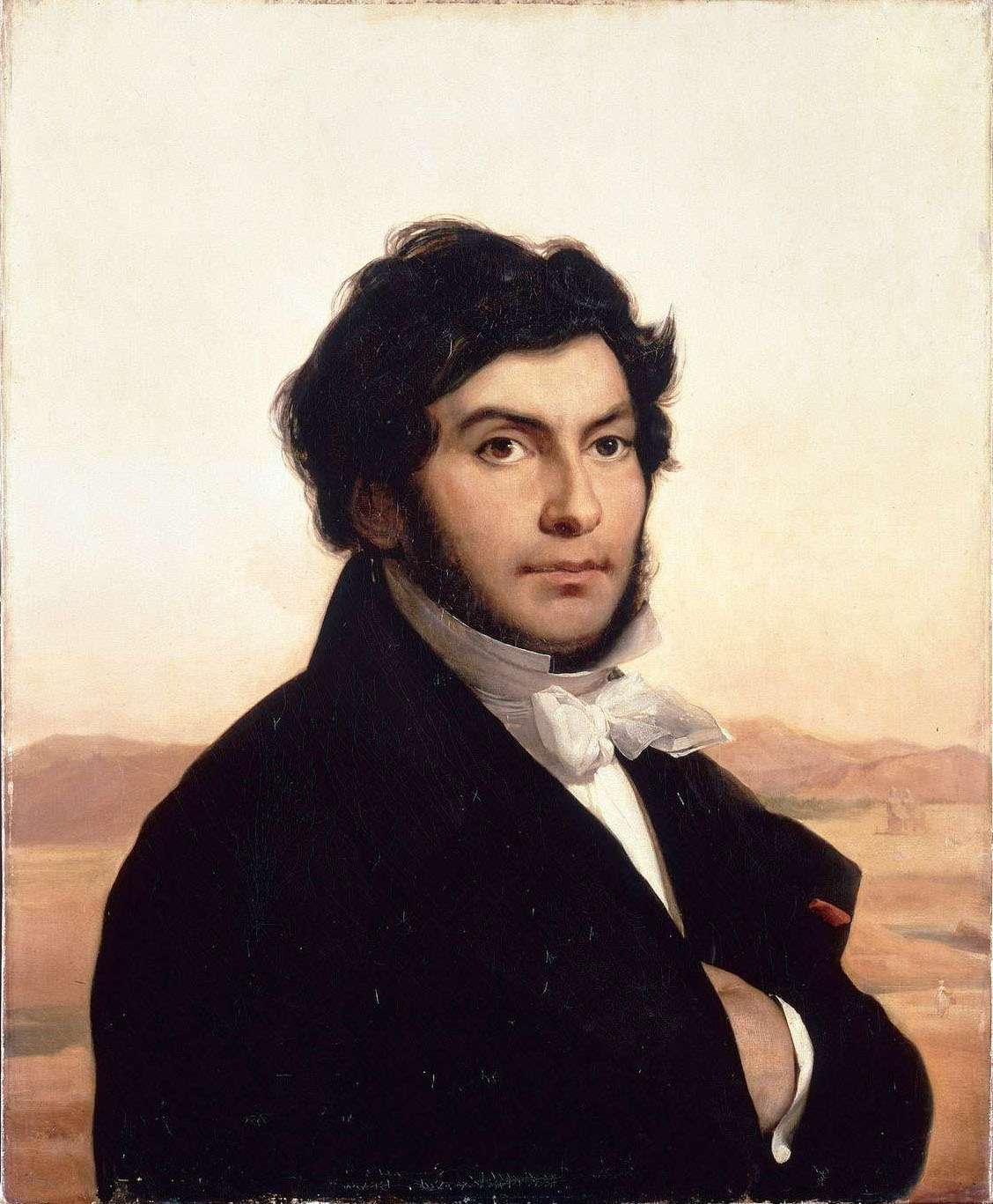
Champollion (1790–1832), painted by Léon Cogniet in 1831. He died less than ten years after announcing the decipherment, at forty-one. Source: Wikimedia Commons, Léon Cogniet, public domain

In 1822 he announced that he had succeeded.
A language already dead in the street, chanted only in churches, turned a script that had been silent for fourteen hundred years back into readable history.
Looking the other way
"Egyptian civilization was taken over" has real impact: the script replaced by an alphabet, the speech by Arabic, the gods by Allah.
But from another angle, you can also say Egyptian civilization has always been changing its shell. The pharaonic age was itself ruled by outsiders several times; Hellenisation, Romanisation, Christianisation, Islamisation each had a break and each had a continuity. Since the twentieth century the Egyptian government has invited pharaonic civilization back into the national story: in 2021, 22 ancient pharaonic mummies were carried through the streets of Cairo in a very grand moving parade.
When I read this history I always think of Chinese characters. They have not broken off, not because they are by nature cleverer than hieroglyphs, but because for two thousand years someone has always been teaching them, learning them, examining on them. If one day no one taught them, they too would retreat into some temple, to wait for a Champollion.
Where does a civilization die: when the last person who could write it is gone, or when the last person who could speak it is gone?
References
- Esmet-Akhom's graffito at the Temple of Philae (24 August 394); the latest demotic graffito at Philae (December 452)
- Theodosian Code 16.10.10–12, the edicts of 391–392 banning pagan sacrifice
- Champollion, Lettre à M. Dacier, 1822
- John DeFrancis, The Chinese Language: Fact and Fantasy, 1984
- Image sources are given in each caption