A line you often hear
Talk to Iranians and you will soon hear it: we are Persians, not Arabs.
To outsiders it may sound odd. Iran is an Islamic Republic, and Islam arrived in the seventh century with the Arab armies; modern Persian is written in the Arabic alphabet. The religion and the script both came from the Arabs, so how can the identity not be Arab?
This question is a good test of a very popular claim: "Iran was taken over by Islam."
The end of an empire
Sasanian Persia was a tough empire. Shapur I, one of its founding kings, defeated a Roman emperor and had the scene carved into a cliff.
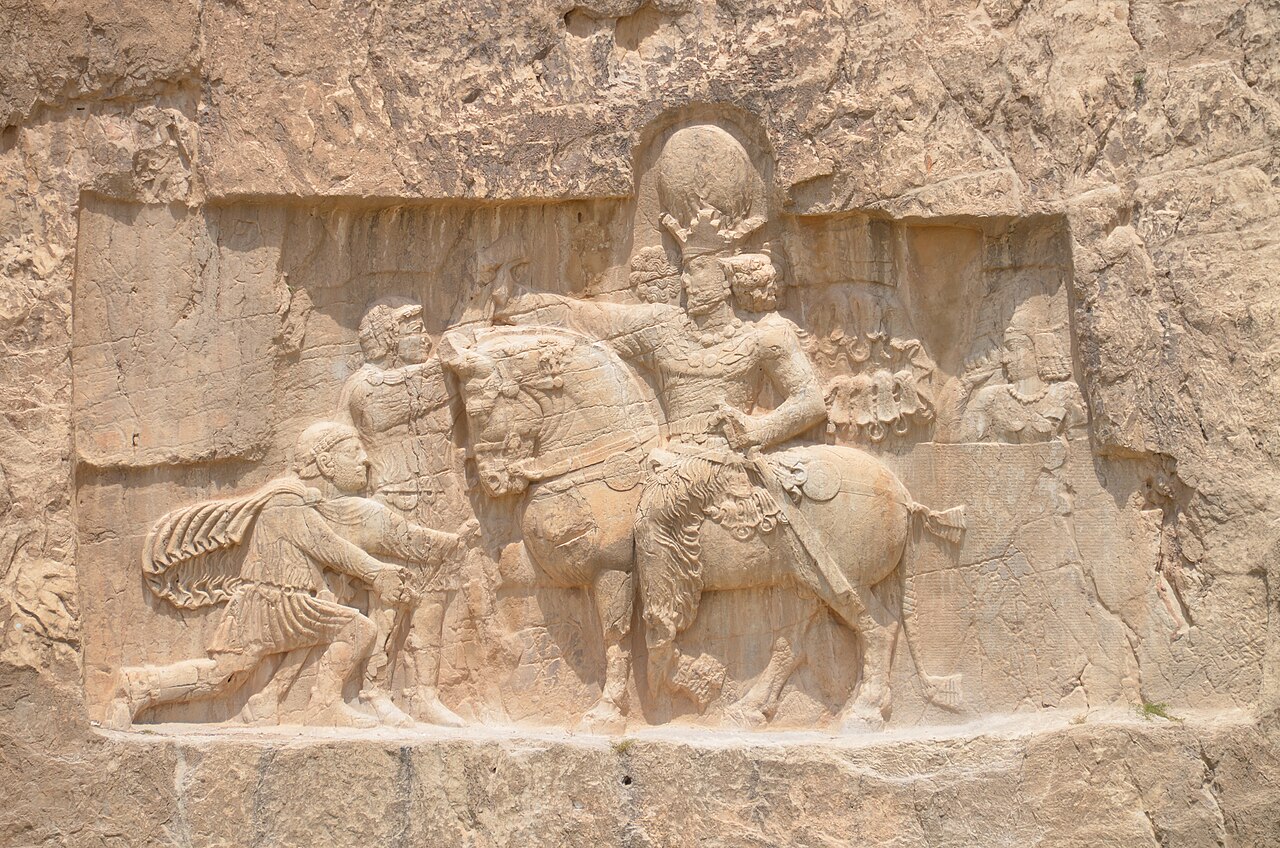
The cliff relief at Naqsh-e Rostam: on horseback is the Sasanian king Shapur I, and the one kneeling before him is a Roman emperor. Iranians of the third century could not have imagined how their empire would end four hundred years later. Source: Wikimedia Commons, CC BY-SA 2.0

From the 630s the rising Arab Muslim armies defeated the Sasanians again and again. In 651 the last Sasanian emperor, Yazdegerd III, was killed while fleeing, and an empire of more than four hundred years was over.
If the story stopped here, "possession" would seem to fit: the regime changed and the religion followed.
Conversion took centuries
But what came next did not happen overnight.
In 1979 the American historian Richard Bulliet published Conversion to Islam in the Medieval Period, using a clever method: he went through the biographical dictionaries of the time and watched how names changed. If, within one family, the names went from old Persian names to Islamic names between grandfather and grandson, you can roughly infer in which generation the conversion happened.
His result: Iranians' conversion to Islam was a slow process that dragged on for centuries, and for a long time after the conquest Muslims were still a minority.
The method is disputed and the numbers are estimates. But it shows at least that conquest and conversion are two different things, with several generations of ordinary life between them.
What was replaced and what was not
What did Iran replace? The religion, and the alphabet used for writing; Persian was later written in the Arabic script.
What was not replaced was the language in the mouth.
After the Arabs came, Egypt's spoken language slowly became Arabic over a few centuries; Iran's did not. Persian absorbed a great many Arabic words, but its grammar and basic vocabulary stayed its own.
Around the year 1010 the poet Ferdowsi finished the long epic the Shahnameh, tens of thousands of couplets. In Persian he wrote back, one by one, the stories of the kings and heroes before Islam: Rostam, Sohrab, Jamshid... Iranians today still know these names well.
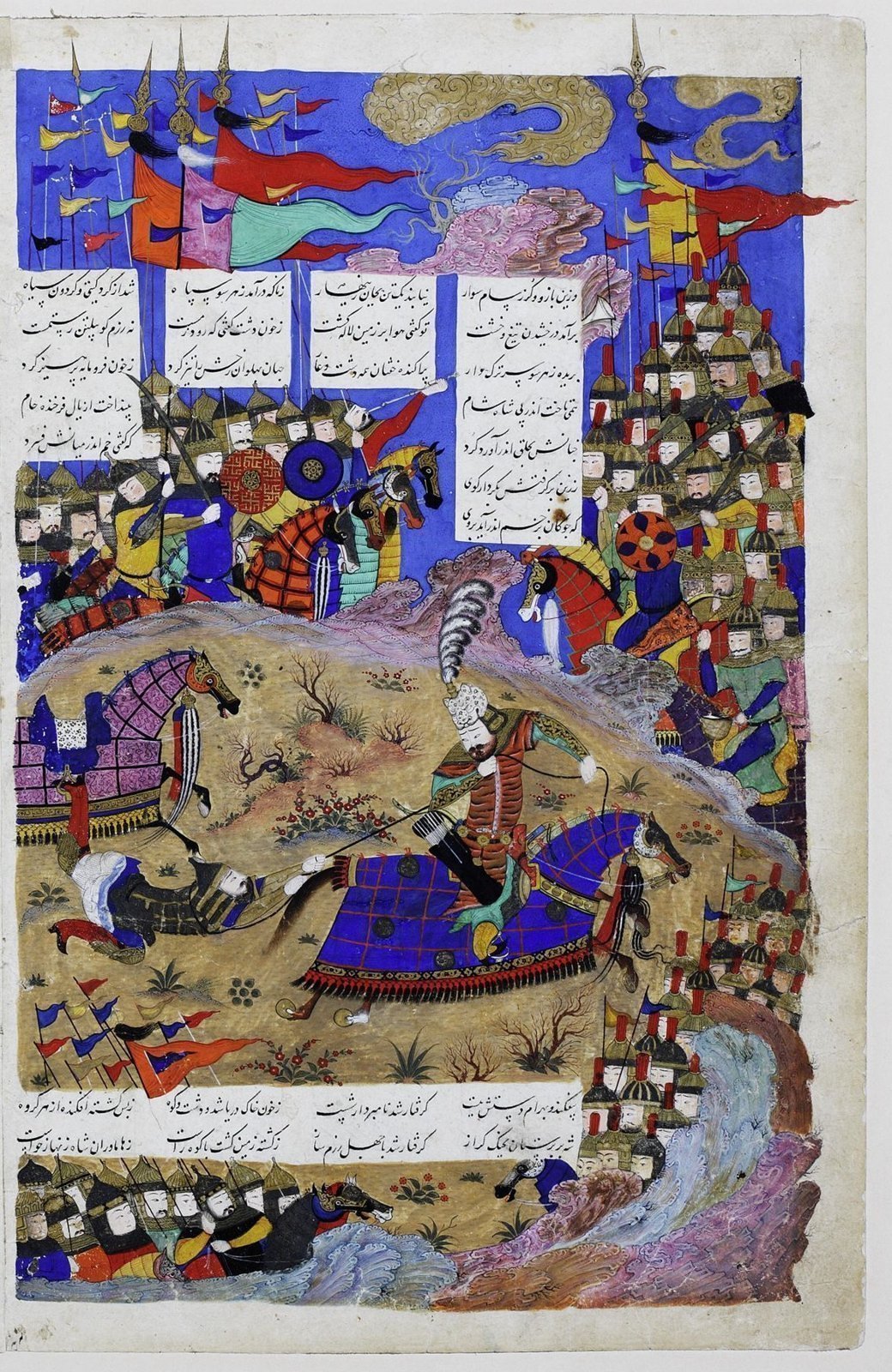
An illustration from the Shahnameh, Rostam lassoing the King of Sham, Tabriz, about 1505–1515. When this page was painted Iran had been Muslim for more than eight hundred years, and it still showed a hero from before Islam. Source: Wikimedia Commons, public domain

Ferdowsi is said to have written for more than thirty years and to have died poor. He probably never imagined that the book would become the sturdiest possession of a people.
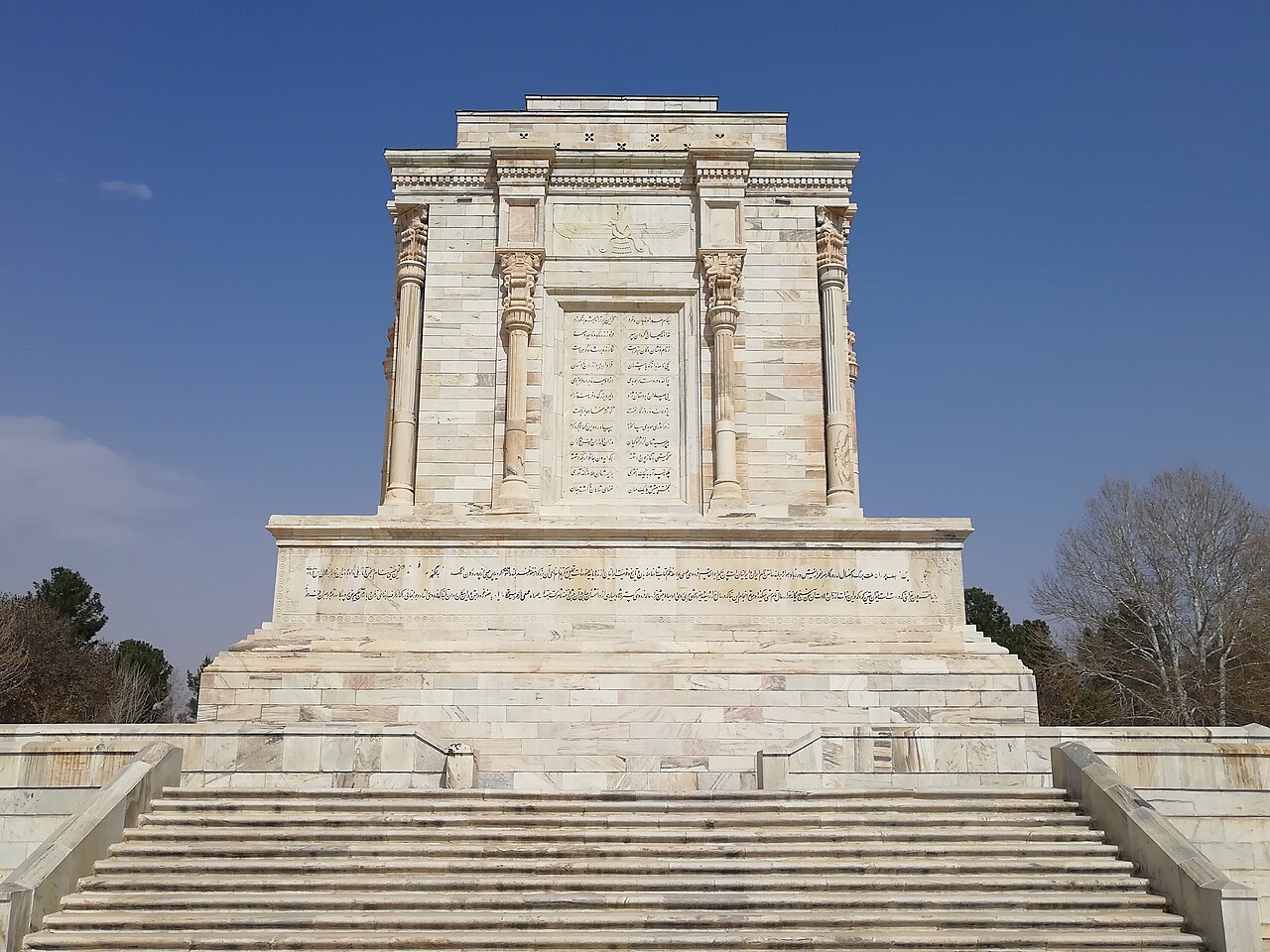
The tomb of Ferdowsi, Tus, Iran. The present tomb was rebuilt in the 1930s, in exactly the years when Iranian nationalism was at its hottest. Source: Wikimedia Commons, photo by Arashk rp2, CC BY-SA 4.0

The conquered, in turn, shaped the conquerors
What came later is more interesting.
Persian not only did not vanish, it became the cultural language of the eastern half of the Islamic world. From Central Asia to India, the courts of many Muslim dynasties wrote poems, histories and official documents in Persian. On the throne might sit descendants of Turks or Mongols, yet the refined culture of the court was Persian.
The historian Marshall Hodgson gave this great area a name: "Persianate," roughly "the Persianised world."
In India, Persian was for a long time the language of office and law courts. Only in 1837 did British India legislate to end Persian's official status in the courts and in revenue, replacing it with English and the regional languages.
The conquerors brought new gods; the conquered carried their own language and their way of telling stories back into the world the conquerors had built.
The winners learning the losers' language: East Asia has seen it too
This should not be strange to East Asians.
In 1644 the Manchus entered the Pass and took the empire, yet emperor after emperor had to learn Chinese, read Chinese books and write memorial replies in Chinese characters. By the late Qing many Manchus themselves could hardly speak Manchu any more, and Manchu script slowly survived only in archives and a few ceremonies. (The decline of Manchu is the usual conclusion of Qing studies; how far it went and how fast in different places I have not read in first-hand sources.)
Unlike the Persians, the Han had no epic like the Shahnameh, written specially to remember "who we are." What held this up was a whole set of things: study, examinations, compiling genealogies, ancestor worship. They worked for a long time, and in the twentieth century they were pulled apart.
Turning it around
The sentence "we are Persians, not Arabs" itself deserves another look.
It was polished to a great extent by modern nationalism. In 1935 the government of Reza Khan required other countries to call the country "Iran" in diplomacy, and at the same time promoted the glory of pre-Islamic Persia. Persian poets and scholars of a thousand years ago would not necessarily have placed themselves so "by nation." In their world, religion, dynasty, language and place were several identities wound together.
From 1501 the Safavid dynasty made Twelver Shia the state religion, and Iran also separated, religiously, from the Sunni world around it. Put plainly, the identity of Iranians today is layered, one on another, out of language, sect, ancient epic and modern nationalism; it is not a fixed original self that was "taken away" and then "found again."
The metaphor of "possession" assumes an unchanging original occupied by something else. But Iran's example says: the conquered also change the conquerors, and neither side remains what it was.
That an identity is layered does not mean it is false.
If you replace religion, script, language or story, which one makes a people "a different people"?
References
- Richard W. Bulliet, Conversion to Islam in the Medieval Period, Harvard UP, 1979
- Marshall G. S. Hodgson, The Venture of Islam, U of Chicago Press, 1974
- Ferdowsi, Shahnameh, about 1010
- Act No. 29 of British India, 1837; the end of the Sasanian dynasty (651); the Safavids making Shia the state religion (1501); the change in the use of the country's name in 1935: standard history
- Decline of Manchu in the Qing: Mark C. Elliott, The Manchu Way: The Eight Banners and Ethnic Identity in Late Imperial China, Stanford UP, 2001 (from the 18th century the court repeatedly urged bannermen to keep "the national language and mounted archery"; the book not re-read); Wei Qiaoyan, "The Development of the Use of Manchu Language and Script in the Qing and the Blending of Manchu and Han Cultures," Manchu Studies, 2024, no. 1 (abstract only) 🟡
- Image credits are in each caption