
A widely circulated claim
In Chinese one often hears the claim that the Hungarians are descendants of the Xiongnu. The reason looks intuitive: the Chinese name for Hungary contains the character Xiong, and the English "Hungary" contains "Hun."
Is it right? To answer, the question has to be taken apart first: when we say "who is descended from whom," do we mean the name, the language, or the blood?
First a note on terms. The Chinese word Xiongnu refers to the Xiongnu of the Mongolian plateau; the people who reached the gates of Rome in European history are the Huns (Attila's people), appearing in the fourth and fifth centuries. Whether the two are one lineage is still disputed by scholars. Below, "the Huns" means the European branch.
First, one thing: claiming ancestors
The Hungarians themselves did once claim the Huns as ancestors.
In the early thirteenth century (scholars mostly date the text between 1200 and 1230), an unknown author wrote in Latin the Gesta Hungarorum, which already put Attila into the royal genealogy. In the 1280s Simon of Kéza wrote the Gesta Hunnorum et Hungarorum, stating plainly that Attila, king of the Huns, was the ancestor of the Hungarians.
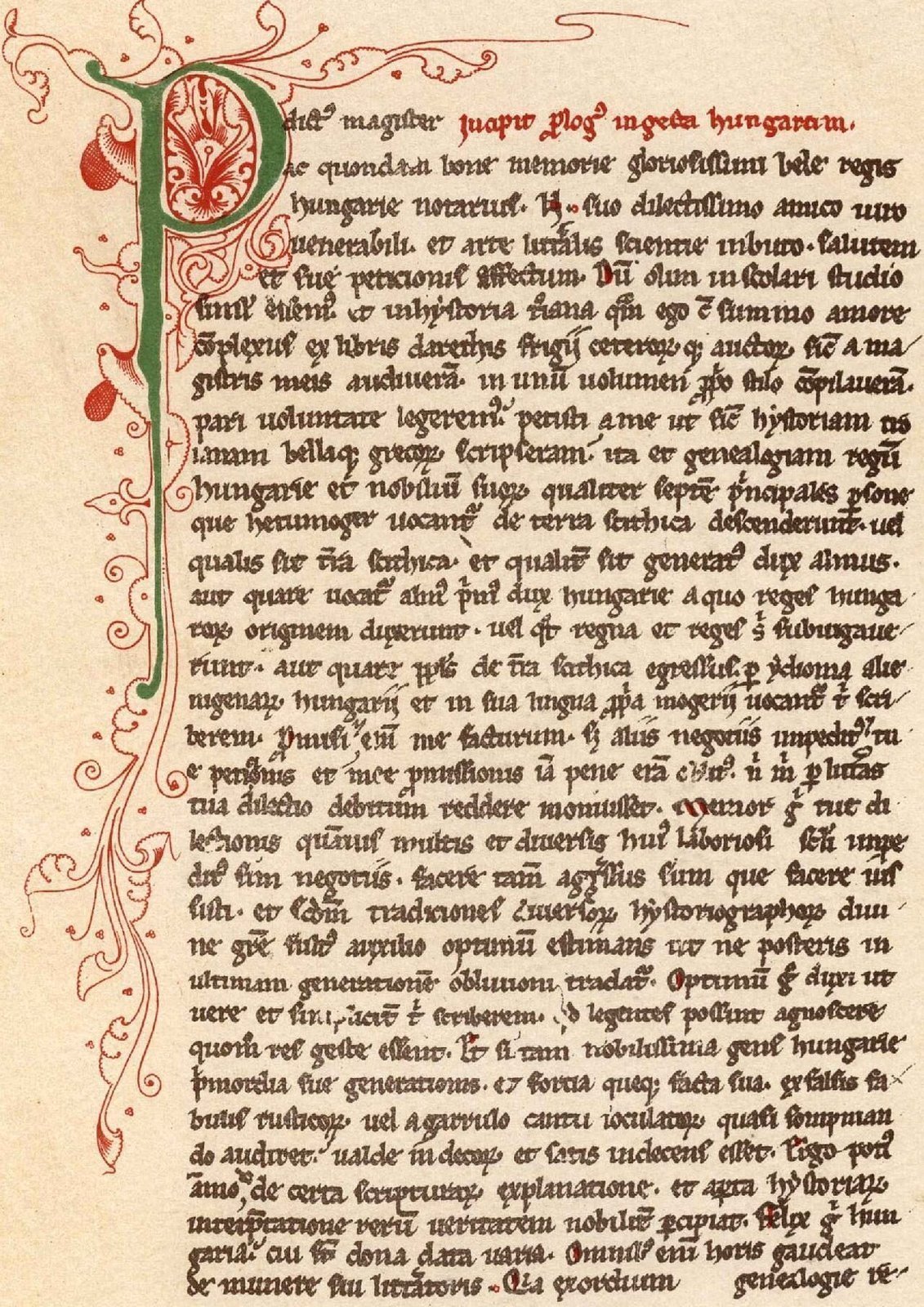
A page of a manuscript of the Gesta Hungarorum*. The author left only the signature "Master P."; scholars generally call him "Anonymus." Source: Wikimedia Commons, public domain*

At that time Hungary had been a Christian kingdom for only about two hundred years. To find for oneself a glorious ancestor who made the Roman Empire tremble was common. Many European royal houses and peoples did it: every newly settled dynasty needed an ancestor who was remote enough and also frightening enough.
So the claim that "the Hungarians are descended from the Huns" was not first invented by outsiders; it was written down by Hungary's own medieval chronicles.
Thread one: the name
How did the name "Hungary" come about?
The Hungarians call themselves "Magyar"; "Hungary" is what outsiders called them. The mainstream etymology is that it comes mainly from the Turkic "On-Ogur," roughly "ten arrows," referring to a tribal confederation. The Magyars had spent time on their migration with Turkic tribes of this kind, and the people around them used that name for them.
In Latin it was written Hungaria, and the opening H was added in medieval texts under the influence of the association with the Huns (Huni).
That is to say, the name's connection to the Huns is largely something later people thought up, not the source itself.
By the way, when I talked about this question with an AI, it told me with great confidence that "Hungary comes from Hun." That is wrong.
Thread two: language
Language is a separate matter.
Hungarian belongs to the Uralic family, a distant relative of Finnish and Estonian, and not of the same family as the German, Slavic or Romanian around it. In a sea of Indo-European languages, Hungarian is an island.
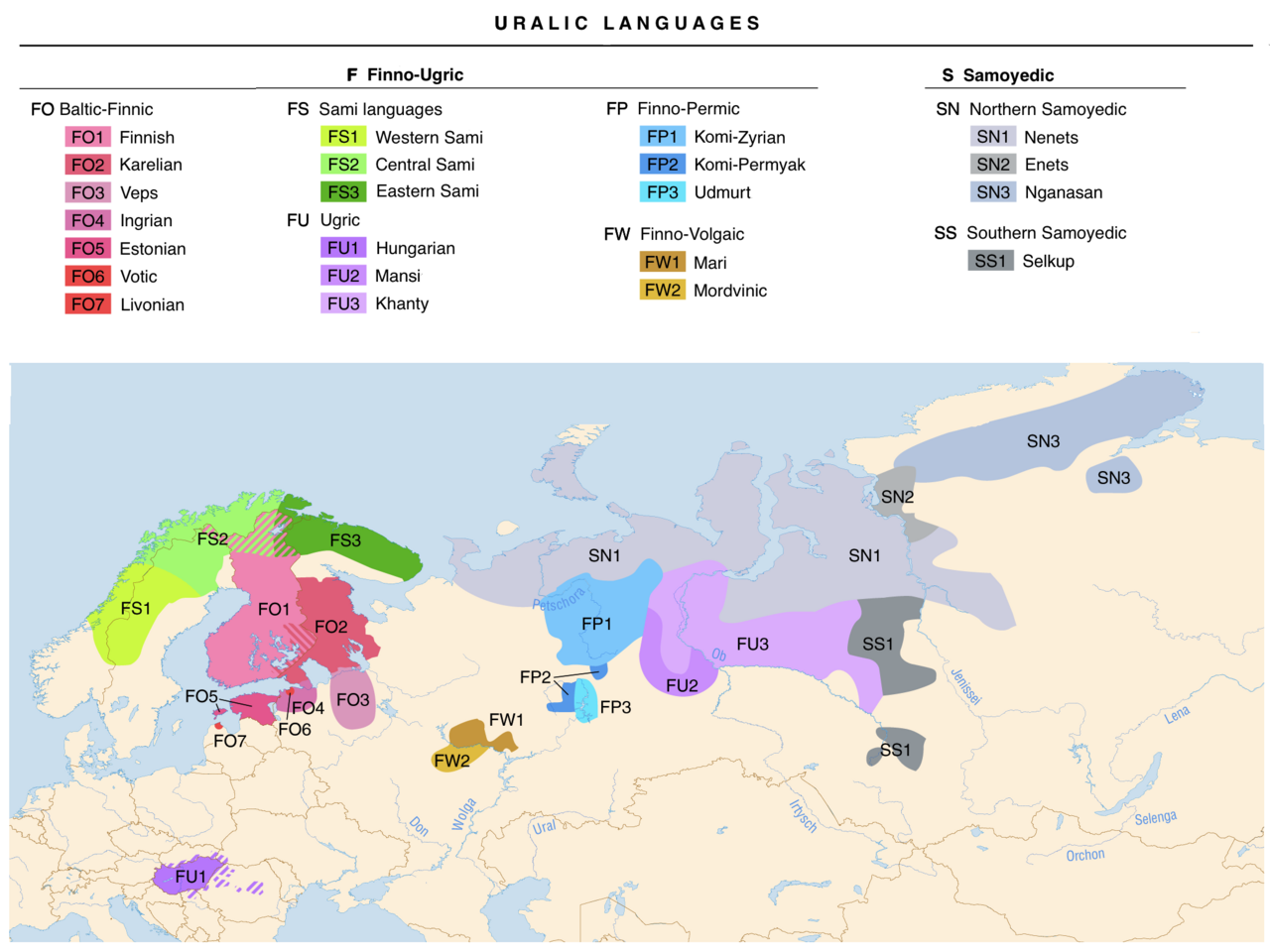
The distribution of the Uralic languages: mostly in Northern Europe and northern Russia, with Hungarian lying alone in Central Europe. Source: Wikimedia Commons, CC BY-SA 3.0

This shows that the Magyars who entered the Carpathian Basin in the late ninth century brought an eastern tongue and kept it to this day.
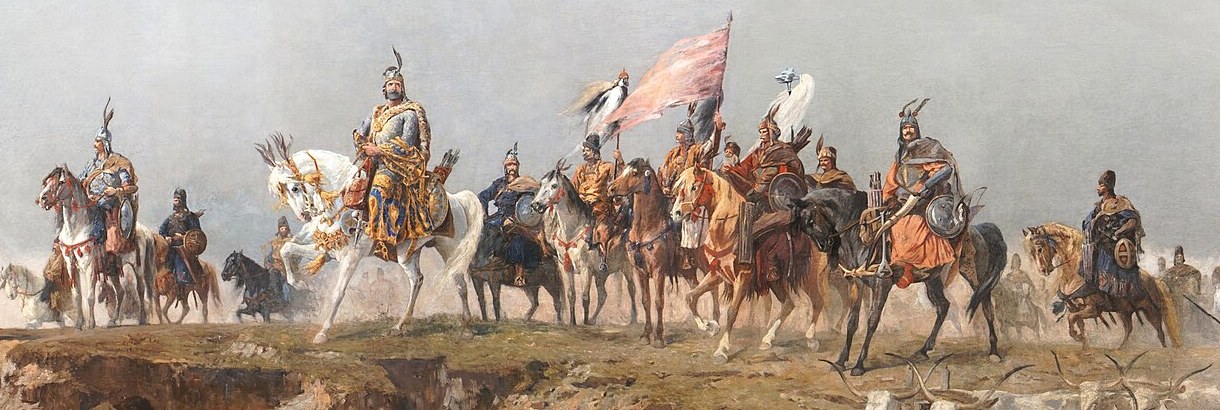
Detail of Feszty's panorama Arrival of the Hungarians*, painted in 1894 for the "Millennium of the founding of the state." The rider on the white horse is the legendary leader Árpád. It paints the ninth century, with the heart of the nineteenth. Source: Wikimedia Commons, Árpád Feszty, public domain*

Thread three: blood
And blood? This is the part for which hard evidence has appeared only in the last dozen or so years.
In 2022 a group of Hungarian researchers published in Current Biology a genetic study of ancient remains. Broadly, the conclusion: the Magyar conquerors of the late ninth century, especially the elite layer, did carry a clear eastern steppe component, from a mixture of Mansi, early Sarmatians and late descendants of the Xiongnu. In some individuals the researchers also detected components related to the Huns, and held that the successive nomadic groups, Huns, Avars and the conquerors, were genetically linked.
One caveat: ancient DNA is taken from graves, and graves are themselves selected. Cemeteries differ in size and rank, and those that survive and get excavated are not all the people of the time. So it suits answering "where did these conquerors come from" better than serving directly as "where did the people on this land at the time come from."
Now look at ordinary Hungarians today: in 2018 another group compared mitochondrial data and concluded that the Asian component in modern Hungarians is small, pointing only to a small contribution from the conquerors. In the 2022 paper too, most individuals from each period still had local European ancestry. Most of today's Hungarians' ancestors were the people already living on this land.
In other words: a small band of conquerors from the east brought a language and a name; after more than a thousand years of intermarriage, the blood was washed very thin by the locals.
Three threads, each going its own way
Put the threads side by side and it is clear:
- Name: mainly from a Turkic tribal confederation; the initial H is an association with the Huns.
- Language: Uralic, brought from the east and kept to this day.
- Blood: the conquering elite had an eastern component; today's majority are locals.
The medieval chronicles' willingness to claim the Huns as ancestors is identity, which is yet another thread.
Turkey is another example: its name and language are inherited from the Turkic peoples, but most studies hold that the genetic main body of modern Turks comes from the local Anatolians.
The Norwegian anthropologist Fredrik Barth put forward an influential view in 1969: an ethnic group rests on its boundary, not on the "content" the boundary encloses. The content, descent, language, customs, can all change; as long as the line between "us" and "them" remains, the group remains.
We claimed ancestors too
This is about Hungary, but reading it I keep feeling it looks familiar.
At the end of the Qing, a group of educated men, in order to oppose the Manchus, switched in the newspapers to counting years by the "Yellow Emperor calendar," inviting the Yellow Emperor of more than four thousand years ago to be the common ancestor of all Han. A "nation" just taking shape also needed an ancestor remote enough and respectable enough. A later piece is devoted to this.
There is nothing laughable in claiming ancestors. A person has to know where they come from. It is only that the ancestor claimed often says who we want to become, not wholly where we come from.
Turning it around
So every time I say "possession" (duoshe), I have to ask first: which strand was taken? The word presupposes an unchanging "original body" occupied by outsiders, but in Hungary's case you can hardly say whether what was taken was the name, the language, or the blood.
The "three threads" are also a simplification. Identity, religion and state institutions are other threads, and threads can still be added. But the three each have their own origin, and that does not become blurred by this.
What is the oldest thing in you? A surname, a dialect, or genes?
References
- Anonymus, Gesta Hungarorum (early thirteenth century, conventionally dated 1200–1230); Simon of Kéza, Gesta Hunnorum et Hungarorum (c. 1282–1285)
- Zoltán Maróti et al., "The genetic origin of Huns, Avars, and conquering Hungarians," Current Biology 32, 2022
- Neparáczki et al., "Mitogenomic data indicate admixture components of Central-Inner Asian and Srubnaya origin in the conquering Hungarians," PLoS ONE 13(11): e0208295, 2018
- Fredrik Barth (ed.), Ethnic Groups and Boundaries, 1969
- Etymology of "Hungary": the standard etymological account (On-Ogur; the H a medieval Latin association)
- Image credits are in each caption