Nagpur, October 1956
On 14 October 1956, in the central Indian city of Nagpur, at a very large gathering, a sixty-five-year-old man led the crowd in taking vows to convert to Buddhism. Over the next two days, the number who followed him is given as anywhere from over 300,000 to 600,000. It was one of the largest mass conversions in human history.
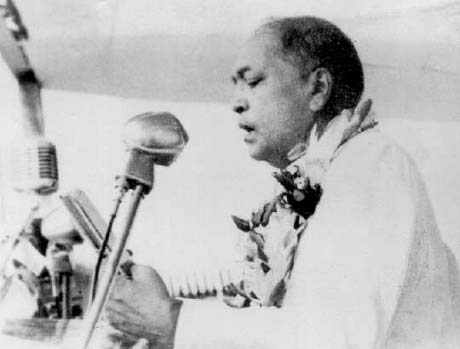
Ambedkar speaking at the conversion ceremony in Nagpur, 14 October 1956. Source: Wikimedia Commons, public domain

The man who led was Bhimrao Ambedkar. He was born into an "untouchable" family; as a child at school he had to bring his own sackcloth to sit on and could not touch the water tap. He went on to earn doctorates at Columbia University and the London School of Economics, and became chair of the committee that drafted India's constitution.
What he wanted to escape was caste. A few weeks later he died.
The most popular story
How did caste come about? The most popular telling goes roughly like this:
More than three thousand years ago a group of outside "Aryans" entered India. They were few and feared being absorbed by the locals, so they invented caste and endogamy, writing the difference between conquerors and conquered into bloodlines, and then used "karma" and "rebirth" to make the oppressed accept it willingly.
The story is very neat, neat as if someone had designed it in one go.
That is exactly where the trouble lies.
Where the story came from
The modern version of this "racial conquest theory" is largely a product of the nineteenth century. That was the age when European race science was at its hottest, and the word "Aryan" slid from a linguistic concept (speakers of Indo-European languages) into a racial one. The official of British India Herbert Risley, in running the census, tried methods such as measuring nose width to match caste with "race" one to one.
Today scholars have largely stopped using the word "Aryan" in this way.
The timetable the genes give
In 2013 researchers at Harvard and other institutions published in The American Journal of Human Genetics a study analysing genetic data from 73 population groups of the Indian subcontinent.
They found that most Indian populations today are descended from a mixture of two ancient populations, and that this large-scale mixing took place between about 4,200 and 1,900 years ago. After that, India went from a place where populations mixed widely to a place where even closely related groups rarely intermarried.
This says two things. First, for a long time the peoples of India kept intermarrying; there was no wall of blood sealed from the start. Second, strict endogamy was settled only slowly, over a long period afterwards.
Caste was not sealed at the moment of conquest; it hardened slowly.
The hand of the colonial archives
There was also another hand in hardening it into the form we know today.
The anthropologist Nicholas Dirks argues in Castes of Mind (2001) that the British colonial government, from 1871, ran all-India censuses requiring everyone to state a definite caste; by 1901 the census officials also wanted to rank the castes by social standing. Identities that had been fluid, different in different places and varied in meaning were entered in a uniform table and became fixed administrative categories.
This view has been very influential, and has also been opposed. In Caste, Society and Politics in India (1999) the historian Susan Bayly stresses that caste was already deeply rooted in Indian society before colonialism; the British were not its inventors but those who reinforced it.
Both sides have evidence. The safer account is that caste has deep precolonial roots, and colonial rule made it stiffer and more "official."
Its strongest hold is at the dinner table
Why is caste so hard to break? One important reason is that it lives not only in law but in the way people live.
In 1952 the Indian sociologist M. N. Srinivas proposed a concept called "Sanskritisation": a low-caste group trying to rise often adopts the ways of higher castes: giving up meat and liquor, keeping the Brahmin rules.
This shows that within the caste system "purity" is a hard currency. Rank is written not only in land and property but in what you eat, with whom you eat at one table, and whom you marry.
So when Article 17 of the 1950 Indian constitution explicitly abolished "untouchability," caste did not vanish with it, because the rules at the dinner table are beyond the law's reach.
Ambedkar knew this well. In 1936 he wrote Annihilation of Caste; twenty years later he took a religious way out: converting to a religion that does not recognise caste.
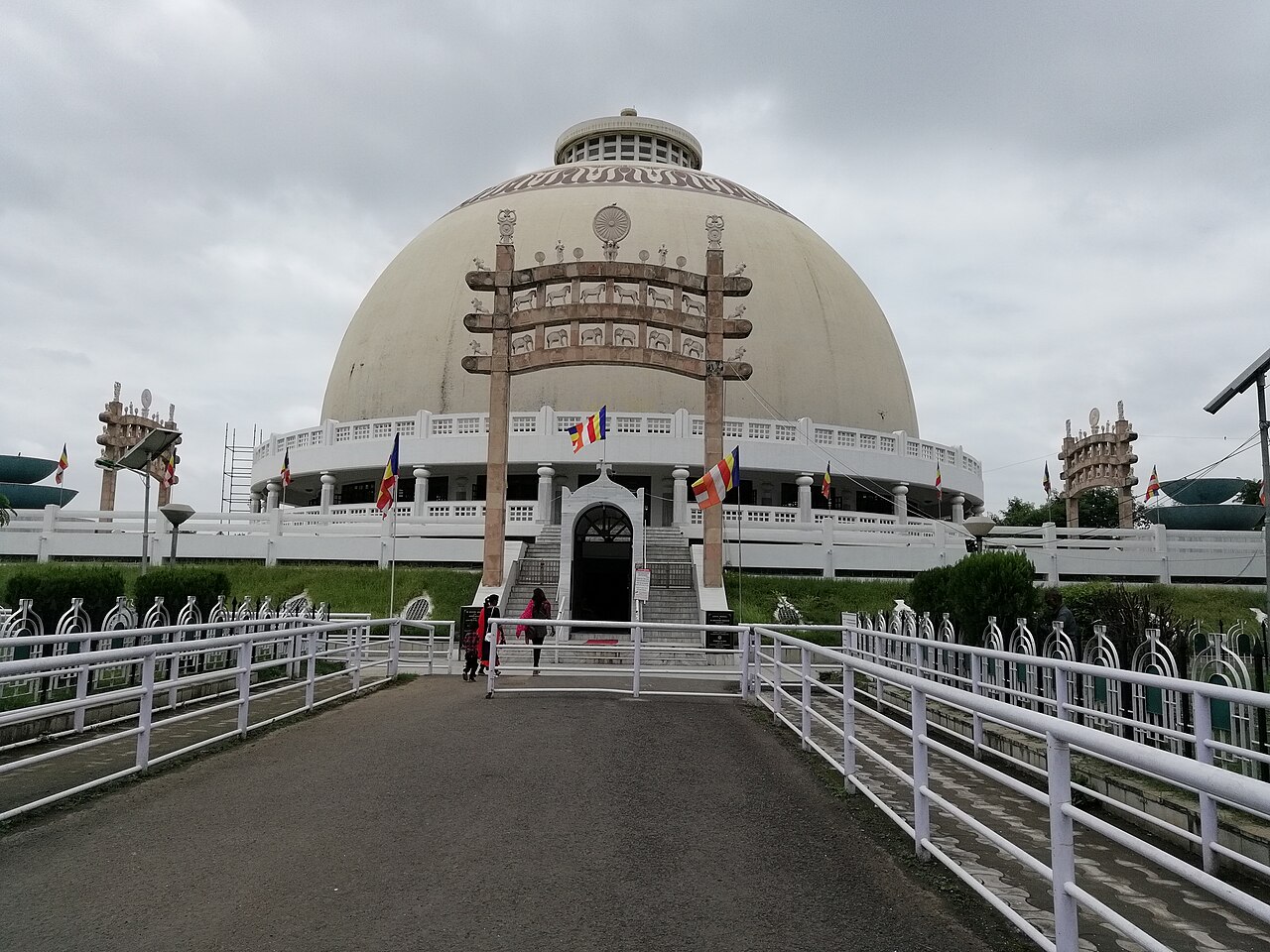
Deekshabhoomi in Nagpur, built on the site of the 1956 gathering. Every October hundreds of thousands come here from all over. Source: Wikimedia Commons, photo by Prakash Lokhande, CC BY-SA 4.0

We had "origin" too
Reading Ambedkar always makes me think of another matter, much closer to us.
After land reform in the early 1950s, everyone in mainland China had a "family origin": landlord, rich peasant, middle peasant, poor peasant, hired hand, and also "capitalist," "office worker," and so on. This class status followed the father and was passed down generation after generation. Children of bad origin ran into walls everywhere, in school entrance, military service, promotion, joining the Youth League; when marriage was discussed, the first thing the other family asked was class status.
It had no talk of "purity" and "impurity," but it too was written into the dinner table and the marriage, and it too put a person into a box from the moment of birth.
In 1966 a Beijing youth named Yu Luoke wrote an essay, "On Origin," saying origin should not decide a person. The essay spread widely among the people. In March 1970 he was shot, at twenty-seven.
On 11 January 1979 the Central Committee of the Communist Party issued the Decision on the Removal of the Hats of Landlords and Rich Peasants and on the Class Status of Their Children: apart from a very few, landlords and rich peasants all had their "hats" removed, and their children were no longer treated according to origin. This box was opened by one document of the state, much faster than in India; but in the thirty years before it, not one of those shut inside could wait for a conversion.
Turning it around
"Caste is actually not that old": the conclusion sounds satisfying and suits our generation's taste. But it too may be another simplification.
Some of caste's ideas, such as the four varnas in the scriptures, really are very old; what the genetic studies tell us is the age at which endogamy settled, not the age at which the idea of rank was born. Saying it is "very old" and saying it "hardened later" may both be right; they are just not about the same layer.
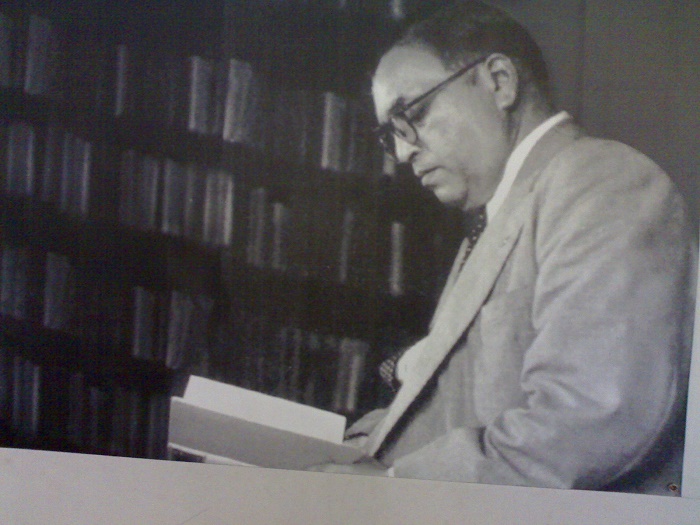
Ambedkar in his study. His library over his lifetime is said to have held tens of thousands of volumes. Source: Wikimedia Commons, public domain

How long must an institution exist before people take it for "just the way things are"?
References
- Priya Moorjani et al., "Genetic evidence for recent population mixture in India," AJHG 93, 2013
- Nicholas B. Dirks, Castes of Mind, Princeton UP, 2001
- Susan Bayly, Caste, Society and Politics in India, Cambridge UP, 1999
- M. N. Srinivas, Religion and Society Among the Coorgs of South India, 1952
- B. R. Ambedkar, Annihilation of Caste, 1936; the mass conversion at Nagpur in 1956
- Central Committee of the CCP, Decision on the Removal of the Hats of Landlords and Rich Peasants and on the Class Status of Their Children, 11 January 1979 (Zhongfa [1979] No. 5), full text on Wikisource 🟢
- The family-origin system, Yu Luoke's "On Origin" (1966) and his execution in 1970: standard history
- Image credits are in each caption