A proclamation in Wuchang
In October 1911, after the Wuchang Uprising had taken the city, the revolutionaries set up the Hubei Military Government. The proclamations they issued were no longer dated "the third year of Xuantong," but "the 4609th year of the Yellow Emperor."
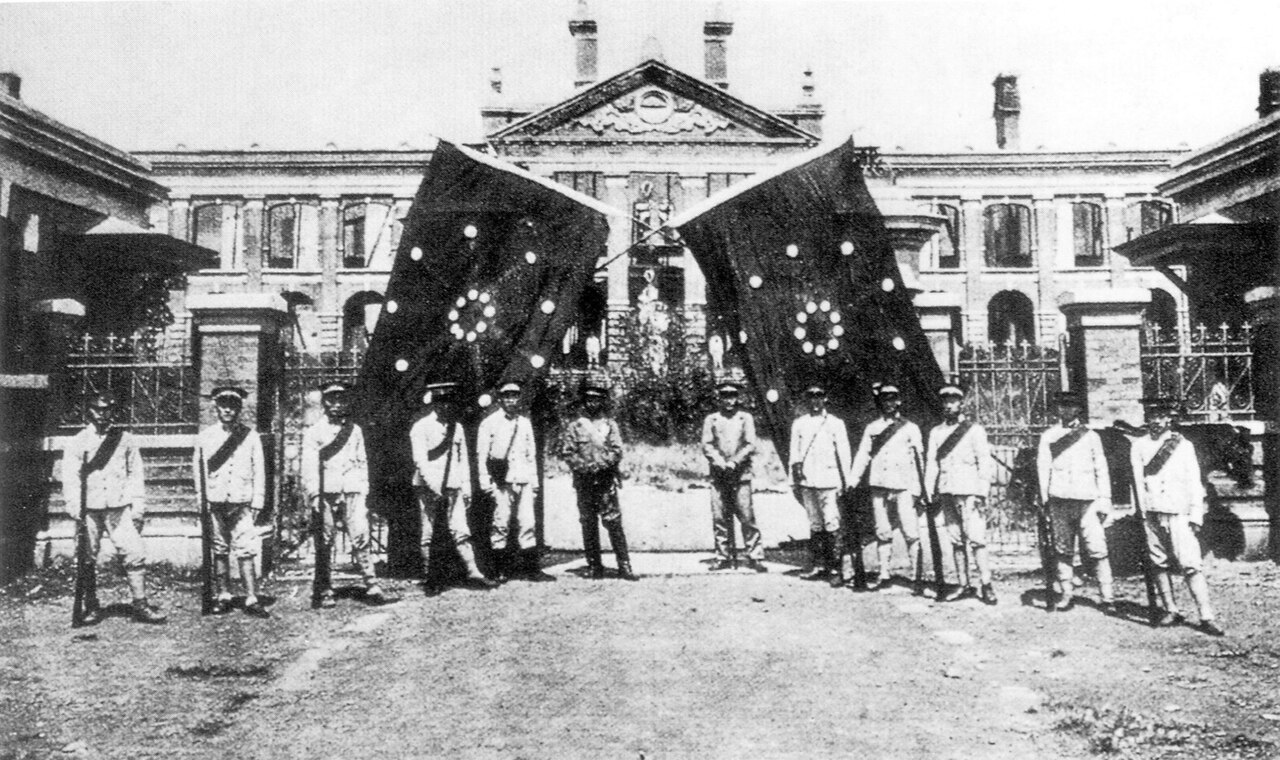
In front of the Hubei Military Government: the crossed flags are the "Eighteen-Star Flag," the eighteen stars standing for the eighteen provinces within the Pass. The soldiers on guard had been Qing New Army men a few months before. Source: Wikimedia Commons, public domain

That year was not written casually. Behind it lay a "dispute over the calendar" that had gone on for almost ten years.
Why the Yellow Emperor
In the age of emperors, years were counted by the emperor's reign title. To use someone's reign title was to accept his rule.
In 1903 the scholar Liu Shipei wrote an essay, "On Counting Years from the Yellow Emperor." The point was direct: to count years by the Qing emperors' reign titles is to accept the Qing; to show you are another "we," you must change the starting point and count again from the beginning, from the Yellow Emperor, honoured as the ancestor of the Han.
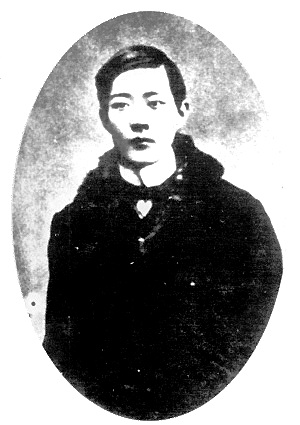
Liu Shipei (1884–1919). He was nineteen when he wrote the essay and a fierce anti-Manchu revolutionary; a few years later he went over to the Qing court, and in the early Republic he helped Yuan Shikai's bid for the throne, dying of illness at thirty-five. A person's first year can change more than once. Source: Wikimedia Commons, public domain

Counting from the Yellow Emperor quickly became the trademark of the revolutionaries. But there is no firm record of the year the Yellow Emperor was born or took the throne. Different newspapers and different people of the time came up with different numbers. For the same ancestor, several papers celebrated different birthdays.
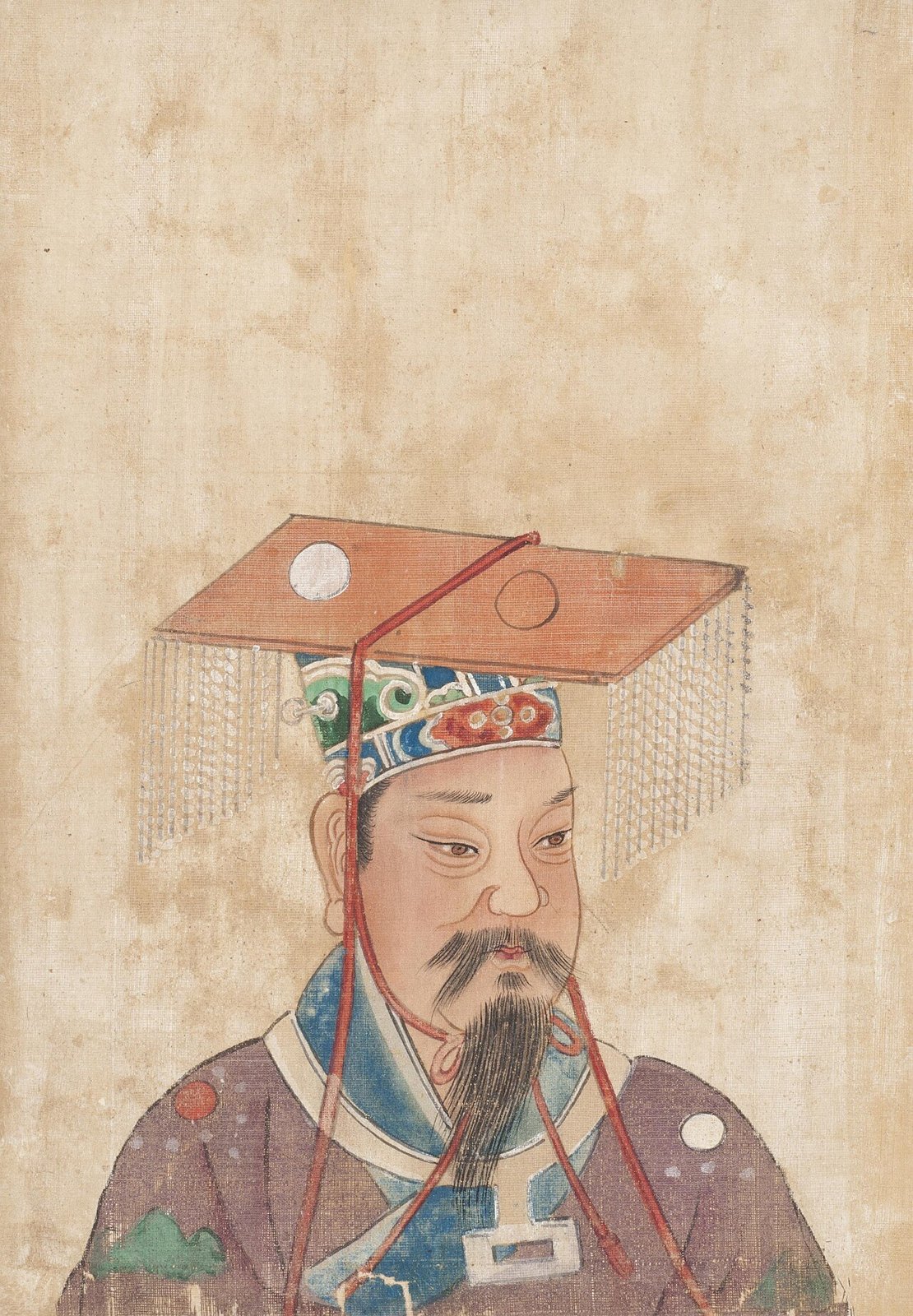
A portrait of the Yellow Emperor painted in the Ming or Qing. Nobody has ever seen the Yellow Emperor; each age painted the ancestor in its own heart. Source: Wikimedia Commons, public domain

Two first years, two kinds of "we"
In the same period there was another kind of "own time": counting from Confucius. Kang Youwei and the other reformers argued for taking Confucius's birthday as the first year.
These two systems of counting stand for two quite different roads of identity:
- Counting from the Yellow Emperor: counted from the blood of the ancestor; it speaks of race and nation;
- Counting from Confucius: counted from the teaching of a sage; it speaks of culture and the transmission of the Way.
One asks "whose descendants are we"; the other asks "what is it that we hand down."
In 1997 the Taiwanese scholar Shen Songqiao wrote a paper tracing how the Yellow Emperor was shaped into the "founding ancestor of the nation" in the late Qing. Its title comes from a poem by Lu Xun: "I dedicate my blood to Xuanyuan" (another name of the Yellow Emperor).
This is not unique to China
Choosing a starting point for oneself is something nearly every group has done.
The Jewish calendar takes "creation" as its first year, corresponding to 3761 BCE. This year was not recorded generation after generation by the ancients; later rabbis worked it out backward, generation by generation, from the genealogies in the Bible, mainly following the Seder Olam Rabbah, traditionally attributed to the second-century scholar Yose ben Halafta.
The Common Era takes the birth of Jesus as its first year, calculated in the sixth century by a monk named Dionysius. Most scholars today think his figure is a few years off from the year Jesus was actually born.
The Islamic calendar takes the year 622, when the Prophet Muhammad migrated from Mecca to Medina, as its first year; this was fixed after his death, in the time of the second caliph, Umar.
They have one thing in common: first there was a group of people, and only then did they turn back and set themselves a beginning.
The Yellow Emperor calendar was used only briefly
On 1 January 1912 the Provisional Government of the Republic of China was founded and announced a change to the Gregorian calendar, with that year as "the first year of the Republic of China." Counted from the Hubei Military Government's proclamations, the Yellow Emperor count served as an official calendar for only a little over two months.
After the revolution succeeded, the new state chose not a time counted from blood, but a new beginning, joined to the calendar the world uses.
The later first years
The story is not over. After 1949 the first years on the two sides of the Strait also parted: the mainland switched to the Common Era and no longer used the Republic's reign count; Taiwan kept the Republic count, and to this day identity cards and official documents there say "year so-and-so of the Republic."
The same "China," and two places each counting its own years.
Turning it around
The American scholar Benedict Anderson, in Imagined Communities (1983), has a famous view: the nation is a product of the modern age, a community "imagined" through newspapers, novels and a unified sense of time.
Other scholars disagree with calling everything "constructed." They hold that premodern times already had real ethnic identity and shared memory, and that modern nationalism worked on this old material and did not invent it from nothing.
So "the Yellow Emperor calendar was constructed" and "identification with the Yellow Emperor has very deep historical roots" can both be true. The starting point was picked out; the year that was picked out did still happen. We smile at predecessors who counted badly; the "starting points" we pick today will probably be looked over the same way by those who come after.
If I had to choose
If I had to choose one of these two first years, I would choose Confucius's.
Not because the Yellow Emperor is bad. It is because, counted by blood, the door is only ever open to "descendants"; counted by teaching, the door is open to all who are willing to come in. Vietnamese, Koreans, Japanese: not one of them will recognise the Yellow Emperor as an ancestor, yet for centuries they have read the Analects and, on some day, sacrificed to Confucius. The thing I am looking for, the thing that could bring East Asians together, can only be looked for on this side.
If you had to set a "first year" for your own family, from which year would you start counting?
References
- Liu Shipei, "On Counting Years from the Yellow Emperor," 1903
- Shen Songqiao, "I Dedicate My Blood to Xuanyuan: The Yellow Emperor Myth and the Construction of the Nation in the Late Qing," Taiwan: A Radical Quarterly in Social Studies, no. 28, 1997
- Seder Olam Rabbah
- Benedict Anderson, Imagined Communities, 1983
- The Hubei Military Government's proclamations "the 4609th year of the Yellow Emperor," the switch to the Gregorian calendar in 1912, the calendars on the two sides of the Strait: standard history
- Image credits are in each caption