A stele in the Xi'an Stele Forest
In the Xi'an Beilin Museum stands a stele almost three metres tall. Its crown carries a cross. Under the cross is a lotus, and around it, auspicious clouds.
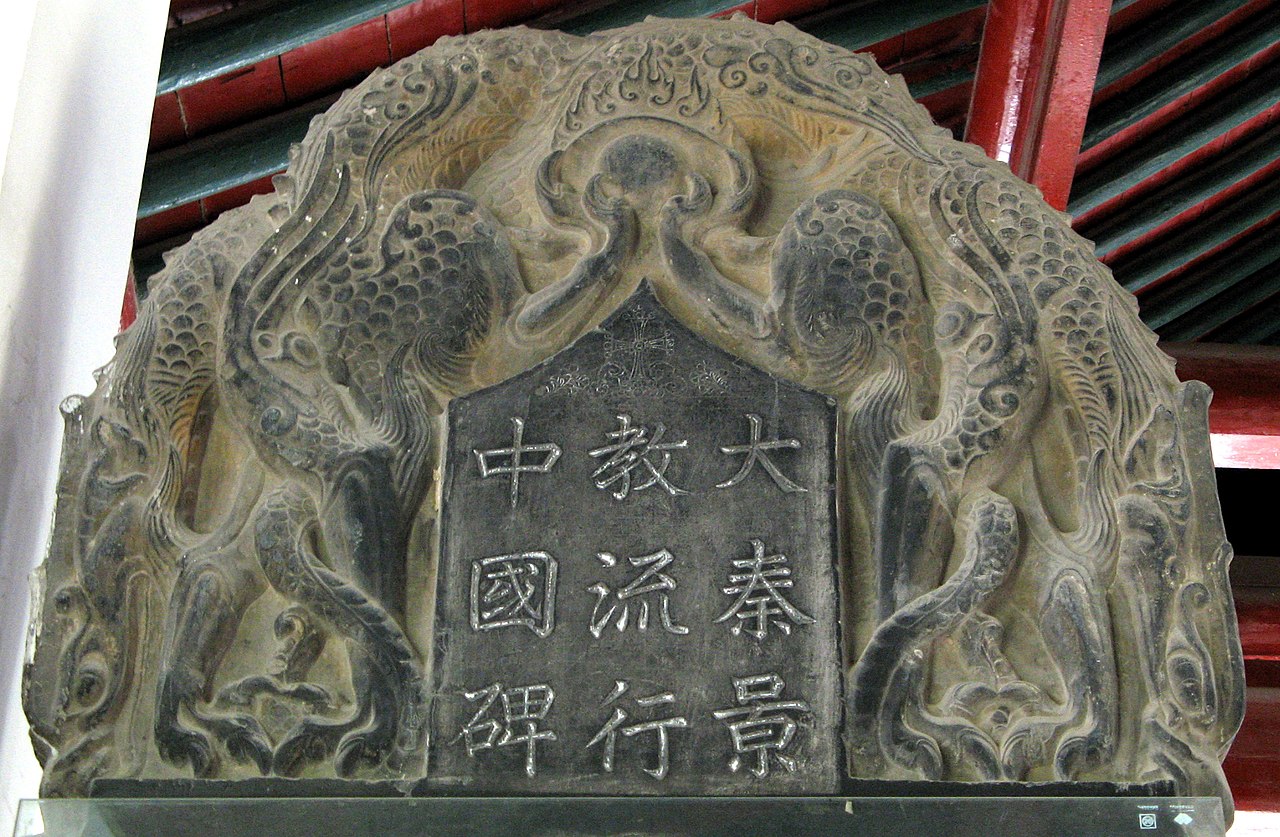
The "Stele on the Spread of the Luminous Teaching of Daqin in China," Xi'an Beilin Museum. The main text is in Chinese characters; Syriac is carved along the foot and the sides. Source: Wikimedia Commons, photo by G41rn8, CC BY-SA 4.0

The inscription is in Chinese characters, and at the foot and on the sides run lines of Syriac. The title across the top is nine characters long: the Stele on the Spread of the Luminous Teaching of Daqin in China.
It was erected in the second year of Jianzhong under the Tang, that is, in 781.
A religion that came along the trade road
The stele says that in the ninth year of Zhenguan under Emperor Taizong (635), a missionary named Aluoben came to Chang'an from "Daqin." Three years later the court issued an edict allowing him to build a monastery in the Yining ward of Chang'an and to preach.
The Tang people called this religion Jingjiao, "the Luminous Teaching." It was in fact a branch of Christianity, usually called the Church of the East today, centred in Mesopotamia and Persia, worshipping in Syriac, on a road quite separate from the churches of Rome and Constantinople.
How did that road reach Chang'an? By the trade routes. The Persians and Sogdians of the Silk Road carried their faiths along with their goods: the Church of the East, Zoroastrianism, Manichaeism. For a time Chang'an held temples of all these foreign religions at once.
Learning to speak Chang'an's language
To survive inside a strange civilisation, a foreign religion first has to learn to speak its language.
Reading the Nestorian stele, one has a curious feeling: it sets out Christian teaching in a vocabulary full of Buddhist and Daoist words. God is rendered "Aluohe," the church is a "temple" (si), the clergy are "monks" (seng), and there are phrases like "the marvellous body of the Three-in-One" and "non-action" (wuwei). Even the cross at the top is set on a lotus.
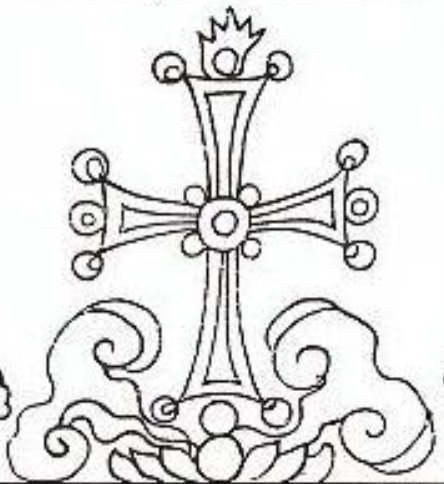
The cross at the head of the stele, a lotus beneath it and auspicious clouds on either side. A symbol from Syria, seated on a Buddhist flower. Source: Wikimedia Commons, public domain

This was not surrender. It was a typical "grafting": joining one's own branch to someone else's root. Buddhism had done the same when it entered China. The early translators borrowed the Daoist "nothingness" (wu) to explain the Buddhist "emptiness" (kong), which scholars call "matching concepts" (geyi).
An edict
This grafting lasted more than two hundred years.
During the Huichang era of Emperor Wuzong (841–846), the court carried out a large-scale suppression of Buddhism: temples torn down, monks and nuns ordered back to lay life, monastic property confiscated. In the edict of 845, besides Buddhism, the clergy of the Church of the East and of Zoroastrianism were also ordered back to lay life.
The causes were mixed: the temple economy had swollen and finances were strained, the emperor himself favoured Daoism, and some at court simply disliked foreign religions. For the Church of the East, the fatal point was its position. It leaned mainly on court permission and on foreign merchants, and had not taken deep root among ordinary Han people. When the court turned its back, it had no root left.
After that the Church of the East all but disappeared from the central plains. Where those clergy, called "monks," went afterwards, the histories do not say. A group of strangers took off their robes, mixed into the crowds of Chang'an, and that was the end of them.
The stele in the earth
The stele was buried in the ground.
More than eight hundred years later, in the Tianqi era of the Ming (1623 or 1625; scholars differ), it came out of the earth again near Xi'an.
The Jesuits, newly arrived in China, treated it as a treasure. In their eyes it proved one thing: Christianity had come to China a thousand years earlier and been received by a Tang emperor; it was not a newcomer. A Tang stone was grafted on once more, this time by the next wave of missionaries.
In 1907 the stele was moved into the Xi'an Stele Forest for safekeeping.
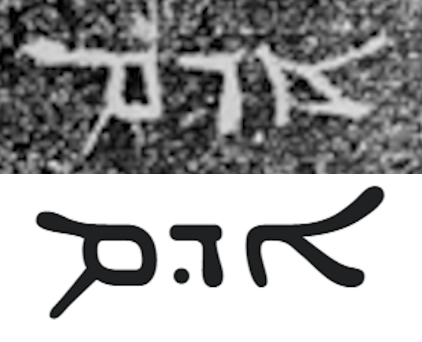
A line of Syriac on the stele reads "Adam," the Syriac name of Jingjing, the monk who set up the stele. Two scripts are carved side by side on one stone, and today few readers remain for either. Source: Wikimedia Commons, public domain

It did not quite vanish
The disappearance of the Church of the East from the central plains is not its disappearance from Chinese history.
On the northern steppe, many among the Öngüt, Kerait and other tribes belonged to the Church of the East. When the Mongol empire rose, these people followed the Yuan into the central plains, and Yuan documents call Christians yelikewen. The line broke again only when the Yuan fell.
A Thousand Years Later, the Same Script
The script has been played out several more times since.
After 1949, within a few years nearly all foreign missionaries in China left, and Chinese Protestantism and Catholicism were asked to be "self-governing, self-supporting, self-propagating," cutting their ties with churches abroad and registering with the state. House gatherings that did not register have lived in a grey zone ever since.
From 2014 to 2016, in the name of cleaning up "illegal structures," Zhejiang took the crosses off more than a thousand churches, and some churches were pulled down entirely. (There is no official total; estimates from media and church groups run from a little over twelve hundred to about seventeen hundred.)
The Tang edict said "return to lay life"; today the word is "illegal structure." The words changed; the bones of the script hardly did. Whether a foreign religion can stand on this land is decided in the end not by how much it sounds like the local speech, but by whether the court is willing to nod.
Looking at it the other way
It is easy to tell the story of the Church of the East as a "failure": it came, did not take root, and was driven out.
Look from another angle and what it left behind is a stone that has been borrowed again and again: the Tang used it to record the arrival of a foreign religion, the Ming missionaries used it to prove their own legitimacy, and we today use it to discuss how a religion travels between civilisations.
Religions often spread on two things, the trade road and royal power. They come in by the trade road and stand by power; but when power turns away, a religion held up only by power is usually the first to fall.
Those that can still stand after power turns are the ones that have sunk into the ordinary family's table and its weddings and funerals. The Church of the East did not manage that.
How far can a foreign religion change before it is no longer itself?
References
- Stele on the Spread of the Luminous Teaching of Daqin in China, second year of Jianzhong, Tang (781), Xi'an Beilin Museum
- Old Book of Tang, "Annals of Wuzong," edict of the fifth year of Huichang (845)
- Erik Zürcher, The Buddhist Conquest of China, 1959 ("matching concepts," geyi)
- Date the stele was unearthed (1623/1625), its move to the Beilin in 1907, the Yuan-period yelikewen: standard history
- The "Three-Self" movement of the 1950s: standard history
- Zhejiang cross removals, 2014–2016: China Aid's February 2016 count of about 1,700 (relayed by International Christian Concern); in the second half of 2015 Hong Kong media relayed an activist's figure of "over twelve hundred" (original not read); Al Jazeera, 28 Feb 2016, and the AP, 29 Feb 2016, say only "hundreds," with the official reason being building-code violations; for an academic survey see Mark McLeister, "Chinese Protestant reactions to the Zhejiang 'Three rectifications, one demolition' campaign," Review of Religion and Chinese Society 5(1), 2018 (full text not read) 🟡
- Image credits are in each caption