
A sociologist admits he was wrong
In the mid-twentieth century, sociology had a theory that had nearly become consensus: modernisation makes religion decline. The richer a country, the more widespread its education, the more advanced its science, the weaker religion becomes, until it retreats into a corner of private life.
The American sociologist Peter Berger was among the best-known representatives of this "secularisation theory."
In 1999 he edited a book called The Desecularization of the World. It contains a line that has been quoted again and again: the assumption that we live in a secularised world is false. The world today, with some exceptions, is as furiously religious as it ever was.
For the figurehead of a theory to overturn it in public is rarer in academia than a religious revival. The evidence he saw: the Islamic revival since the 1970s, the return of religion in Russia after the Soviet collapse, the fast growth of Christianity in the Global South, and the ever-larger American evangelical movement.
A paradox
Yet on the other side, European churches really are emptying, and many have been turned into bookshops, bars and apartments. How can both be true?

Maastricht, the Netherlands: a thirteenth-century Dominican church turned into a bookshop in 2006. Shelves stand in the nave, and a café sits where the altar was. Source: Wikimedia Commons, photo by Bert Kaufmann, CC BY 2.0

In Sacred and Secular (2004), the political scientists Pippa Norris and Ronald Inglehart gave a powerful explanation, the "existential security" theory:
- The safer and richer a society, the weaker people's need for religion really is; that is the secular side.
- But the more secular a society, the fewer children it has; the more devout a society, the more children.
So here is a paradox: almost every country is becoming more secular, while the share of religious people in the whole world may still be rising.
The forecast of ten years ago
In 2015 the Pew Research Center published a large report forecasting how the world's religious populations would change from 2010 to 2050. Its main conclusions:
- By 2050 the world's Muslims (about 2.8 billion, 30%) would nearly equal Christians (about 2.9 billion, 31%).
- The Muslim population would grow fastest, by a projected 73%, mainly not through conversion but because it is younger and has more children.
- The absolute number of the religiously unaffiliated would rise, but their share of world population would fall from 16% to 13%.
This forecast is nearly the data version of that paradox.
The numbers ten years later
In 2025, Pew used new data to look back at what really happened between 2010 and 2020. Some of it matched; some did not:
- Muslims did grow the most, by 347 million over the decade, more than the gains of all other religions put together.
- But the unaffiliated also grew by 270 million, to about 1.9 billion, and their share of world population rose rather than fell, to 24.2%.
- Christians grew by 122 million, but their share fell by 1.8 percentage points, to 28.8%.
- Buddhists were the only major religion whose absolute number shrank, by about 19 million.
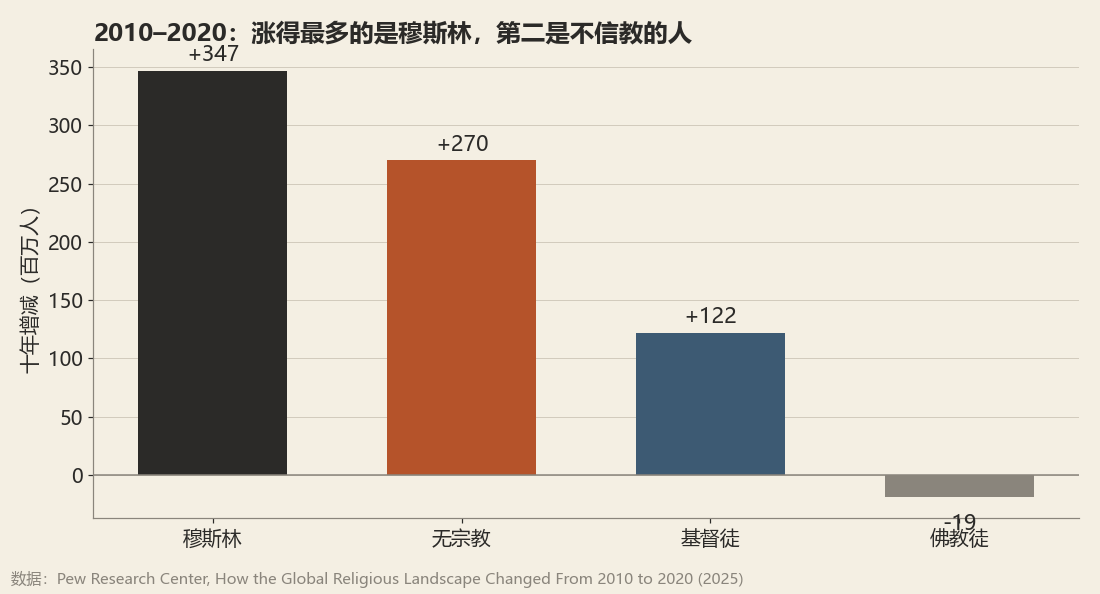
How much each of four groups grew or shrank over the decade 2010 to 2020 (millions of people). Data: Pew Research Center, 2025
The two reports count differently, so the figures cannot be subtracted directly. But the difference in direction is clear: the forecast expected the unaffiliated share to shrink, and over this decade it grew. The main reason is "switching": large numbers of people raised in Christian families stopped identifying with any religion as adults.
Assumptions fail
Why was the forecast off? Because every population forecast rests on assumptions: that fertility and switching rates in each place will roughly follow past trends.
That assumption has been broken again and again.
The most dramatic example is Iran. An Islamic republic should, by common sense, be the textbook case of "religion holding up high fertility." Yet Iran's total fertility rate fell from nearly 7 children per woman in the early 1980s to just over 2 around 2000, one of the fastest recorded fertility declines. A later piece in this series is devoted to it.
Another problem is what counts as "religious." The British sociologist Grace Davie spoke of "believing without belonging": many people never go to church yet keep some kind of faith; and conversely many are counted statistically as believers of a religion only because they were born into such a family.
The East Asian end
Turn the gaze back to East Asia and things get more interesting.
A large share of the world's unaffiliated live in East Asia: mainland China, Japan, Korea, Taiwan, Hong Kong. China alone has nearly 1.3 billion, roughly two thirds of the world's unaffiliated. But this "no religion" is not the same as the European kind, "walking out of the church." Many people sweep graves at Qingming, bow to the ancestors at New Year, burn incense in temples, and yet when a questionnaire asks "what religion do you follow," they answer "none."
East Asia is also the place with the fewest births in the world. By the existential security theory, with the cradles empty, religion should weaken further; but East Asia never had a "church" for people to walk out of in the first place.
So is the world becoming religious?
The honest answer is:
- In population terms, religious people are younger and have more children on the whole; that is a real force.
- In terms of switching, more and more people are religious as children and leave as adults; that is another real force.
- Which force is larger differs by place and by decade.
The future religious map depends on two things: on one side, whose cradles are fuller; on the other, whose doors can keep people. It has little to do with how brilliant a doctrine is.
Turning it around
Every judgement about "the religions of the future," this piece included, is only a curve that has not yet turned. In the 1960s Berger thought religion would recede; in 1999 he said it never had. In 2015 Pew said the unaffiliated share would fall; the numbers of 2025 say it is rising.
In the next decade the numbers will probably bend again.
When I read these numbers
When I read these numbers, I am not looking at which religion is winning. I am looking at the East Asian block.
The cradles are emptying, and there is no door either. Young Europeans who leave the church at least know what they are leaving; our young people have scattered without anything they could leave. I have kept watching the experience on the Islamic side: it can make people scattered across the world recognise one another as their own the moment they meet. That is something we have to learn.
Around you, are people leaving religion, or believing in a different way?
References
- Peter L. Berger (ed.), The Desecularization of the World, 1999
- Pippa Norris & Ronald Inglehart, Sacred and Secular, Cambridge UP, 2004
- Pew Research Center, The Future of World Religions: Population Growth Projections, 2010–2050, 2015
- Pew Research Center, "How the Global Religious Landscape Changed From 2010 to 2020," 2025; for China's nearly 1.3 billion unaffiliated, about two thirds of the global total, see the chapter on the unaffiliated 🟢
- Abbasi-Shavazi et al., The Fertility Transition in Iran, Springer, 2009
- Grace Davie, Religion in Britain since 1945: Believing without Belonging, 1994
- Image credits are in each caption