
A strange fact
Shakyamuni was born in what is now southern Nepal, awoke at Bodh Gaya in India, and spent his life teaching mainly in the Ganges region. In the third century BCE Ashoka of the Maurya dynasty strongly backed Buddhism and sent people everywhere to spread it. For over a thousand years after that, India produced great Buddhist seats of learning such as Nalanda and Vikramashila, and both Xuanzang and Yijing studied at Nalanda.
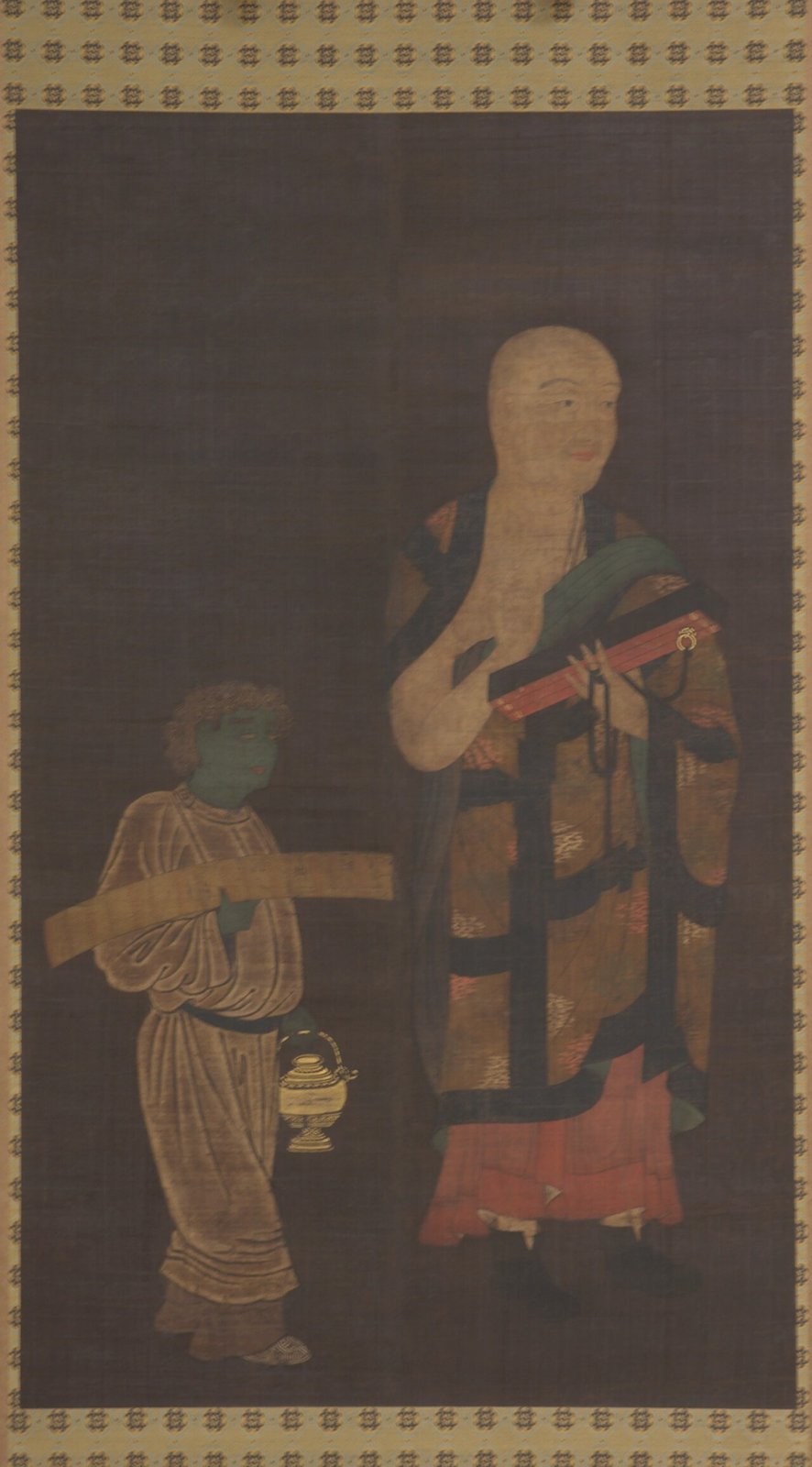
Xuanzang as painted by a Japanese artist. He lived at Nalanda for about five years, and on returning to Chang'an he brought back more than six hundred scriptures. Source: Wikimedia Commons, Metropolitan Museum of Art, New York, CC0

But by the thirteenth century Buddhism was almost impossible to find in India proper. A large part of India's Buddhists today are the neo-Buddhists who converted with Ambedkar in 1956, and their descendants.
How can a religion disappear from its own home?
The most common answer
The explanation most often heard: Islamic armies came.
This has a factual basis. In the late twelfth and early thirteenth centuries the Turkic Muslim commander Bakhtiyar Khalji led troops into Bihar and Bengal, and Buddhist centres such as Nalanda and Vikramashila were sacked. The traditional account puts the destruction of Nalanda around 1193; some scholars place it around 1200, and say that Nalanda survived in a reduced state for a while afterwards.

The ruins of Nalanda, Bihar. What one sees today are brick monasteries and the bases of stupas; once over a thousand monks and students lived here. Source: Wikimedia Commons, photo by Sumitsurai, CC BY-SA 4.0

Online this is often used as an example of "monotheism wiping out polytheism." But the question is: if Buddhism in India were still full of life then, spread through town and country, could a few sackings make it vanish altogether?
The longer story researchers see
The Indian scholar K. T. S. Sarao in The Decline of Buddhism in India: A Fresh Perspective (2012), and the American archaeologist Lars Fogelin in An Archaeological History of Indian Buddhism (2015), both offer a longer, more winding story. Roughly these strands:
First, the royal houses stopped supporting it. The great monasteries and universities of Buddhism depended heavily on the support of royal houses and rich merchants. After the Gupta dynasty, more and more dynasties turned to supporting Hindu temples and Brahmins. Once the support stopped, a monastic community that lived on support could not hold on.
Second, the ground shifted. Early Buddhism was tied closely to cities, commerce and trade routes. Later India's economy came to depend more and more on land and the countryside; kings granted land to Brahmins and temples, and local order was kept more and more by landlords and Brahmins. In an order based on villages and land, Buddhist monasteries were pushed more and more to the edge.
Third, Hinduism itself changed. In this period Hinduism went through deep change, especially the bhakti movement: personal devotion to gods such as Vishnu and Shiva, with a low threshold and warm feeling, and enormous appeal among ordinary people. In competing for ordinary believers, the Buddhist monastic model had no advantage.
Fourth, they became harder to tell apart. In late Buddhism the Tantric strand grew heavier, and its rituals and deities looked more and more like those of the Shaiva and Shakta schools of Hinduism. The Hindu Puranas even absorbed the Buddha as one of Vishnu's avatars. As the two grew more alike, the boundary of Buddhism as an independent religion also grew blurred.
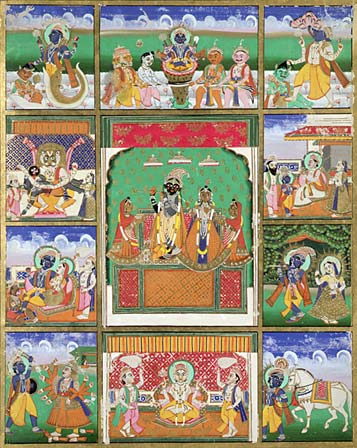
Vishnu and his ten avatars, the Buddha among them. Inviting a rival into your own pantheon is sometimes more thorough than defeating it. Source: Wikimedia Commons, public domain

Fifth, the final blow. On such a base, when Islamic armies sacked the great monasteries, what they struck was a Buddhism that had already shrunk to a few large centres. It was not only Buddhism that was struck; many Hindu temples were destroyed too. But Hinduism was planted in family, caste and village, whereas the main body of Buddhism had been reduced to the monastery.
Where Buddhism went
Buddhism did not vanish; it only left India.
By the time it was declining in India it had already taken root in Sri Lanka, Southeast Asia, China, the Korean peninsula, Japan and Tibet. Many of Indian Buddhism's last scholars and texts flowed to Tibet. For a religion to die out at home and flourish abroad is nothing rare in religious history: in Palestine, Christianity's birthplace, Christians are only a minority today.
The same blow: why it did not kill Buddhism in China
Here is a comparison worth pausing on.
Buddhism in China also took several severe blows. The most famous was in the Huichang era of Emperor Wuzong of the Tang: temples torn down, monks and nuns ordered back to lay life, monastic property confiscated (mentioned in this series' piece on the Church of the East). But that time, Buddhism in China did not die.
One important reason is that by then Buddhism had entered Chinese people's homes: Guanyin enthroned in the main room, rites for the ancestors at the Ghost Festival on the fifteenth of the seventh month, monks invited to chant at funerals. Temples can be torn down; these things in the home cannot. When the storm passed, the temples were rebuilt one by one.
From the 1960s to the 1970s China's temples were smashed again, more thoroughly than in Huichang: monks forced back to lay life and struggled against, Buddha images smashed, scriptures burned. Later, with reform and opening, many temples were rebuilt, with incense burning even more strongly than before. Their return relied again on those habits that nobody was preserving for them, yet which stayed in the home.
What this shows
The decline of Buddhism in India is a good example:
- It was not defeated by a "stronger doctrine."
- It lost on a few very concrete things: who paid to support it, whether it was rooted in the cities or the villages, whether it could still be told apart from its rivals, and whether it had entered ordinary people's birth, ageing, sickness and death.
- The military blow was real, but it fell on a frame that was already very brittle.
This is also why I grow more wary of claims such as "polytheism cannot beat monotheism." They squeeze a process of several centuries with many causes into a duel between doctrines.
Turning it around
Sarao's and Fogelin's views are also contested. Some scholars think they underestimate the destructive force of the Islamic conquest; others say that "decline" is itself a word with hindsight in it, and that people at the time did not necessarily feel Buddhism was declining.
A safer way to put it may be: the military blow and the long structural change are both real; the dispute is over which mattered more.
What habits at home does no institution preserve for you?
References
- K. T. S. Sarao, The Decline of Buddhism in India: A Fresh Perspective, 2012
- Lars Fogelin, An Archaeological History of Indian Buddhism, Oxford UP, 2015
- The mass conversion at Nagpur in 1956
- The date of Nalanda's destruction (1193 or about 1200), Ashoka's support of Buddhism, the Huichang suppression, the destruction of temples in 1966–1976 and their later rebuilding: standard history
- Image credits are in each caption