A question argued for over a century
Is Confucianism a religion?
The Chinese-speaking world has argued about this for more than a hundred years. In 1912 Chen Huanzhang and others founded the Confucian Association in Shanghai, with Kang Youwei as its spiritual leader; in 1913 and again in 1916 they petitioned to make Confucianism the "state religion" of the Republic of China, and failed both times. Their opponents said Confucianism is philosophy, ethics, moral instruction, not religion; Confucius "did not speak of prodigies, force, disorder or spirits" and said to "respect the spirits but keep them at a distance."
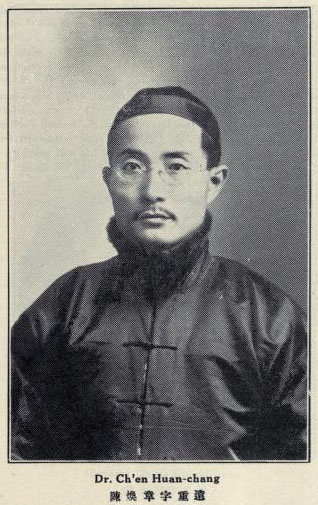
Chen Huanzhang (1881–1933), from Gaoyao in Guangdong, a Columbia University PhD in economics and the founder of the Confucian Association. He wrote The Economic Principles of Confucius and His School*, and later set up a Confucian Academy in Hong Kong. Source: Wikimedia Commons, public domain*

In China the question has no settled answer even today. In Indonesia it has a very concrete one: Confucianism (Khonghucu) is one of the six religions recognised by the government, and a believer can write it in the religion box on the ID card.
Why Indonesia "recognises" religions
To understand this, one has to know a feature of Indonesia: its founding ideology, Pancasila (the five founding principles), puts first "belief in the one and only supreme God." In Indonesia every citizen is expected to belong to some recognised religion.
In 1965 a presidential decree of the Sukarno government listed the six religions of Indonesians: Islam, Protestantism, Catholicism, Hinduism, Buddhism, and Confucianism.
This mattered a great deal to Chinese Indonesians. Many of them honoured ancestors, worshipped gods and kept festivals in a mixture of Confucian, Buddhist, Daoist and folk belief that does not fit neatly into any one "institutional religion." "Confucianism" gave them an identity they could register administratively.
Taken away, then given back
The good times did not last.
After the failed coup of 30 September 1965, Indonesia fell into a great purge, and Suharto took power. Ethnic Chinese, suspected of sympathy with the Communists and loyalty to China, became the target of anger. During the thirty-odd years of the "New Order" that followed, Chinese schools were closed, Chinese newspapers were shut down, and many Chinese were pressed to adopt Indonesian names.
In 1967 Suharto issued Presidential Instruction No. 14, restricting public religious, belief and customary activity by the Chinese.
Confucianism's position went steadily downhill. The 1967 instruction restricted public activity; by the late 1970s Confucianism had been demoted to a "belief stream" and was no longer an officially recognised religion: the Ministry of Religion no longer kept an office for it, schools no longer taught it, and believers could not register as Confucians on their ID cards. (The year of the demotion is given as 1977 in some sources and 1978 in others; a circular of the Ministry of Home Affairs of 18 November 1978 is the one whose reference I could find, and what I read was a scholarly paper's account of it, not the original.) Many Chinese had no choice but to register as Buddhists or Christians.
An old woman might keep ancestral tablets at home all her life and still have "Buddhism" written on her ID card. That is how many families lived through those thirty years.
Suharto stepped down in 1998. In 2000 President Wahid ordered the 1967 restrictions revoked; the Chinese could celebrate the lunar New Year in public, and Confucianism regained the standing of an official religion. In 2006 the Ministry of Home Affairs and the Ministry of Religion each issued a document, and the marriages of Confucians could again be formally registered with the civil authorities. (The Ministry of Religion's 2006 letter is numbered MA/12/2006, and the Ministry of Home Affairs' letter of 24 February 2006 is numbered 470/336/SJ; I did not read the originals, and the numbers are written differently in different places.)
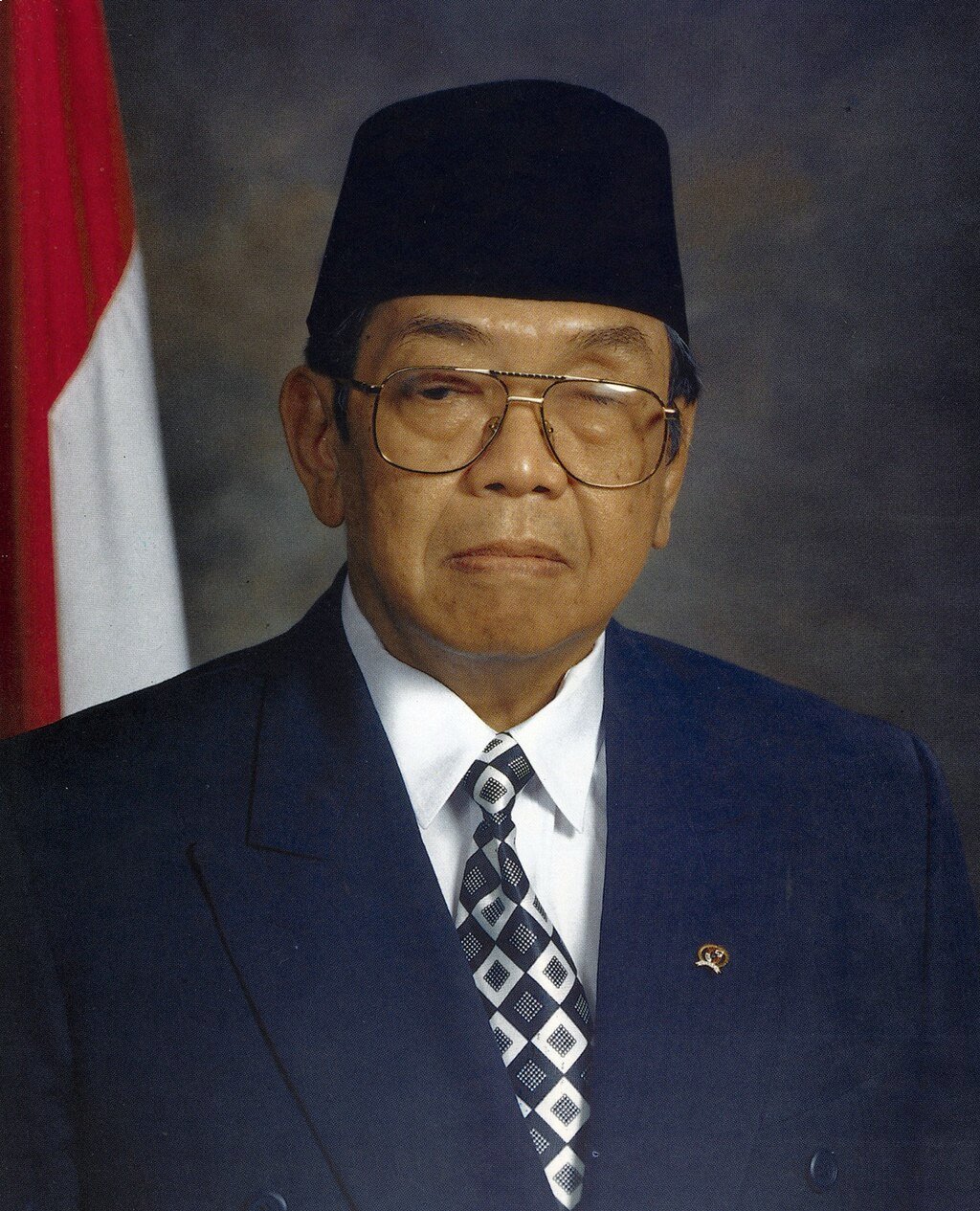
Abdurrahman Wahid (1940–2009), the fourth president of Indonesia, known as "Gus Dur." He had chaired Nahdlatul Ulama, Indonesia's largest Islamic organisation, and many Chinese Indonesians later called him the "father of the Chinese." Source: Wikimedia Commons, Government of Indonesia, public domain

The one who pushed for the recognition of Confucianism was a Muslim religious leader.
What Confucianism became in Indonesia
In the Indonesian setting, Confucianism was shaped to look more like a "religion": it has places of worship (temples), clergy, scriptures (the Four Books and Five Classics), religious festivals, and ceremonies for weddings and funerals.
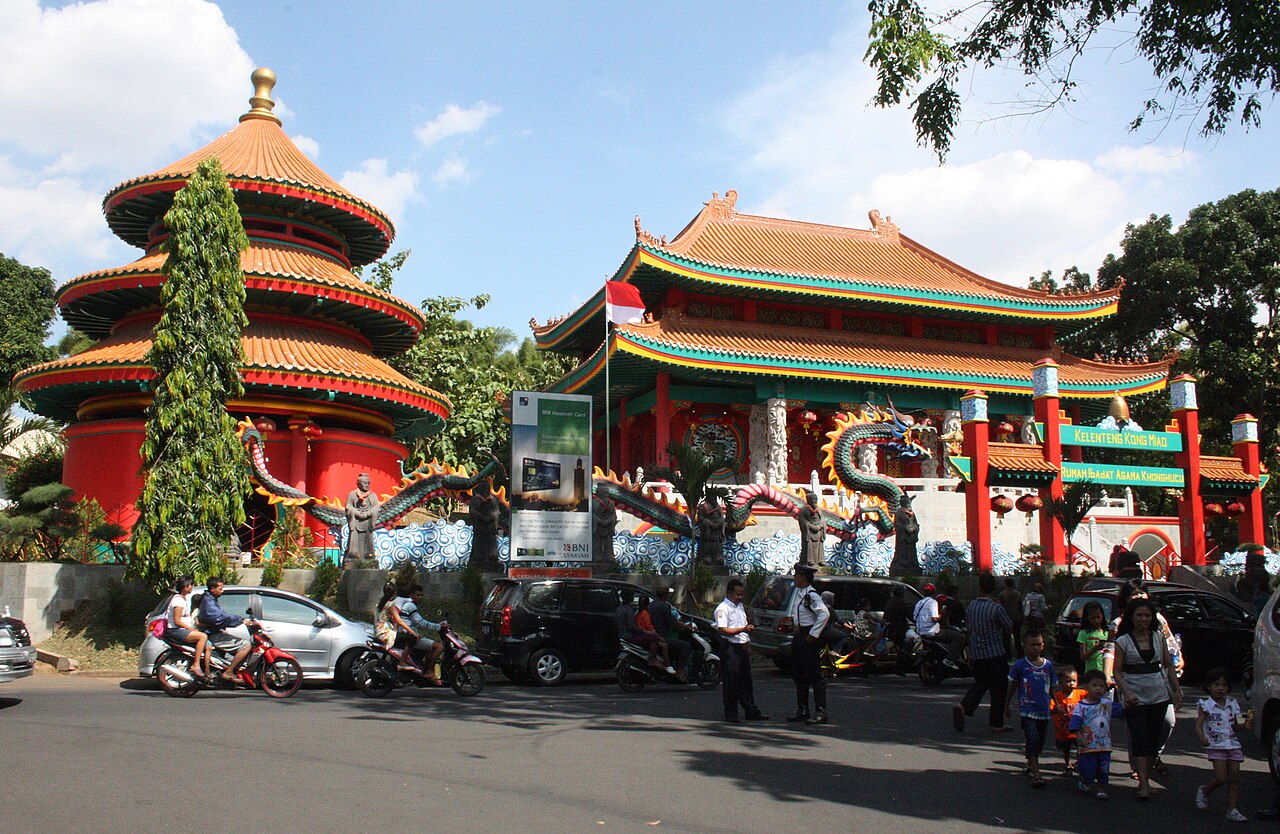
The Confucian temple in Taman Mini Indonesia Indah, Jakarta. In this park every officially recognised religion has a house of worship of its own; the Confucian one was added later. Source: Wikimedia Commons, photo by Gunawan Kartapranata, CC BY-SA 3.0

This is rather interesting: to survive in a country that requires its citizens to belong to a religion, Confucianism was forced to grow into the shape of a "religion." Put plainly, "is Confucianism a religion?" in Indonesia is not wholly a philosophical question; it is an answer the system forced out.
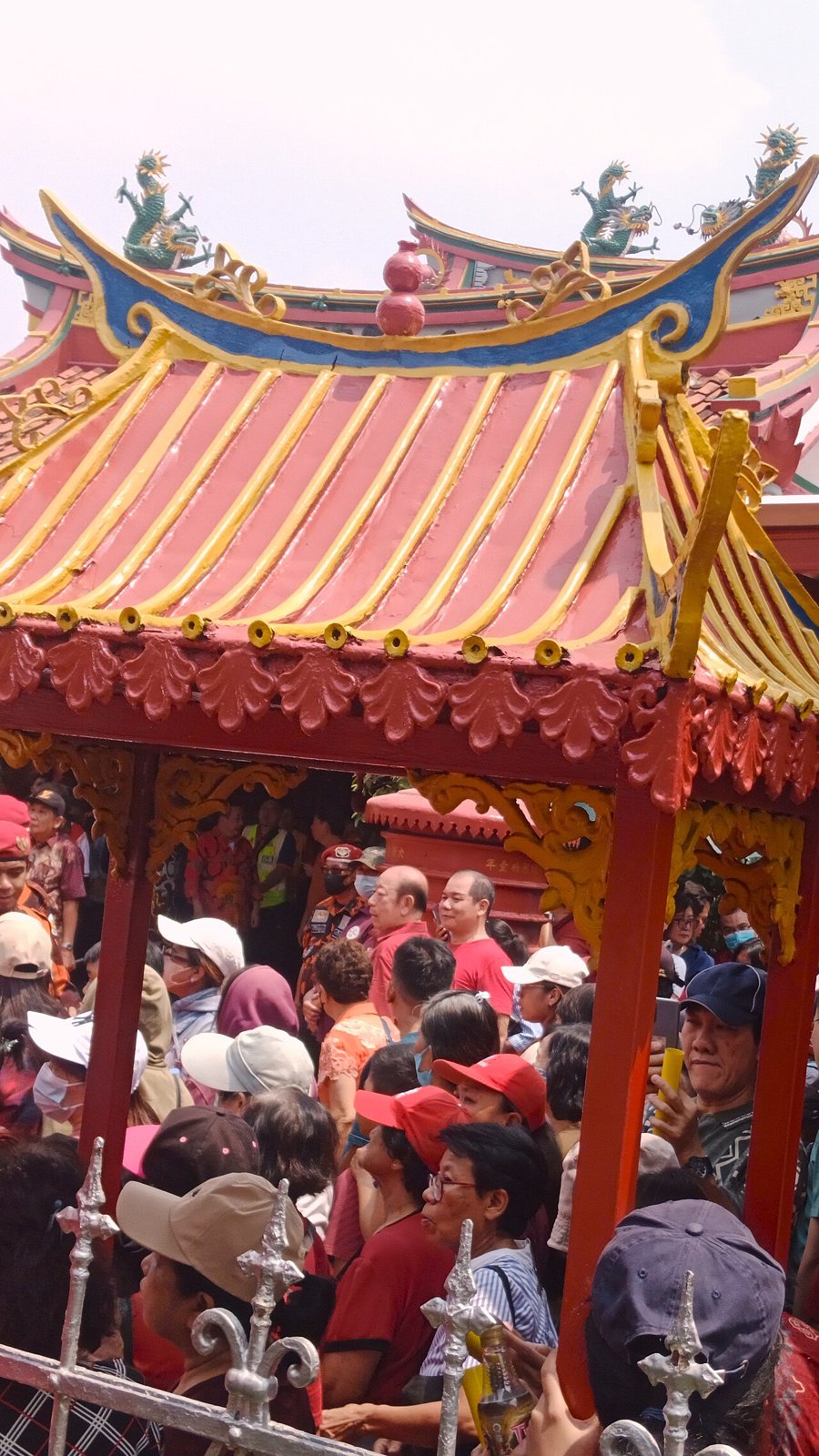
Boen Tek Bio in Tangerang, the oldest Chinese temple in the area. It is a temple of Guanyin, and it also holds many other deities. In Indonesia, Confucianism, Buddhism and Daoism often live in the same temple. Source: Wikimedia Commons, photo by Swarabakti, CC BY-SA 4.0

Back to the old question
In Religion in Chinese Society (1961), the sociologist C. K. Yang drew a very influential distinction:
- Institutional religion: with its own doctrine, organisation and clergy, such as Buddhism, Daoism and Christianity.
- Diffused religion: belief and ritual scattered through the daily life of family, community and state, without independent organisation, such as ancestor worship, village earth gods, city gods and the state's sacrifice to Heaven.
Within this frame, traditional Confucianism is more like the "skeleton" of a diffused religion: it supplied ancestor worship, ritual and the idea of the Mandate of Heaven, but no "church" independent of family and state.
So "is Confucianism a religion?" may be the wrong question. A better one: what kind of religiousness does it have, and where does that religiousness reside?
In China it resides in the family and the state; in Indonesia it was forced to grow an organisation of its own.
Turning it around
Some also hold that "religionising" Confucianism is itself a distortion: it squeezes a system of ethics and a way of living into a mould made from the Western concept of "religion." Is Indonesian Confucianism the real Confucianism, or something new that grew to fit the system?
Accept registration, not definition
I have looked at the Indonesian case many times, and in the end it leaves two flavours in me.
One is relief: it proves that Confucianism can grow temples, scriptures, festivals and rites for weddings and funerals, and can live on as a real religion. The other is a chill afterwards: it was forced into being by the state; the state gave it, and the state also took it back, and the taking lasted thirty years.
So my position is: a religion can accept registration by the state, but not the state's definition. It is something that crosses states, peoples and times, and no one government should decide what it is or whether it counts. Indonesian Confucianism has done the first half; the second half it still has to earn for itself.
Which shapes a religion more strangely: a state that demands everyone have a religion, or a state that prefers everyone have none?
References
- Indonesia's 1965 presidential decree listing six religions; Presidential Instruction No. 14 of 1967: standard history
- The demotion of Confucianism in the late 1970s: the article by the Center for Religious and Cross-cultural Studies, Gadjah Mada University (CRCS-UGM) gives 1977 as the year of demotion to a "belief stream" (The Struggle for State Recognition of Confucian Believers in Indonesia, 2019-04-08); Leo Suryadinata records it as "recognised until 1977, withdrawn in 1978" (Fulcrum, 2024-04-03); a 1978 circular of the Minister of Home Affairs limited the religion box on ID cards to five official religions and was revoked in 2002 (Hukumonline, 2002-10-11; the circular's number is written differently in different places) 🟡
- Presidential Decision No. 6 of 2000, 17 January 2000, by President Wahid, revoking Presidential Instruction No. 14 of 1967 so that Chinese religious, belief and customary activity no longer needs special permission (original text on Indonesian Wikisource) 🟢; the decision's text does not name "Confucianism," and "Confucianism then regained the standing of an official religion" is the scholars' account (the CRCS-UGM article above, Suryadinata) 🟡
- The Ministry of Home Affairs and the Ministry of Religion issued separate documents in 2006, recognising Confucian marriage and Confucian religious education respectively, so that Confucians can register marriages with the civil authorities: same CRCS-UGM article 🟡
- C. K. Yang, Religion in Chinese Society, UC Press, 1961
- The founding of the Confucian Association in 1912, the state-religion petitions of 1913 and 1916, the 30 September Movement of 1965: standard history
- Image credits are in each caption