A widely circulated answer
Among the things I had saved was an answer to this effect: Chinese native belief is declining and a foreign religion will inevitably replace it, "and South Korea is the clearest example, where seventy percent of the native population already believes in Jesus."
The line has real impact. A clear number, a clear conclusion, and a touch of urgency. I did not doubt it at the time and saved it.
Later I went and checked the Korean census.
What the census says
Statistics Korea surveys religion in the census every ten years. The 2015 results:
- No religion: 56.1%
- Protestant: 19.7%
- Buddhist: 15.5%
- Catholic: 7.9%
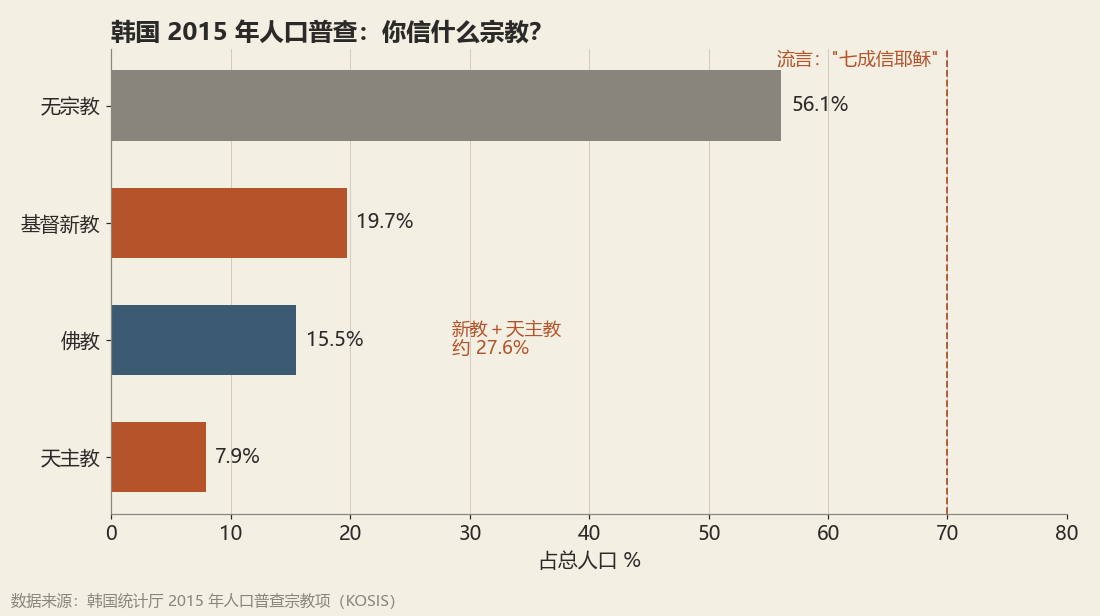
Korea's 2015 census, "What is your religion?" The dotted line is the seventy percent in that answer. Data: Statistics Korea
Protestants plus Catholics make about 27.6%, under thirty percent. And more than half of Koreans say they have no religion, a share that has risen since 2005.
So "seventy percent" is off by more than double. More important, the direction the rumour points, "native belief declines and Christianity replaces it," does not match the main trend in the census either: the fastest-growing category in Korea is "no religion."
Half of the rumour is true
Still, the rumour was not made from nothing. It caught a real phenomenon: Christianity's growth in Korea is indeed unusual.
In the twentieth century Christianity in Korea covered in a few decades a road that took centuries elsewhere. Today Korea's Christian share is far ahead in East Asia, Seoul has some of the largest churches in the world, and Korea was at one time one of the countries sending out the most missionaries abroad.
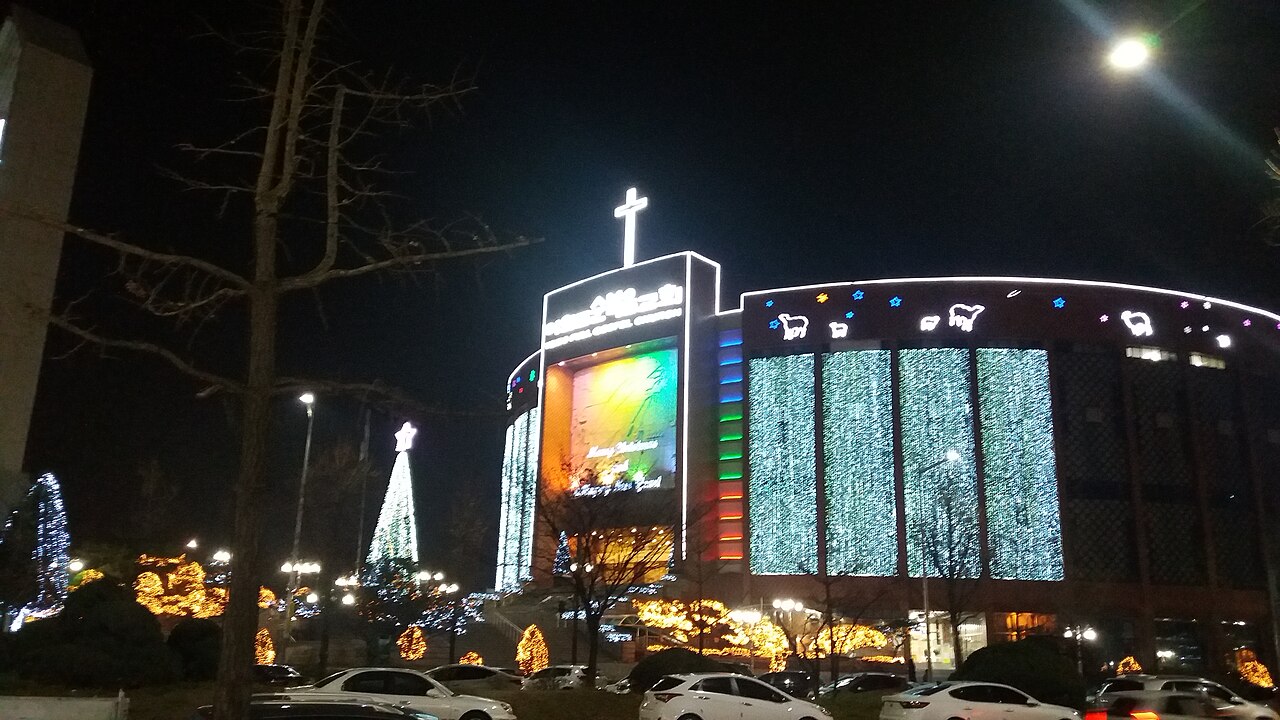
Yoido Full Gospel Church in Seoul, said to be the largest single congregation in the world, with several hundred thousand registered members. Source: Wikimedia Commons, photo by Striker9498, CC0

Why? Researchers have offered many explanations: under Japanese colonial rule the church was an important space for nationalism and resistance; after the war the church ran schools, hospitals and social welfare; in the years of fastest urbanisation, people who left the countryside found a new community in the church.
So "Korean Christianity is strong" is true; "seventy percent" is exaggeration; "native belief is being replaced" gets the direction wrong.
And Buddhism?
In the same period, Buddhism in Korea has been shrinking.
A 2026 Pew Research Center analysis says that in Korea, among those raised in Buddhist families, about six in ten no longer identify as Buddhist; in Japan the share is about half. Most did not convert to another religion; they became "unaffiliated."
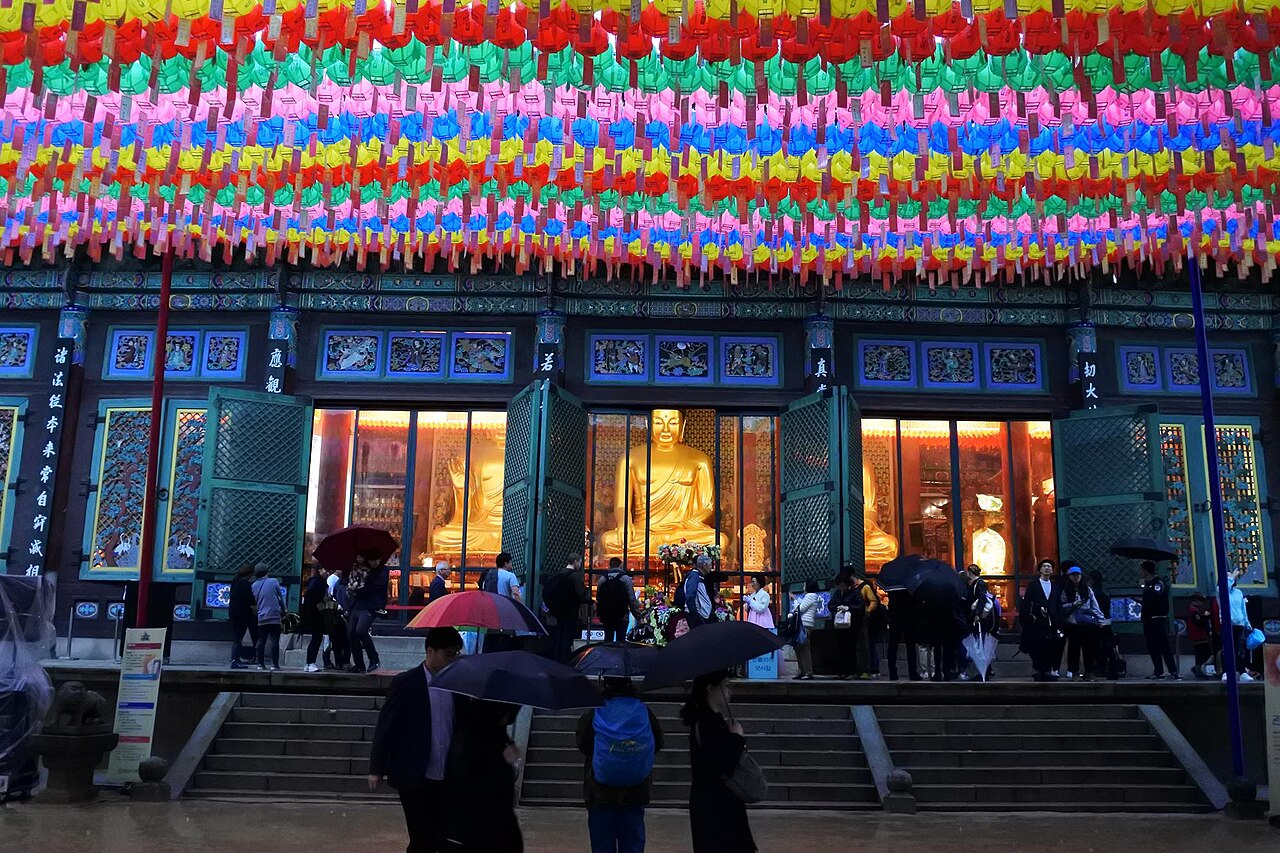
Jogyesa in Seoul, hung with lotus lanterns before the Buddha's birthday. Many people come to see the lanterns, and fewer and fewer tick "Buddhist" on questionnaires. Source: Wikimedia Commons, photo by Ken Eckert, CC BY-SA 4.0

This does not match another popular claim online either: "the Buddhists have all gone over to Christ." The data show they mainly left religion itself.
How many Christians in mainland China
At this point many people ask: and China?
This number is a puzzle. The official figure published in 2018 is more than 38 million Protestants and about 6 million Catholics; the estimates of overseas bodies and the churches themselves run as high as over 100 million, two or three times as many. Conversely, in nationwide questionnaires only about 2% of adults, roughly 20 million, call themselves Christian. A large part of the gap lies in unregistered house gatherings that questionnaires cannot reach and statistics do not want to ask about.
To say of a place that cannot even count its people that it "is being replaced" is, like "seventy percent of Koreans believe in Jesus," to fill a blank with imagination.
Where East Asia's religiousness is
Still, the "no religion" statistic must be read carefully too.
In East Asia many people tick "no religion" on a questionnaire and yet go on honouring ancestors, sweeping graves, visiting a temple before exams, burning incense at New Year and checking dates for weddings. Asked "what religion do you follow," they say none; asked "do you do these things," the answer is often yes.
The sociologist C. K. Yang called this form "diffused religion": the religiousness is not in an independent church but scattered through family, festivals and daily life.
So how many in East Asia "have a religion" depends on how you ask. To measure East Asia with the Western questionnaire of "do you belong to a church" may itself be measuring in the wrong place.
But "diffused" has another side: it is in no organisation, so no organisation keeps watch over it. When the family scatters and the city moves, it fades with them. Of Korea's "no religion" half, how many are people who never needed a church and how many are people who can no longer find a place to go back to, the questionnaire cannot tell.
Why rumours like this travel so fast
Finally, about myself. Why did I save that answer without the slightest doubt?
Looking back, it met all the conditions for a rumour to spread: a specific number (seeming credible), a clear cause (native belief declines, a foreign religion invades), a sense of crisis (we are next), and it happened to fit a worry I already had.
The last time you shared something, did you check the original data first?
References
- Statistics Korea, religion item of the 2015 census
- Pew Research Center, "Why is Buddhism shrinking worldwide?", 2026-03-11
- State Council Information Office, China's Policies and Practices on Protecting Freedom of Religious Belief, white paper, 2018-04-03 (more than 38 million Protestants, about 6 million Catholics) 🟢
- Pew Research Center, "Measuring Religion in China: Christianity", 2023 (2018 Chinese General Social Survey: about 2% of adults, about 20 million, call themselves Christian; external estimates as high as 7%–9%, about 100 to 130 million) 🟢
- C. K. Yang, Religion in Chinese Society, 1961
- Image credits are in each caption