A paper by Chen Yinke
In 1930 the historian Chen Yinke published an article in the Tsinghua Journal, titled "Cao Chong, Hua Tuo and Buddhist Stories in the Records of the Three Kingdoms."
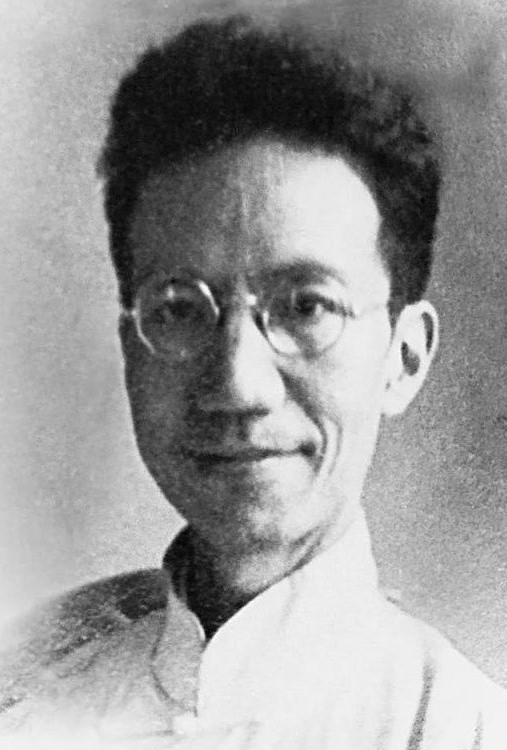
Chen Yinke (1890–1969). He knew over a dozen languages and read Sanskrit, Pali and Tibetan; he was forty when he wrote this paper. Source: Wikimedia Commons, public domain

The article discusses two stories everyone knows. One is Cao Chong weighing the elephant, the other is the miracle physician Hua Tuo. Chen Yinke held that Buddhist stories from India had been mixed into both.
This scholar, who wrote of "independence of spirit, freedom of thought," went blind in old age, suffered greatly in the campaigns of the 1960s, and died in Guangzhou in 1969. Many of the hypotheses he left have waited ever since for someone to prove or overturn them.
On Hua Tuo he put forward a very bold view.
"Hua Tuo" and "agada"
The Records of the Three Kingdoms says: "Hua Tuo, courtesy name Yuanhua, was a man of Qiao in the Pei state, also called Fu." Hua Tuo's given name may have been "Fu," with the courtesy name "Yuanhua."
Chen Yinke noticed that "Fu" and "Yuanhua" match in meaning ("fu" carries the sense of unfolding and nurturing). So where does "tuo" come from?
His guess: Sanskrit has a word agada, meaning "medicine," transliterated in Buddhist scriptures as "agetuo." The old Chinese pronunciation of "hua" was close to "qie/ga," so "Hua Tuo" may be a transliteration of gada. That is, because this physician's skill was so wondrous, people of the time called him by a foreign name meaning "god of medicine."
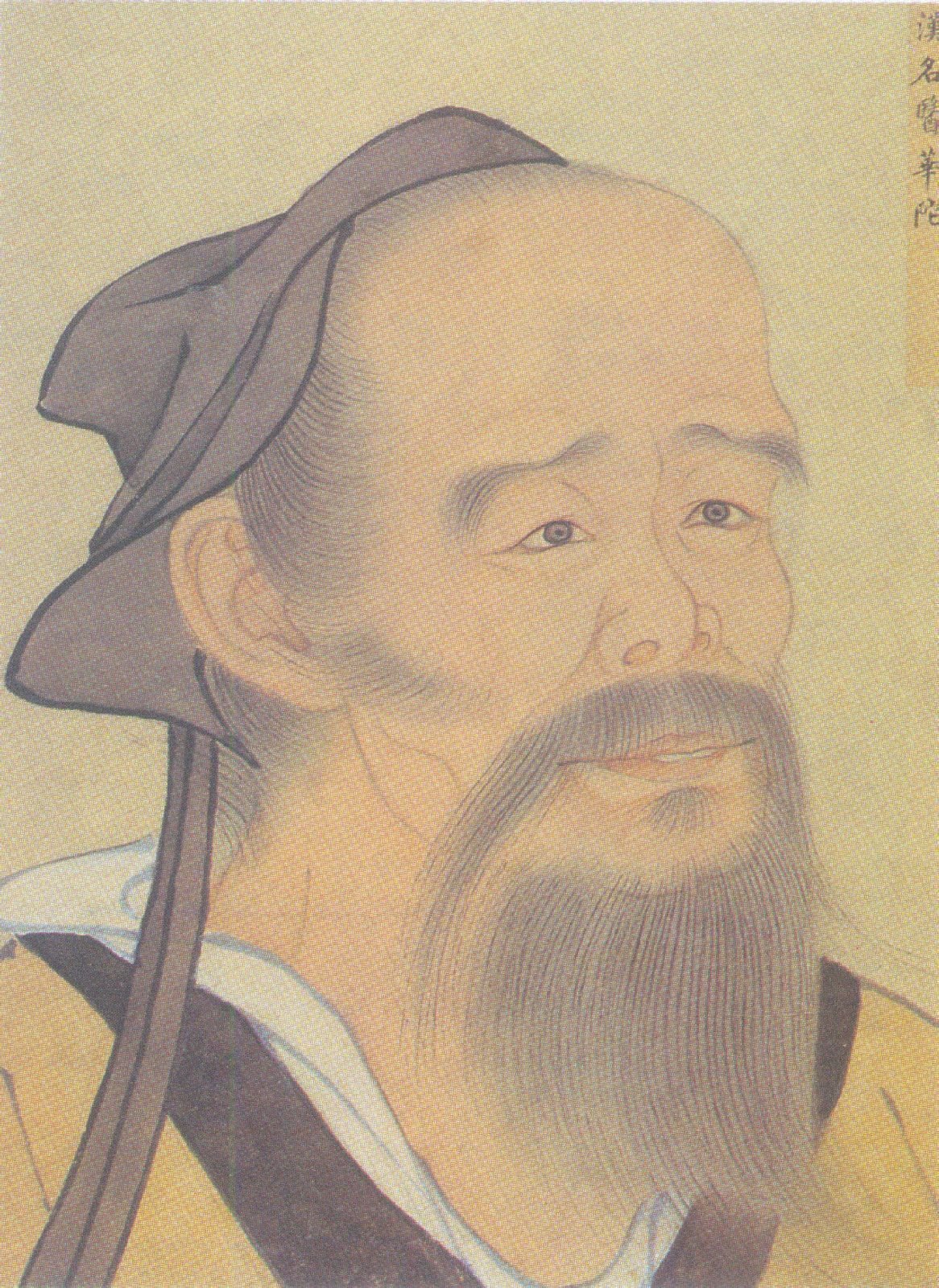
A portrait of Hua Tuo painted by later people. Nobody knows what he looked like; people are still arguing even about what he was really called. Source: Wikimedia Commons, public domain

He also held that some of Hua Tuo's miraculous cures in the Records of the Three Kingdoms resemble stories of the Indian physician Jivaka in the Buddhist scriptures. Some scholars later conjectured that the ingredients of Hua Tuo's "mafeisan" anaesthetic may have had to do with datura (Sanskrit mandārava).
Does the hypothesis hold up
The idea is fascinating, but the scholarly world has formed no consensus on it.
Historians such as Lü Simian, when discussing Hua Tuo, did not adopt this explanation. Several objections can be listed:
- "Tuo" as a personal name was not rare in the Han. The king of Nanyue at the end of the Qin and the start of the Han was called Zhao Tuo. To prove "tuo" a foreign transliteration by saying "few people before the Han were named Tuo" is not solid.
- A transliteration match needs stricter evidence. That the old pronunciation of two characters resembles the last two syllables of a Sanskrit word can serve as a clue, but on its own it is hard to settle.
- Similar stories do not mean the same source. Stories of miracle physicians follow similar patterns in many civilisations.
So the safer statement: Chen Yinke put forward an interesting hypothesis, and to this day it is still a hypothesis.
Some borrowings are certain
Still, when Buddhism entered China it did bring along a great many Indian things, and some are beyond dispute.
Take the "five pungent roots" that Buddhist precepts forbid: scallion, garlic, leek, Chinese chive, and one called xingqu. Xingqu is rare in Han lands; it is in fact asafoetida, a spice native to Central Asia and common in Indian cooking. A Han monk reading xingqu in the precepts might never have seen the thing in his life, because this rule was moved over unchanged from India.
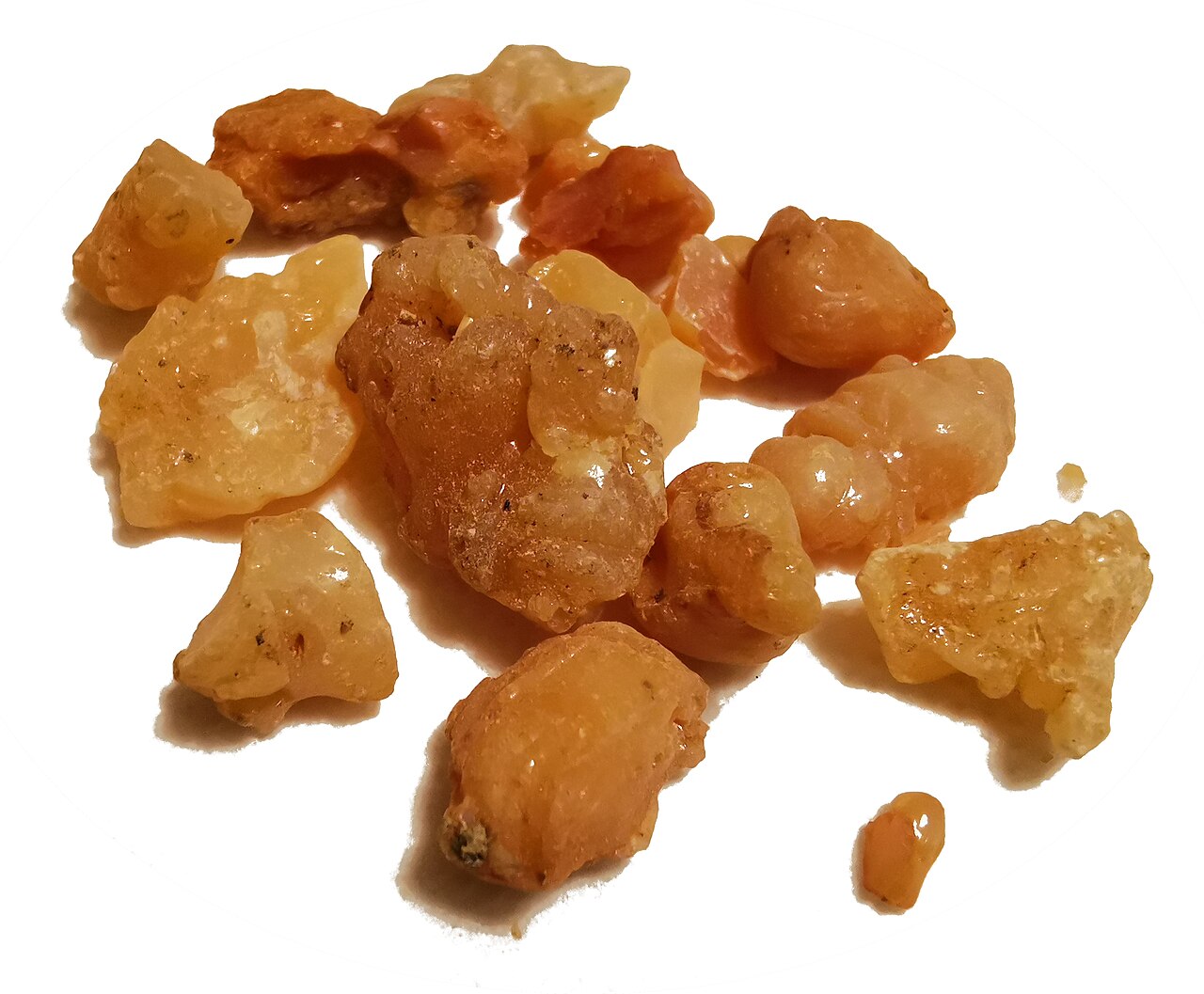
Asafoetida resin from Isfahan, Iran. In the Buddhist scriptures it is called "xingqu." Many Chinese monks who kept the five-pungent-roots precept all their lives probably never smelled it. Source: Wikimedia Commons, photo by Tricholome, CC BY-SA 4.0

Borrowings in language are more numerous still: chana (instant), niepan (nirvana), pusa (bodhisattva), luohan (arhat), shijie (world), yinguo (cause and effect)... A whole batch of everyday Chinese words today comes from the translation of Buddhist scriptures.
Deeper are the borrowings of ideas. In forming and developing, Daoism took in Buddhist notions of rebirth, karmic retribution and hell; and Buddhism in China also took in Confucian filial piety and the Chinese worship of ancestors. For instance, the story of "Maudgalyayana Saves His Mother" fused Buddhist rites for the dead with Chinese filial care; the Ullambana festival that came of it later merged with the Daoist Zhongyuan festival to become today's "mid-seventh-month."
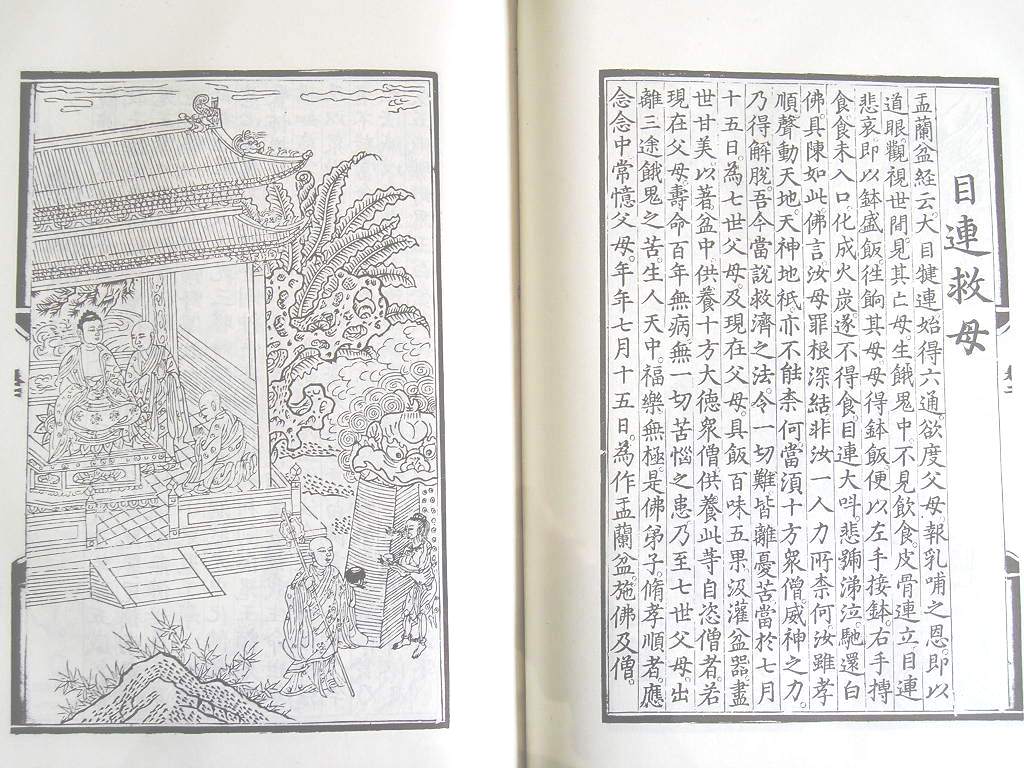
Woodcut illustration from an old printed edition of "Maudgalyayana Saves His Mother." A rite-for-the-dead story from India became in China a filial-son play, performed for hundreds of years. Source: Wikimedia Commons, public domain

A religion is a freight wagon
The most interesting thing here: the spread of a religion has never carried doctrine alone.
It is like a freight wagon, loaded with scriptures and also with language, medicine, spices, art, festivals, food taboos. When the wagon reaches a new place, some goods are unloaded as they are, some are converted, and some are taken by the locals and used for something else.
The wagon also drives back
The wagon did not stop on reaching China.
Chinese characters hauled this load another stretch east and south: the Buddhist scriptures read by the Japanese, Koreans and Vietnamese are the Chinese-translated scriptures; words like "world," "cause and effect" and "instant" went into Japanese, Korean and Vietnamese together with the characters, read differently in each but written as the same characters. Today a Seoul person saying "세계," a Tokyo person saying "せかい" and a Hanoi person saying "thế giới" are all saying the same "world" that took a turn through Sanskrit.
Whether Hua Tuo's name is Sanskrit may never be confirmed. But the hypothesis that "the name of a Chinese miracle physician may have come from India" itself reminds us: many things taken for "homegrown" may have behind them a journey across civilisations.
Turning it around
But the reminder can also go too far. There is a claim online that "Chinese medicine all came from India." That is plainly wrong: the core theories of Chinese medicine (yin and yang, the five phases, meridians, the zang-fu organs) have no corresponding source in Indian medicine.
The borrowing is real, but borrowing is not wholesale copying. When a civilisation takes in something foreign, it often grafts it onto its own roots; it does not replace the roots.
Among the words or customs you know, which one actually comes from far away?
References
- Chen Yinke, "Cao Chong, Hua Tuo and Buddhist Stories in the Records of the Three Kingdoms," Tsinghua Journal 6(1), 1930 (later collected in Hanliutang ji)
- Erik Zürcher, The Buddhist Conquest of China, 1959
- Records of the Three Kingdoms, "Biography of Hua Tuo"; the Buddhist "five pungent roots" and xingqu (asafoetida): standard texts and common knowledge
- Chen Yinke's life: standard history
- Image credits are in each caption