A counterintuitive ending
In the thirteenth century the Mongol Empire conquered nearly half the known world: from the Pacific to Eastern Europe, from Siberia to the Persian Gulf.
By the intuition that "the strong export their faith," the conquered should have converted to the conquerors' religion. History went the other way: a few generations on, Mongol rulers one after another converted to the religions of the lands they had conquered. More interesting still, they did not all convert to the same one.
The west: Islam
In Persia, Genghis Khan's grandson Hülegü founded the Ilkhanate. The early Ilkhans followed shamanism and Buddhism, and were rather friendly to Christianity.
In 1295 Ghazan took the throne and formally converted to Islam. He was the first Ilkhan to convert, and he went on to make Islam the state religion and require courtiers and army commanders to convert as well. The Persian vizier and historian Rashid al-Din recorded this history in his great work, the Jami' al-tawarikh.
In the north, in the Golden Horde (the Kipchak Khanate), Özbeg Khan took the throne in 1313 and pushed Islam, and used it along the way to purge political enemies.
A few generations later, the Mongol descendants in the west had Persian names, spoke Turkic or Persian, and were Muslims. Babur, who founded the Mughal Empire in the sixteenth century, was a ruler who was Muslim, proud of Persian culture, and at the same time proud of his descent from both Genghis Khan and Timur.
The east: Tibetan Buddhism
In the east, Kublai founded the Yuan dynasty. The religion he honoured was Tibetan Buddhism.
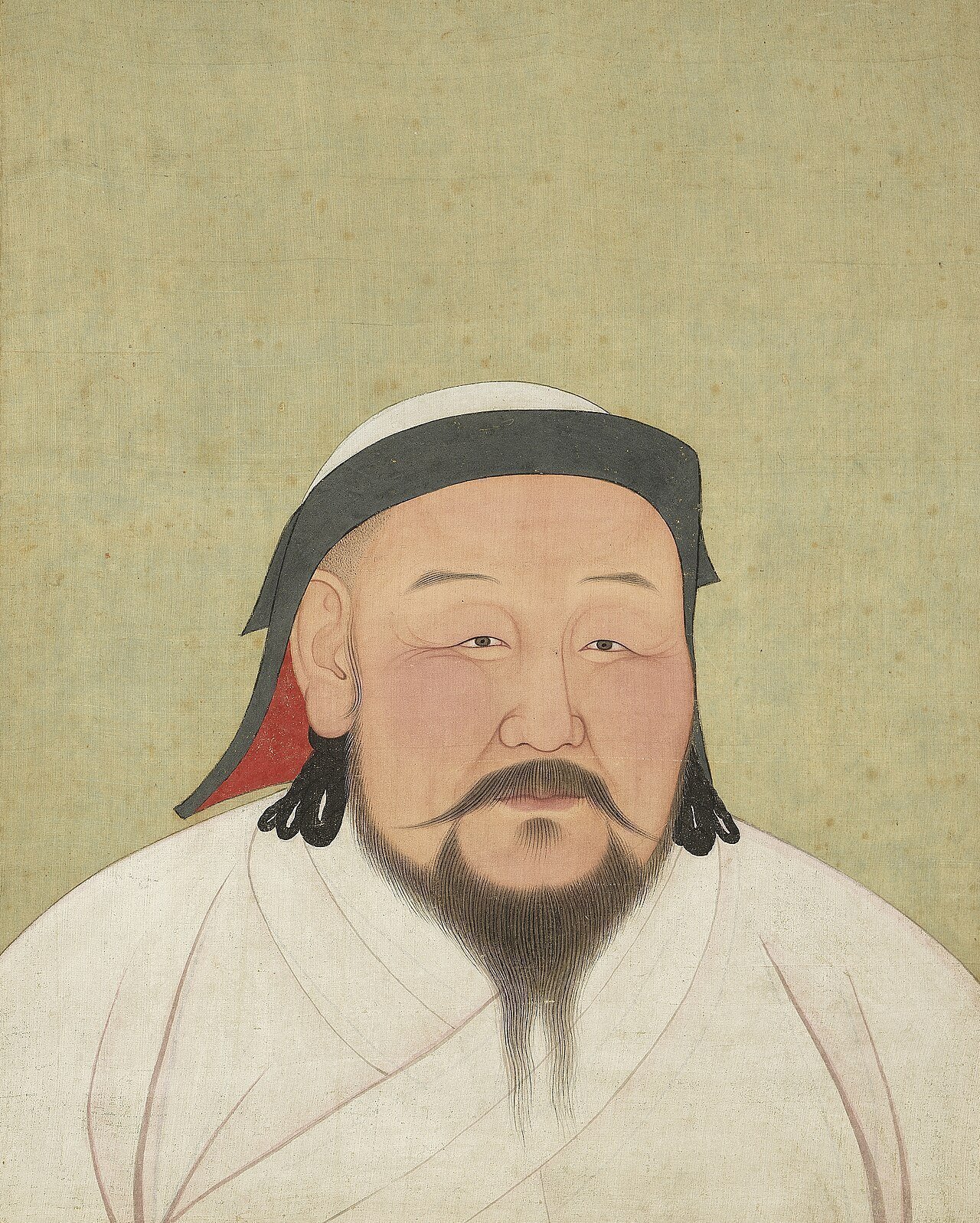
Portrait of Kublai Khan, Emperor Shizu of the Yuan, from the Yuan album of emperors and empresses, said to be in the manner of the Nepalese craftsman Anige. Source: Wikimedia Commons, National Palace Museum, Taipei, public domain

In 1260 he named the Sakya lama Phagspa "State Preceptor," later renamed "Imperial Preceptor," and put him in charge of Buddhist affairs across the empire. Phagspa was also ordered to create the "Phags-pa script," one of the official scripts of the Yuan.
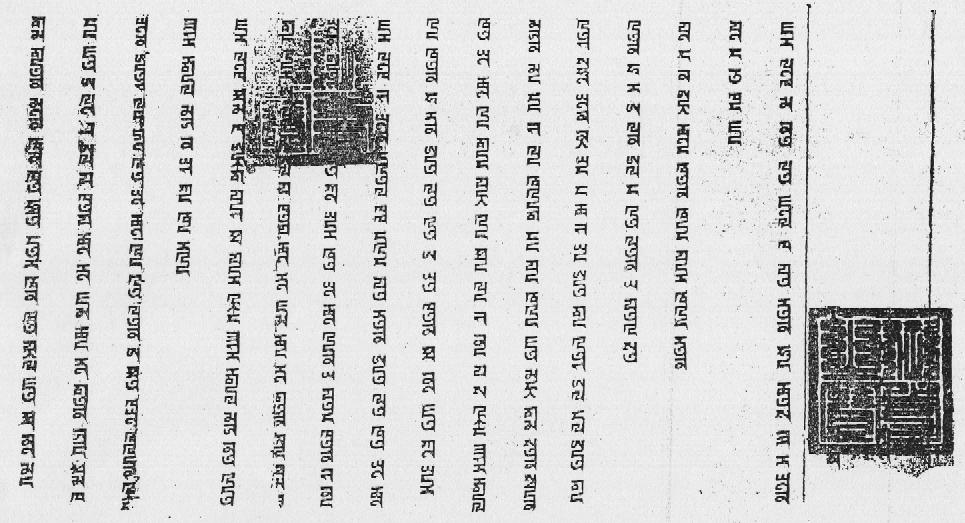
A copy of a Yuan imperial edict written in Phags-pa script. A Tibetan monk made these letters for a Mongol emperor, to spell Mongolian and also Chinese. Once the Yuan fell, hardly anyone used them. Source: Wikimedia Commons, public domain

The Yuan fell and the Mongols withdrew to the steppe; for a time Tibetan Buddhism's influence weakened. But the story was not over. In 1578 Altan Khan of the Tümed met Sonam Gyatso of the Gelug school and gave him the title "Dalai," Mongolian for "ocean." That is how the title "Dalai Lama" began. Step by step, Mongolia too became a land of Tibetan Buddhism.
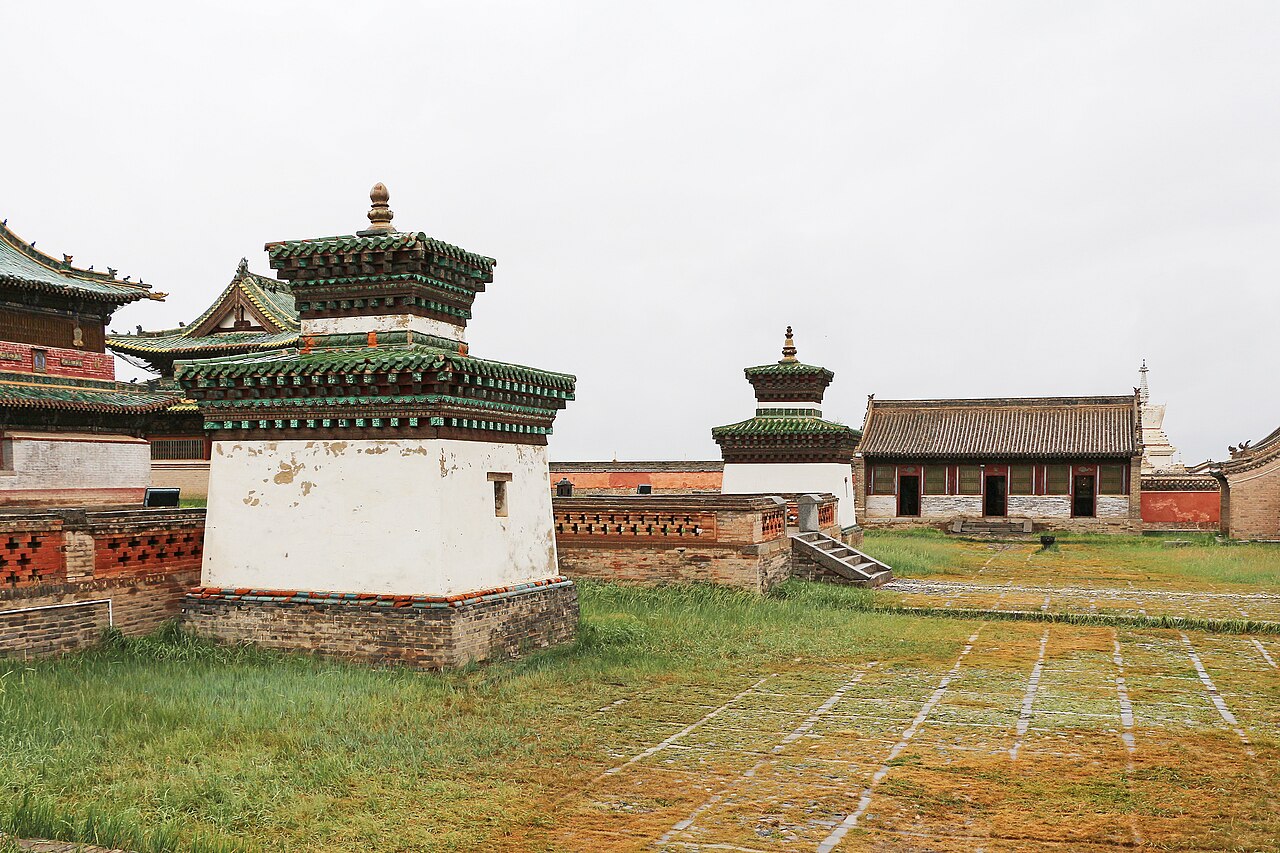
Erdene Zuu Monastery at Karakorum in Mongolia, built in 1585, one of the earliest great Tibetan Buddhist monasteries in Mongolia. It stands on the ruins of the Mongol Empire's old capital and was built with the old capital's stones. Source: Wikimedia Commons, photo by Bernard Gagnon, CC0

It was a two-way trade: Altan Khan got religious legitimacy, presenting himself as a reincarnation of Kublai; the Gelug school got a protector who could fight.
The central plains: not conversion but assimilation
The central plains were different again. The Mongol rulers of the Yuan did not convert to Confucianism; Confucianism was not a religion that called for "conversion" in the first place. But large numbers of Mongols and Semu people who stayed in the central plains slowly melted into the local population after the Ming.
Why this happened
The same conquerors ended up three different ways in three places. Why?
One explanation comes from the fourteenth-century North African scholar Ibn Khaldun. In the Muqaddimah he says that peoples who come out of harsh borderlands have great cohesion and can conquer rich settled civilisations; but once they move in, they are absorbed by the finer institutions, culture and religion of the settled civilisation, and within a few generations their cohesion dissolves.
Another explanation is more practical: rulers have to rule. In Persia the great majority of the ruled were Muslims; by converting to Islam the rulers obtained the legitimacy to rule and the cooperation of the people who ran things (religious scholars, officials). In Tibet and in Mongolia proper, Tibetan Buddhism offered a ready-made monastic community, a script and a way of legitimating rule.
Put plainly, a conqueror's conversion is not necessarily the result of being "persuaded" by a doctrine; it is often a political choice: using the religion of the ruled to rule the ruled.
Does this have anything to do with "monotheism being stronger"?
Someone may say: look, Islam conquered the Mongols of the west, so monotheism is stronger.
But in the same period the Mongols in the east took up Tibetan Buddhism, a religion that does not centre on a creator god. If "the stronger doctrine wins," it is hard to explain why one set of conquerors chose entirely different faiths in different places.
What makes more sense is this: what won was not any one doctrine, but whatever had already taken root in each place.
What became of the title "Dalai"
The title of 1578 later became tangled up with the question of "who has the say," and it has stayed tangled to this day.
In 1959 the 14th Dalai Lama fled to India and has never been back to Tibet. In 1995 he recognised a six-year-old boy as the 11th Panchen Lama; within days the child and his family disappeared from public view, and Beijing chose its own Panchen Lama by the "golden urn" lottery. Today the world has two 11th Panchen Lamas, and one of them has not been seen by anyone in thirty years.
In 2007 the State Administration for Religious Affairs issued the Measures on the Management of the Reincarnation of Living Buddhas in Tibetan Buddhism, requiring that a reincarnation be reported for government approval. A religion that passes on its leaders by "reincarnation," and the reincarnation itself must be approved by an atheist government.
Back then it was a Mongol khan who exchanged a title for religious legitimacy; today it is the government that wants to hold religious legitimacy in its own hands through the power of approval.
My view has not changed: a religion can accept registration by the state, but the state should not define it. Who is a living Buddha and who is a Panchen Lama should be recognised by the believers and their lineage, not approved by someone in an office.
Turning it around
"Conquerors are assimilated by the conquered" is not an iron law either. The Ottomans and the Arabs both carried their own religion into the lands they conquered and ended up with most of the people converted. Ibn Khaldun's "decline in three generations" has many exceptions.
So this is more a common tendency than a rule: when the conquerors are few and the religion and culture of the conquered land are mature enough, it is often the conquerors who are "conquered in reverse."
If the conquerors end up believing in the religion of the conquered, who has conquered whom?
References
- Ghazan's conversion to Islam in 1295 (Rashid al-Din, Jami' al-tawarikh)
- Ibn Khaldun, Muqaddimah, 1377
- Özbeg Khan's accession in 1313; Phagspa's investiture as State Preceptor in 1260; Altan Khan's gift of the title "Dalai" to Sonam Gyatso in 1578: standard history
- The Dalai Lama's flight in 1959, the Panchen Lama reincarnation dispute of 1995, the 2007 Measures on the Management of the Reincarnation of Living Buddhas in Tibetan Buddhism (Order No. 5 of the State Administration for Religious Affairs): standard history
- Image credits are in each caption