A set of numbers
In 2025 the Pew Research Center published a report counting how the world's religious populations changed from 2010 to 2020.
Most religions grew: Muslims by 347 million, Christians by 122 million, Hindus by 126 million, the unaffiliated by 270 million.
There was one exception: Buddhists fell from 343 million to 324 million, about 19 million fewer, and their share of world population dropped from 4.9% to 4.1%.
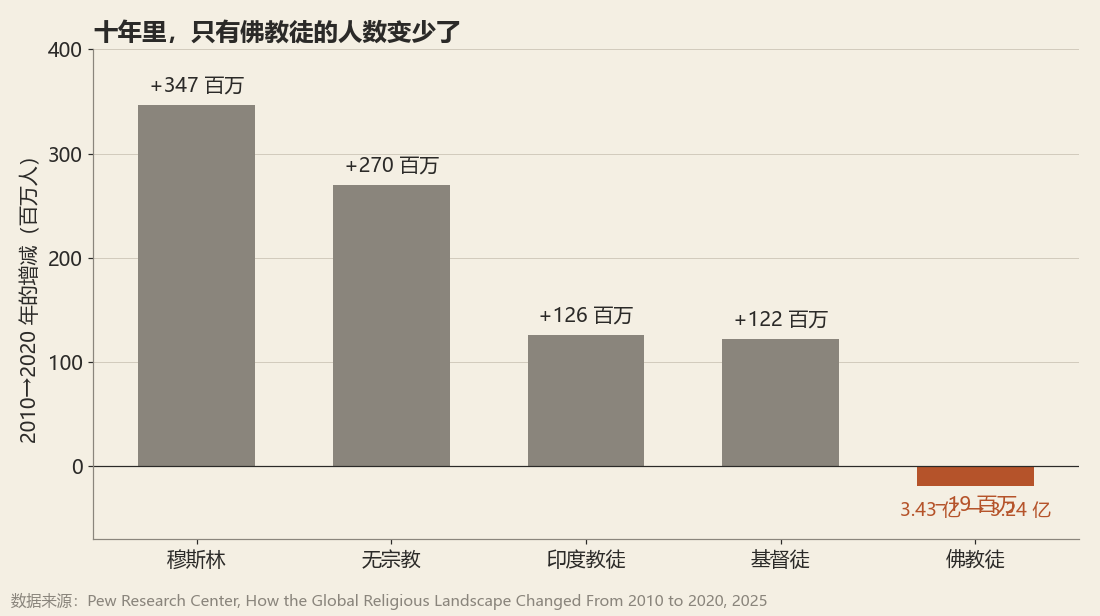
In ten years, only the number of Buddhists got smaller. Data: Pew Research Center, 2025
It was the only major religion whose absolute numbers fell over the decade.
Reason one: older, fewer births
Pew's analysis says Buddhists are the oldest and have the fewest children of any religious group in the world: in 2020 the median age of Buddhists was 40, nine years above the global median; from 2010 to 2015 the fertility rate of Buddhists averaged only about 1.6, the only religious group below replacement level.
This has to do with where Buddhists live: 98% of Buddhists live in the Asia-Pacific region, and many of the countries and territories there, China, Japan, Korea, Taiwan, Thailand, are exactly the places with the fewest births in the world.
Reason two: they left
But that is only half. The other half stings more: many people raised Buddhist leave when they grow up.
Pew's figures: of every 100 adults raised in Buddhist families, 22 are no longer Buddhist; at the same time only 12 people have become Buddhist from another religion or from no religion. One in, one out: a net loss of 10.
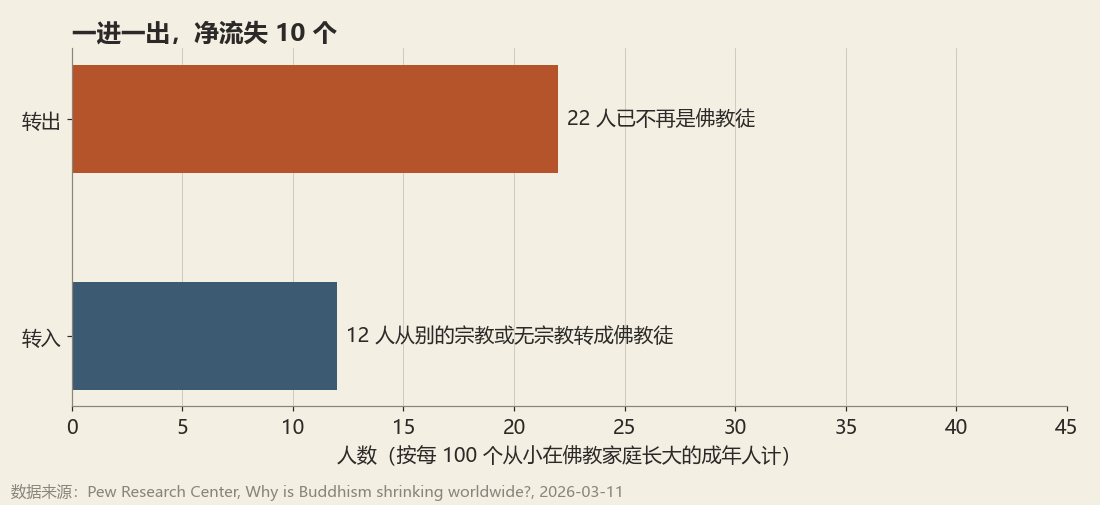
Of every 100 adults raised in Buddhist families, 22 left and 12 came in. Data: Pew Research Center, 2026
In East Asia the loss is especially serious. In Japan about half of those raised Buddhist have left, in Korea about six in ten. Most did not take up another religion; they became "unaffiliated."
From 2010 to 2020, the Buddhists of mainland China, Japan, Korea, Taiwan and Hong Kong together fell by about 32 million, down about 22%.
Why it cannot hold people
Numbers can only say "what"; "why" takes interpretation. Among things I had saved I once came across a rather interesting view that can serve as one explanation.
This netizen said Buddhism in East Asia is like a "wishing pool": when something is wrong you go, light a stick of incense, draw a fortune slip, and when nothing is wrong you do not think of it. You do not know the person burning incense next to you, you do not know the monk in the temple, and you do not know when you will come back.
The Christian church and the Islamic mosque occupy the position of "community": weekly gatherings, believers who know one another and help one another, and someone to organise weddings and funerals. Even a person who is not very devout stays because of these ties.
He had a sharper point too: the most attractive "products" of Buddhism, meditation, vegetarianism, a simple life, have been taken over by secular society. Meditation became mindfulness apps and mental-health classes, vegetarianism became a health and environmental choice, and wanting little and being content became minimalist design. People can enjoy all this without ever becoming Buddhists.
This is one netizen's explanation, not a research conclusion, but it matches some discussions in sociology: whether a religion can hold people depends largely on whether it is embedded in the web in which people live their lives.
Turning it around
The conclusion that "Buddhism is declining" also needs some hedging.
First, how it is counted. In East Asia many people will not say on a questionnaire that they "are Buddhists," yet they go to temples, keep a Buddha at home, and invite monks to perform rites for the dead. The sociologist C. K. Yang called this "diffused religion": it is not in an independent organisation but scattered through family and festivals. Some of the "leaving" a questionnaire measures may be only people no longer using the label "Buddhist."
Second, regions differ greatly. In Thailand almost everyone raised Buddhist still identifies as Buddhist. Buddhism's shrinking in East Asia does not mean it is shrinking in Southeast Asia too.
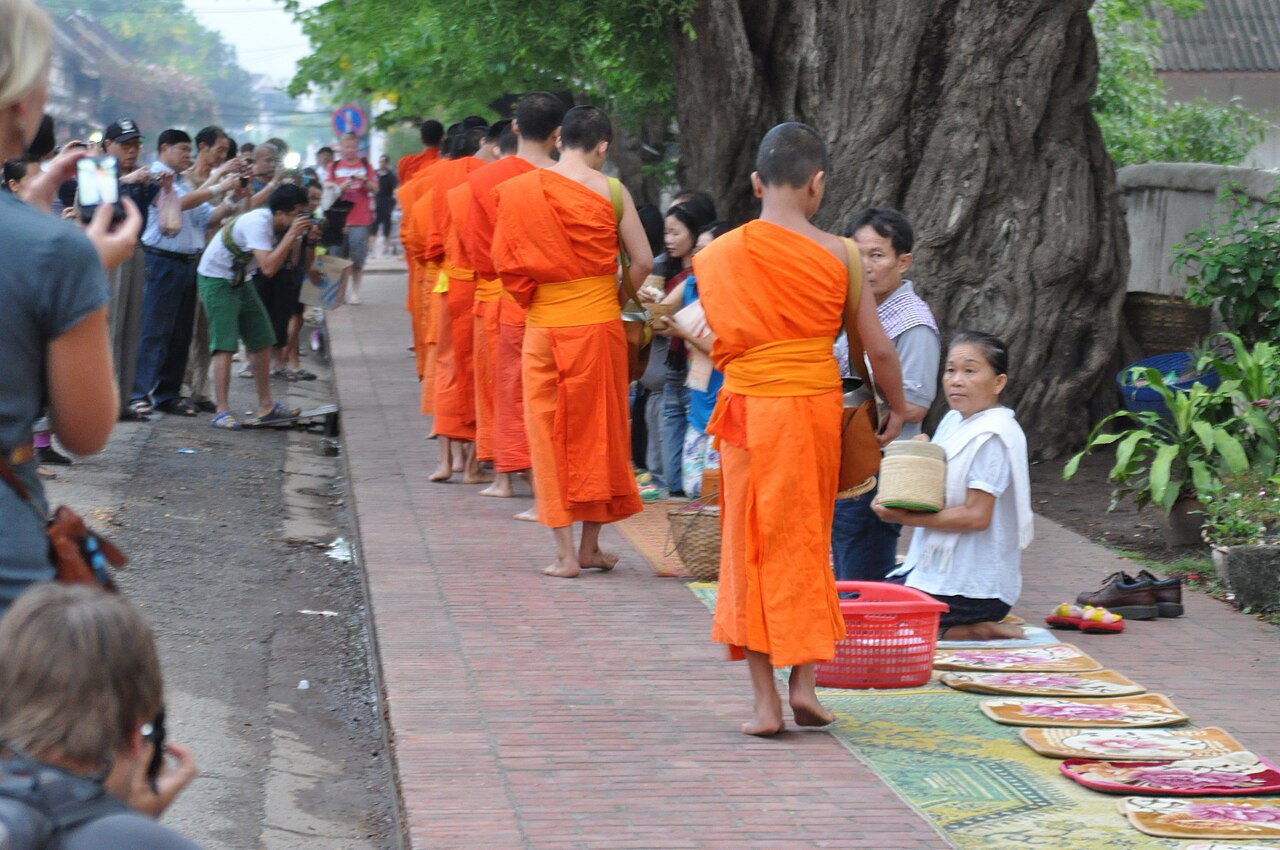
Early morning in Luang Prabang, Laos: a woman gives sticky rice to a young novice. In Theravada countries Buddhism is still part of the daily breakfast. Source: Wikimedia Commons, photo by shankar s., CC BY 2.0

Third, influence and numbers are not the same thing. Buddhist ideas and practices are growing more influential among Western intellectuals and the middle class. As a mass religion its people are fewer; as a source of ideas it may be spreading.
A warning for ourselves
When I read the data in this piece, what I am thinking of is not Buddhism but Confucianism.
Buddhism in East Asia looks like a "wishing pool": you come when you want something, you leave when you have asked, and there is no web between the temple and the people. Confucianism today is in a worse state, not even a wishing pool: the ancestral halls are torn down, the genealogies broken, and what remains is the one day of Qingming when everyone goes back to their home village to burn a bundle of paper.
So I have always felt that for Confucianism to live it cannot rely on "culture" alone. It needs a place where people can gather every week or every month, where people know you and someone will organise things when you need it. Churches and mosques have done this, and the native-place halls and clan associations of Southeast Asia once did too. Buddhism has taken this lesson first on our behalf.
If the most valuable parts of a religion can exist apart from it, does it still need to exist as a religion?
References
- Pew Research Center, "How the Global Religious Landscape Changed From 2010 to 2020," 2025
- Pew Research Center, "Why is Buddhism shrinking worldwide?", 2026-03-11
- C. K. Yang, Religion in Chinese Society, 1961
- A netizen's answer (2026-02), cited as a netizen's view, not a research conclusion
- Image credits are in each caption