
A shape that looks familiar
Look at a few stories first:
- Humans originally lived in the Garden of Eden, fell through original sin, and in future will enter heaven through redemption.
- Israel once had a glorious kingdom, was exiled for faithlessness, and in future the Messiah will come and rebuild the kingdom.
- Humans originally lived in a classless primitive society, later fell into class oppression and alienation, and in future will enter communism.
Utterly different in content, identical in shape: perfect past → suffering present → bright future.
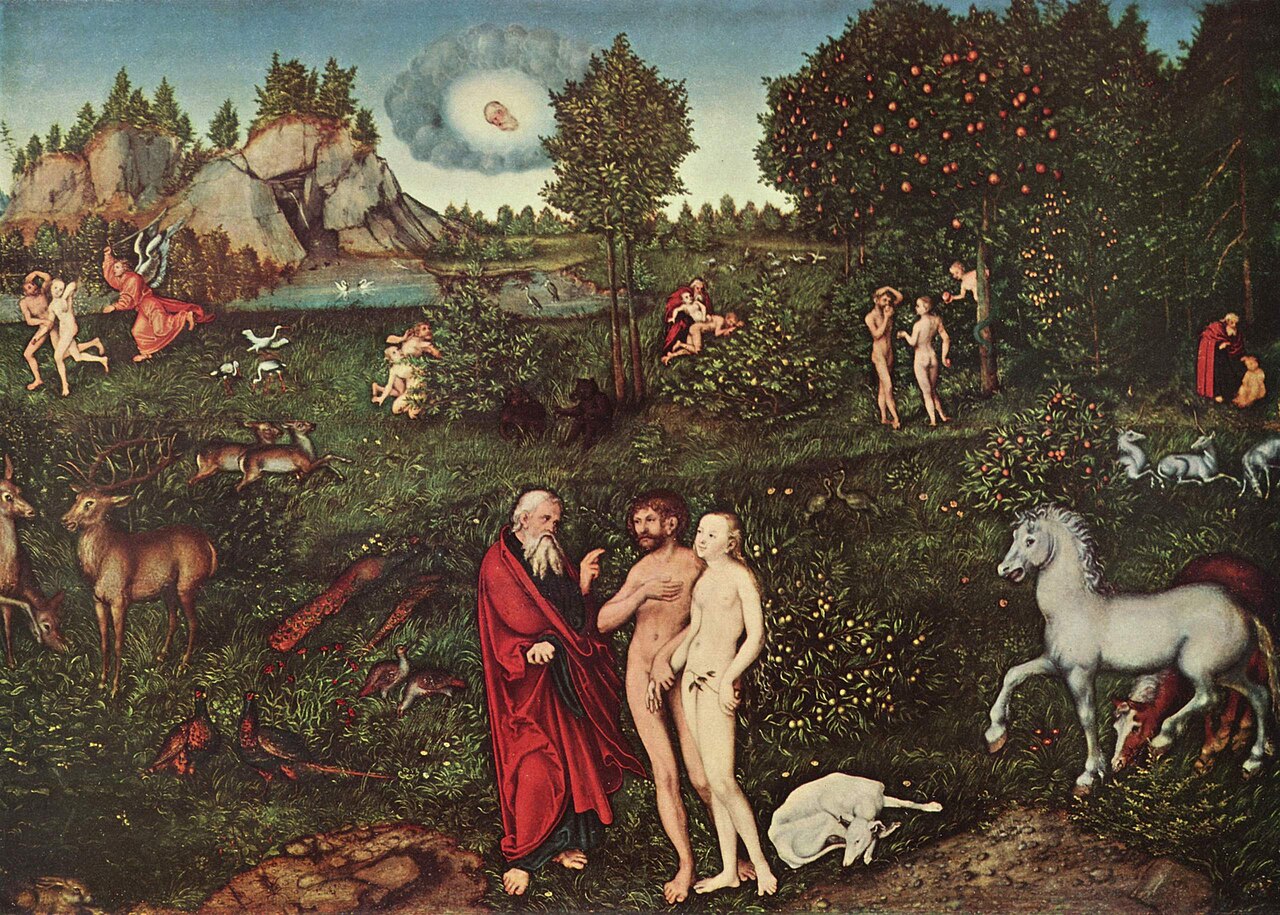
Lucas Cranach the Elder, The Garden of Eden, 1530. In one picture, from the making of man and the stealing of the fruit to the expulsion, all at once. Everything begins in a perfect garden. Source: Wikimedia Commons, Kunsthistorisches Museum, Vienna, public domain

Among the things I had saved I came across an answer that called this structure the "three-act narrative" and held that nearly all the most widely spread religions and ideologies in history used this shape. Its force lies in four places: contrasting past and present stirs emotion at once; it makes people willing to bear present suffering; it lets them risk everything for the future; and "there once was a perfect past" proves a perfect future is possible.
Linear time
This observation fits the work of historians of religion.
In The Myth of the Eternal Return (1949) the Romanian-born historian of religion Mircea Eliade distinguished two views of time:
- Cyclical time: the world repeats itself, and every year and every age re-enacts the first sacred event. The festivals and myths of many ancient civilisations are built on this view of time.
- Historical time: time is a line with a beginning and an end, and history moves toward a final goal. Eliade held that this view of time stands out especially in the Hebrew tradition and, through Christianity, later shaped the whole West.
The "three-act narrative" is the most typical story shape of linear time: history has direction, suffering has meaning, the end is worth hoping for.
When Buddhism told a three-act story
So can a religion with cyclical time as its base not mobilise the masses?
Chinese history gives a very interesting example. The core of Buddhism is rebirth: beings turn through birth and death in the six realms, and liberation must be won by one's own practice, by leaping out of the cycle. This story shape is by nature not well suited to mass mobilisation.
But in China another teaching slowly grew within Buddhism: the descent of Maitreya. We are now in the age of the decay of the Dharma, the world is bad; in future the Buddha Maitreya will descend to the human world and open a clear and peaceful realm. This is the standard three-act narrative.
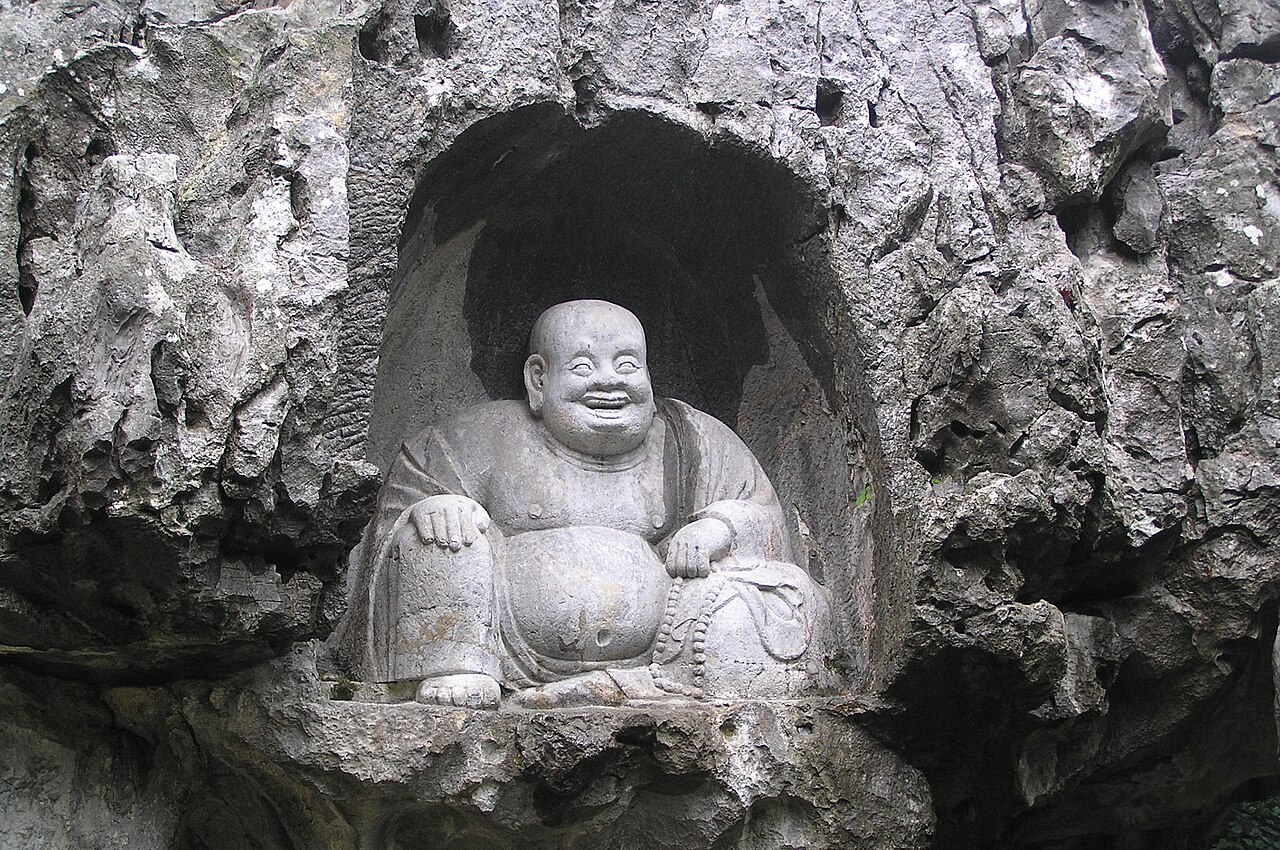
The Maitreya carving at Feilai Peak in Hangzhou, Song dynasty. The laughing fat monk we know today was, to those who rose in revolt in every age, the promise of a "new heaven and earth." Source: Wikimedia Commons, photo by Mr. Tickle, CC BY-SA 3.0

From the Sui and Tang to the Ming and Qing, "the descent of Maitreya" was again and again the banner of popular uprisings. The Red Turbans of the late Yuan rose with the slogans "Maitreya is born" and "the Bright King appears." Folk sects such as the White Lotus also kneaded this end-time salvation teaching together with folk organisation.
Europe was the same. In The Pursuit of the Millennium (1957) the historian Norman Cohn traced one millenarian movement after another in medieval Europe: prophets said the end was at hand and called on "the elect" to rise, clear out evil and build the kingdom on earth.
The Taiping
The greatest three-act narrative in modern China was the Taiping.
Hong Xiuquan said that the ancient Chinese originally worshipped "Huang Shangdi" (the August Lord on High), and were later led astray by the "demons" since the First Emperor of Qin; now God had sent him down to slay the demons and build a "little heaven" on earth, where everyone would have fields to till together and food to eat together.
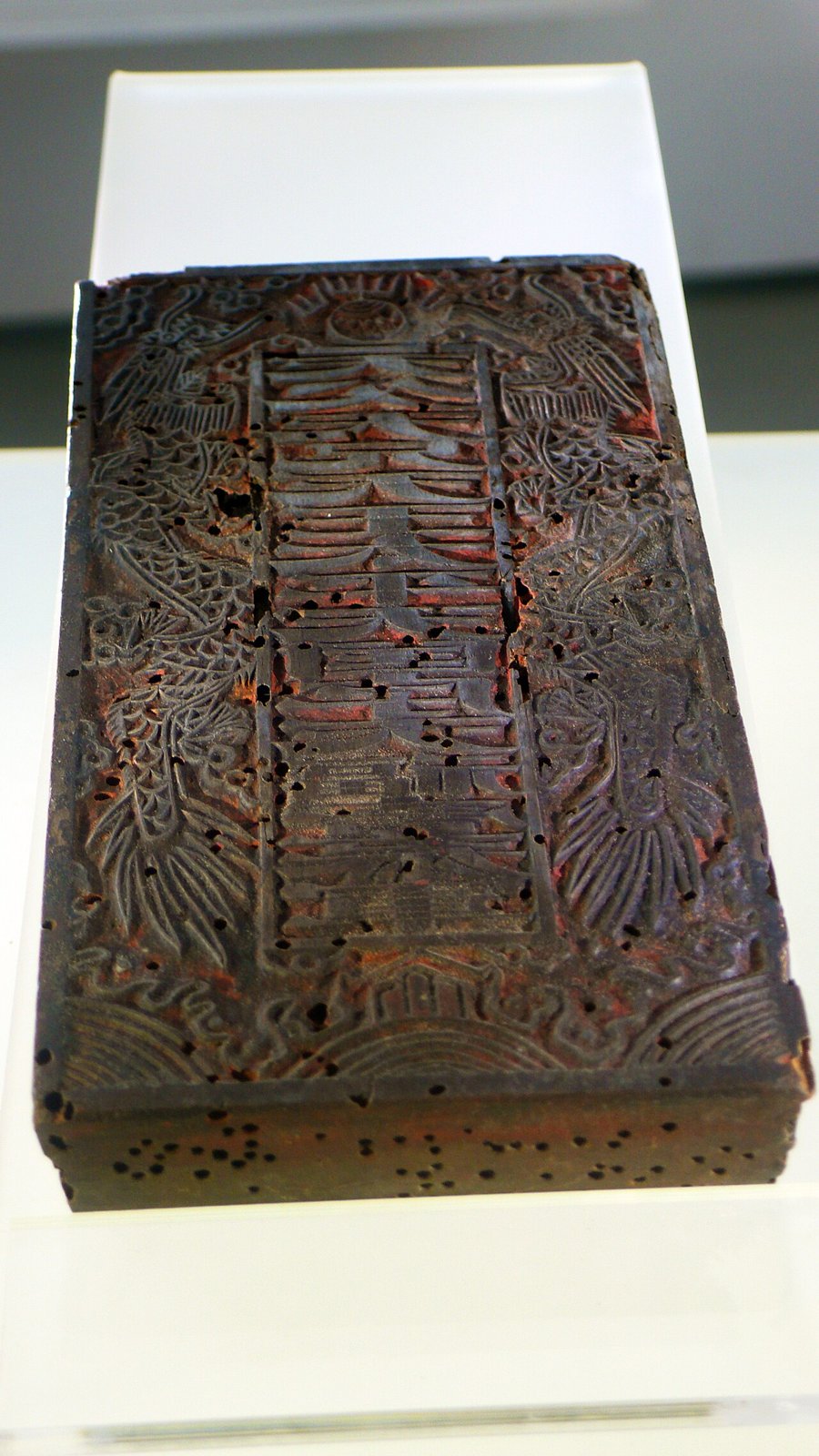
A wooden seal of a Taiping officer. A regime that promised heaven on earth left behind mostly things like this, seals, flags, coins, and a dozen years of war. Source: Wikimedia Commons, photo by Sanlie, CC BY-SA 4.0

A perfect past (worshipping God in antiquity), a suffering present (the Manchu "demons"), a bright future (the little heaven). All three acts present. Those it mobilised went from a few thousand God Worshippers in the mountains of Guangxi to holding half of China. The commonly given estimate of those who died in the war is twenty to thirty million.
The other side of the three-act narrative
The three-act narrative mobilises strongly, and it has its dangers.
Once a group believes "the future is perfect and we are the ones who will bring it about," every present cost can be called worth paying. For the sake of the "bright future," people before one's eyes can be sacrificed; the "suffering present" needs someone to blame, so an enemy must be found.
Russell, in A History of Western Philosophy, used this very structure to analyse Marxism: the elect (the proletariat), the day of judgment (the revolution), the millennium (communist society). He held that it is this emotional structure from Judaism and Christianity that makes the theory seem credible.
Today's three-act narrative
This shape is still in use today.
You may know the set well: the Chinese nation has five thousand years of splendid civilisation (a perfect past); after the Opium War it went through more than a hundred years of humiliation (a suffering present); now the great rejuvenation of the Chinese nation is to be realised (a bright future). After 2012, "rejuvenation" became one of the most often heard official phrases.
The same shape, the same force: it makes people willing to endure and willing to give, and it also needs someone "who made us suffer humiliation." Where it differs from the descent of Maitreya and the Taiping is that the storyteller has the state in hand.
I am not saying the wish for "rejuvenation" is wrong. To want one's own civilisation to be respected again is a very natural thought, and I have it myself. I only want to add a reminder: when you hear this shape, ask once more who is telling it and why, and when the future arrives, on whose head the bill falls.
Turning it around
The claim that "the three-act narrative explains everything" must itself be treated with care.
First, it fits almost any story. A frame that can explain everything often cannot explain anything specific.
Second, religions with a cyclical view of time have spread far all the same. Hinduism and Buddhism, with rebirth as their base, spread across South, Southeast and East Asia. The mass spread of Buddhism did not depend chiefly on end-time teachings such as the descent of Maitreya.
Third, the Chinese traditional notion of "fortune of the age" (qishu) is another powerful teaching. The cycle of order and disorder and the transfer of the Mandate can also mobilise people ("he can be taken and replaced"), only what it promises is not "the end of history" but "the next round."
So the safer statement is: the three-act narrative is a story shape that is especially good at mobilising people, but not the only one.
When were you last moved by a story like this?
References
- Mircea Eliade, Le Mythe de l'éternel retour, 1949
- Norman Cohn, The Pursuit of the Millennium, 1957
- Bertrand Russell, A History of Western Philosophy, 1945
- The "Maitreya is born" slogan of the late-Yuan Red Turbans, the Taiping "little heaven" and estimates of war deaths, the official formulation of "the great rejuvenation of the Chinese nation": standard history
- A netizen's answer (2026-05), cited as a netizen's view
- Image credits are in each caption