
A popular intuition
In discussions of East Asia's low fertility I often see a claim, one I once largely accepted myself: a secular society is doomed not to have children, only religion-driven populations can sustain high fertility, so East Asia must either find a religion or head for exhaustion.
The example behind this claim is usually Israel: a developed country with a total fertility rate close to 3, and still higher among the ultra-Orthodox.
The intuition is partly right: in surveys in many countries, the more devout the group, the more children they have on average.
But if "religion determines fertility" is a law, Iran is hard to explain.
Iran's numbers
After the Islamic Revolution of 1979, Iran became an Islamic republic led by religious scholars. In the early revolution, the government encouraged childbearing, and the family planning programme of the Pahlavi era was shelved.
In the early 1980s Iran's total fertility rate was close to 7 children per woman.
Then the number began to fall. By 1988 it was about 5.5; by 1996 it was below 2.8, halved in eight years; around 2000 it fell to replacement level, about 2.1. After that it went on falling, below replacement.
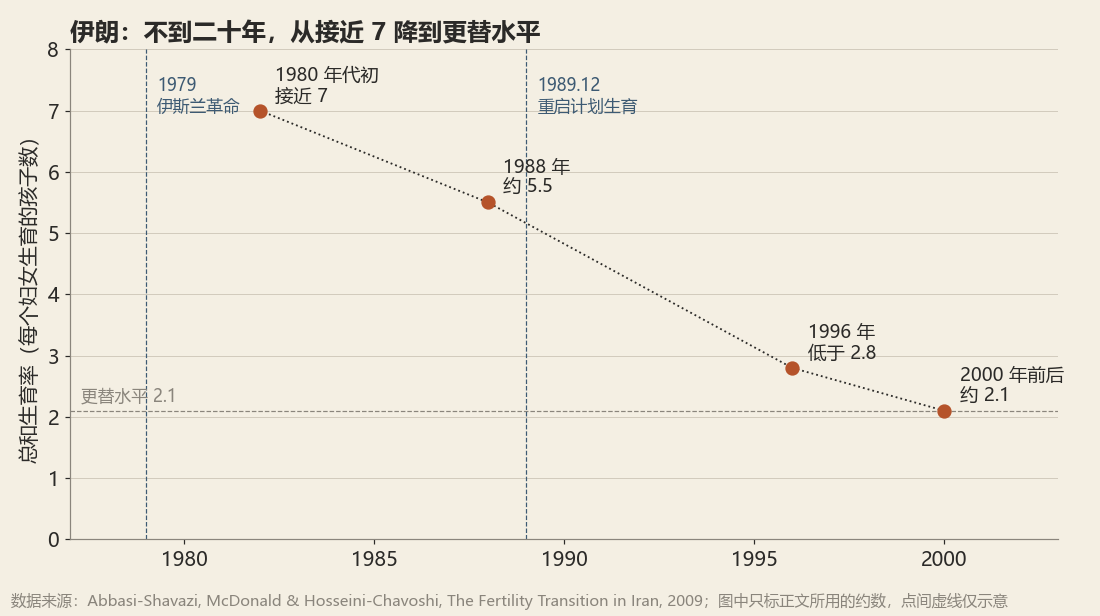
Iran's total fertility rate, marking only the four approximate figures used in the text; the dashed lines between points are only illustrative. Data: Abbasi-Shavazi et al., 2009
In their monograph on Iran's fertility transition, the demographers Abbasi-Shavazi and colleagues say it was one of the largest and fastest recorded declines in fertility.
A theocracy covered, in under twenty years, a road that many countries took decades or even a hundred years to cover.
Which side the religious leaders stood on
More surprising still, this decline did not happen against religion.
In the late 1980s, just after the Iran–Iraq War, the population was growing too fast, and the economy, employment and education could not bear it. In December 1989 the government relaunched national family planning: it encouraged women to space births three or four years apart, discouraged pregnancy under 18 and over 35, and advocated at most three children per family.
The key step was to win religious legitimacy. In their weekly sermons religious leaders presented the small family as a social responsibility; they also issued rulings confirming that contraception and birth control are permitted under Islamic law.
At the same time Iranian women's education rose sharply, the medical network in town and country reached remote places, and contraceptives were given free.

An old street in Tehran in 2017. Among university students in Iran today, women are often more numerous than men. Source: Wikimedia Commons, photo by somiz, CC BY-SA 2.0

Then the direction reversed
The story is not over.
From the 2000s, Iran's fertility rate stayed below replacement level. In 2012 Supreme Leader Khamenei said publicly that the population-control policy should have been stopped as early as the mid-1990s; in 2014 he formally put forward a set of "general population policies" encouraging births. After that Iran turned to encouraging more births, and contraceptive services were tightened step by step.
But fertility did not rise much.
On the Chinese side
This script is not unfamiliar to East Asians.
China began the one-child policy in 1980 and carried it out for over thirty years, in many places by fines, IUDs, sterilisation and forced abortion. In 2016 a second child was allowed, in 2021 a third, and later localities began to give childcare subsidies to encourage births.
The direction turned through a hundred and eighty degrees, yet the fertility rate did not follow it back. To push it down, a whole administrative machine was used; when they wanted to pull it back, they found the machine knew only how to push, not how to pull. How the families felt who were fined, had their houses demolished and were forced to hospitals in those years, and were later urged to have more, nobody has asked them.
I will write on fertility separately later, in the series Current Affairs. Here only one sentence: in Iran it is religious authority turning around, in China administrative authority turning around, and the results of both turnarounds are much the same.
What this shows
The Iranian case shows at least three things:
First, religious authority can support birth control, and it can support births. The same religious system gave opposite instructions at different times. Religion is not a machine that "only raises fertility"; the interpretation of doctrine adjusts to reality.
Second, education, urbanisation, medicine and economic pressure are enormously powerful. When women read more and children cost more, even in a theocracy the fertility rate falls fast.
Third, once the fertility rate has fallen, it is hard to pull back by exhortation. The countries of East Asia are going through this now.
Turning it around
This is not to say religion has no effect on fertility. Within one country, the more devout groups often really do have more children; Israel's ultra-Orthodox are an example. The British scholar Eric Kaufmann argued the demographic advantage of religiously conservative groups at length in Shall the Religious Inherit the Earth? (2010).
But "a correlation inside groups" and "the way out for a country as a whole" are two different things. To treat religion as the key to raising fertility may overrate religion and underrate modern life.
What do you think matters most in deciding whether a person has children?
References
- Mohammad Jalal Abbasi-Shavazi, Peter McDonald, Meimanat Hosseini-Chavoshi, The Fertility Transition in Iran, Springer, 2009
- Eric Kaufmann, Shall the Religious Inherit the Earth?, 2010
- Iran's relaunch of family planning in 1989, religious rulings supporting contraception, the policy turn in 2012, the "general population policies" of 2014: standard history and research surveys
- China's one-child policy (1980), second child (2016), third child (2021): standard history
- Image credits are in each caption