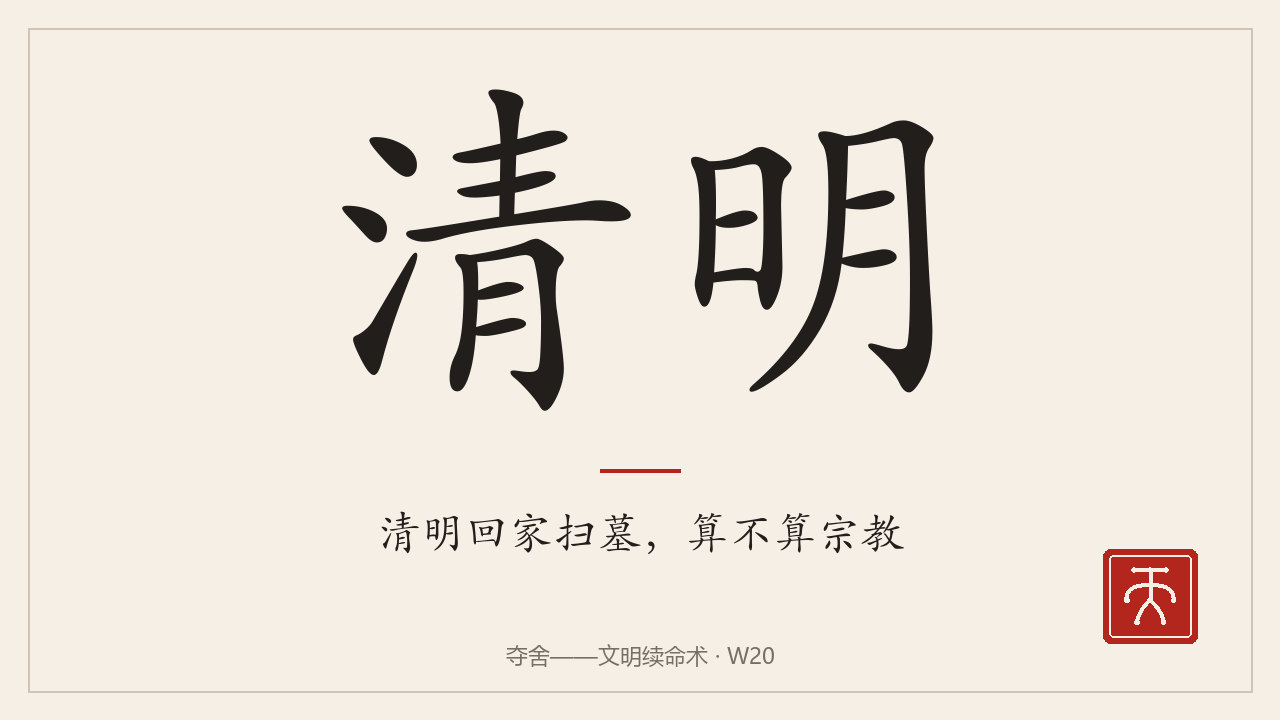
An argument in a comment section
Every year around Qingming a question surfaces online: is ancestor worship at Qingming a religion?
I once saved an argument from a comment section, and its positions are quite representative:
- One person said: "Remembering the dead has nothing to do with religion. Missing your family is a perfectly normal feeling."
- Another replied: "Then why burn paper, set out offerings, kowtow? By Occam's razor, missing your family does not need any of these rituals. Yet for thousands of years the Chinese have kept making them."
- Someone brought out the textbook definition: "A religion has four elements: an object of belief, doctrine, ritual, a centralised organisation. Ancestor worship has no doctrine and its organisation is scattered, so it does not count."
- Someone else said: "It has all four: ancestors, family instructions, sacrifice, ancestral hall. It is only that people are atomised now and the halls are gone."
The argument is interesting because it touches a real problem: where did the ruler we use to define "religion" come from?
A Western ruler
The Chinese word for "religion" today (zongjiao) was carried over in the late nineteenth century from Japanese, to match the English "religion." And the concept of religion grew up with Christianity as its model: a clear object of belief (God), a written doctrine, an independent organisation (the church), and clear membership (baptism).
Measured with this ruler, Buddhism and Daoism can just about be fitted in; ancestor worship, worship of the Earth God, geomancy, burning incense at New Year are hard to measure. They have no church, no initiation, and no identity of "I am an adherent of such-and-such."
So an odd thing happens: in international surveys East Asia is often listed among the places with the highest share of the "unaffiliated." In South Korea's 2015 census, more than half said they had no religion; in China and Japan the share of "no religion" is higher still.
Asking differently
But ask differently, not "what religion do you follow" but "do you do these things," and the answers change a great deal:
- At New Year and festivals, do you offer incense to your ancestors?
- At Qingming, do you sweep the grave?
- Have you been to a temple to burn incense and draw a fortune slip?
- For a wedding or a move, do you check the date?
In East Asia, those who answer "yes" to such questions are often far more numerous than those who tick "has a religion" on a questionnaire.
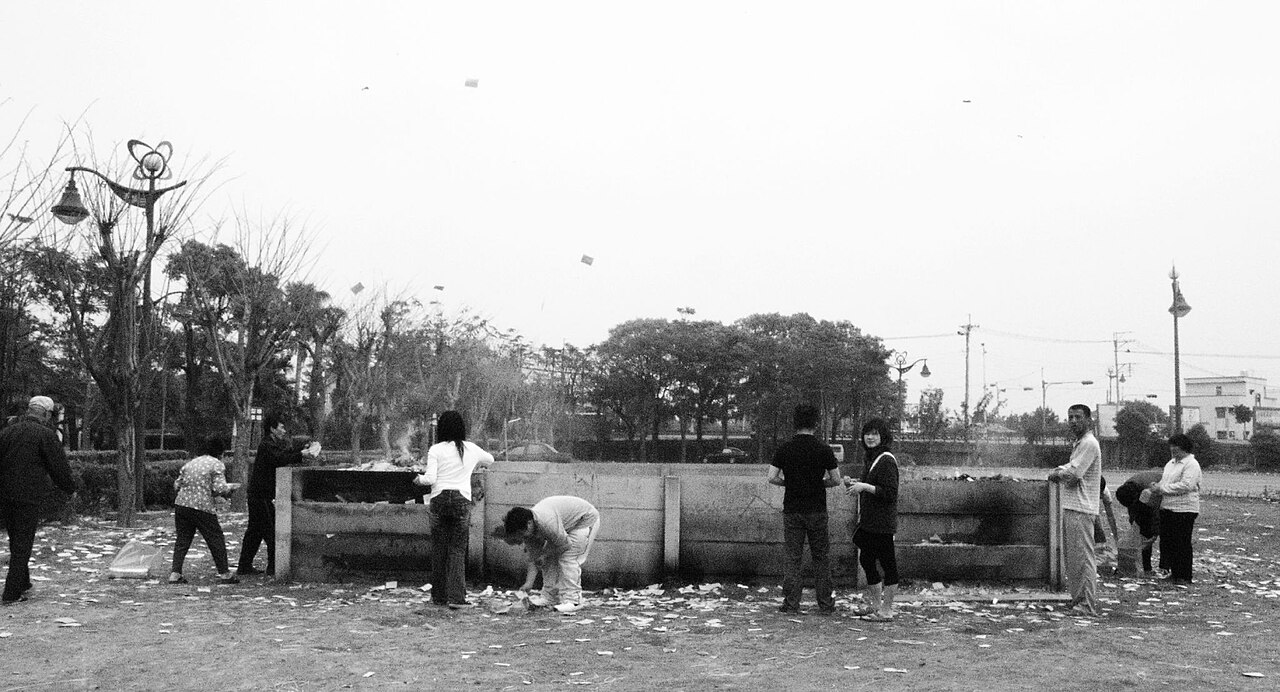
Tomb-sweeping day: paper money flying over the graveyard hill. Source: Wikimedia Commons, photo by chia ying Yang, CC BY 2.0

Since 2008 Qingming has been a statutory public holiday in China. Every Qingming, hundreds of millions of people hurry along the roads just to stand before an ancestor's grave for a while. It is hard to say this has nothing to do with "belief."
Diffused religion
In Religion in Chinese Society (1961), the sociologist C. K. Yang offered an explanation that is still influential today.
He distinguished two forms of religion:
- Institutional religion: with independent theology, organisation and clergy, such as Buddhism and Daoism.
- Diffused religion: no independent organisation, belief and ritual scattered through the life of family, lineage, community and state. Ancestor worship is led by the head of the family, the village earth god is maintained by the village, and Heaven is sacrificed to by the emperor.
Yang held that Chinese religious life exists mainly in a diffused way. There is no church, yet it is everywhere.
By this frame, sweeping the graves at Qingming is of course religious behaviour; only its "church" is the lineage, its "clergy" the elders of the family, and its "scripture" the rules handed down generation after generation.
Qingming has been managed too
This diffused religion was also battered in the twentieth century.
From the 1950s the government pushed funeral reform: cremation first in the cities, later extended to the countryside, with burial squeezed bit by bit. In the "Smash the Four Olds" years of the 1960s and 70s, ancestor worship and burning paper were treated as "feudal superstition"; ancestral halls were torn down, tablets smashed, genealogies burned, and in many places even the graves were levelled.
In 2012, for "funeral reform," Zhou kou in Henan levelled over two million graves in less than a year (the official figure is 2.46 million). Some families had barely levelled an ancestral grave when, the following spring, they quietly piled the earth back up.
A religion without a church has no one to speak for it and nowhere to hide. That it has lasted to today is entirely because each household has carried it, year after year.
Qingming in the South Seas
Interestingly, overseas this body of practice is sometimes kept more completely.
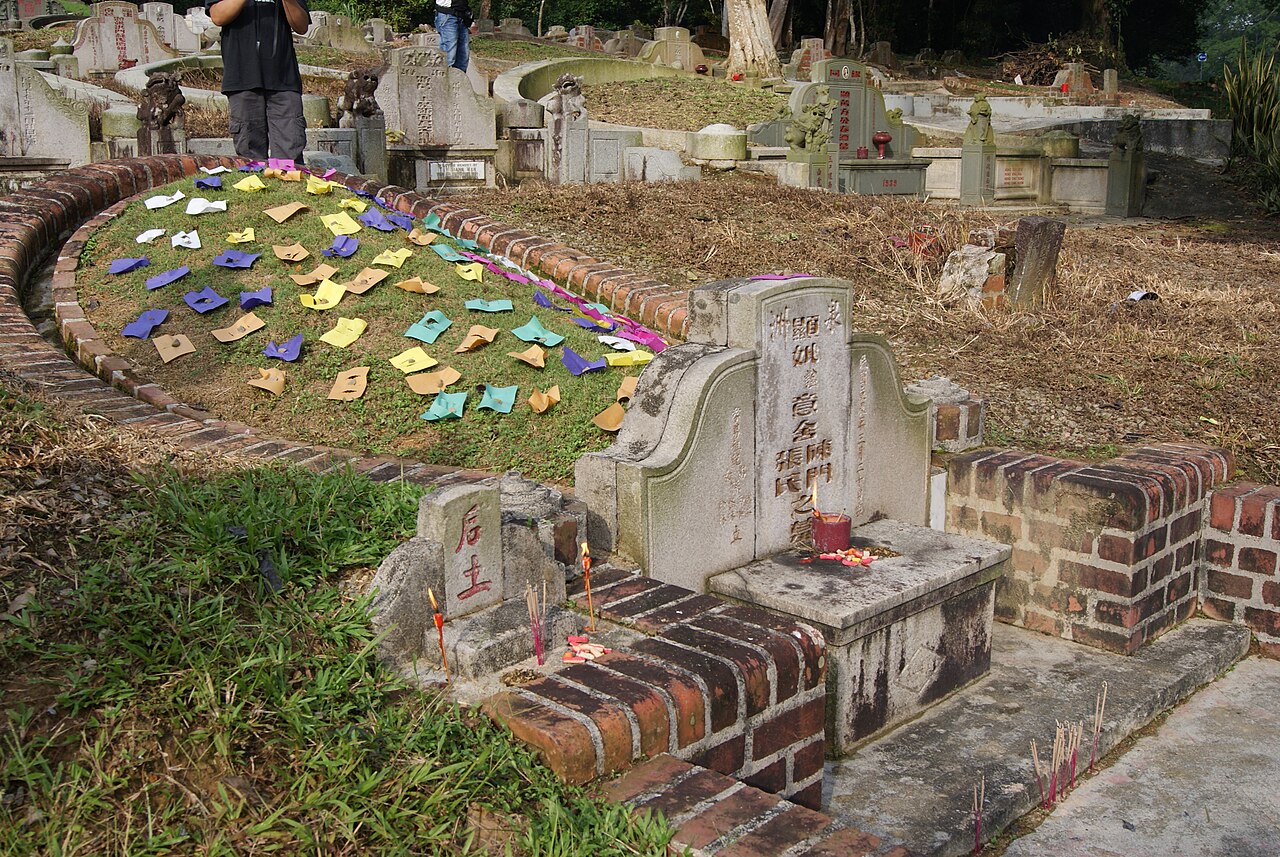
Bukit Brown Cemetery, Singapore: five-coloured paper weighted down on a grave mound at Qingming. This Chinese cemetery holds over a hundred thousand burials, and the earliest tombstones go back to the Qing. Source: Wikimedia Commons, photo by Jacklee, CC BY-SA 3.0

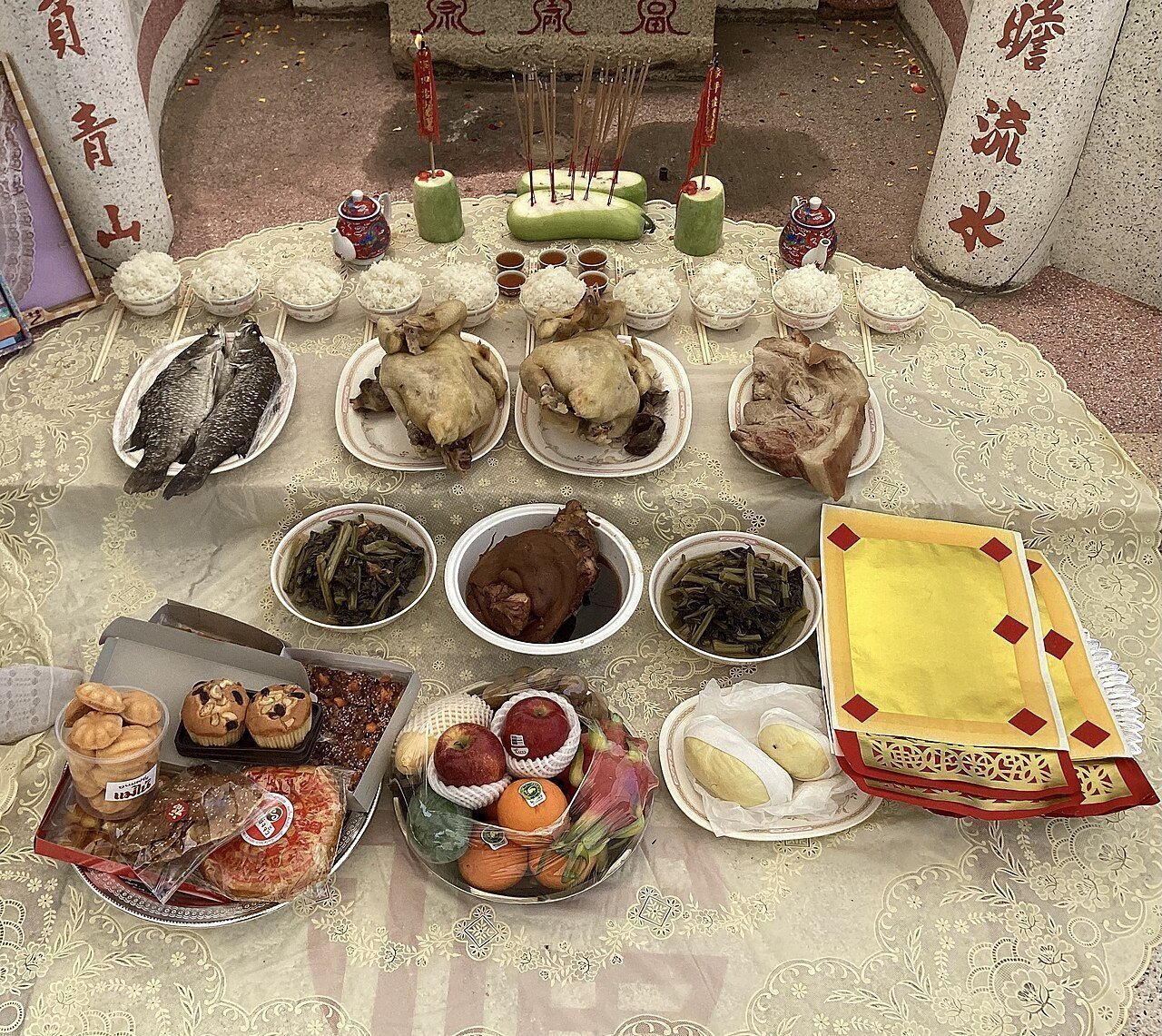
Offerings set out for the ancestors at Qingming by a Thai Chinese family: a whole chicken, pork, fruit, cakes. Several generations no longer speak Chinese, but they remember how to lay out the offerings. Source: Wikimedia Commons, photo by Ubs6u!d-pongsakorn, CC BY-SA 4.0

In Thailand, Malaysia and Singapore, many Chinese have not spoken Chinese for generations, yet at Qingming the whole family still goes up the hill, and the offerings are laid out as they always were. Their passports are not Chinese, and on a questionnaire they may not tick "has a religion," but this is something they have kept doing.
East Asia's religiousness is in the "doing"
So is East Asia really the place that is "least religious"?
A perhaps more accurate way to put it: East Asia's religiousness is not in "belonging" but in "doing." People do not say much "I am an adherent of such-and-such," yet they do many things with a religious flavour.
This also explains why the claim "East Asians have no faith, so they need a religion" so often feels awkward: it takes a ruler built on Christianity, measures out a "blank," and then hurries to find an institutional religion to fill it.
Turning it around
But "diffused religion" is also changing.
Urbanisation has scattered the lineages and the halls are gone; many young people go home only once a year, at Qingming. Ancestor worship looks more and more like a "cultural custom" and less and less like a rite with content of belief. If a person sweeping a grave does not believe the ancestors are watching from another world, is that still religion?
On the other hand, some argue that precisely because diffused religion has no organisation, it is especially fragile in modern society: with no church to gather people, no weekly meeting, once the family scatters, the belief scatters with it. This may be one reason some institutional religions have grown in East Asian cities.
Why I keep staring at Qingming
When I say I want to turn Confucianism into a religion, many people think I want to build a new church. I do not. What I want has been there all along: ancestor worship, Qingming, New Year, Chinese characters you can read. These are East Asians' common faith, only nobody has ever looked at it as a religion, and so nobody has ever kept watch over it.
Christianity has the church, Islam has the mosque, and wherever they scatter they can gather again. Our body of practice relied on the ancestral hall and the lineage; when the city came and the hall was torn down, it was left with that single day of Qingming. What I want to do is give it a form that can gather people without the lineage, so that a child who grew up in Singapore, a child who grew up in Seoul and a child who grew up in Guangzhou know, on that day, that what they are doing is the same thing.
When you sweep a grave, what is on your mind?
References
- C. K. Yang, Religion in Chinese Society, UC Press, 1961
- Statistics Korea, religion item of the 2015 census
- The Zhoukou grave levelling: People's Daily, 4 Dec 2012, "by the end of November, funeral reform in Zhoukou, Henan, had been under way for 10 months … 2.46 million graves levelled or moved" (reposted by National Business Daily) 🟢; on New Year's Eve 2013, one village in Taikang County piled up more than 160 graves in two hours: Huashang Daily (reposted by Rujia Net, 2013-02-22) 🟡; after the State Council amended the Funeral Management Regulations, villages piled their graves up again, and by 2016 "most of the levelled graves had been rebuilt": The Beijing News, 2016-04-05, "The Aftermath of the Zhoukou Grave Levelling" (reposted by Rujia Net) 🟡
- Qingming a statutory holiday in China since 2008; funeral reform since the 1950s, the "Smash the Four Olds" campaign: standard history and news reports
- Related online discussion (2026-04), cited as netizens' views
- Image credits are in each caption