
A service like a music festival
I once saved a piece a netizen wrote about a church service he attended in the American countryside:
The stage was set up like a rock band: electric guitar, electric bass, drum kit, synthesiser, in place of the organ and choir he had pictured. The pastor preached like a TED speaker, with a ceiling camera automatically following his face, big screens on either side playing in sync, and slides behind him changing with the sermon. Before new believers were baptised, a short interview film was shown, telling the story of "confusion, struggle, finding the Lord, being saved."
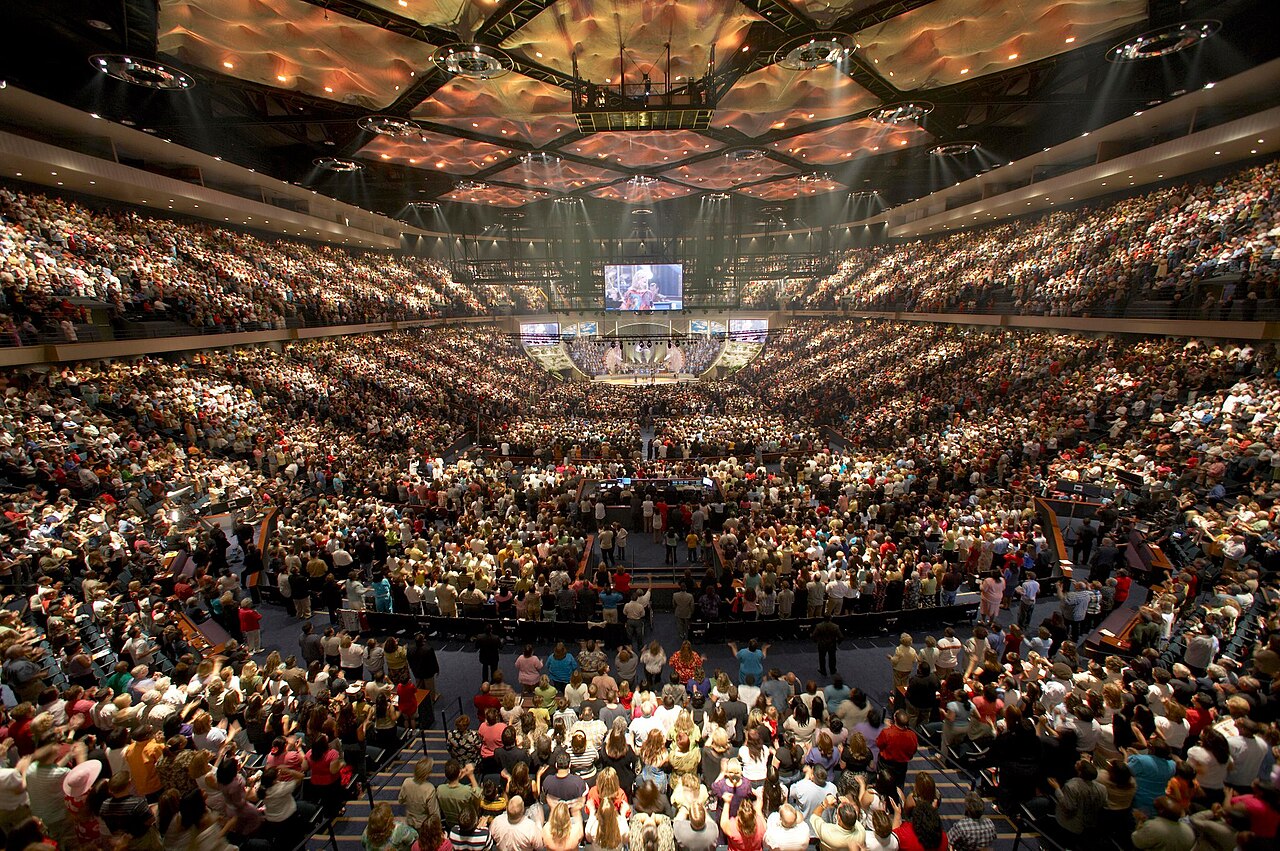
A service at Lakewood Church in Houston. The church's auditorium was originally a basketball arena, the home court of the Rockets. Source: Wikimedia Commons, CC BY 3.0

The church also ran a pile of side programmes: youth Bible study, workplace fellowships, alcohol-recovery groups, a relief organisation, a kindergarten.
His conclusion: such a church operates like a company. The senior pastor is like a CEO, with associate pastors under him for finance, personnel and public relations, and young pastors sent to new cities to "plant churches," the way a chain store opens branches.
The religious market theory
This intuition has a formal version in the sociology of religion, called "religious market" theory, or "religious economy" theory.
The sociologists Roger Finke and Rodney Stark published The Churching of America, 1776–1990 in 1992. They advanced a very challenging view: America is more devout than Europe precisely because America has no state church.
The logic runs like this:
- Where there is a state church (as in the history of many European countries), the church is supported by the state, like a monopoly firm; without competitive pressure it has little drive to recruit believers.
- Where there is religious freedom and no state church (as in America), the denominations compete for believers like firms and must offer better "service" to survive: more moving sermons, a warmer community, more practical help.
- The result: the fiercer the competition in the "religious market," the more people take part in religion.
This is exactly the reverse of traditional "secularisation theory." Secularisation theory holds that pluralism weakens religion; religious market theory holds that pluralism and competition energise it.
Megachurches
America's "megachurches" are the most vivid example of this theory. By the standard commonly used by the Hartford Institute for Religion Research, a Protestant church with 2,000 or more people at weekly services counts as a megachurch. America has well over a thousand of them, and the biggest draw tens of thousands a week.
What they have in common is what the netizen described: modern music and media, corporate management, programmes sorted for different groups of people, and a strong sense of community.
China's three-colour market
Someone has put this pair of glasses on in China.
The Chinese-American sociologist Fenggang Yang proposed in 2006 that religion in China is a "three-colour market."
- Red market: government-approved religion, registered temples, Daoist monasteries, churches and mosques, operating under the official patriotic religious associations.
- Black market: religious groups banned by the government, branded "evil cults," operating underground.
- Gray market: the large area that is neither red nor black, legally unclear: unregistered house churches, folk temple fairs, qigong, geomancy, fortune-telling, the "study traditional culture" scripture-reading classes…
His observation was that the more tightly the red market is controlled, the larger the gray market grows. What the government can control is the registered part, but a great deal of religious demand squeezes out of the red market into the gray, and grows there by itself.
By Finke and Stark's account, state monopoly weakens religion; but in China the state did not support a state church, it rationed religion as a whole. The result was not that religion weakened, but that religion moved to live somewhere else.
What this is good for in understanding the future of religion
The "religious market" view can explain many phenomena elsewhere:
- Why do Pentecostal churches in Africa and Latin America grow so fast? They are flexible, localised, not dependent on the old churches' structures, and expand like start-ups.
- Why are some old religions declining? They may have lost their "grassroots position," no longer able to handle ordinary people's weddings and funerals and mutual help in emergencies.
- Why is the number of people who are "spiritual but not religious" rising? Perhaps there are too many substitutes in the "market": counselling, meditation apps, fitness groups, hobby clubs.
I also saw a comment online that puts it very clearly: "Religion, lineage and association are all ways of grassroots self-organisation. In birth, ageing, illness and death, weddings and funerals, whoever can better meet people's needs holds more of the population."
Turning it around
Religious market theory is hotly disputed in academia.
First, it has trouble with some counterexamples. In some highly pluralistic, fiercely competitive countries, religious participation is not high; in some countries where one church almost monopolised (such as Poland and Ireland in the twentieth century), religious participation was for a time very high. By market theory, monopoly should have weakened religion.
Second, it may make faith sound too much like consumption. Many people are religious not because they compared the "service" of several churches and picked one, but because of family, tradition and real experience of faith. Treating religion wholly as a "market" misses what in it cannot be exchanged.
Third, America itself is changing. In the past twenty years the share of Americans with "no religion" has risen markedly. Even the churches best at "management" face the loss of the younger generation.
So religious market theory is more like a pair of glasses: put on, it lets you see what you could not see before, but you cannot keep it on to look at everything.
Where is our "megachurch"?
While reading this piece, what I thought of was the native-place halls of Nanyang.
A hundred-odd years ago, a young man from Fujian or Guangdong who took a boat to Penang or Singapore went first, on landing, to the native-place association hall: a place to stay, someone to introduce work, care if he fell ill, someone to lay him out if he died, his tablet placed in the hall's ancestral shrine, and someone to sacrifice to him every year. Is that not a "megachurch"? Only it has no pastor; what it has is ancestors and fellow villagers.
What we lack is not faith but a place like this that can catch people. The halls did it in their day, and later they were torn down on the Chinese mainland and worn thin by time overseas. For the Confucianism I want, the first step is not to write scriptures but to build such places again.
Do you think a religion should be "run" like a company?
References
- Roger Finke & Rodney Stark, The Churching of America, 1776–1990, Rutgers UP, 1992
- Fenggang Yang, "The Red, Black, and Gray Markets of Religion in China," The Sociological Quarterly 47(1), 2006
- The Hartford Institute for Religion Research definition of a "megachurch" (2,000 or more at weekly services): standard definition
- Netizens' answers and comments (2026), cited as netizens' views
- Image credits are in each caption