
An extreme religion
Many people first hear of Jainism because it is "extreme."
The core Jain teaching is non-violence (ahimsa), and it is pushed to the limit: devout monks cover their mouths and noses with cloth so as not to breathe in small insects; they sweep the ground with a whisk as they walk so as not to tread on ants; some followers do not eat root vegetables, because digging them up harms the life in the soil.
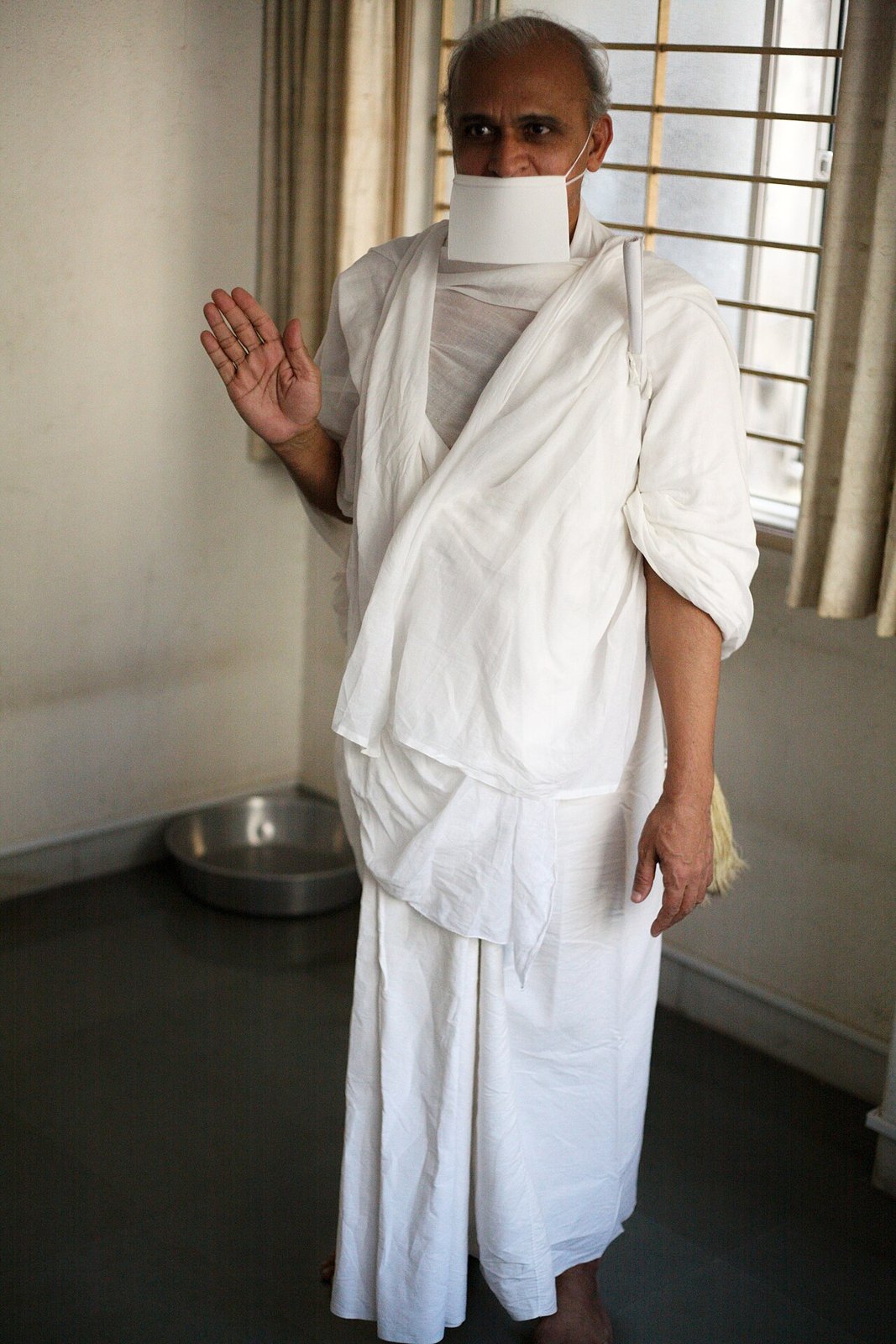
A monk of the Śvetāmbara Jains with a white cloth (muhpatti) over his mouth so as not to breathe in small insects while speaking. Everyone has worn a mask lately; they have worn theirs for over two thousand years. Source: Wikimedia Commons, photo by Samyak Modi, CC BY-SA 4.0

Jainism arose in India at about the same time as Buddhism, around the sixth century BCE. Both opposed the Brahmin sacrifices and caste privilege, and historians place them together in the śramaṇa movements of the time. But Buddhism took the "Middle Way," while Jainism taught strict asceticism.
Historically Jainism split into two great sects: the Digambara hold that a true renunciant must give up all property, even clothing; the Śvetāmbara monks may wear white robes. The two also differ on questions such as whether women can attain liberation.
Non-violence and business
The teaching of non-violence has deeply shaped what work Jains choose.
Farming cannot avoid harming the creatures in the soil, and soldiering and slaughtering even less. For a long time many Jains turned to trade, moneylending and jewellery. Today Jains are among India's religious groups with the highest education, the most urbanisation and the highest average income.
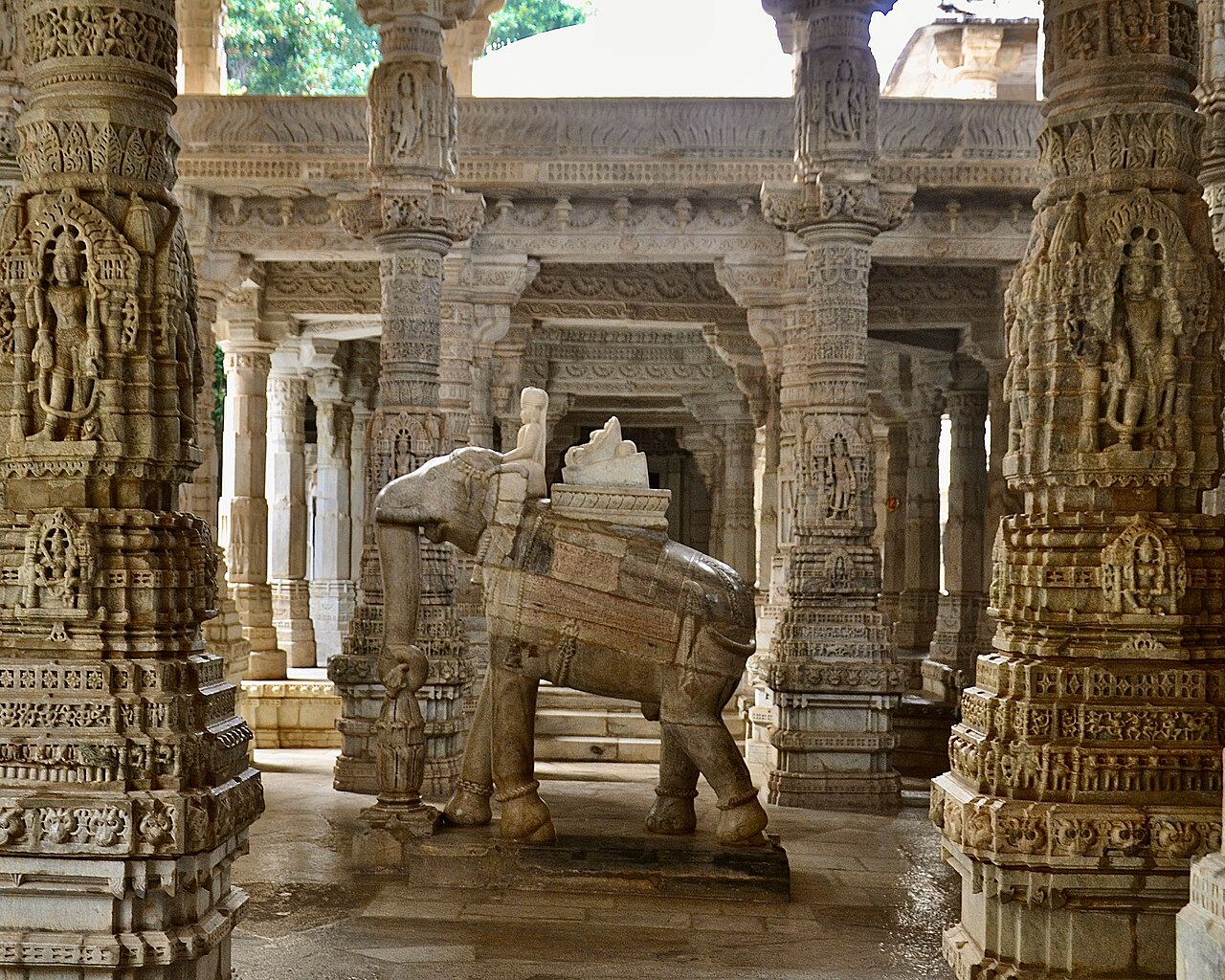
The Jain temple at Ranakpur in Rajasthan, built in the fifteenth century, with over a thousand marble columns, said to be no two alike. The money to build it came from a Jain merchant. Source: Wikimedia Commons, photo by Brihaspati, CC BY 4.0

This is often taken as an example of "religion shaping economic behaviour," a little like Max Weber's Protestant ethic and capitalism.
The numbers are getting smaller
But Jainism has run into a modern difficulty: its share of the population is falling.
According to India's census, in 2011 India had about 4.45 million Jains, 0.37% of the national population. In 1981 the share was 0.47%. In thirty years the share fell by more than a fifth. From 2001 to 2011 the Jain population grew only a little over 5%, far below India's overall growth.
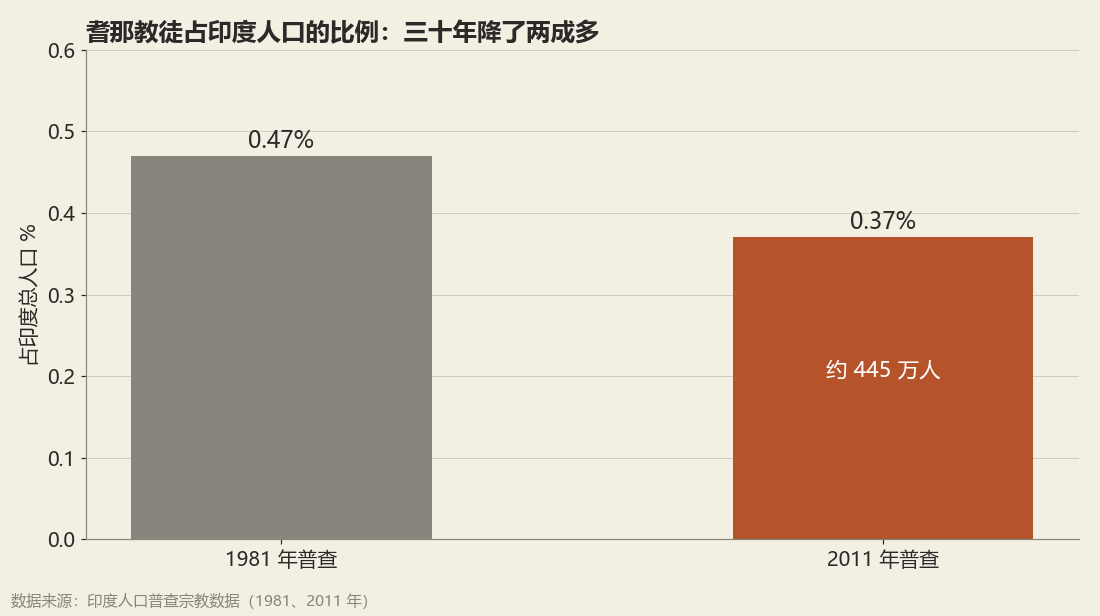
Jains as a share of India's population, censuses of 1981 and 2011. Data: Census of India
One reason is few births. The census data show that Jain families have markedly fewer children than the national urban average. Much schooling, high earnings, city living: the factors that push fertility down elsewhere nearly all apply to Jains, and to a deeper degree.
Another reason is blending with the society around them. Jainism and Hinduism share many festivals and customs, and intermarriage is not rare; in some censuses Jains are also recorded as Hindus from time to time.
A surprising contrast
The Jain case makes an interesting contrast with a popular claim.
The claim goes: strongly religious groups have more children, so religious groups will "inherit the earth."
But the Jains are a very strongly religious group with very strict rules, and they have few children. This suggests that religion itself does not necessarily bring high fertility; a religious group's circumstances, how much schooling, whether they live in cities, whether women work, may matter more than doctrine.
The same reasoning can be applied to Buddhism: Buddhists have few children largely because they are clustered in the East Asian societies with the fewest births.
How a small religion lives
Still, perhaps Jainism does not need "many people."
Jains have never been numerous, yet they have continued for more than two thousand five hundred years. They have relied not on numbers but on a very tight web: temples, charities, business networks, a circle of marriage. In India and abroad, Jain communities are known for helping one another and trusting one another.
It is a bit like the Jews and the Parsis (India's Zoroastrians): few in number, clear boundaries, high internal trust, with an economic and cultural weight far above their share of population.
For such a group the real threat may not be "few people" but blurring boundaries: if the younger generation no longer cares about what sets them apart from others, the community may slowly dissolve in the blending.
Turning it around
"The richer, the smaller" may also be a simplification. India's census has its own problems of how people are recorded; the Jain population overseas is also growing; a falling share does not mean a community in decline.
Few people, or loose borders?
The Jains, the Jews and the Parsis all chose the road of "few people, tight borders," held on, and also shut many people outside the gate.
That is not the road I want. East Asians already number well over a billion and are scattered across the world. We do not lack people; what we lack is something that people are willing to come back to and can find the way back to. So I would rather have the borders a little looser and the threshold a little lower: if you can write Chinese characters, sweep the graves at Qingming, offer to your ancestors at New Year, you are one of us, whatever passport you hold and whatever language you speak. With so many people, the web cannot be tightened through marriage circles as the Jains' is; it has to be tied together by a set of rites and festivals that everyone recognises.
If a group keeps its cohesion through strict borders, at the price of an ever smaller number of people, do you count that as success or failure?
References
- India's 2011 census religion data (Jains about 4.45 million, 0.37%; 0.47% in 1981)
- Fredrik Barth (ed.), Ethnic Groups and Boundaries, 1969
- Eric Kaufmann, Shall the Religious Inherit the Earth?, 2010
- Pew Research Center, "Why is Buddhism shrinking worldwide?", 2026-03-11
- Image credits are in each caption