1830
In March 1830, in western New York State, a new scripture was published: the Book of Mormon.
Its "translator" was a twenty-four-year-old man, Joseph Smith. On 6 April 1830 he and a few followers founded a church, later called The Church of Jesus Christ of Latter-day Saints, generally known as the Mormon Church.
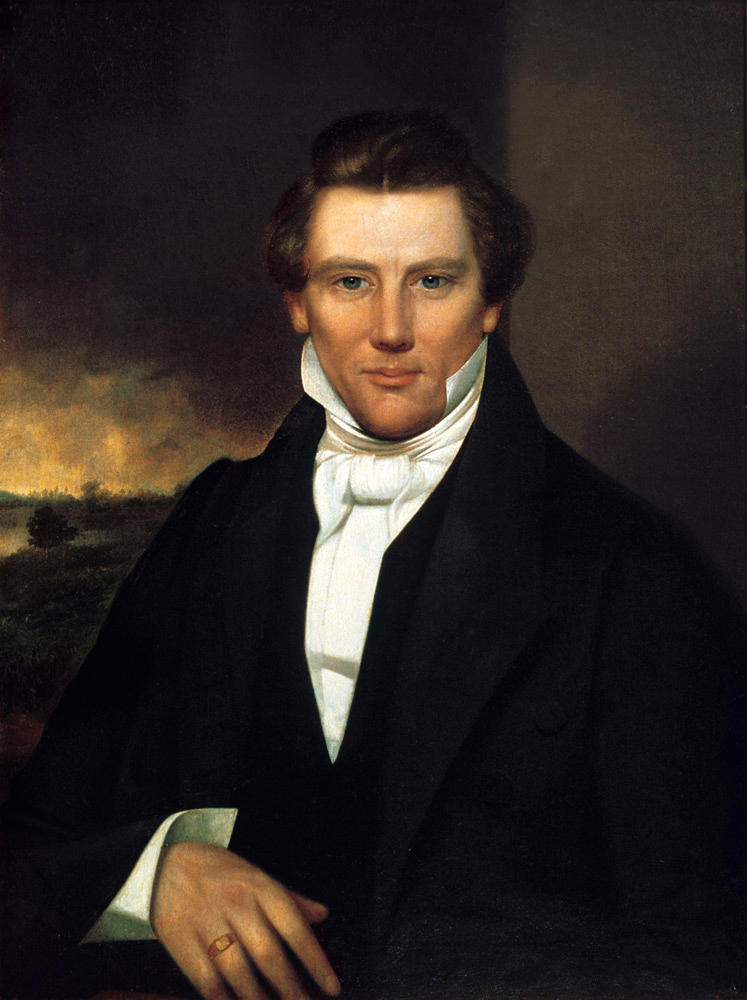
Joseph Smith (1805–1844). He died at thirty-eight in a jail in Illinois, shot by a mob with blackened faces. Source: Wikimedia Commons, public domain

Nobody then would have bet on its survival. In 1844 Smith was killed by a mob. In 1847 Brigham Young led the believers all the way to Salt Lake City. In 1890 the church formally announced that it was giving up polygamy, and only then made peace with the federal government.
A number
At the end of 2025 the church reported registered members of 17,887,212.
This is the church's own count of registered members, not the number sitting in church every Sunday. Even so, it is where a body that began nearly two hundred years ago with six people has arrived.
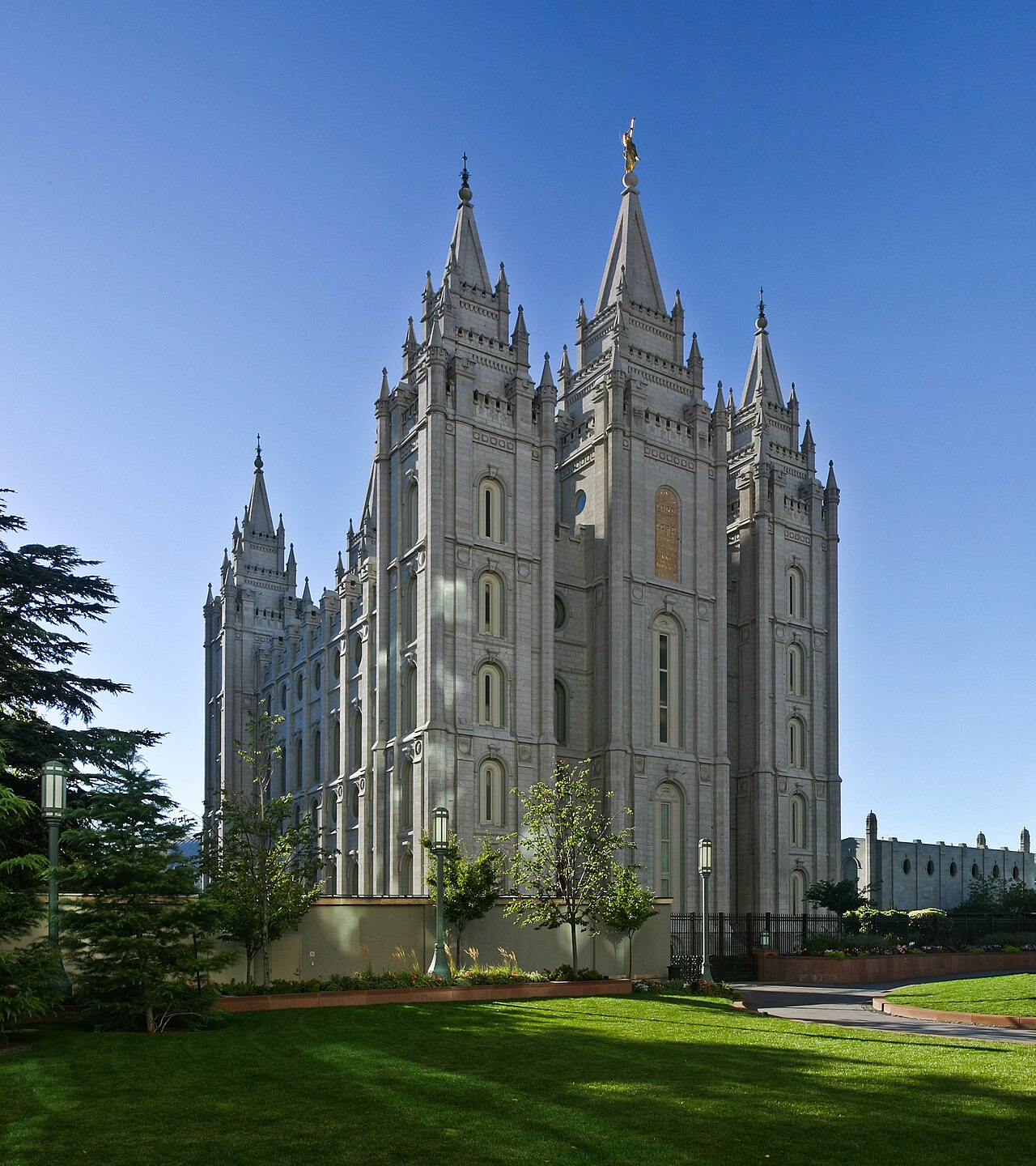
The Salt Lake Temple, begun in 1853 and completed in 1893, forty years in the building. A people driven out of the East built a temple for themselves at the edge of the desert. Source: Wikimedia Commons, photo by Diliff, CC BY 2.5

Stark's prophecy
The American sociologist Rodney Stark is among the best-known students of this church.
He took Mormonism as a case to answer a question: why do some new religions succeed and others fail? In 1996 he arranged his answer into a checklist, with roughly these conditions:
- Keep a certain continuity with the mainstream culture of the society; it cannot be something wholly alien.
- Have a "medium degree" of tension with the surroundings: too loose, there is no reason to join; too tight, nobody dares to join.
- Have legitimate, authoritative leadership.
- Be able to mobilise a body of volunteers willing to give their time.
- Have enough children to replace those who die.
- Grow up in a religious environment where competitors are relatively weak.
- Have tight internal ties and at the same time be open to outsiders.
- Teach the next generation well and lose few.
From this Stark projected that, at the growth rate of the time, the Mormon Church would have about 267 million members in 2080.
How much of the prophecy came true
We now have the figure for 2025: 17,887,212.
To reach 267 million by 2080, it would have to grow by about 5% a year from now on.
Actual growth in the last two years was 1.5% and 2.2%. In 2025 the church reported 385,490 baptisms, a record, and that year did grow faster than the one before.
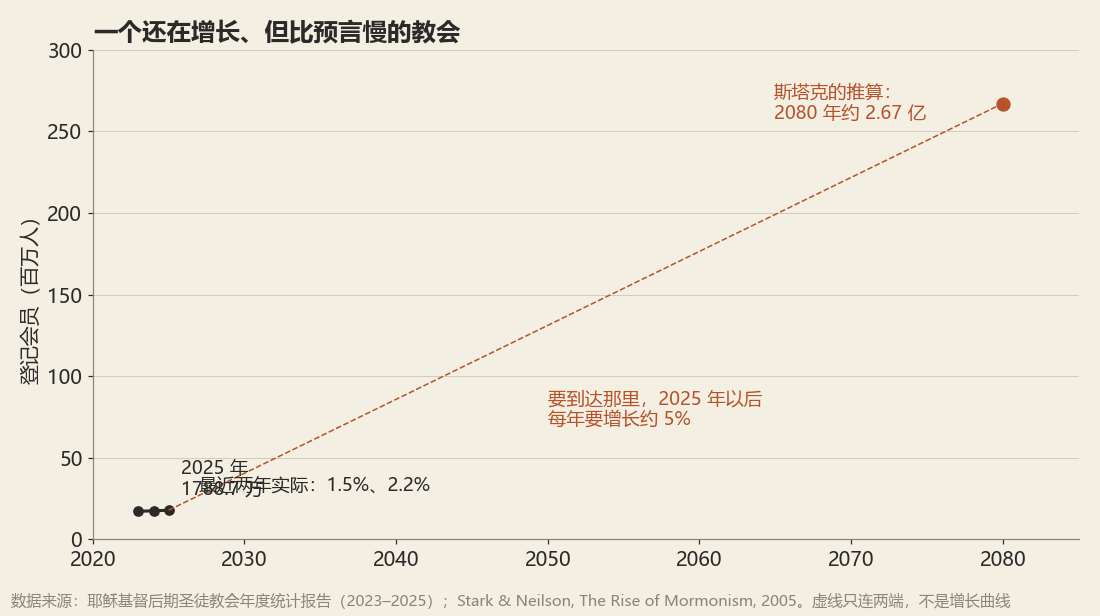
Registered members of the Latter-day Saints, actual figures for 2023–2025 and Stark's projection for 2080. The dotted line only joins the two ends; it is not a growth curve. Data: the church's annual statistical reports; Stark & Neilson, 2005
So the prophecy is so far too high, but the direction is right: it is a church that is still growing.
Another example
Japan's Soka Gakkai is a very different body.
On 18 November 1930 the educators Tsunesaburo Makiguchi and Josei Toda founded it, then called the "Soka Kyoiku Gakkai" (Value-Creating Education Society). On 18 November 1944 Makiguchi died in prison because he refused to enshrine the talisman of the Ise Shrine. I told this in Neighbours' Heaven.
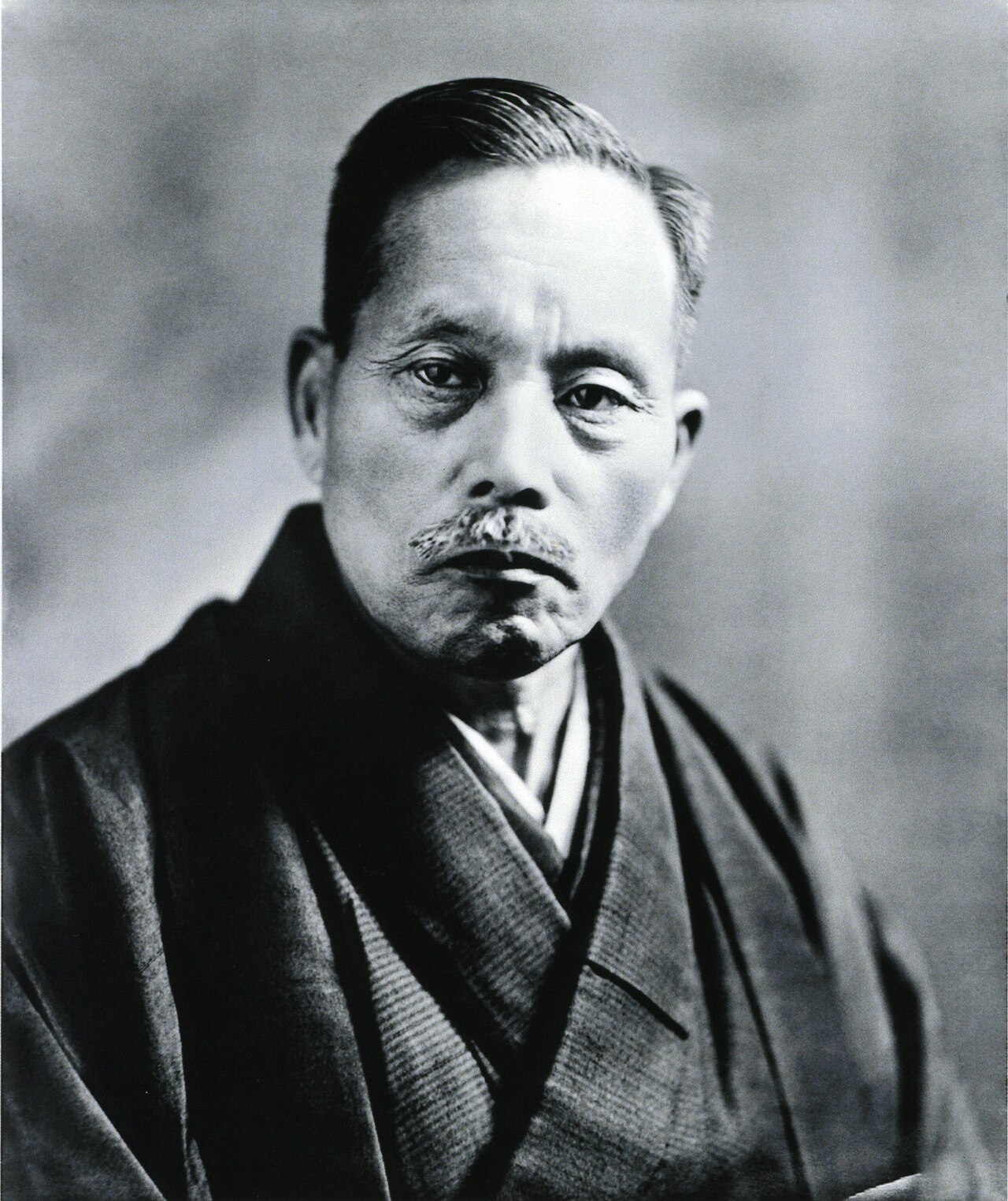
Tsunesaburo Makiguchi (1871–1944). He died in prison on the very day, the fourteenth anniversary, of the society's founding. Source: Wikimedia Commons, Soka Gakkai, public domain

After the war Josei Toda came out of prison and in 1951 began the "great propagation" campaign, setting himself the goal of 750,000 households before he died. By 1960 the body reported about 1.3 million households. In 1964 it founded the Komeito party. In 1967 it claimed 6.2 million households.
Today Soka Gakkai itself says it has 8.27 million member households in Japan. Some scholars estimate that the truly committed members number between two and four million.
Set Stark's checklist beside it and some items fit, such as the power to mobilise and the web; some do not fit so well. Whether anyone has tested this systematically, I did not look up this time.
Another kind of ending
On the checklist's item "medium tension," East Asia offers two very conspicuous examples.
One is the Unification Church in Japan. In July 2022 former prime minister Shinzo Abe was shot dead on a street in Nara. The gunman said his mother had given so much money to the Unification Church that the family was ruined, and he hated the church and the politicians close to it. In the following years Japanese society went through a round of scrutiny of the Unification Church's large donations, and the government even applied to a court to dissolve it. A body held up by large offerings had become so tense that society could no longer tolerate it.
The other is Falun Gong. It was founded in 1992 in Changchun, China, and within a few years practitioners were found in cities and villages everywhere. In April 1999 over ten thousand practitioners gathered near Zhongnanhai in Beijing to petition; in July the government announced its ban, followed by long suppression, with many practitioners detained or sent to labour camps and some dying inside; the exact numbers differ greatly between the government's account and Falun Gong's. It has almost vanished in China, yet it has survived overseas, running newspapers, television stations and touring shows.
By Stark's checklist its "tension" in China went far beyond "medium," and it should by rights have died; but in another country, in an environment of religious freedom, the tension dropped straight back to "medium." Whether a new religion survives depends not only on itself but on the ground it stands on.
Turning it around
Stark's checklist has a basic flaw: it was drawn up after the fact.
What we see is the religions that survived, and then we look for what they have in common. The new religions that died mostly never made it into any book. The same "medium tension" can explain success and can explain failure, because how much "medium" is can only be known after the result is in.
Besides, "registered members" is a very soft number. Those of the Mormons and of Soka Gakkai are both published by the bodies themselves, and their way of counting often differs widely from outside estimates.
What counts as a religion's success
I do not look at numbers.
On whether a religion is a success I ask only two things: can it let scattered people recognise one another, and can it be passed down to the fifth, the tenth generation. The Jews are few, and have been handed down three thousand years; in my eyes that is success. A body that drew in several million people in ten years and vanished like smoke twenty years later is not.
By this standard, the East Asians' ancestral body of practice, Qingming, New Year, reading Chinese characters, has already been a success for two thousand years. Its problem now is not that nobody believes, but that nobody gathers people for it and hands it on. What I want to do is supply that missing link.
Among the people you know, who first stepped into a place of worship because a friend introduced them?
References
- Rodney Stark, "Why Religious Movements Succeed or Fail: A Revised General Model," Journal of Contemporary Religion 11(2), 1996; Rodney Stark & Reid L. Neilson, The Rise of Mormonism, Columbia UP, 2005 (the projection of about 267 million for 2080)
- Annual statistical reports of The Church of Jesus Christ of Latter-day Saints: 17,255,394 in 2023; 17,509,781 in 2024; 17,887,212 in 2025; 385,490 baptisms in 2025
- Soka Gakkai: founded 18 Nov 1930; "great propagation" from 1951; about 1.3 million households in 1960; Komeito in 1964; 6.2 million households claimed in 1967; 8.27 million claimed (2025); Levi McLaughlin estimates 2–4 million people
- Tsunesaburo Makiguchi: died in prison 18 Nov 1944
- Joseph Smith (born 1805), the church's founding on 6 Apr 1830, his killing in 1844, arrival in Salt Lake in 1847, the renunciation of polygamy in 1890: standard history
- Falun Gong: Human Rights Watch, Dangerous Meditation: China's Campaign Against Falungong, 2002 (full text): Li Hongzhi founded it in May 1992; on 25 April 1999 over ten thousand practitioners queued to petition near Zhongnanhai; on 22 July the Ministry of Civil Affairs and the Ministry of Public Security announced the ban; up to ten thousand estimated sent to labour camps; when the report was written, Falun Gong said 234 had died in custody or shortly after release, and the government had accounted for only 72 of these cases; on practitioner numbers, the government estimated 40 million at the end of 1998 and revised it to about 2 million in 2001, and Falun Gong claims over 70 million inside China 🟢
- The assassination of Shinzo Abe in 2022 and the Unification Church issue: standard history and news reports
- Image credits are in each caption