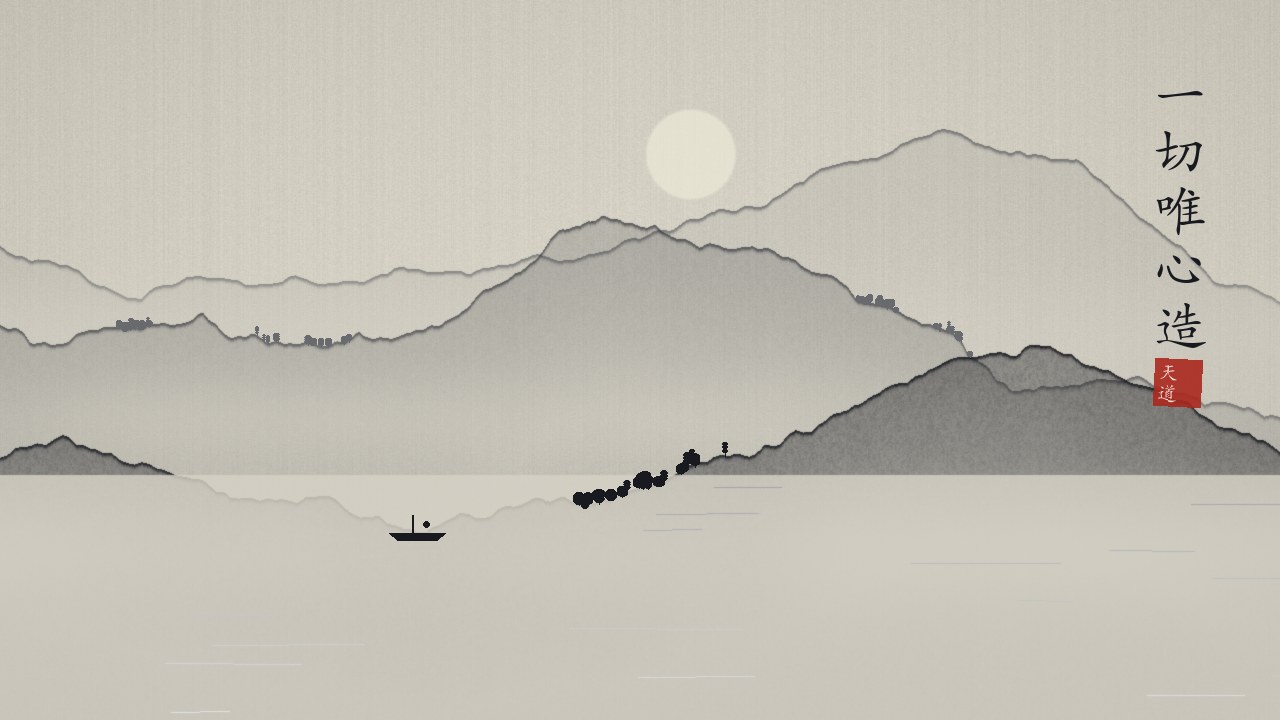
Search online for "simulated universe Yogacara" and you will find a batch of articles that put Yogacara, quantum physics and "consciousness is the base layer of the universe" together, very satisfying to read. One netizen said the world is only a "three-dimensional great dream, moment by moment."
I want to read it against the original: what does Yogacara itself say? What does the original of "all dharmas are made by the mind" say? This is Part 1, covering only the Yogacara side. Part 2 turns to the simulated universe.
One thing first: both parts read the relevant claims as thought experiments, and do not decide for any side.
1. What the original says of "all dharmas are made by the mind"
The most often cited source of this line is the Avatamsaka Sutra. In the eighty-fascicle version, fascicle 19, chapter "Verses of Praise in the Yama Palace," a verse spoken by the bodhisattva Jue Lin (Awakening Forest). The original runs:
"The mind is like a skilled painter, able to paint all the worlds; the five aggregates all arise from it, there is no dharma it does not make. ... If a person wishes to understand all the buddhas of the three times, he should contemplate the nature of the dharma realm: everything is made by the mind alone."
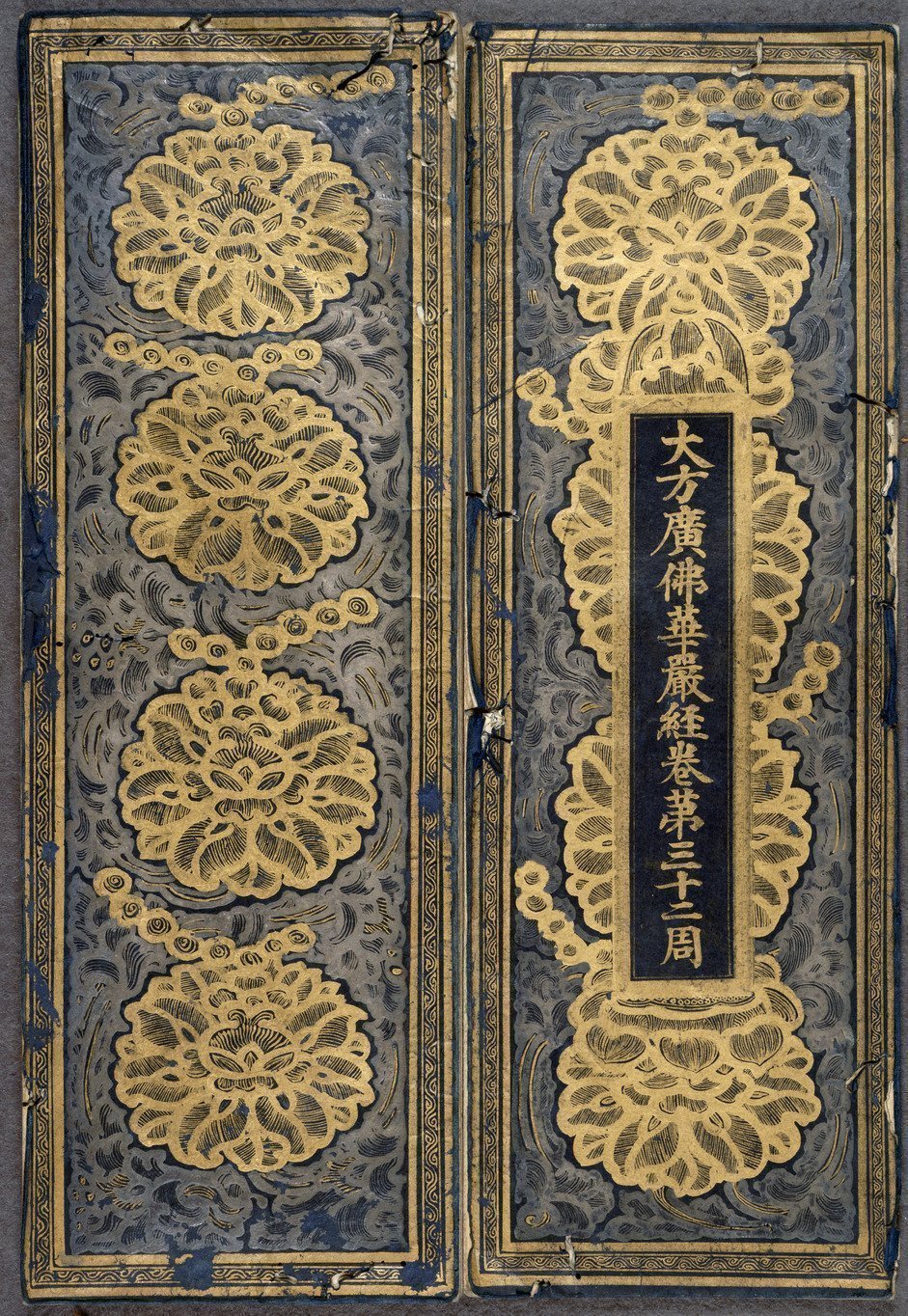
Cover of a Goryeo-period (c. 1400) manuscript of the Avatamsaka Sutra*, flowers drawn in gold paint on indigo paper. In Korea and Japan this sutra has always been more honoured than in China. Source: Wikimedia Commons, British Library, CC0*

Note that the original says "everything is made by the mind alone." "All dharmas are made by the mind" is the later common wording; I could not find where it first appears.
This verse itself has several points not usually mentioned.
It uses the painter as an analogy. The same verse also has a line: "Like a skilled painter, he cannot know his own mind, yet by the mind he paints." The painter can paint a world, yet does not know his own mind.
It says "As the mind, so the Buddha; as the Buddha, so living beings": mind, Buddha and living beings are not different. The point of the verse is the relation among these three, not "whatever I want, I get."
In the same chapter another bodhisattva, Li Lin (Power Forest), says: "The world is not made by itself, and also not made by another." The world is neither made by oneself nor by anyone else. This line will be used in Part 2.
The popular reading is "what the mind wishes comes true." In the verse's original, there is no such meaning.
2. Yogacara: turning "mind-made" into an argument
The one who turned this thought into an argument was Vasubandhu. His Twenty Verses on Consciousness-Only survives in Xuanzang's translation. It opens:
"I establish that the three realms of the Mahayana are consciousness-only, in accord with the sutra's saying that the three realms are mind alone."
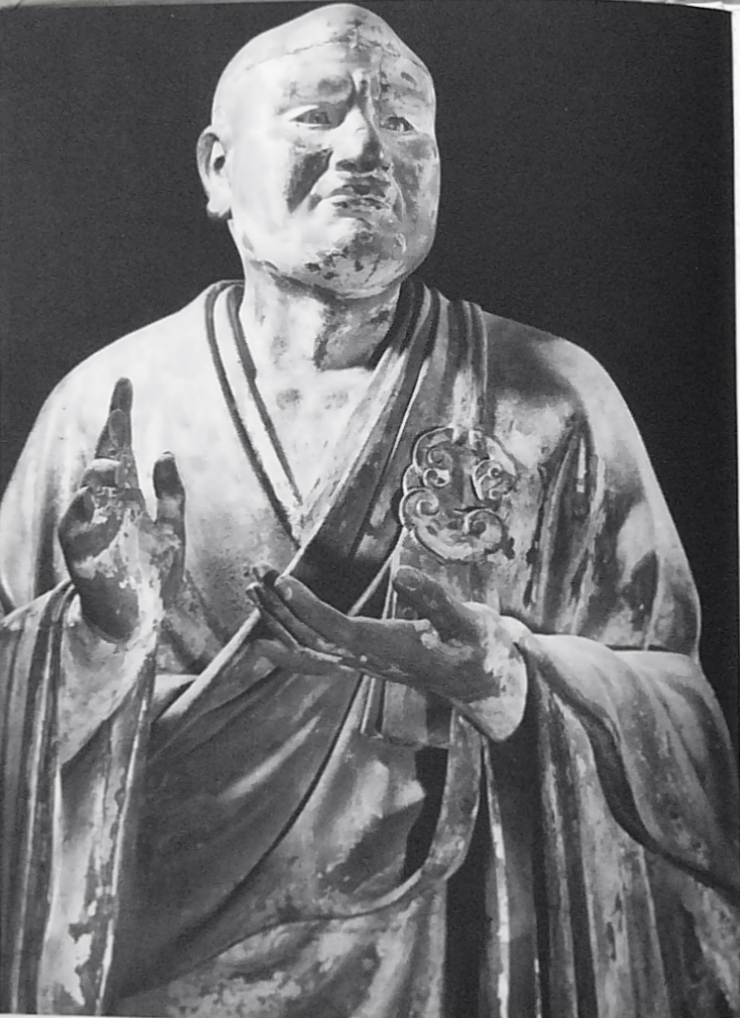
Statue of Vasubandhu at Kofukuji in Nara, Japan, carved in the thirteenth century by the Unkei school. An Indian master, in a Japanese temple, carved as a weathered old monk. Source: Wikimedia Commons, public domain

Next comes the most crucial line of the whole treatise:
"When inner consciousness arises, it appears like an outer object, as one with eye disease sees hairs and flies."
Meaning: when the consciousness in the mind arises, it looks as if there were something outside, just as a person with an eye disease sees hairs and flies.
Said this way, someone at once objects: if there is nothing outside, why do I see such a thing only in this place and at this time? Why do many people see the same thing at once? Why can those things still act, be eaten, harm people?
Vasubandhu answers with dreams, hungry ghosts and hells. Two passages are very interesting:
"Take hungry ghosts who share the same karma and ripening: many bodies gathered together all see a river of pus."
"In the same place at the same time, many continuums all see together prison guards, dogs, crows, iron mountains and so on coming to where they are, to harass and harm them."
A group of hungry ghosts sees at the same moment the same river of pus; a group of beings in hell sees at the same moment the same guard coming at them with a knife. There is no real guard; their karma is alike, so what they see is alike. This is called "shared karma." That a hallucination can hit you becomes, in this argument, a merit.
This answers exactly the biggest hole in "mind-made": if it is made by the mind, why does the world not obey me?
Yogacara's answer is: the world is not something I produce by a thought now; it is the transformation of habit-energies since beginningless time. The Thirty Verses say: "By the consciousness of all seeds, it transforms in this way and that; through the force of mutual conditioning, this and that discrimination arise."
The Cheng Weishi Lun (Treatise on the Establishment of Consciousness-Only), fascicle 2, also divides "seeds" into two kinds. One's own body is "by the ripening power of the uncommon seeds of the vipaka consciousness, transformed into the semblance of the material sense organs and their supports"; and there are also "common seeds," which let everyone enjoy one world together. (This is my summary: the body is transformed from each person's own seeds, the world from seeds held in common.)
The world does not obey me because it is not transformed only from my own seeds.
3. Yogacara's exit: the turning of the basis
Having said how the world comes about, one must say how to come out. Yogacara's exit is called "turning of the basis" (zhuanyi).
Fascicle 9 of the Cheng Weishi Lun gives a very clear definition:
"'Basis' means what is relied upon, that is, the dependent nature, which serves as the support of defiled and pure dharmas. 'Defiled' means the falsely imagined, clung-to nature; 'pure' means the real, perfected nature. 'Turning' means the two aspects: turning away and turning toward."
It goes on to say that when practice cuts off obstacles one can "turn away the imagined nature clung to on the dependent nature, and turn toward the perfected nature in the dependent nature. By turning the afflictions one gains great nirvana; by turning the obstruction to knowledge one realises supreme awakening."
My summary: the ground on which the world works (the dependent nature) remains; what is to be dropped is the clinging to "real self, real things" laid over it; what is to be gained is how it was before that was laid on. So Yogacara's liberation points to changing how one sees the world, not to leaving this world.
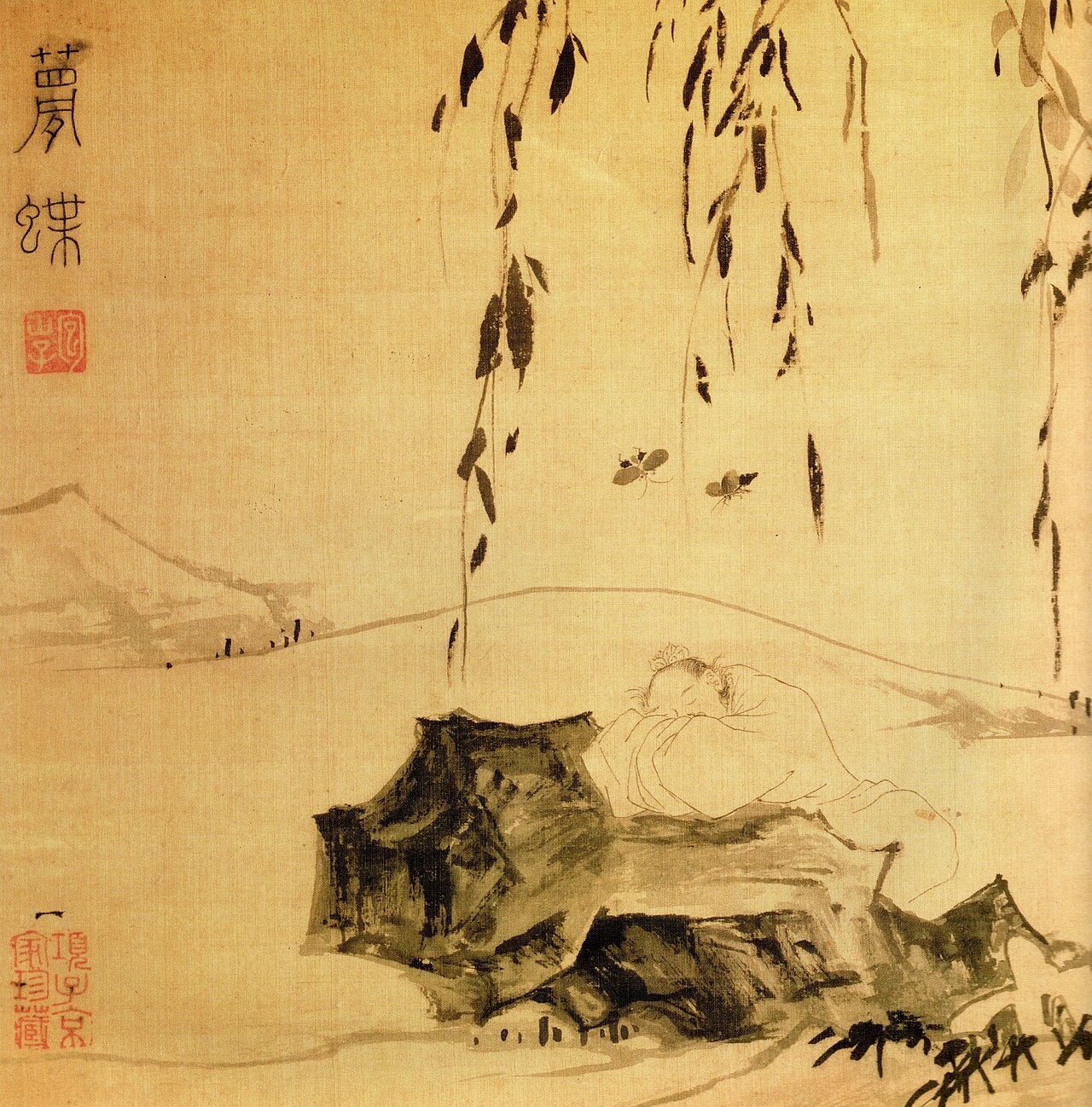
Zhuangzi dreaming of a butterfly, painted by Lu Zhi of the Ming. "I do not know whether Zhou dreamed he was a butterfly or the butterfly dreamed it was Zhou." The Chinese were asking the same question very early; only Zhuangzi had no plan to come out of the dream. Source: Wikimedia Commons, public domain

How does one go? The Cheng Weishi Lun lists five stages, called the "five positions": the stage of provisions, the stage of preparatory practice, the stage of penetrating insight, the stage of cultivation, and the ultimate stage.
The last lines of the Thirty Verses are: "Non-attainment, inconceivable, is supramundane wisdom; by abandoning the two kinds of heaviness one realises the turning of the basis. This is the undefiled realm, inconceivable, wholesome, permanent, the body of peace, bliss and liberation, named the great sage's dharma."
The two characters "non-attainment" deserve a second look: even the thought "I have gained something" must be put down. When the Thirty Verses speak of one stage of practice there is a warning: "Setting up a little something before one, and saying 'this is the nature of consciousness-only,' because there is something gained, one does not truly abide in consciousness-only." Meaning: if you hold "consciousness-only" too in your hand as a thing and say "this is it," you do not yet truly dwell in consciousness-only.
This line will be used again in Part 2.
Turning it around
First, the claims often seen online I could not find as such in the original texts cited above. For instance, "the world regenerates one frame at every moment." That does not mean they are wrong; it means they are later elaborations, not the letter of the treatises.
Second, Yogacara does not say the body does not exist. The Twenty Verses itself says that although what is in a dream has no real object, it "has the function of loss of semen and blood and so on," and the treatise admits this "illusory function." Pain is real pain; only its source, the treatise does not place in matter outside the mind. A netizen put this point very clearly, and I agree.
Third, whether Yogacara is idealism, that "only mind exists in the world," is still disputed in the academy. Some read it as epistemology or phenomenology, some as ontological idealism. This piece does not judge for them.
Fourth, I have read only the originals handed down in Xuanzang's line. Yogacara has other translation traditions in China; I have not read their accounts.
Has there been a dream whose feeling stayed with you longer, after waking, than something in real life?
References
- Avatamsaka Sutra, eighty-fascicle version, fascicle 19, "Verses of Praise in the Yama Palace," chapter 20, translated by Śikṣānanda (verses of Bodhisattva Jue Lin and Bodhisattva Li Lin), Taishō (Wikisource)
- Vasubandhu, Twenty Verses on Consciousness-Only, translated by Xuanzang, Taishō (Wikisource)
- Vasubandhu, Thirty Verses on Consciousness-Only, translated by Xuanzang (Wikisource)
- Cheng Weishi Lun, fascicles 2 and 9, translated by Xuanzang, Taishō (Wikisource)
- Stanford Encyclopedia of Philosophy, "Yogācāra": https://plato.stanford.edu/entries/yogacara/
- Netizens' articles and answers (read 2026-10-05, used as leads, not as evidence)
- Image credits are in each caption