
Part 1 covered the Yogacara side: the original of the Avatamsaka Sutra is "everything is made by the mind alone"; Vasubandhu used dreams, hungry ghosts and hells to argue that outer objects need not exist; the exit is called the turning of the basis. This piece goes on to the simulated universe, to see where it parts ways with Yogacara.
This series is called Duoshe, "possession." The word has a premise: consciousness can leave this body and move into another shell.
In 2003 the Oxford philosopher Nick Bostrom published a paper whose premise is also a single one: consciousness need not grow in a brain; as long as the computation is fine enough, it can exist on other material too.
Both sides are "consciousness changes shells." That is a coincidence, and I do not intend to build on it.
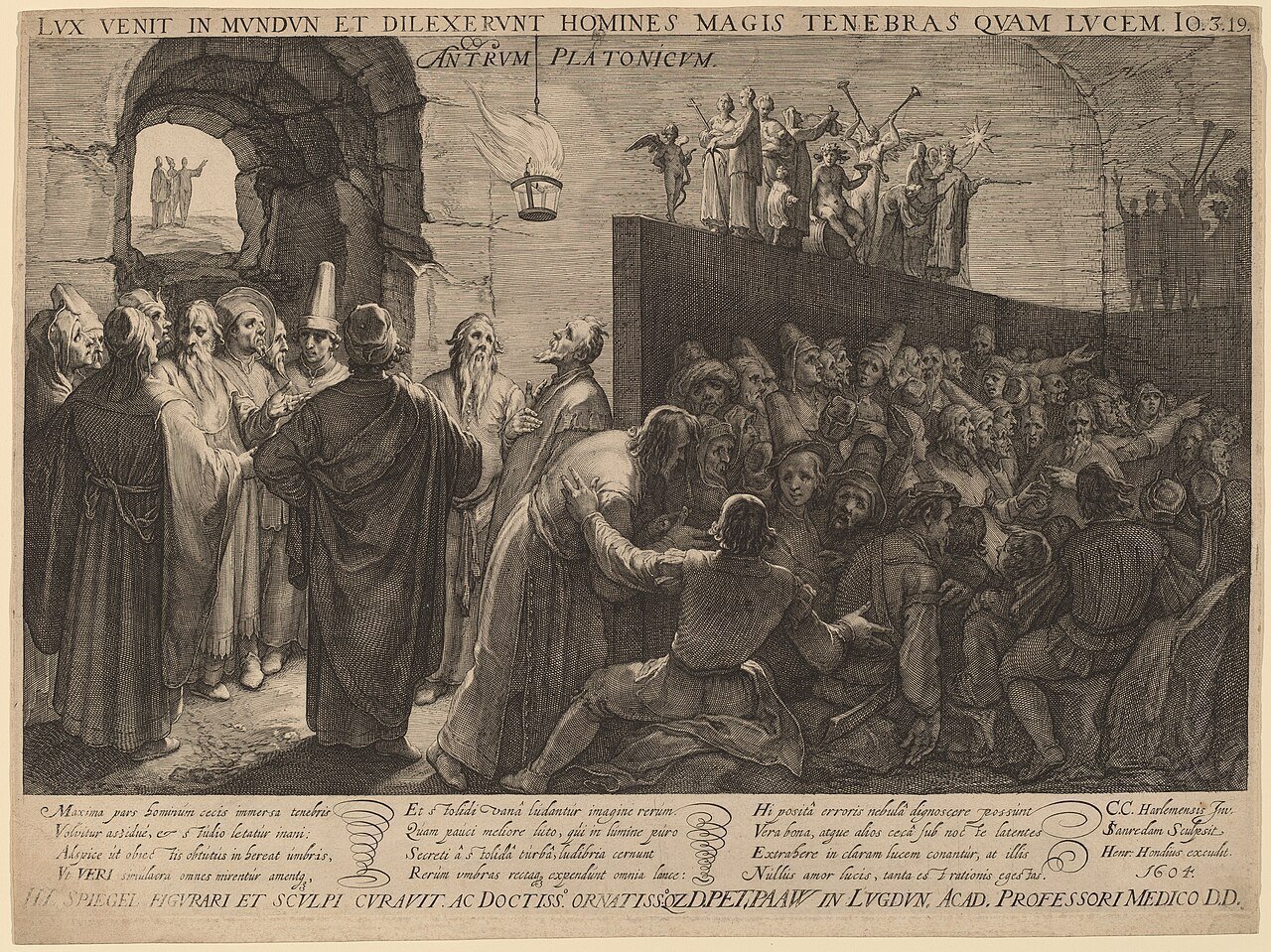
Plato's Cave, engraved by Jan Saenredam after a painting by Cornelis van Haarlem, 1604. The prisoners watch shadows on the wall and think they are the world. "The world is not what it looks like": people were thinking this over two thousand years ago. Source: Wikimedia Commons, National Gallery of Art, Washington, CC0

1. The simulation hypothesis: it says something else
Bostrom's 2003 paper offers a choice of one from three:
First, humanity will very likely go extinct before reaching a "posthuman" stage. Second, posthuman civilisations will almost never run large numbers of ancestor simulations. Third, we are almost certainly living in a simulation.
The argument also relies on two assumptions: that consciousness can be realised on different material substrates, and the "principle of indifference," meaning that if most minds like yours are in simulations, you should estimate your own situation in that proportion.
Note that Bostrom himself accepts that "the disjunction holds," which does not mean he accepts the third. He also says that even if the third were true, the implications would not be so radical.
The philosopher David Chalmers also wrote "The Matrix as Metaphysics." He breaks "we live in the Matrix" into three claims: the physical world is made of an underlying computational process, space-time was created by an external being, and my mind is outside space-time.
His most interesting point: this is not scepticism. Even in the Matrix, a table is still a table, most beliefs are still true; only the underlying implementation of the table differs from what we thought. In Reality+ (2022) he later said it more fully: a virtual world is not a second-class reality.
2. The fork: is there a "host machine"
Yogacara and the simulation hypothesis look alike in one place: the world we see is not what it looks like.
On the Chinese internet many articles read Yogacara, quantum physics and "the universe is a simulation" together, and the few I read all take this form. I say only that this is a common way of writing, and do not evaluate each article.
The fork is right here.
The simulation hypothesis's world is "made by another." Chalmers's "creation hypothesis" says it bluntly: space-time was created by a being outside. Outside there is a more basic layer of reality, with machines and the people who made it.
What Yogacara sets out to block is the "external object," that is, real, external matter. In the passages I quoted, there is no place for a "host machine outside that makes the world." The Huayan verse is even plainer: "The world is not self-made, and also not made by another." The simulation hypothesis is exactly "made by another."
So reading "all dharmas are made by the mind" as "someone outside made this world" is a misreading. (Care is needed here; one cannot turn it round and say "Yogacara opposes the simulation hypothesis." Yogacara is an argument of over a thousand years ago, and never thought about servers.)
There is a second fork, more hidden. Yogacara does not stop at "consciousness." Part 1 quoted the warning from the Thirty Verses: "Setting up a little something before one, and saying 'this is the nature of consciousness-only,' because there is something gained, one does not truly abide in consciousness-only."
Within Yogacara's three natures this is put in fine detail: the "real self and real things" laid over the workings of the world are what is clung to; remove that clinging and what is revealed is the "perfected nature." Both subject and object are, finally, not real: this is the Stanford Encyclopedia of Philosophy's summary of Yogacara.
So if someone takes "the world is code" as the end point, Yogacara would probably say: you have set up one more thing.
3. The exits
After "the world is not what it looks like," each tradition gives a different exit.
| Who made it | Is there a more basic world outside | True or false | Exit | |
|---|---|---|---|---|
| Gnosticism (for comparison) | A lesser demiurge | Yes, the "Pleroma" | A flawed creation | Recognise one's origin through "gnosis" |
| Simulation hypothesis | The simulators | Yes | Chalmers: it is real | None, and none needed |
| Yogacara | Seeds and shared karma since beginningless time | No external creator (by the passages quoted above) | An illusion built by clinging; the workings of the world are not themselves nothing | Turning of the basis |
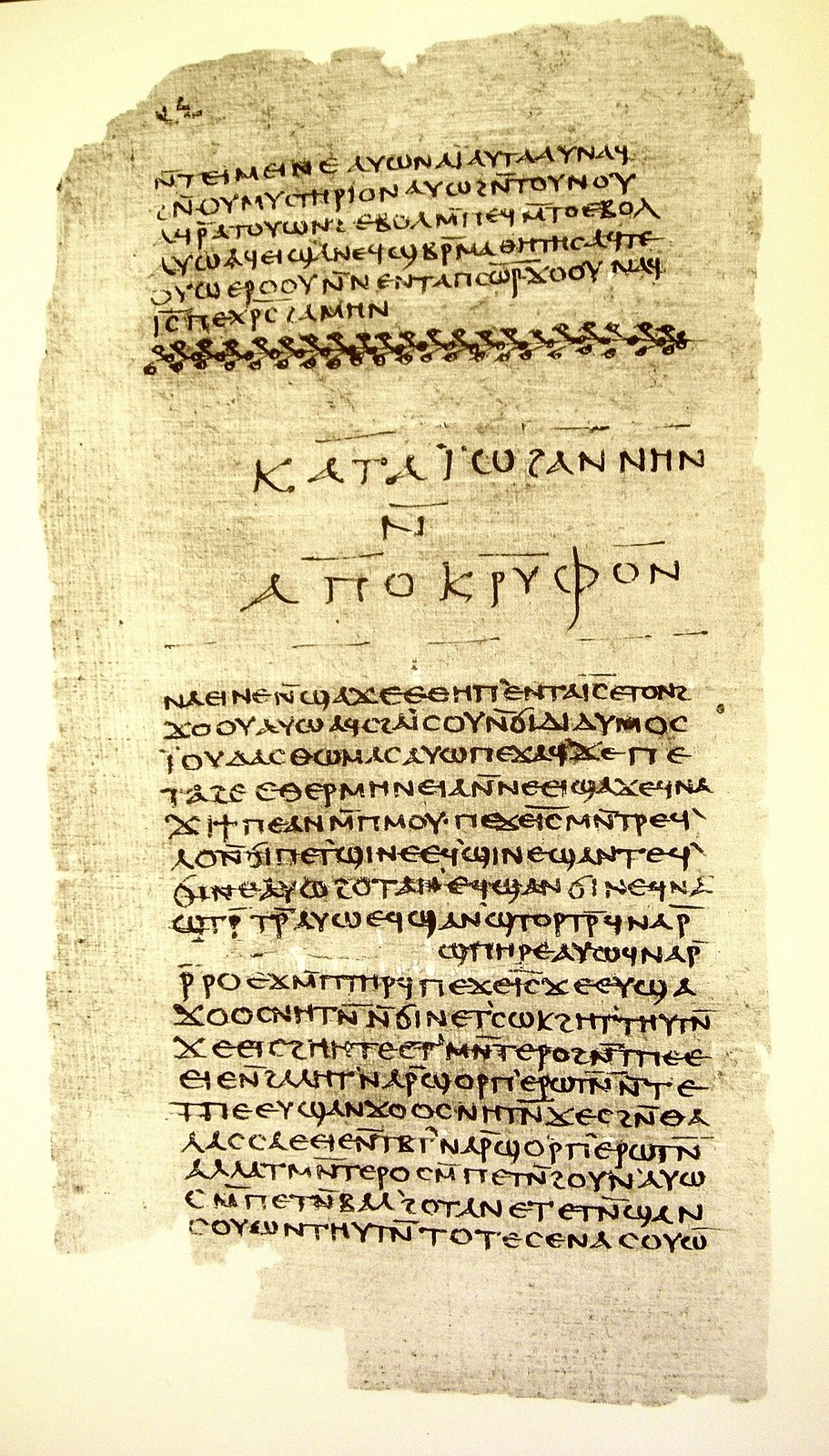
A page of Nag Hammadi Codex II, the end of the Apocryphon of John*. In 1945 Egyptian farmers dug up these fourth-century Coptic codices in a clay jar, and the Gnostic scriptures saw daylight again. Source: Wikimedia Commons, public domain*

Gnosticism is a comparison. It holds that the material world is the work of a lesser demiurge, and that humans carry a spark of divine light which, recognised through "gnosis," lets them return to that higher world. The story of The Matrix is close in shape to this. (In recent years scholars have questioned whether "Gnosticism" can count as one unified category; I borrow only its rough outline here.)
On the simulation side, Chalmers says that even if it is a simulation, life has meaning all the same, and there is no exit to look for. Bostrom also says the implications are not so radical.
Yogacara's exit was covered in Part 1: the turning of the basis, changing how one sees the world, with no intention of leaving this world. Of the three, only Gnosticism wants to "escape."
4. Where "ultimate meaning" is placed
The three place "meaning" differently.
Chalmers's view: meaning rests on consciousness and relations, not on whether the base is a simulation. Gnosticism places meaning in going home. Yogacara puts the problem on "suffering," not on whether the world is real or false, so its end is "to abide in supreme perfect awakening."
What I see is this: asking "is the world real or fake" and asking "what counts as being free of suffering" are two questions. The simulation hypothesis answers the former, and answers it very uncertainly; Yogacara's main work lies in the latter. Putting them together makes it easy to use the answer to one question on the other.
Turning it around
First, an analogy can help imagination but cannot serve as proof. The alaya consciousness is not a hard drive, and seeds are not data. Translating Yogacara into computer language sounds satisfying, but every translation has a price.
Second, the claim above that there is "no external creator" rests only on the passages I quoted. Whether the whole Yogacara tradition has other accounts, and how the schools read it, I have not checked fully. Whether Yogacara counts as idealism is disputed in the academy to begin with.
Third, the simulation hypothesis has also been criticised a good deal. The physicist Sabine Hossenfelder calls it pseudoscience, one reason being that it cannot be falsified: any evidence could itself be simulated. Chalmers himself admits this.
Fourth, Gnosticism is only a comparison. I have read only overviews, not the primary texts. Be careful about setting it equal to either side.
My leaning
I take all three as thought experiments.
The use of a thought experiment is to pull a premise all the way through and see what follows. Pulled through, the three exits differ: Gnosticism wants to escape, the simulation hypothesis has no need to, Yogacara does not escape but turns. That in itself is already very interesting, and does not need to be sorted into true and false first.
If one day someone produced conclusive proof that "we live in a simulation," what would be different about your next day?
References
- Nick Bostrom, "Are You Living in a Computer Simulation?", Philosophical Quarterly, 2003: https://simulation-argument.com/simulation.html
- David Chalmers, "The Matrix as Metaphysics" (author's page version): https://consc.net/papers/matrix.html
- David Chalmers, Reality+: Virtual Worlds and the Problems of Philosophy, 2022
- "Gnosticism," Wikipedia (overview, including scholarly dispute over the category)
- Sabine Hossenfelder's criticism of the simulation hypothesis (as relayed by Big Think): https://bigthink.com/thinking/why-the-simulation-hypothesis-is-pseudoscience/
- Stanford Encyclopedia of Philosophy, "Yogācāra": https://plato.stanford.edu/entries/yogacara/
- Vasubandhu, Thirty Verses on Consciousness-Only, translated by Xuanzang (Wikisource); Avatamsaka Sutra, eighty-fascicle version, fascicle 19 (same as Part 1)
- Netizens' articles and answers (read 2026-10-05, used as leads, not as evidence)
- Image credits are in each caption