
First, let me say where I stand
I value gold; diamonds, designer toys and sneakers I lean towards thinking of as "passing the parcel." Someone with a position writing about this has to set himself a rule: put down the evidence that favours me, and the evidence against me, side by side.
One more thing: this piece is only about gold; silver gets its own. The reason is simple: they are worth something for different reasons. According to the World Gold Council (WGC), industrial uses were only about 6.5% of gold demand in 2025 (323 tonnes of 5,002 tonnes total); silver is the opposite, with more than half going to industry: according to the Silver Institute's 2026 survey, industrial demand in 2025 was about 657 million ounces, more than half of total demand (the share is my own calculation). Writing them together would either turn gold into an industrial good or turn silver into money; both wrong.
Three common reasons, checked one by one
When people say gold is "reliable," there are roughly three common reasons: it has industrial value; its supply is limited and it doesn't spoil; it's more reliable than paper money backed by a regime. One at a time.
One: industrial value
This one doesn't hold, or has to be put differently.
Global gold demand in 2025 was 5,002 tonnes. Jewellery was about 1,542 tonnes, three-tenths (my calculation); technology 323 tonnes, about 6.5%; and the big rest was investment (ETFs plus bars and coins, about 2,175 tonnes) and net purchases by central banks (863 tonnes). Investment plus central banks come to about six-tenths (my calculation).
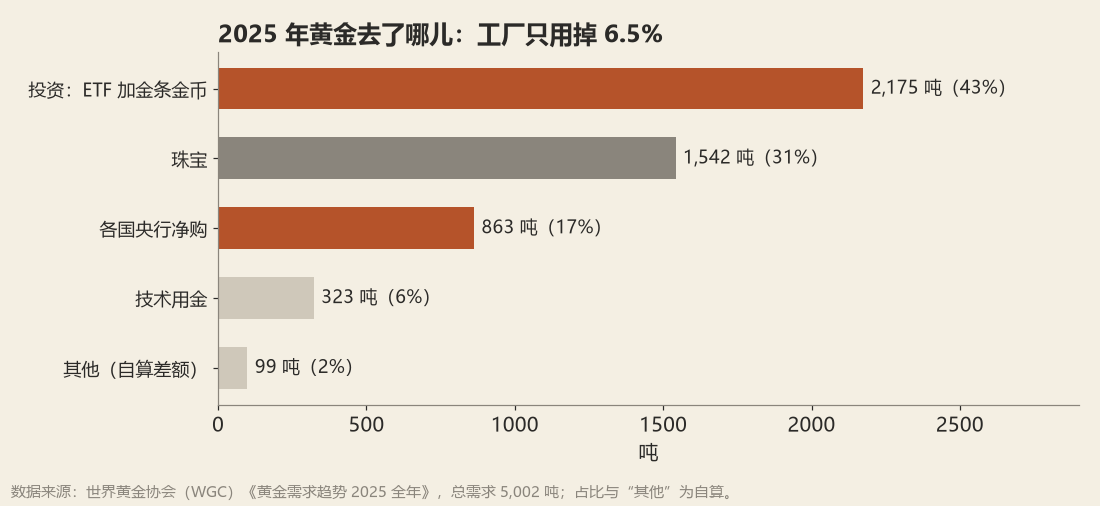
Source: World Gold Council, "Gold Demand Trends Full Year 2025"; shares and "other" are my own calculation.
That is, the gold price is mainly not set by factories' needs. It is worth something because people generally are willing to accept it, to store money in it, and to hold it as reserves. That is a different matter from "having industrial value," and exactly the biggest difference from silver.
So this reason has to be changed to: gold's value doesn't come from industry, but from being "generally accepted."
Two: limited supply, and it doesn't spoil
This one is real.
According to the WGC, by the end of 2025 humankind had dug up about 219,900 tonnes of gold in all. In 2025 new mine production was 3,672 tonnes, a record, and still only about 1.7% of the stock (my calculation). Gold doesn't rot or rust; gold ornaments from thousands of years ago are still here. When something adds only a percent or so of its stock each year and isn't used up, its supply really is hard to enlarge suddenly.
Two additions, though.
First, supply doesn't completely ignore price. With the gold price up sharply in 2025, mine output set a record, and recycled gold also rose 3%, to 1,404 tonnes. When the price is high, some people open new mines, and some sell old jewellery.
Second, "limited supply" shows only that it won't be printed at will like paper money; it doesn't show the price must rise. Price also depends on demand, and demand changes. We'll see this below.
Three: more reliable than regime-backed paper money
This one is half right, and half needs care.
The right half: paper money's credit does depend on the regime that issues it. There are many cases in history of paper money collapsing, the fabi of 1935 and the gold yuan of 1948, which I'll write about later. Gold wasn't issued by any government and doesn't become void because a regime falls.
The half to be careful about: gold is not "beyond the regime's reach."
- On 5 April 1933, US President Roosevelt signed Executive Order 6102: individuals holding more than about 5 ounces of gold coins, bullion or gold certificates had to hand them to the government before 1 May, at the official price of 20.67 dollars an ounce. The ban on private holding of gold was lifted only on 31 December 1974.
- On 19 August 1948, the Nationalist government issued the gold yuan and at the same time declared that gold, silver and foreign currency were "forbidden to circulate or be held," to be exchanged for gold yuan by 20 November.
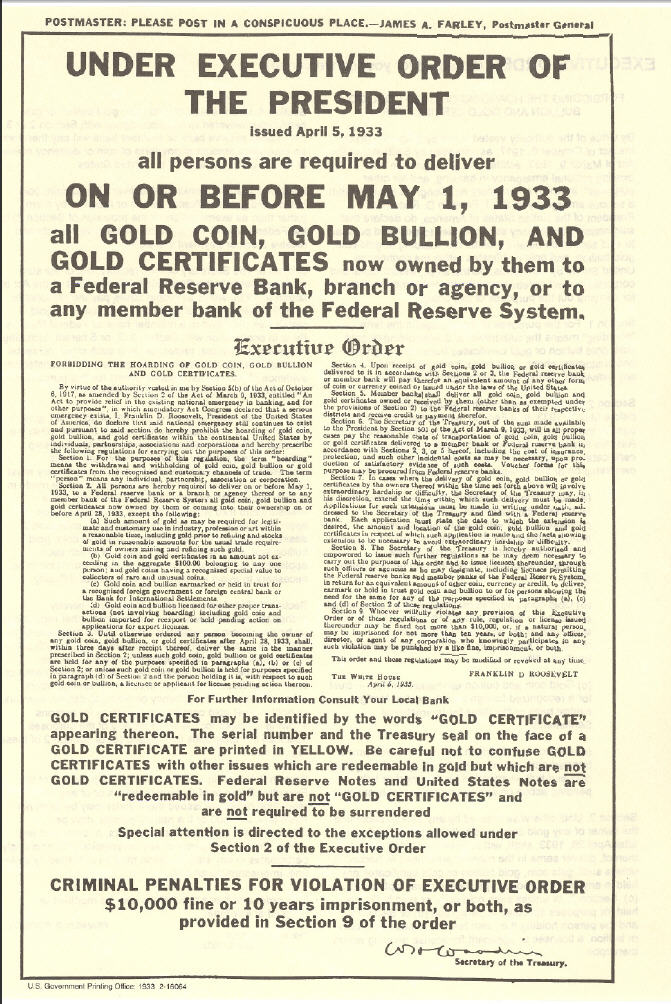
Notice of the US Executive Order 6102 of 1933: gold coins, bullion and certificates held by individuals had to be handed to the Federal Reserve Banks by 1 May. Source: Wikimedia Commons, U.S. Government Printing Office, public domain

In both cases the regime didn't rely on "backing"; it simply "took." Gold's advantage is that it can be carried and is still recognised across a border; it isn't that a regime can't take it. Whether you keep it depends on whose hands it is in and where it is.
Fleeing across the sea: buying lives with gold
In Vietnam's exodus by boat, people bought their lives with gold. This is the heaviest part of the gold story, and I'll write it separately.
Around 1978–1979, Vietnam's ethnic Chinese left in large numbers. According to reports at the time, those who wanted to leave had to pay "twelve taels of gold," split among officials, brokers and boat owners. One report of 1980 says some people first paid one tael of gold (about 3,000 dollars), with the full price about 15,000 dollars.
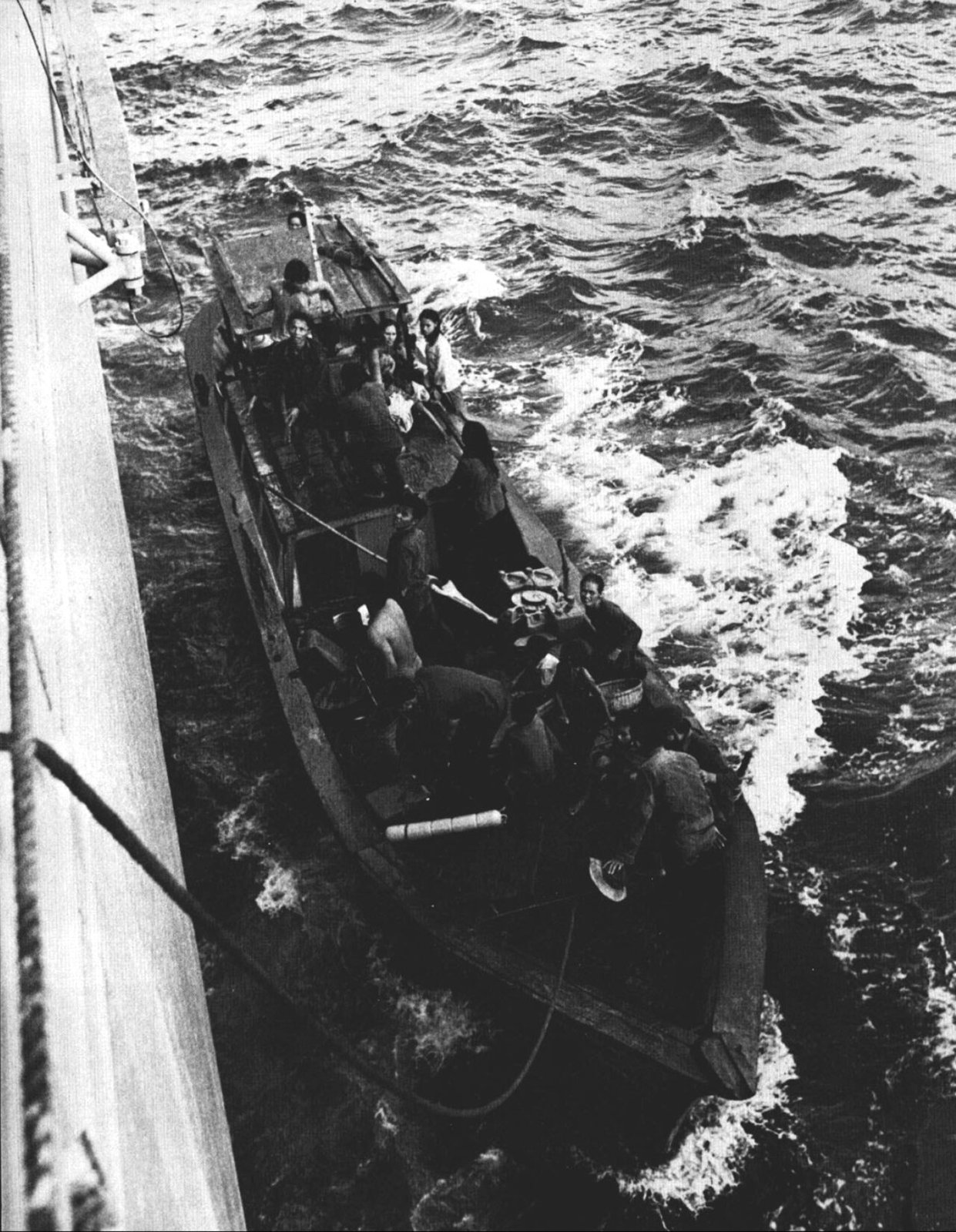
About 1979, a small boat carrying Vietnamese refugees alongside the US Navy supply ship USS White Plains. Source: Wikimedia Commons, U.S. Navy, public domain

Think about that predicament: one country's money, once elsewhere, is accepted by no one; the house and the shop at home, none of it can be taken. At that time gold was one of the few things "the other side" also recognised. It is small, light, valuable, and a small boat can carry it. What was paid to the officials and what was paid to the boat owners was the same thing.
But this example also has two sides. Among those who took the gold were officials; the money that bought lives was divided layer by layer. What it proves is that "outside the border, gold is still accepted," not that "gold protected the one who held it." Many people paid their gold, boarded boats, and did not live to reach the shore.
By the way, "twelve taels" is the standard price in the reports; it varied greatly by time, place and route, and I don't treat it as a uniform price or convert it into today's money.
What "worth something" rests on: insurance, not income
Gold pays no interest. No dividends, no coupons. For each kind of thing I ask the same question: "where does its return come from?" For gold there is only one answer: the price difference, that is, someone later being willing to pay a higher price for it.
Seen this way, it has something in common with "passing the parcel": what the next person is willing to pay decides what you hold is worth. I don't dodge that.
Then where does it differ from other "parcels"? I think in three ways. I'll put the evidence against it in too.
First, the drum has been passed for thousands of years, and those taking the parcel are special: central banks. According to the WGC, net central-bank purchases worldwide in 2022 were over 1,100 tonnes, more than twice the previous year; from 2022 to 2025 the cumulative total exceeded 4,000 tonnes, about equal to the whole previous ten years. The freezing of the Russian central bank's foreign-exchange reserves in February 2022 is often seen as the trigger of this round of gold buying, though that is an interpretation, not something counted.
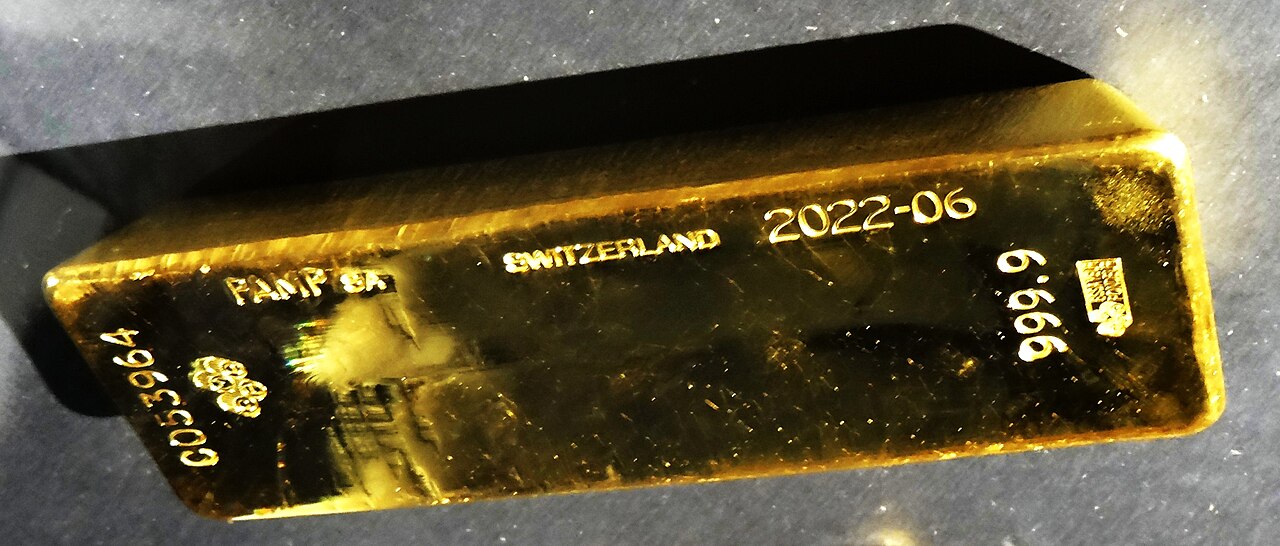
A gold bar displayed by the Banque de France on Heritage Days 2022, engraved "PAMP SA SWITZERLAND 2022-06 999.9." Source: Wikimedia Commons, Ibex73, CC BY 4.0

But this has a reverse side: in 2025 net central-bank purchases were 21% lower than the previous year, yet the 2025 average gold price still rose 44%. So you can't say "central banks are buying, so the price won't fall"; what pushes the price isn't only central banks.
Second, the evidence for "inflation hedge" and "crisis refuge" is less good than their reputation. Erb and Harvey's 2013 paper "The Golden Dilemma" examined every sense in which gold is a "hedge": against inflation, against currency moves, against low real interest rates, or as disaster insurance. The conclusion: over a few years, its record as an inflation hedge is poor; each claim explains only a small part of short-term gold-price moves; and the real gold price then was already above its historical mean, and historically, returns after such times were on the low side.
History also has a very ugly stretch: on 21 January 1980 the gold price touched about 850 dollars intraday, and by 1999 it had fallen to about 255; the nominal 850 wasn't passed until 2008, almost 28 years in between. In 2008, from the year's high to the low after Lehman's collapse, gold itself fell by about a third; in one week of March 2020 it fell 8.6%, its worst week since 1983, when everyone was grabbing cash and covering margin and selling everything.
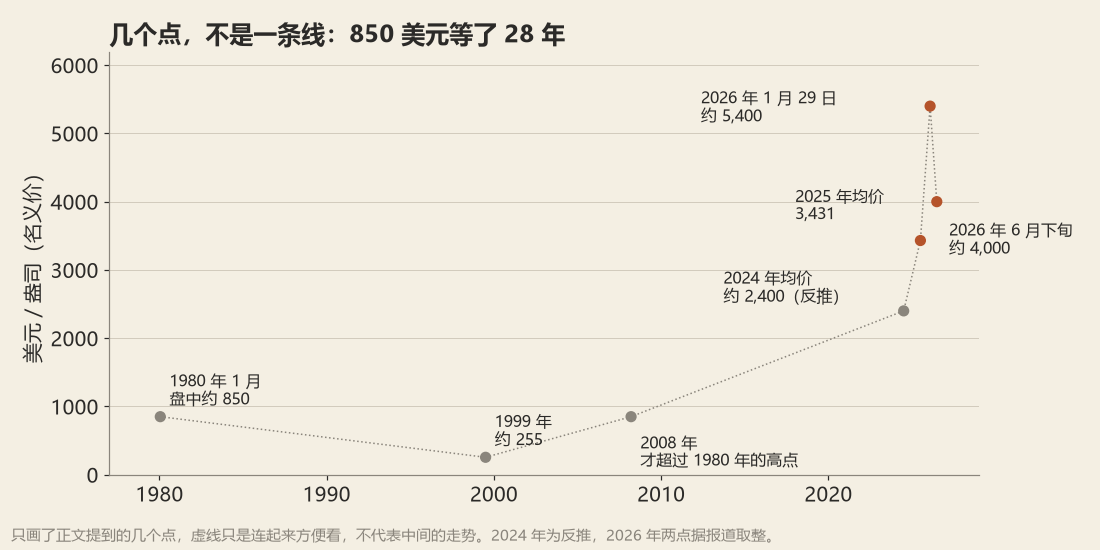
Only the points mentioned in the text are drawn; the dashed line is just for ease of viewing and doesn't represent the path in between. 2024 is back-calculated; the two 2026 points are reported and rounded.
So gold is insurance, not income.
Third, bought and then sold, the discount is small; other things have big discounts. This is a ruler I want to use to judge "passing the parcel," and I call it the discount test: buy something, sell it right back, how much do you get?
- Diamonds: according to Epstein's 1982 article "Have You Ever Tried to Sell a Diamond?", a reseller in the cases got back only about sixty percent of the wholesale price. A seller's blog from jewellers now says the resale price is about 25% to 50% of retail. That figure comes from a seller's blog, with no statistical basis, and counts only as "reportedly."
- Gold: the buy and sell prices for gold bars differ by a few percent; I didn't get official data, so I don't write a number here. That is one gap in this piece.
I bring up this ruler because the phrase "passing the parcel" can't just be used to scold other people's things. Whether it stands depends on something that can be measured.
What happened in the last two years
WGC numbers I write as fact; those from second-hand sources I write as "reportedly" and round.
Price:
- In 2025 the LBMA gold price averaged 3,431 dollars an ounce, up 44% on the year before, which means the 2024 average was about 2,400 (my back-calculation). 2025 set 53 record highs through the year, and the fourth-quarter average was 4,135.
- Reportedly, on 29 January 2026 the LBMA afternoon fix was about 5,400 dollars, the highest ever in nominal terms. Then came a steady pullback; reportedly the low of the fix in late June was about 4,000, roughly 27% below the January high. In September it was in the low four thousands.
Demand:
- Total demand in 2025 was 5,002 tonnes. ETF inflows were 801 tonnes, the second-strongest year on record; bars and coins 1,374 tonnes, of which the fourth quarter was 420 tonnes, the highest in 12 years; central banks' net purchases 863 tonnes, 21% less than in 2024, but the WGC says still at the upper edge of the expected range.
- Jewellery is the opposite: in 2025 the weight consumed fell 18%, and because the price went up, the money spent rose 18%. In the second quarter of 2026, jewellery volume fell another 17% year on year. This shows that jewellery buyers are sensitive to high prices, and that it wasn't jewellery that pulled the gold price up.
- In the second quarter of 2026, total demand was 1,269 tonnes, flat on a year earlier; central banks' net purchases 289 tonnes, 62% more than a year earlier; investment demand 262 tonnes, with ETFs seeing 45 tonnes of outflows in the quarter.
Taken together, this round was driven mainly by investment and central banks, with those buying jewellery squeezed out by high prices. The pullback after January happened while central banks were still buying, ETFs began to flow out, and jewellery was falling. Which factor matters most, I don't conclude: the WGC counts only who bought how much, and doesn't explain why the price changed.
The next two years: three possible paths
First, to be clear: I give no price levels. Below are three scenarios, what each needs, and which numbers to watch.
Base rate: this section was meant to say "in all past two-year windows, what is the distribution of gold's gains and losses." I couldn't get the LBMA historical series, so the section is left empty and I don't fill it with impressions.
Scenario A: central banks and investors both keep buying. Needs: central banks continue net buying, and ETFs see inflows again. Watch: whether central banks' net purchases, published quarterly by the WGC, can stay at about the second-quarter-2026 level (289 tonnes); whether ETFs' quarterly net flow turns positive.
Scenario B: moving sideways at a high level. Needs: investment inflows and outflows cancelling, with total demand stuck at around 1,270 tonnes a quarter. Watch: WGC quarterly total demand staying close to the second-quarter-2026 figure of 1,269 tonnes for several quarters; the gold price moving back and forth between the June 2026 low and the January high.
Scenario C: keeps giving back. Needs: central-bank gold buying going back to pre-2022 levels, ETFs continuing to see outflows, and real interest rates continuing to rise. Watch: WGC annual central-bank net purchases returning to pre-2022 levels for two years running (the exact number to be fetched); the LBMA gold price falling below the June 2026 low again; the yield on US Treasury inflation-protected securities (TIPS) rising persistently (data from the US Treasury).
Check table for two years on (compare back in October 2028):
| Signal | Source | Reading for scenario A | Reading for scenario C |
|---|---|---|---|
| Central-bank net purchases (annual) | WGC | Still in the range since 2022 | Back to pre-2022 |
| ETF holdings change (cumulative) | WGC | Net inflow | Net outflow |
| LBMA gold price vs the June 2026 low | LBMA | Above | Below |
This table is not a forecast; it only leaves something to check against two years from now.
Looking the other way
This piece has a position: gold is more like "a thing to store money in" than other things. It stands a little shakily in at least four places:
- "Gold is unaffected by regimes" is not accurate. In the US in 1933 and the Nationalist government in 1948, as soon as the regime reached out, gold was taken.
- Gold is also a "parcel." It pays no interest, its return rests only on the price difference; in the 28 years from 1980 to 2008, the drumbeat stopped.
- Central banks buying doesn't mean it can't fall. In 2025 central banks bought less and the price still rose, which shows there are other drivers in the price, and those drivers can leave too.
- For the "discount test" I use to separate gold from diamonds, I don't yet have the number for the gold end. So that distinction is so far only half standing.
My view
I still value gold. Not because it will rise, but because among the things I know, it is the one most like "storing money."
I accept the checks in the text: that gold "has industrial value," I withdraw; its value rests on the whole world accepting it, which is harder than industrial value. "More reliable than paper money" is also only half right; Roosevelt and the gold yuan both remind me that when a regime wants to take, gold is taken as well. So what I value is really that it can be "carried away": those Vietnamese families who bought their lives with gold, whose houses, shops and bankbooks overnight no longer counted, and what was finally honoured was those few taels of gold sewn into their clothes.
Diamonds, designer toys and sneakers are completely different from gold. A diamond bought and then resold supposedly has to be cut by half, and that kind of thing looks to me like a scam; designer toys and Air Jordans have no moat at all, they rely on a passing fashion, and when the fashion is over, the flower falls into the last person's hands. Gold also depends on the next person to take it, I admit that; but this drum has been passed for thousands of years, and among those taking the parcel are central banks. That is where I draw the line.
I also remind myself: gold is insurance, not a thing that makes wealth. It doesn't pay me interest, and there was a stretch when you'd wait 28 years. Valuing it doesn't mean I should change all my money into it.
Is there something in your family that, "when the day really comes," can be carried away?
References
Ratings: 🟢 original read; 🟡 second-hand, written in the text as "reportedly" and rounded.
- World Gold Council (WGC), Gold Demand Trends, full year 2025 and Q2 2026; above-ground stock and mine production 🟢
- The Silver Institute, World Silver Survey 2026 (2025 industrial demand) 🟢
- US Executive Order 6102 (5 April 1933); the ban on private gold holding lifted 31 December 1974 🟢
- The Nationalist government's Emergency Economic Measures Decree and the issue of the gold yuan (19 August 1948), with deadlines for exchanging gold, silver and foreign currency 🟡
- Reports on ethnic Chinese in Vietnam paying gold to leave in 1978–1979 ("twelve taels," the 1980 report of one tael at about 3,000 dollars and a full price of about 15,000) 🟡
- Erb, C. B. & Harvey, C. R. (2013), "The Golden Dilemma," Financial Analysts Journal 🟡 (abstract and secondary accounts)
- Gold prices in 1980, 1999 and 2008; drawdowns in 2008 and March 2020 🟡
- Epstein, E. J. (1982), "Have You Ever Tried to Sell a Diamond?", The Atlantic 🟡 (original page not accessible); jewellery-trade seller blogs on resale prices 🔴
- LBMA fixes of January and June 2026, as reported 🟡