What this series is about
The Neighbours' Heaven is about the neighbours.
The Korean peninsula, Japan, Vietnam, Ryukyu, Taiwan, and the East Asian communities scattered around the world. They read much the same books we did and honoured much the same ancestors. Under pressure from outside and under the weight of their own states, each of them kneaded Confucianism, Buddhism, Daoism, Shinto and Christianity into something different. Some of those things survived. Some fell. Some were taken up by a state, used, and then broken apart by that same state.
I want to look at them one by one: how their religions and their states came together, how they came apart, and how they survived.
I am writing two other series at the same time. Yigui is about China itself, from 1644 onwards. Duoshe looks across the world's civilizations and religions side by side. This one looks only at the neighbours, with the Chinese side of the comparison brought in where it helps. Where two pieces should be read together, I put a pointer at the end rather than repeat the other piece's history.
Let me be clear: I am not visiting the neighbours to gawk. I come with a leaning.
A conversation partner with no position
I use AI a lot for research. After a while I noticed something. It looks most thorough and most objective precisely because it has no position. It can make every view sound convincing because it doesn't have to carry any of them.
People are not like that. Each of us reads history carrying where we come from, what we worry about, and what we want to protect. If I took the hardest evidence to pull other people's views apart while pretending I had no instincts of my own, that would be a different kind of dishonesty.
So in this first piece, I put my leaning on the table.
My leaning
My leaning is this: the future of East Asians may depend on Confucianism becoming a religion.
For now I call it "Tiandao", the Way of Heaven.
For its symbol I'd like the seal-script form of the character 天, tian, "heaven". In the Shuowen Jiezi, the dictionary Xu Shen compiled in the Eastern Han, the entry reads: 天,颠也。至高无上,从一大。"Tian is the crown of the head. Highest, with nothing above it. It is made of 一 (one) and 大 (a person standing large)." (My translation.) In seal script, 天 is a person standing with arms and legs spread, with one stroke across the top. Above a person's head is heaven.
I like this character because it is not the image of a god. It is a person, and the thing above their head.

天 in seal script: a person standing with arms and legs spread, one stroke above the head. Source: Wikimedia Commons, Public domain

The Way of Heaven I want is the one in the line "Heaven moves with vigour; the gentleman, likewise, strengthens himself without rest" (天行健,君子以自强不息). It is constancy. It is an order that makes people feel awe and also hold themselves to account, not an object that asks for blind fervour.
Where the leaning comes from
This leaning didn't come out of nowhere. In my reading I kept running into the same kinds of things.
First, religions last through boundaries and community. Jains are only about four in a thousand of India's population, yet they have lasted more than two and a half thousand years. When the Jews lost their Temple, they packed a whole nation into a book. Being few is not necessarily dangerous. Blurred boundaries are.
Second, East Asian religiosity has no organization. The sociologist C. K. Yang called Chinese religion "diffused": it is spread through family, lineage, festivals and state ritual, with no church of its own. It is everywhere, but once cities scatter the family, it scatters too. Qingming, the grave-sweeping day, is still there; the ancestral hall is gone. In East Asia, Buddhism works like a wishing well: you burn incense when something comes up and forget it otherwise. Between 2010 and 2020, East Asia had about 32 million fewer Buddhists.
Third, something I can't make peace with: voice. According to W3Techs in June 2026, among all websites whose content language can be identified, English accounts for about 49.7%, Japanese about 5.0%, and Chinese only about 1.2%. That count covers only public websites, not closed platforms like WeChat. But that is part of the problem: many long, serious pieces written in Chinese simply can't be found by the world's search engines. People whose mother tongue is Chinese are about one-seventh of humanity, yet on the open internet you can barely hear them think, and this is especially true of Simplified Chinese.
A culture with no organization and no voice: what does it live on? My instinct is that it needs something that can bring people together, cross borders, and give people both belonging and self-discipline. In the East Asian tradition, the closest thing to that is Confucianism. But Confucianism never grew a "church" of its own.
By the rules, take it apart
The rule I've set for this series is that every instinct I like has to face the hardest evidence that could overturn it. My leaning is no exception. Here are the five hardest counter-examples I have right now. Later pieces will open them up one by one.
Counter-example one: the Confucian Church failed. In 1912, Chen Huanzhang, Kang Youwei and others founded the Confucian Church (Kongjiao Hui) in Shanghai. In 1913 and again in 1916 they petitioned to make Confucianism the state religion of the Republic of China, and failed both times. The New Culture Movement then turned "Down with the Confucius shop" into a slogan for a generation. People tried to turn Confucianism into a religion more than a hundred years ago, and they were the most learned people of their time.
Later I read more closely and found something that matters more to me. What the Confucian Church actually produced was rites for honouring Confucius, annual meetings and periodicals. Weekly gatherings, membership rolls, a daily life handed down from one generation to the next: I found none of that. Even the "church" Kang Youwei imagined was never built. So its failure only shows that one version doesn't work: relying on the state and the constitution, tied to the monarchy, with no everyday believers. It doesn't yet show that making Confucianism a religion is impossible. I go into this in Yigui. (This rests on secondary studies; I have not read the primary archives.)
Counter-example two: State Shinto. After the Meiji Restoration, Japan reshaped Shinto into a faith of the state. Shrines were run by the state, and worship of the emperor entered the schools. It really did bind a people together, and it was also bound up with militarism. In December 1945 the occupation authorities issued the "Shinto Directive", cutting the tie between Shinto and the state. When a tradition is remade into a state religion, its power and its danger come from the same place.
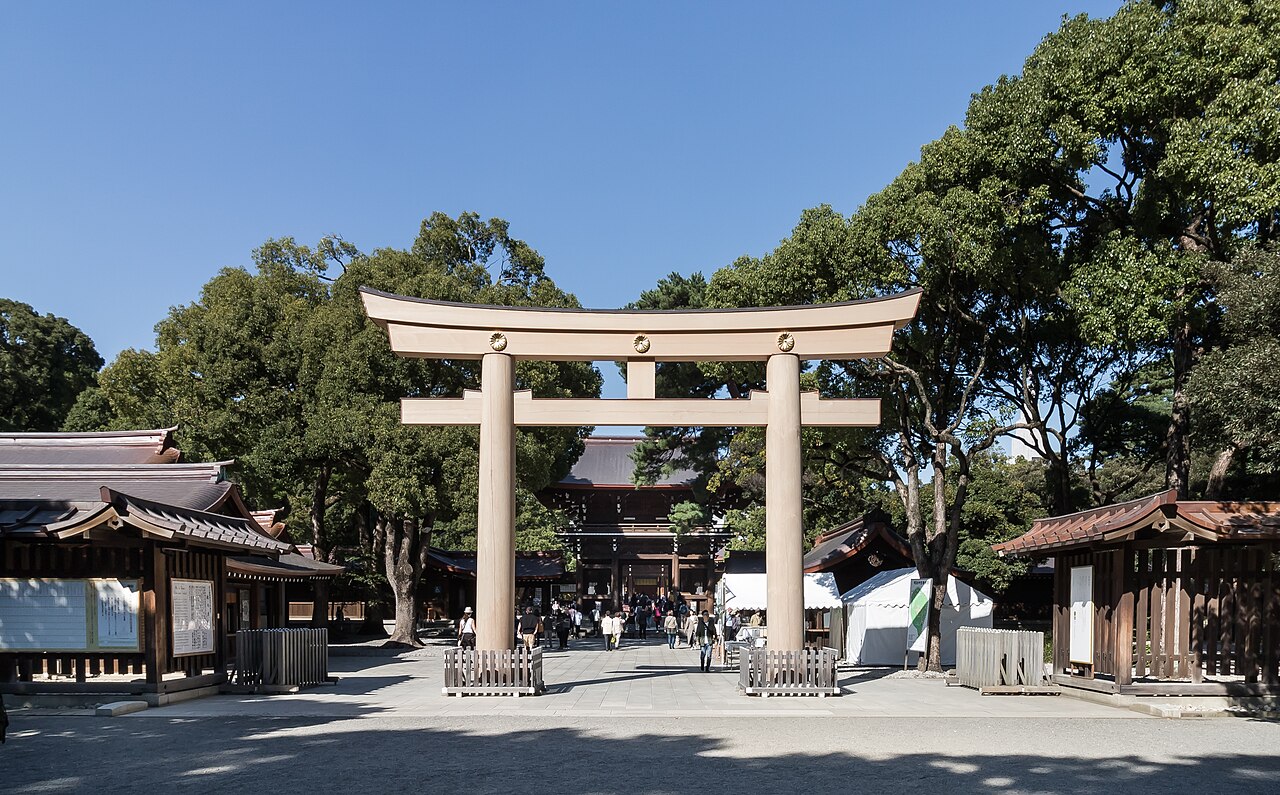
The torii of Meiji Shrine, Tokyo. The shrine was built for the Meiji Emperor and completed in 1920. Source: Wikimedia Commons, Kakidai, CC BY-SA 4.0

Counter-example three: Confucianism in Indonesia. In Indonesia, Confucianism really was made into a religion: it has temples, clergy, scriptures and rites, and you can write it on your identity card. But today it is a very small minority, and it became a religion because a system that required everyone to have a religion forced it to. (I wrote about this in Duoshe.)
Counter-example four: Iran. In a state led by religious scholars, the religious authorities first urged people to have fewer children, then urged them to have more. The birth rate listened only to the first half. If I hope religion can help East Asia out of low fertility, Iran is a cold reminder. (Also in Duoshe.)
Counter-example five: a religion with the same name. Only when I chose the name did I discover that Korea has had a religion called Cheondogyo, written with the same characters, 天道教, since 1905. It is not what I mean, but its rise and fall are worth looking at. It grew out of Donghak, the "Eastern Learning" of the nineteenth century. Its third leader, Son Byong-hi, renamed it Cheondogyo and built a modern religious organization. It was one of the backbones of the March First Movement in 1919. It was once powerful; today it has few believers. A home-grown East Asian religion named for the Way of Heaven really did exist, and really did rise and fall. The next piece is about it, and also separates it clearly from what I mean.
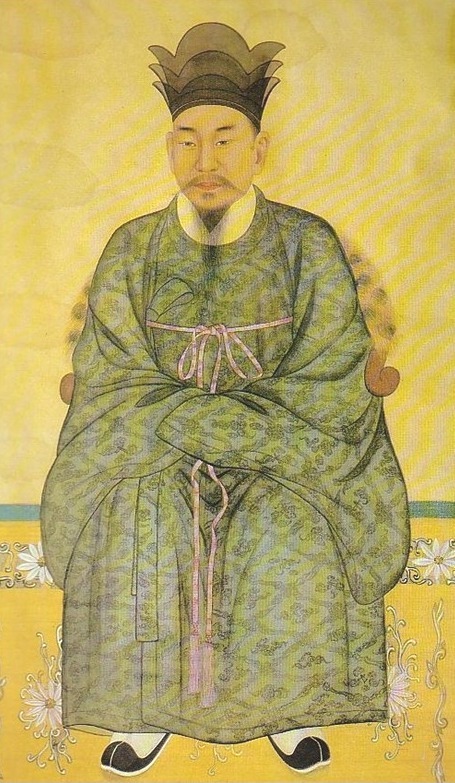
Choe Je-u (1824–1864), founder of Donghak. Source: Wikimedia Commons, unknown author, Public domain

Who I mean by "East Asians"
When I say "East Asians", I mean the whole pan-Confucian world of East Asia: China, Japan, the Korean peninsula, Vietnam, and their descendants scattered around the world. People who read the same Four Books, honoured much the same ancestors, and every year, on much the same days, add a handful of earth to much the same graves. It is only a name. I don't use it to explain anything, and I will never write "because they are East Asian, therefore…".
The people I want to talk to are the ones among them who know things, who think deeply, who can understand.
Taken as a whole, this group is weak and its voice is faint, and mainland China and the Simplified Chinese world most of all. It isn't that nobody is thinking. It's that once they've thought it through, they write it somewhere search engines can't reach, and it sinks along with that day's trending topics.
A few rules
- Every fact comes with a source. If I can't give a source, it doesn't go up.
- Every piece has a section called "The other way round", which takes the strongest argument against me, and doesn't turn it into a straw man.
- I will say plainly where I stand, and mark which parts are my opinion and which are history.
- I write about ideas, history and costs, not about how to set up a religion.
- On living politicians and current politics, facts are facts and judgments are judgments; I keep them apart, and I take responsibility for my own judgments.
- I write in Chinese and I'm looking at the neighbours from outside, so there are things I can't see. If you live there, please tell me where I've got it wrong or slanted.
What comes next
Next, I'll keep testing this leaning against other people's cases: Korea, Japan and Vietnam each had their own Way of Heaven, and each met its own end.
It starts with the next piece: a religion called Cheondogyo, which appeared in Korea more than a hundred years ago. Then Japan's State Shinto, Vietnam's Cao Đài, and on the Chinese side, why the Confucian Church failed and what the character 天 really means. I'll write several pieces on Korea, because after modernization it is the neighbour whose rituals are still most alive, and the one most worth asking.
The rest I'll take as I come to it.
A word to the neighbours. If you've read this far, and you are in Seoul, Tokyo, Hanoi, Taipei or Naha, or in Singapore, Jakarta or San Francisco, or anywhere else in the world, let me start with something small. Is there, in your family too, an ancestral tablet, or an old photograph, and one day every year when you have to go back and stand in front of it? You've never called that "religion", have you? Maybe you've never recited a single scripture in your life, but you know that on that day you can't not go back. That is what this series is about. We have no common church and no common name, but we have days that are almost the same, characters that are almost the same, and a reverence, almost the same, that we're a little shy to say out loud. They are slipping away one by one, and I can't accept that. I want to walk to your doors one at a time and see how you kept them, how you lost them, and how you picked them up again. Not to teach you anything. To listen, and to ask: could we think about this together?
Objectivity is a method, not a personality. I can use the hardest evidence to take my instincts apart, but I don't have to pretend I have none.
If you had to design a way for your own civilization to survive, what would you choose?
References
- Xu Shen, Shuowen Jiezi, entry for 天
- W3Techs, "Usage statistics of content languages for websites", June 2026 (public websites only)
- Cheondogyo (천도교): Son Byong-hi renamed Donghak as Cheondogyo in 1905; the March First Movement, 1919
- Helen Hardacre, Shinto and the State, 1868–1988, Princeton UP, 1989; the "Shinto Directive", December 1945
- Confucianism in Indonesia: 1965 / 1967 / 2000
- What the Confucian Church built and did: see the Yigui piece "To Sacrifice to Confucius Is to Break the Law; Not to Is to Betray the Religion" and the author's research notes behind it (secondary studies; primary archives not read)
- Meiji Shrine founded 1 November 1920 (Taishō 9): Meiji Jingu official site https://www.meijijingu.or.jp/about/ 🟢
- Image sources are given in each caption
- Abbasi-Shavazi et al., The Fertility Transition in Iran, 2009
- C. K. Yang, Religion in Chinese Society, 1961
- Pew Research Center, 2025 and 2026 reports (change in numbers of Buddhists in East Asia)
- Founding of the Confucian Church in 1912 and the state-religion petitions of 1913 and 1916: standard history