A clash of names
In the last piece I said my leaning is towards turning Confucianism into a religion, and that for now I call it "Tiandao", the Way of Heaven.
After choosing the name, I looked it up. And found that in 1905 Korea already had a religion written with exactly the same characters, 天道教: Cheondogyo, "the Religion of the Heavenly Way". It had a constitution, churches, newspapers and schools. Korea's Declaration of Independence in 1919 carried 33 signatures; 15 of the signers were its believers, and the first name on the list was its leader's.
Today, it has very few followers in South Korea.
The names clash. But it is obviously the thing I most need to look at carefully. Whether our roads clash too, I'll say after looking.
Donghak: an answer in one word
The story starts in 1860.
That year a Korean scholar named Choe Je-u said he had received a mandate from Heaven. He came from a yangban (aristocratic) family, but because of his birth he was barred from the civil-service examinations, and he spent most of his life wandering. He called his teaching Donghak, "Eastern Learning". The name itself was an answer: Western Learning has arrived; we have Eastern Learning.
What he taught was not complicated. Heaven is not far away; it is inside every person. To serve Heaven is to serve that small thing inside your own heart. The poor could understand it, and they took it in.
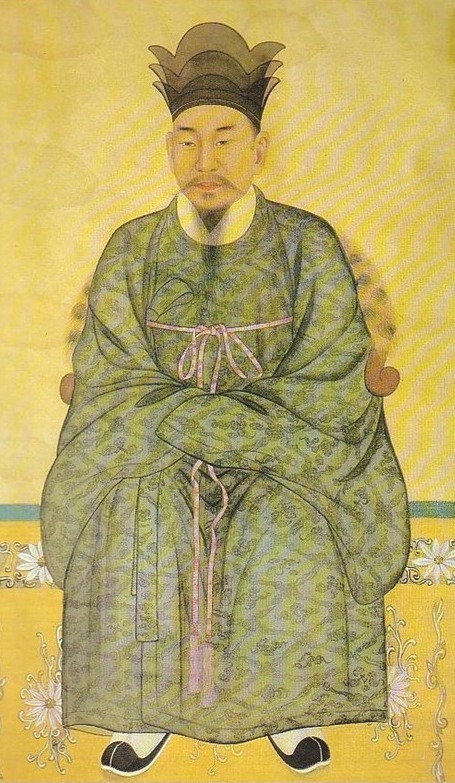
Choe Je-u (1824–1864), founder of Donghak. Source: Wikimedia Commons, unknown author, Public domain

The court saw it differently. In 1864 Choe Je-u was executed.
When I read this, he always seems a little lonely to me: a man shut out of the examinations, on the road for most of his life, who in the end left behind one sentence the poor could understand, and his life.
That same year in China, Hong Xiuquan died and the Taiping capital at Nanjing fell. Two East Asian religions born under the Western impact, one that borrowed the Western God and one that insisted on calling itself "Eastern Learning", lost their founders in the same year.
1894
Donghak did not die. Its second leader, Choe Si-hyeong, compiled Choe Je-u's words into scriptures, and the movement spread further and further among ordinary people.
In 1894, peasants in Jeolla province rose under Donghak banners: against corrupt officials, against crushing taxes, and against foreigners. The court could not put them down and asked the Qing for troops. Japan, citing a treaty, sent troops too. The uprising was soon crushed, but the two armies stayed in Korea. A few months later, Qing China and Japan went to war on someone else's land.
That was the First Sino-Japanese War.
So one of the sparks of the Sino-Japanese War was a religion. Chinese history lessons rarely mention this, probably because, in China, that war was never really about Korea.
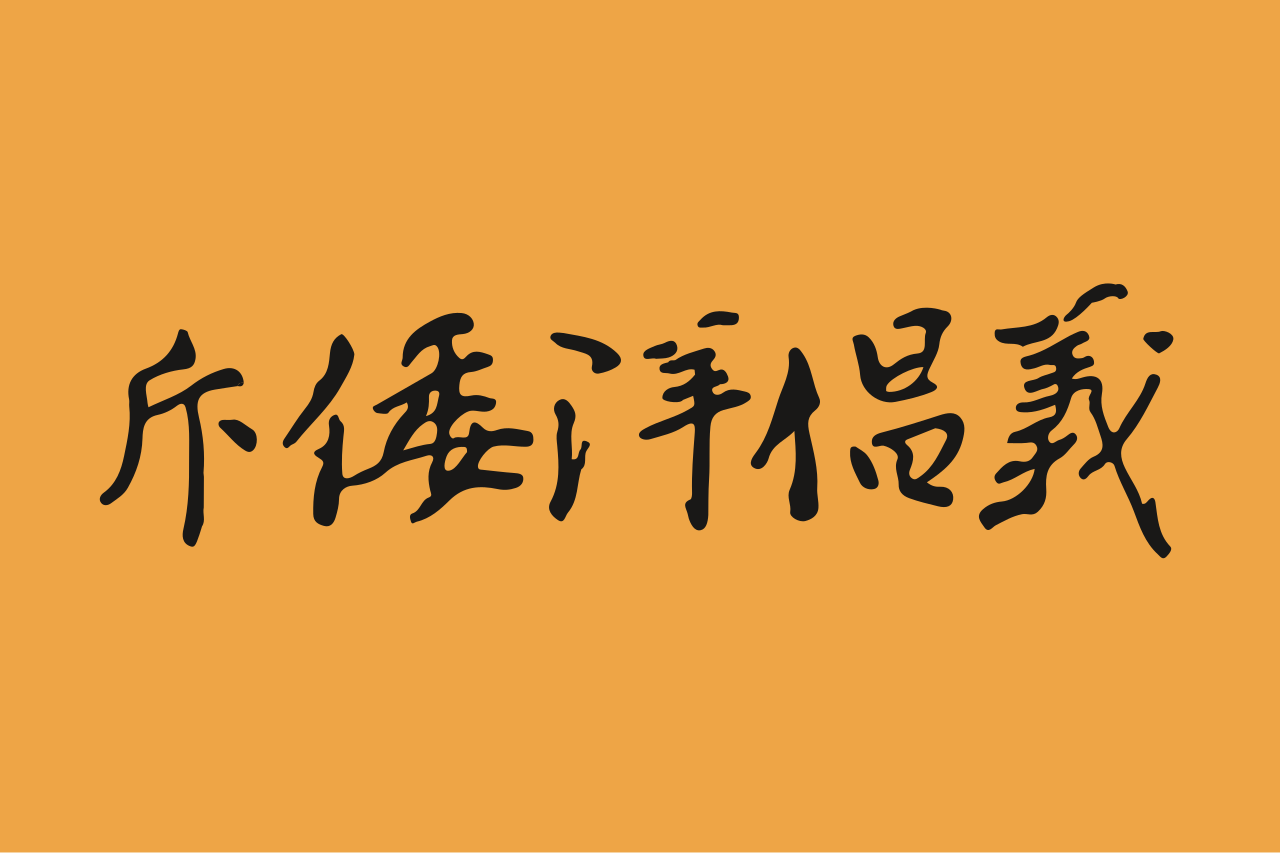
Flag of the Donghak Peasant Revolution, written in Chinese characters. Source: Wikimedia Commons, Samhanin, CC0

One of the uprising's leaders was Jeon Bong-jun. In February 1895 he was brought under guard into Seoul. In the photograph he lies on a stretcher, carried, surrounded by people in winter clothes and snow. He was later executed. Every time I look at that photograph, it doesn't look like a "rebel" to me. It looks like a man who is frozen through.
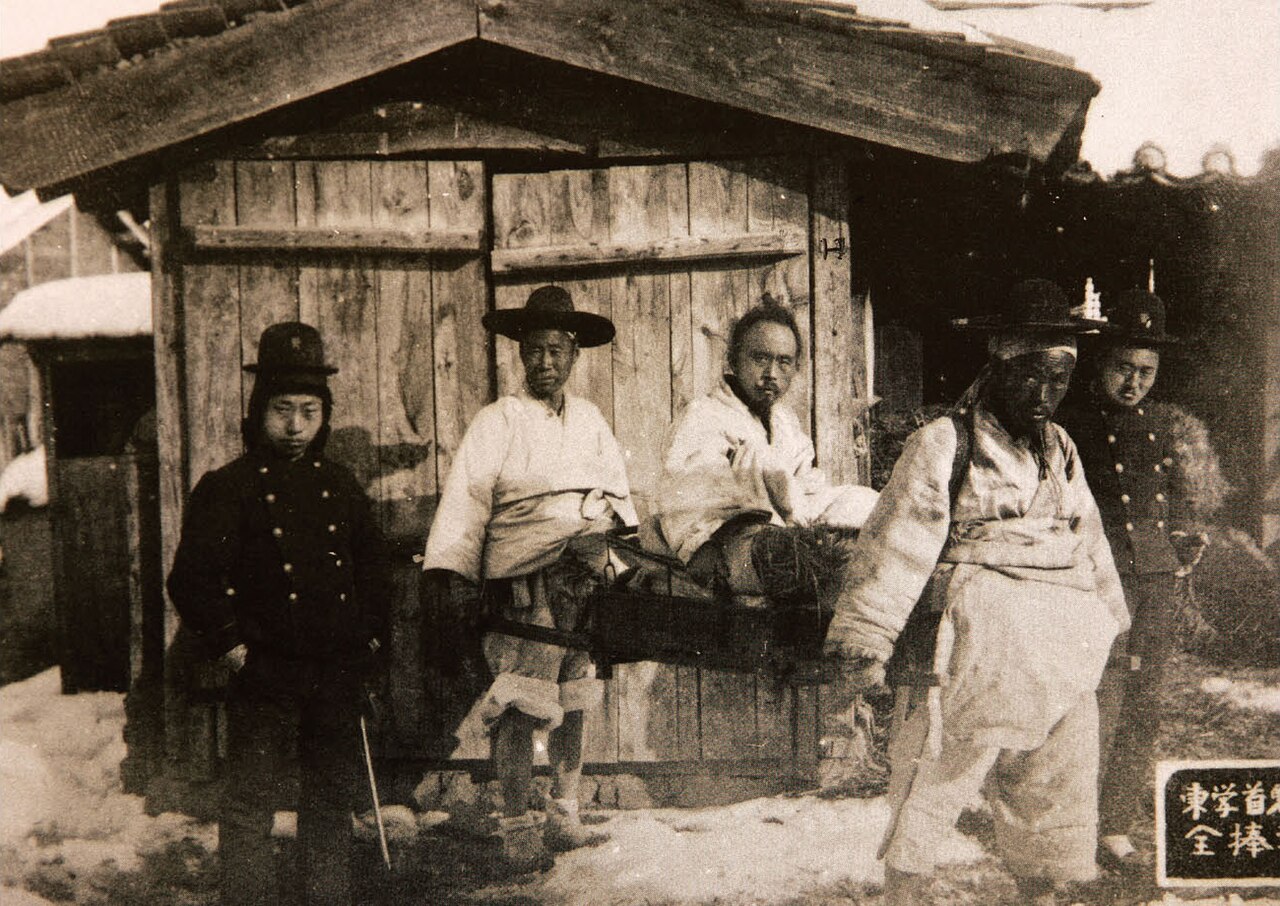
February 1895: Donghak leader Jeon Bong-jun under arrest, lying on a stretcher, carried, with uniformed soldiers standing by. Source: Wikimedia Commons, Murakami Tenshin, Public domain

In 1898 Choe Si-hyeong was executed too.
Cheondogyo: turning an uprising into a church
The third leader, Son Byong-hi, took a different road.
In 1901 he went into exile in Japan, and there he saw how a modern state worked. On 1 December 1905 he formally renamed Donghak as Cheondogyo. The next year he issued a constitution for it, set up a central organization, and opened schools and newspapers. He turned a failed peasant uprising into a modern religion with rules, structure, and the ability to deal with officialdom.
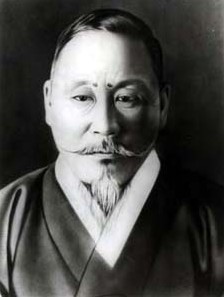
Son Byong-hi (1861–1922), third leader of Cheondogyo. Source: Wikimedia Commons, unknown author, Public domain

Its teaching was later condensed into three characters: innaecheon (人乃天), humans are Heaven.
The symbol I picked for my own idea is the seal-script 天: a standing person with one stroke above the head. They took that stroke away.
1919
On 1 March 1919, in a restaurant in Seoul, the 29 national representatives who had come read out a Declaration of Independence. The declaration carried 33 signatures: 15 Cheondogyo believers, 16 Christians and 2 Buddhists; a few signers could not make it. Son Byong-hi signed first.
The March First Movement then swept the Korean peninsula and was brutally suppressed by the Japanese colonial authorities. Son Byong-hi was arrested, later released on medical bail, and died at home in 1922.
This was Cheondogyo's brightest moment. A religion that grew out of East Asian soil, named for the Way of Heaven, stood at the very front of a nation.
The other end
But the same movement produced another group of people.
In 1904 one branch of Donghak merged into the Iljinhoe, the "Advance in Unity Society". In 1906 Son Byong-hi expelled its leader, Yi Yong-gu, from the faith. In 1909 the Iljinhoe led a petition asking Japan to annex Korea.
One religious body: at one end, the first signature on the Declaration of Independence; at the other, people asking to be annexed.
I don't want to tell this as a story of "traitors" and "heroes". What matters more to me is this: once a religion is tied to politics, it gets carried in directions it cannot control. The same "Heavenly Way" can be used to resist the colonizer, and to argue for submitting to him.
After rescue
In 1945 the Korean peninsula was liberated, and then divided.
In the North, Cheondogyo survives as a nominal political party. In the South, its followers are very few: in a population of fifty million, almost invisible.
Why didn't it grow into a great religion? Researchers have offered many explanations. I'll just give my own guesses.
First, it was tied too tightly to the nation's fate. When the nation was in danger, it was the spark. Once the nation was saved, it hadn't worked out what else it could be. If a religion only answers "how do we keep our country from dying", then when the country is safe, nobody asks that question any more.
Second, when cities grew, someone else got there first. In a few decades South Korea went from a rural society to an urban one, and the people leaving their villages needed a new community. That place was taken by the churches. At night in Seoul today, what stands out most are the red crosses.
Third, "humans are Heaven" may be too close to what modern people already believe. Equality, human dignity: once a whole society accepts these, a religion built on them struggles to show what it offers that can't be found elsewhere. It's the same story as Buddhist meditation being taken over by secular society.
The churches got there first
Let me dig a little deeper into the second guess: how did "the churches took the place" actually happen?
Christianity didn't arrive in Korea late. In 1784 a Korean who had been baptized in Beijing set up the first place of prayer in Seoul. It was banned by the court, and there were major persecutions in 1801, 1839 and 1866. For 1866, an old account says eight thousand died; the encyclopedia of the Academy of Korean Studies considers that an exaggeration from hearsay, with about 1,400 recorded martyrs. Nine French priests were also killed. Protestantism came only after 1883. It followed a policy of "self-supporting, self-governing local churches", and the churches ran schools and hospitals as well. In 1907 there was a "Great Revival" in Pyongyang; among the signers in 1919 were 16 Christians. Later scholars explain it this way: anti-Japanese nationalism, modernization and education, literacy in Hangul spreading to ordinary people, and the idea that "everyone is made in God's image", which shook the Confucian hierarchy.
In the 2015 census, Protestants were 19.7%, Buddhists 15.5%, Catholics 7.9%, and people with no religion 56.1%. (Another survey gives 31% for 2024, measured differently, so I don't put them side by side.)
There's one detail here that hurts more than the numbers. Korean Protestantism asked believers to stop performing ancestral rites, to stay away from the offering table. Only later did they come up with the "memorial service", gathering on the anniversary of a death to hold a worship service, described as remembrance, not sacrifice. I wrote about this in Yigui. What I want to say is this: the churches took the place not only because they arrived first, but because they gave people who had left their villages a new "home". It's just that this home asked them to put down part of the old one.
It is not the same as what I mean
Same name, different road. So that nobody mixes them up, here are the differences:
| Korea's Cheondogyo (천도교) | The Tiandao I mean | |
|---|---|---|
| Where it comes from | Donghak: a home-grown new religion of 19th-century Korea, blending Confucianism, Buddhism, Daoism and folk belief, born in answer to "Western Learning" | Confucianism becoming a religion: growing out of the Four Books, ancestral rites and the Mandate of Heaven |
| Where Heaven is | Innaecheon: humans are Heaven | "Made of 一 and 大": above a person's head there is still Heaven. Heaven moves with vigour, it is constant, it inspires awe and self-discipline |
| For whom | The Korean nation and its independence | The whole pan-Confucian world of East Asia, the people I call East Asians |
| Today | Very few believers in South Korea | Still only an idea |
From here on in this series, whenever I mean the one from the Korean peninsula, I'll call it Cheondogyo.
Reminders to myself
Having written this far, I have three new reminders for my own idea:
- A religion that wants to outlive a crisis can't only answer the crisis's questions.
- The closer it gets to politics, the more likely politics carries it off, in whatever direction, not of its choosing.
- It needs something that secular society can't take away.
As for what that something is, I don't know yet.
After writing this I thought of one more thing. The "something secular society can't take away": the best I can come up with now is everyday life. If a religion is only useful for big things, remembered only when the nation is in danger or when there's a choice to make, then once the country is settled, it will be taken away. But if it has a place in every single day, sweeping the graves at Qingming, honouring the ancestors at New Year, thinking of Heaven for a moment before a meal, no modern society will come to "take" these things, because they aren't claims; they are days. Cheondogyo's great difficulty was that its place was in "claims", not in the days. What I want should be the other way round: first the days, then the claims.
To my Korean friends. On 1 March 1919, in a restaurant in Seoul, Son Byong-hi was the first to put his name on the Declaration of Independence, and of those thirty-three names, fifteen were people of your Cheondogyo. They knew what signing would mean. Go back a little: Choe Je-u could never take the examinations, and was executed at forty; Jeon Bong-jun was carried into Seoul on a stretcher, with snow all around; Son Byong-hi, after being released on bail, died in his own house. I am a writer in Chinese. Not one of these people appeared in my textbooks; I got to know them one by one only after I grew up. It is true that your Cheondogyo has few believers today. But in the coldest years of a nation, it was the one that stood at the front. I named my own idea "Tiandao" and the name clashed with yours. I didn't come to take the name. I came to learn from you.
Is a religion that is only useful when the nation is in danger still a religion?
References
- Read alongside: the Yigui pieces "A Regime That Wanted to Burn Confucius and Mencius" and "Who Chose the Word 'Shangdi'" (the Taiping response, same era); in this series, "What Is Heaven?" (innaecheon versus "made of 一 and 大")
- Carl F. Young, Eastern Learning and the Heavenly Way: The Tonghak and Ch'ŏndogyo Movements and the Twilight of Korean Independence, University of Hawai'i Press, 2014
- Cheondogyo timeline: 1860 Donghak; 1864 Choe Je-u executed; 1894 Donghak Peasant Revolution; 1898 Choe Si-hyeong executed; 1904 Iljinhoe; 1905-12-01 renamed Cheondogyo; 1906 Yi Yong-gu expelled; 1909 Iljinhoe annexation petition; 1919-03-01 Declaration of Independence (Cheondogyo 15 / Christian 16 / Buddhist 2); 1922 Son Byong-hi dies
- Pew Research Center, "Why is Buddhism shrinking worldwide?", 2026-03-11 (for "taken over by secular society")
- How Korea became Christian: Yi Seung-hun baptized in Beijing in 1784 and returned to preach; in the 1866 Byeongin persecution 9 of 12 French missionaries were executed: Wikipedia, "Catholic Persecution of 1866" 🟡
- Martyrs of the 1866 Byeongin persecution ("eight thousand" is an exaggeration; about 1,400): Academy of Korean Studies, Encyclopedia of Korean Culture, "병인박해" https://encykorea.aks.ac.kr/Article/E0023139 🟡
- Religion in the 2015 South Korean census (Protestant 9.68 million, 19.7%; Buddhist 15.5%; Catholic 7.9%; no religion 56.1%): Korea Times, 2017-01-10, citing Statistics Korea https://www.koreatimes.co.kr/amp/lifestyle/others/20170110/more-koreans-now-non-believers-census-shows 🟡
- Image sources are given in each caption