One directive
On 15 December 1945, Allied General Headquarters issued a directive, SCAPIN 448. Its title is long: "Abolition of Governmental Sponsorship, Support, Perpetuation, Control, and Dissemination of State Shinto (Kokka Shinto, Jinja Shinto)".
It was drafted by William Bunce, an officer in the US Naval Reserve. As the Allies saw it, what they called "State Shinto" was Shinto twisted into a propaganda tool for militarism and ultra-nationalism.
After the directive, shrines were no longer funded by the state, and schools no longer held Shinto ceremonies. The state and the shrines were cut apart.
What had happened in the decades before?
First, separate shrines from temples
Before the Meiji Restoration, Japan's gods and buddhas had long been mixed together. There were buddhas in shrines and gods in temples; monks and shrine priests were often the same people.
In 1868 the new government ordered the "separation of gods and buddhas" (shinbutsu bunri), forcing the two apart. In some places a wave of destruction of Buddhist temples followed.
Think of the people in those temples. They and the shrine priest next door had chanted together and kept the festivals together; then an order came saying you are two households now, separate. In many places ordinary people woke up one day not knowing which side they were supposed to burn incense at.
The new nation needed something to gather people's hearts around the emperor. It chose Shinto.
"Shrines are not religion"
Japan wanted to become a modern state, and a modern state promises freedom of religion.
The Meiji Constitution of 1889 guaranteed freedom of religion in Article 28, but with limits: so long as it did not disturb peace and order, and did not go against the duties of subjects.
To make everyone worship at shrines while still claiming to guarantee freedom of religion, there was only one way: declare that shrines are not religion.
In 1882 the Home Ministry ruled that shrine priests could no longer also serve as "national instructors" preaching doctrine. Shrines were carved out by regulation. What they performed were rites of the state, "the etiquette of the people", not "religion". Scholars later called this arrangement the theory that "shrines are not religion" (jinja hishūkyō ron).
In 1890 the Imperial Rescript on Education was issued. The Rescript and the emperor's portrait became the centre of school ceremonies.
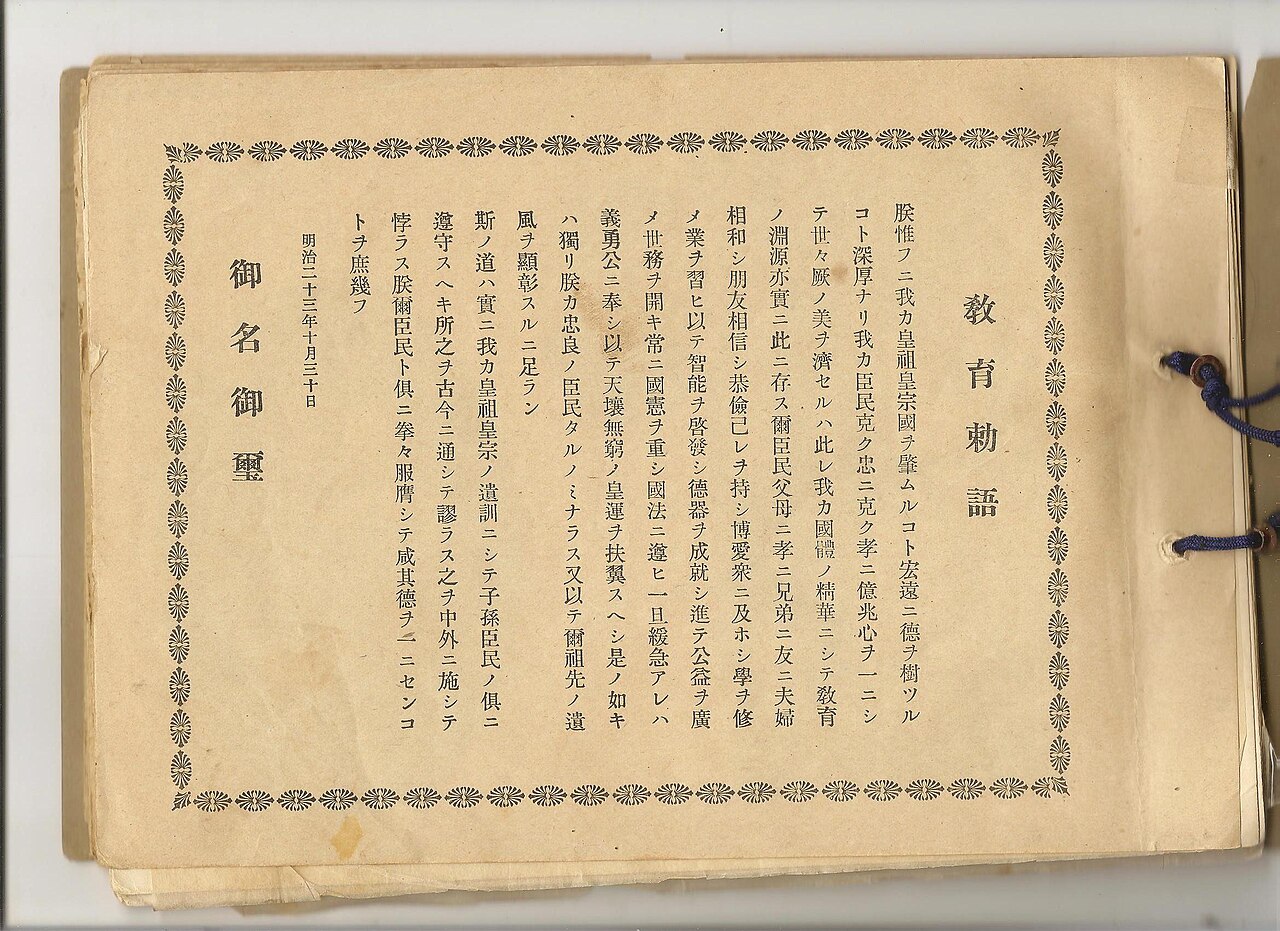
The Imperial Rescript on Education, 1890. Together with the emperor's portrait, it later became the centre of school ceremonies. Source: Wikimedia Commons, Inoue Kowashi et al., Public domain

Someone who would not bow
On 9 January 1891, at the First Higher Middle School in Tokyo, during a ceremonial reading of the Rescript on Education, a part-time teacher, Uchimura Kanzō, did not bow deeply to the Rescript.
He was a Christian.
The newspapers picked it up, and it became a national affair. Uchimura was forced to resign. The philosopher Inoue Tetsujirō wrote a series of articles arguing that Christianity was incompatible with a Japanese subject's duties to the emperor.
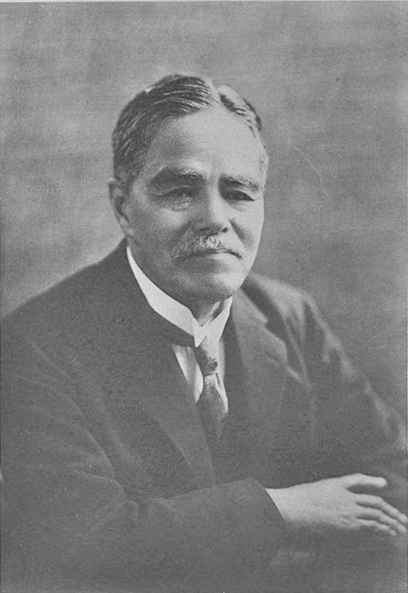
Uchimura Kanzō (1861–1930). Source: Wikimedia Commons, photographed by Masumoto Shigeo and Fujisawa Otokichi, Public domain

The definition "shrines are not religion" turned a bow into a test: are you Japanese?
A man who wasn't trying to rebel, who simply didn't make that one deep bow, lost his job and became, on everyone's lips across the country, "disrespectful". Reading this, I feel tired on his behalf.
The war years
By the 1930s, the "national polity" (kokutai) was stressed more and more, and shrine worship looked more and more like an obligation.
In 1943 Makiguchi Tsunesaburō, later remembered as one of the founders of Sōka Gakkai, refused to accept a kamifuda, a shrine talisman. He and other leaders of the group, including Toda Jōsei, were arrested as "thought criminals".
On 18 November 1944, Makiguchi, then in his seventies, died in Sugamo Prison in Tokyo.
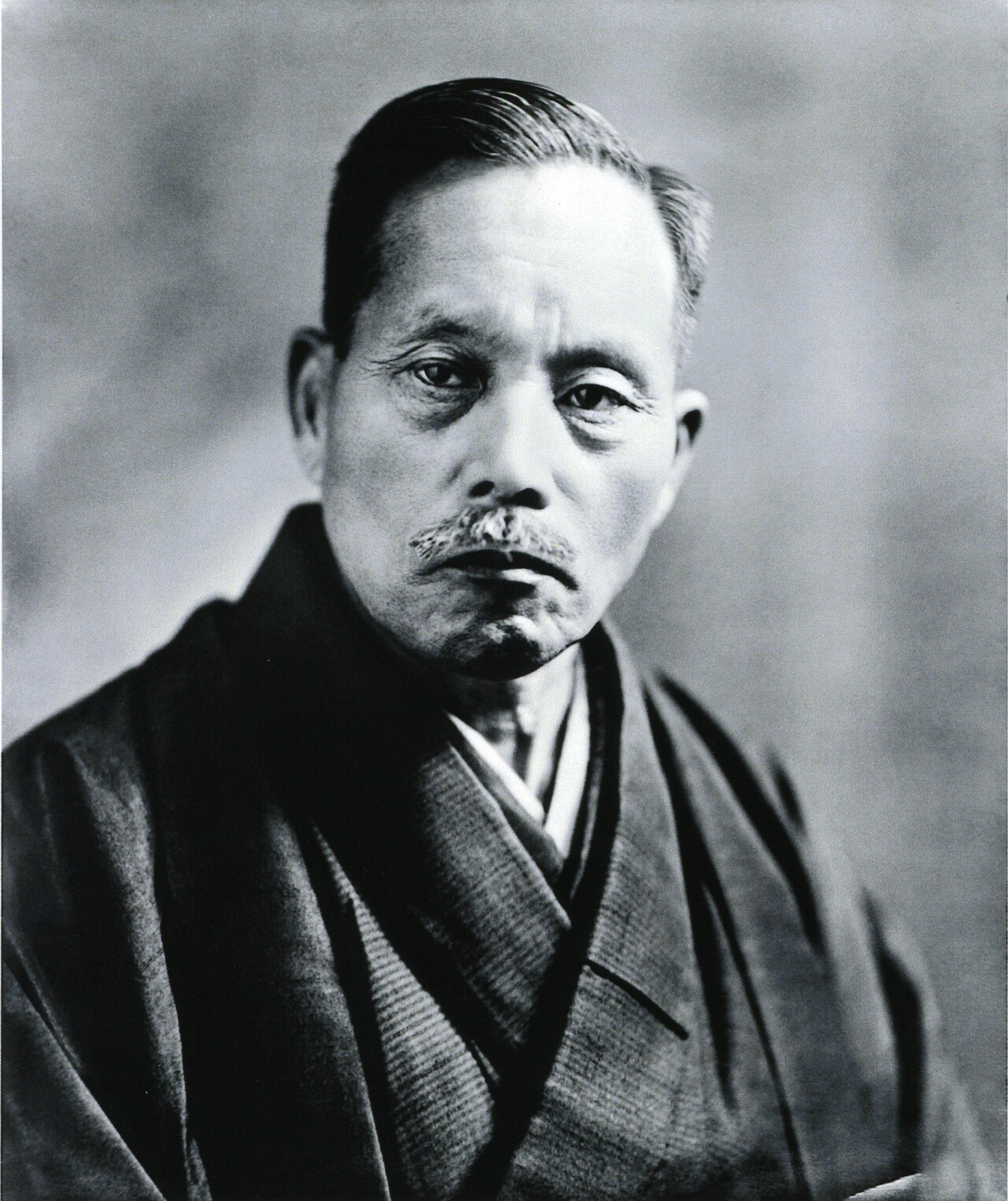
Makiguchi Tsunesaburō (1871–1944). Source: Wikimedia Commons, Sōka Gakkai, Public domain

His motives are disputed. His religious group sees it as a protest against the militarist system; some scholars think he was mainly holding on to his Nichiren faith, and was not a political dissenter.
After the separation
After 15 December 1945, on 1 January 1946, the emperor issued the "Declaration of Humanity". Article 20 of the new constitution of 1947 established the separation of religion and state.
The shrines left the state's embrace and became private religious corporations. In 1946 shrines across the country joined to form the Association of Shinto Shrines (Jinja Honchō).
Japan is not the only state that defines religion
"Shrines are not religion" was a state's definition of a tradition. This doesn't only happen in Japan.
In Indonesia, as far as I can tell from what I've read: in 1965 the state recognized Confucianism as one of six religions; in 1967 it restricted the religious and cultural activities of the Chinese; in 1978–79 a Home Ministry circular recognized only five religions, on the grounds that Confucianism hindered Chinese assimilation and "isn't a religion in China either"; recovery began only in 2000, and a 2006 circular from the Ministry of Religious Affairs recognized it again. The same thing, declared a religion one moment and not a religion the next, switching back and forth with political need. (I read the original texts of the 1965, 1967 and 2000 decrees; I did not read the 1978 and 2006 circulars, only accounts of them in Indonesian scholars' papers.)
In mainland China, five religions are officially recognized today: Buddhism, Daoism, Islam, Catholicism and Protestant Christianity. Confucianism isn't among them.
Hong Kong is different again. A 1928 ordinance, the Chinese Temples Ordinance, counts as a "Chinese temple" not only temples, monasteries, nunneries and Daoist halls, but any place where gods are worshipped, spirits consulted or fortunes told for payment from the public. What counts is what the place does and whether it takes money, not its doctrine. It set up a committee, and the ordinance states that the income, funds, investments and property of all Chinese temples are under the committee's full control. At the same time, according to the government's 2012 reply, the Home Affairs Bureau does not register religious bodies, and Hong Kong law does not regulate how religious bodies operate. (The Indonesian circular of November 1978 and the two letters of February 2006: I have read only scholarly paraphrase, not the originals.)
The other way round
"When the state and religion are tied together, trouble follows": this isn't always true.
Article 4 of Denmark's constitution still says that the Evangelical Lutheran Church is the established church of Denmark and is supported by the state. Sweden ended its state church on 1 January 2000. Norway amended its constitution in 2012 to remove the wording "state religion", but the church remains "the people's church" and still receives state support. In these countries, the church coexists with freedom of religion and a plural society.
So the problem may not be "is there a state religion?" but something else: whether participation is forced, how high the price of leaving is, and whether what the state mobilizes is ritual or war.
One more layer: the "State Shinto" defined in the directive was the occupation's policy definition. Whether it was a single, unified thing is debated among scholars.
Japan's case is a very clear reminder for me. I often say that a religion crosses states, peoples and time, so it shouldn't be defined by a state. I can accept that a state registers it: land, taxes, legal personality, these are realities. But "what is a religion" and "does your tradition count as a religion": that definition I don't want the state to make. Because once the state defines it, you have to be whatever it wants you to be. If it says shrines are the people's etiquette, you have to bow; if it says Confucianism isn't a religion, you have to turn your temple into an academic institution. The same tradition, in the state's hands, "is" one moment and "isn't" the next, changing with its uses.
I should also say something in fairness: in practice, the state staying completely out is not easy. In countries like Denmark and Sweden, church and state could be very close without trouble. Japan's problem was that the state used shrines as a tool to mobilize its people; the state required that you "must". What I want is a narrower line: registration, yes; support, yes; but no requirement, no compulsion, no definition. Whether that line can be drawn, I don't know yet. History has few examples of it being done.
To my Japanese friends. The two people I most want to remember are these. On 9 January 1891, at the First Higher Middle School in Tokyo, on the day the Rescript was read, Uchimura Kanzō did not make that deep bow to it; he lost his job and was scolded by newspapers across the country. More than fifty years later, Makiguchi Tsunesaburō, in his seventies, refused to take the talisman the shrine handed out, and in November 1944 he died in Sugamo Prison. Neither meant to oppose his own country. They just did not want the deepest thing in their hearts taken away by someone else. Reading about them today, you probably don't think of it as "disrespect." Then I'd like to ask you to think this way too: a country has no need to make everyone bow the same bow, and a person who keeps the thing in his heart is still a person of that country.
When a state declares that a tradition is "not religion, just custom", is it protecting it, or taking it over?
References
- SCAPIN 448 (1945-12-15), "Abolition of Governmental Sponsorship, Support, Perpetuation, Control, and Dissemination of State Shinto"; 1882 Home Ministry separation of shrine priests from national instructors ("shrines are not religion")
- Helen Hardacre, Shinto and the State, 1868–1988, Princeton UP, 1989
- Uchimura Kanzō's "lèse-majesté incident" (1891-01-09); Inoue Tetsujirō's "Conflict between Education and Religion" debate
- Makiguchi Tsunesaburō: refused a shrine talisman and arrested in 1943, died in Sugamo Prison 1944-11-18
- Danish Constitution, Article 4; Church of Sweden separated from the state 2000-01-01; Norwegian constitutional amendment 2012-05-21
- 1868 order separating gods and buddhas, 1889 Meiji Constitution Article 28, 1890 Imperial Rescript on Education, 1946-01-01 "Declaration of Humanity", 1946 founding of Jinja Honchō, 1947 Constitution Article 20: standard history
- Registration and definition in Indonesia, mainland China and Hong Kong: the author's notes "From Tianxia to the State", section 3 (secondary); original texts checked are below, the rest still to be verified
- Indonesia, Presidential Decree No. 1 of 1965, explanatory note (six religions including Confucianism): Indonesian Wikisource https://id.wikisource.org/wiki/Penetapan_Presiden_Republik_Indonesia_Nomor_1_Tahun_1965 🟢
- Indonesia, Presidential Instruction No. 14 of 1967 (Chinese religion and customs only at home): https://id.wikisource.org/wiki/Instruksi_Presiden_Republik_Indonesia_Nomor_14_Tahun_1967 🟢
- Indonesia, Presidential Decision No. 6 of 2000 (revoking the 1967 instruction): Audit Board regulations database https://peraturan.bpk.go.id/Details/57713/keppres-no-6-tahun-2000 🟢
- Indonesia, 1978 Home Ministry circular (No. 477/74054, 1978-11-18, listing only five religions) and the 1979 cabinet statement that Confucianism "is not a religion", with the government's reasons including that "Confucianism is not a religion in China either"; recognised again in 2006: accounts in papers by Yang Fenggang and others and in Inside Indonesia; the circular itself not read 🟡
- Mainland China's five religions: State Council Information Office, Freedom of Religious Belief in China (1997), Wikisource https://zh.wikisource.org/wiki/中国的宗教信仰自由状况 🟢
- Hong Kong Home Affairs Bureau reply: Legislative Council question LCQ16, "Government support for religious groups", 2012-06-27, info.gov.hk ("the Home Affairs Bureau does not register religious bodies, and Hong Kong law does not regulate how religious bodies operate") 🟢
- Hong Kong Chinese Temples Ordinance (Cap. 153), definition and section 7(1): Legislative Council Panel on Home Affairs paper "Review of the Chinese Temples Ordinance", 2015-03-24, https://www.legco.gov.hk/yr14-15/chinese/panels/ha/papers/ha20150324cb2-1045-7-c.pdf 🟢
- Image sources are given in each caption