A person standing upright
Xu Shen of the Eastern Han, in the Shuowen Jiezi, explains tian like this: "Tian is the crown of the head. Supreme, with nothing above it; from 'one' and 'big'." (天,顛也。至高無上,從一大。)
Dian ("crown") is the top of the head. Da ("big") is a person standing with arms and legs spread. If you trace the character back, the oracle-bone tian shows a person seen from the front, with the head drawn deliberately large; in some forms the head is a square box, in some it is marked with a dot.

Tian in oracle-bone script: a person standing seen from the front, with an especially large head. Source: Wikimedia Commons, Public domain

Xu Shen split it into "one" and "big". Most scholars of writing today think that split is wrong: tian was a human figure from the start and should not be taken apart.
In other words, what this character first pointed to was very likely just the patch of space above a person's head. That patch, the more it was used, grew larger, until it became "supreme, with nothing above it".
The shape of the character can take us only that far. It cannot tell us what the ancients saw over their heads.
A Heaven older than Confucius
Before Confucius, how did the Zhou people talk about tian? There are a few lines I think are worth copying out.
In the Book of Documents, "Against Idleness" (無逸), the Duke of Zhou lectures the young King Cheng. The Shang king Zhongzong, he says, "was grave, reverent, and in awe; he measured himself by Heaven's mandate, ruled the people with caution and dread, and did not dare to be idle or indulgent" (嚴恭寅畏,天命自度,治民祗懼,不敢荒寧), and so he held the throne for seventy-five years. Some later kings were born into pleasure and knew nothing of the hardship of farming, and "none of them could live long: some ten years, some seven or eight, some five or six, some three or four" (亦罔或克壽,或十年,或七八年,或五六年,或四三年). Those who worked hard and stayed wary reigned long; those who indulged reigned briefly.
In the Book of Songs, in the Hymns of Zhou, there is a poem called "The Mandate of Heaven" (維天之命): "The mandate of Heaven, how profound, never ceasing" (維天之命,於穆不已). Heaven's course is deep and does not stop.
Two more lines say that the mandate does not stay with one house for ever. The Book of Documents, "Announcement to Kang" (康誥): "The mandate is not fixed" (惟命不于常). The Book of Songs, "King Wen" (文王): "The mandate of Heaven is never constant" (天命靡常).
And in the Zuo Commentary (the fifth year of Duke Xi), Gong Zhiqi urges the lord of Yu not to lend a road to the state of Jin, and quotes a line from the Documents of Zhou: "August Heaven has no favourites; it helps only the virtuous" (皇天無親,惟德是輔). Heaven does not especially love anyone; it helps only people of virtue.
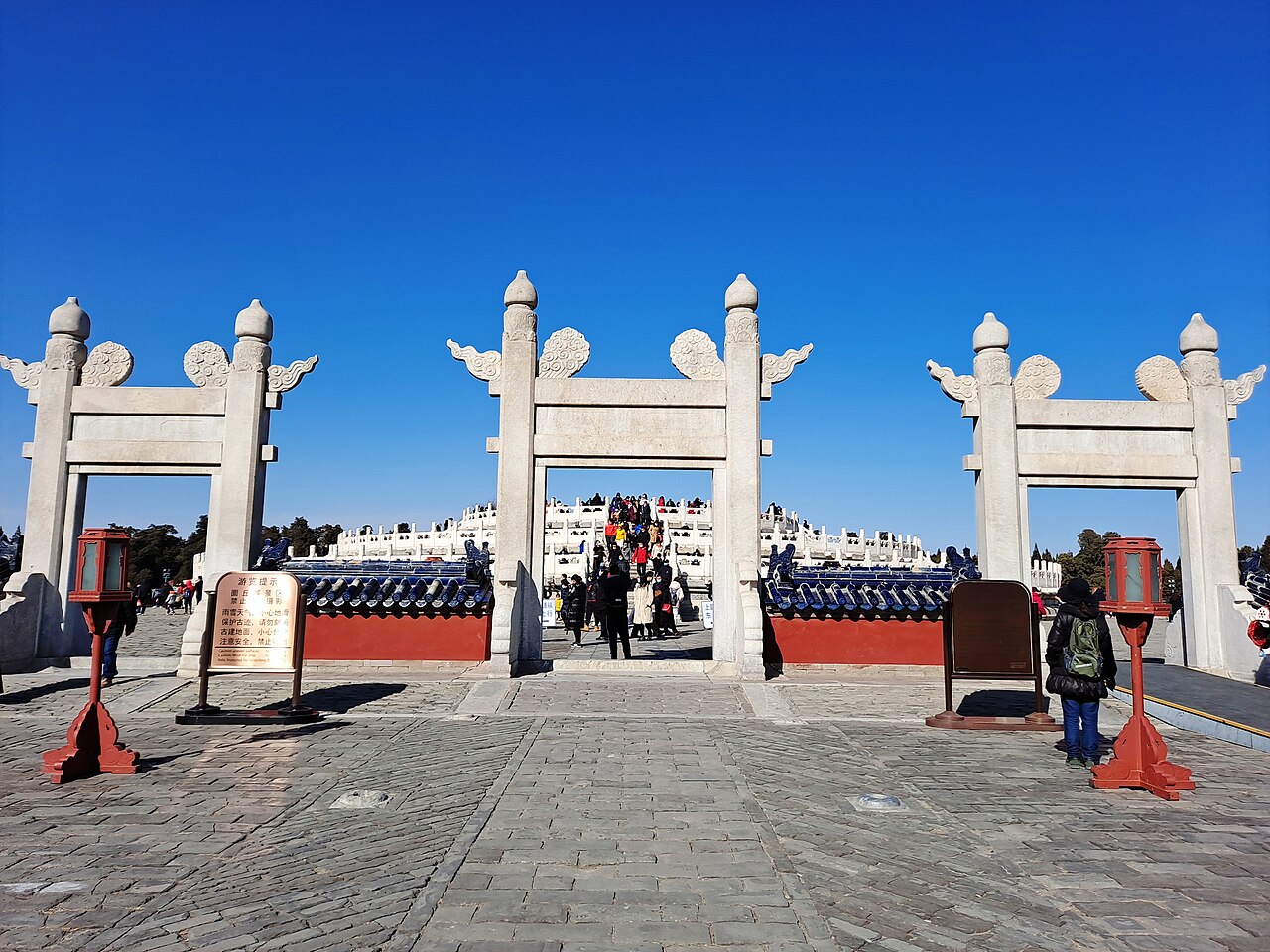
The Circular Mound Altar at the Temple of Heaven in Beijing, where Ming and Qing emperors sacrificed to Heaven at the winter solstice. Source: Wikimedia Commons, Dingding, CC BY-SA 4.0

What moves me most in these lines is that in their mouths Heaven is not a god who flies into a rage at will, and not only a physical sky either. It is something that looks: it looks at whether you work hard, whether you stay wary, whether you have virtue; and having looked, it gives the mandate to one person or withholds it from another. This was already there before Confucius. (The phrase "tiandao", the Way of Heaven, actually shows up more often in later forged chapters. I have said that on the "About" page of TenTao and will not repeat it here.)
One word, five meanings
The philosopher Feng Youlan, in his History of Chinese Philosophy, gave a famous summary: in Chinese, "tian" has five meanings.
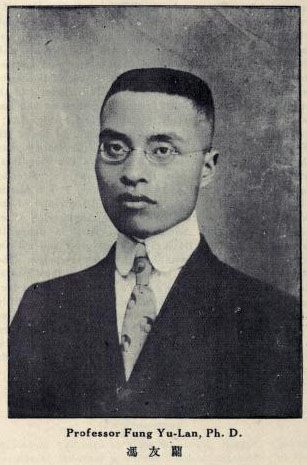
Feng Youlan (1895–1990). Source: Wikimedia Commons, unknown photographer, Public domain

The first is the material Heaven: the sky as opposed to the earth, the tian of "Heaven covers, Earth bears".
The second is the ruling Heaven: a Heaven with a will, able to reward and punish, that is, "August Heaven, the Lord on High". Confucius's line "He who offends against Heaven has nowhere to pray" (獲罪於天,無所禱也) is about this one: if you have offended it, praying elsewhere does no good.
The third is the fate Heaven: the part of one's lot that human effort cannot reach. Feng Youlan's example is Mencius: "As for success, that is Heaven's" (若夫成功則天也). "At fifty, I knew Heaven's mandate" (五十而知天命) is often read this way.
The fourth is the natural Heaven: a Heaven that runs by regularities. Xunzi pushed it to the extreme: "Heaven's course is constant; it does not persist for Yao, and does not perish for Jie" (天行有常,不為堯存,不為桀亡). The line in the Analects, "Does Heaven speak? The four seasons turn, the hundred things are born" (天何言哉?四時行焉,百物生焉), is also often read this way.
The fifth is the moral-principle Heaven: the highest principle in the universe. The Doctrine of the Mean says "What Heaven confers is called nature" (天命之謂性); and in the Northern Song, Cheng Hao said of himself: "Though I received my learning from others, the two words 'Heavenly principle' I worked out for myself" (吾學雖有所受,天理二字卻是自家體貼出來).
These five are Feng Youlan's arrangement, not a list the ancients drew up themselves. He also held that the tian Confucius spoke of was always the second kind. Not everyone who reads the Analects agrees.
Put side by side, the five are a little absurd: the second one can get angry, the fourth takes no notice of you at all, the fifth is a principle. One word that names almost five different things.
And often all five turn up in the mouth of a single person, in a single book.
It never had a name
Now look at what it has and what it lacks.
It has a state-level sacrifice: in the Ming and Qing, the emperor went to the Temple of Heaven at the winter solstice to sacrifice to Heaven, and only the Son of Heaven could do it.
It has no name. The god of the Jews has a name, the god of the Christians has a name; tian has none. It is just "tian".
It has no scripture. There are many sayings about Heaven in the Analects and the Mencius, but no book that is "the Book of Heaven".
And it has no church. Sacrificing to Heaven was the state's business; what ordinary people did was ancestral rites, and saying "may old Heaven bless us".
This is the biggest difficulty in my idea. My symbol is the seal-script tian: one stroke above a person's head. But to build a religion around it, I first have to answer one question: which of the five is it?
Someone tried to turn it into a person
A group of Europeans ran into this same question several hundred years ago.
In the late Ming, Jesuits came to China and had to find a Chinese name for their God. Should they choose "tian" (Heaven), or "Shangdi" (the Lord on High), or coin a new word, "Tianzhu" (Lord of Heaven)? They argued among themselves for decades. This was the Rites Controversy of history.
In 1704 Pope Clement XI ruled that "tian" and "Shangdi" must not be used for the Christian God; "Tianzhu" was allowed. In 1715 he said it again.
What the ruling meant is quite clear: the Europeans judged that the character "tian" could not hold the god they wanted. It was too broad, too vague, perhaps too natural.
More than two centuries on, in 1939, the Vatican finally reviewed the dispute.
What stays with me is this: a native concept was "claimed" by a foreign religion, and the claim failed. It would not become a person.
Looking at it the other way
This vagueness of "tian" may not be a defect.
One concept can be used by five kinds of people at once: scholars use it to argue principle, emperors use it to speak of legitimacy, peasants use it to curse and to pray. It is not locked into a single definition, so it has survived to today and has not been taken hostage by any one theology.
Some would also say that Chinese people do not in fact tell the five apart. In daily speech "old Heaven", "Heaven knows", "Heavenly principle will not allow it" cover ruling, fate and principle in one breath, and nobody finds that awkward.
So perhaps the "five senses" were arranged by scholars, and in people's minds there are not really five drawers.
But that is precisely the problem a religion has to deal with: is it facing ordinary people who have no drawers in their heads, or scholars who do?
The Heaven I want
The Heaven I want is not the second kind. I do not want a Heaven that gets angry, rewards and punishes, and can have someone speak for it.
What I want is a Heaven that does not speak but has rules. It does not persist for Yao and does not perish for Jie; its rule is "take from those who have too much, and give to those who have too little" (損有餘而益不足). A Heaven like this is not a person, takes no offerings, listens to no petitions; so I say, revere it but ask nothing of it.
In Feng Youlan's five, it lies between the fourth and the fifth: nature's course and the highest principle of the universe, put together and called "tiandao".
As for that daily not-telling-apart, I do not want to take it apart. I only want to give it a direction: toward "tiandao".

Tian in seal script: a person standing with arms and legs spread, one stroke above the head. Source: Wikimedia Commons, Public domain

I should also make clear why I want a Heaven that does not speak, rather than a god who has a name and speaks. There are two reasons. One is fear. A god who speaks gets people who speak for him; once someone speaks for him, someone will say "this is what Heaven told me", and that is Hong Xiuquan, that is Yang Xiuqing, that is everyone who has ever killed in the name of Heaven. Make Heaven silent, and that road is shut. The other reason is that I think this is the Chinese Heaven as it originally was: think of what the Zhou people said, "August Heaven has no favourites; it helps only the virtuous". It shows no partiality and cannot be bribed; it only looks at what you have done. Only a Heaven like that deserves to be revered.
But I also know this is a hard choice. How do you make people remember a silent Heaven every day? Christianity has the Bible and worship, Islam prays five times a day, Judaism has a Sabbath every week; tian has no name, no scripture, no church. The only way I can think of for now is to put it into the days. At Qingming, honour the ancestors; on the winter solstice, have the whole family stand in the yard and look up at the sky for a moment; before a meal, think of "it does not persist for Yao, and does not perish for Jie". A Heaven like this does not depend on anyone to preach it; it depends on each person, at some moment of each day, lifting their head to look. I have not thought it through. It is only a starting point.
This is for everyone who has ever lifted their head. Whatever country you are in, whatever passport you hold, whatever script you write in, when you were small you probably said "oh Heaven!" or "old Heaven!" at some point. In that moment you did not think about what it was; you only knew that something was above your head, watching. The ancients wrote it as a person standing with arms and legs spread, one stroke above the head. From Seoul to Hanoi, from Tokyo to Singapore, we use the same character. Alone at night, looking up, saying nothing, and yet feeling that someone heard: I think we have all had a moment like that. The tiandao I want is that one stroke above the character's head. There is no need to kneel; lifting your head is enough.
When you say "Heaven knows", which tian do you mean?
References
- For comparison: "Korea Really Did Have a 'Religion of the Heavenly Way'" (same series: "Man is Heaven")
- Xu Shen, Shuowen Jiezi, entry "tian"; oracle-bone and bronze forms of "tian"
- Feng Youlan, A History of Chinese Philosophy: the five meanings of "tian" (see also A New History of Chinese Philosophy, vol. 1)
- Analects: "Bayi" (八佾) "He who offends against Heaven has nowhere to pray", "Weizheng" (為政) "At fifty I knew Heaven's mandate", "Yanghuo" (陽貨) "Does Heaven speak?"; Mencius "As for success, that is Heaven's"; Doctrine of the Mean "What Heaven confers is called nature"
- Xunzi, "Discourse on Heaven"
- Cheng Hao on "the two words tianli", in Collected Works of the Two Chengs
- Book of Documents, Documents of Zhou, "Against Idleness" and "Announcement to Kang"; Book of Songs, Hymns of Zhou, "The Mandate of Heaven", and Greater Odes, "King Wen"; Zuo Commentary, fifth year of Duke Xi, quoting the Documents of Zhou (checked word for word against Wikisource, not checked against the page numbers of the printed books)
- The Chinese Rites Controversy: decree Cum Deus optimus, 20 November 1704; Ex illa die, 1715; Plane compertum est, 1939
- The Temple of Heaven and the Ming and Qing emperors' winter-solstice sacrifice: standard history
- Image sources are given in each caption