That number
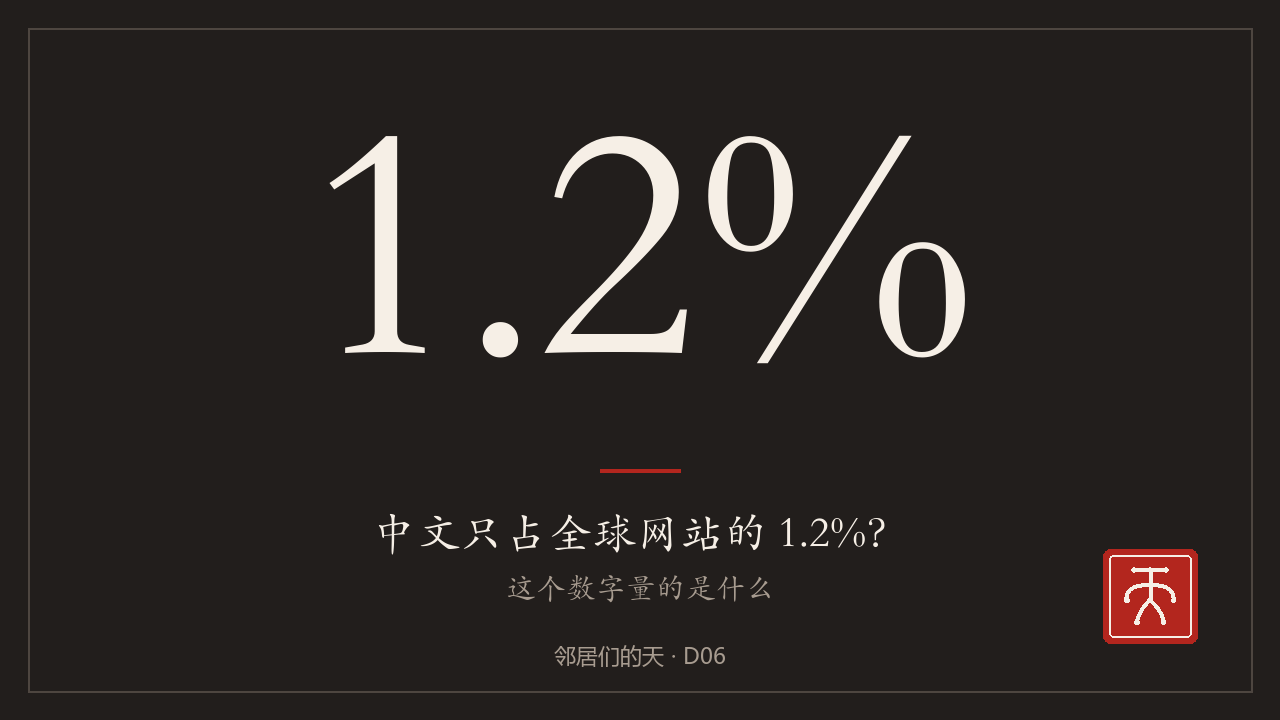
In the preface I wrote a sentence like this: according to W3Techs in June 2026, among websites whose content language can be identified, English accounts for about 49.7%, Japanese about 5.0%, and Chinese only about 1.2%.
The number is real. On 30 September 2026 I went back to the page once more: English 49.5%, Japanese 4.9%, Chinese 1.3%.
But as soon as I had written that sentence I began to doubt it: what is it actually measuring?
The first way: counting websites
W3Techs counts websites. One website is one vote, however large it is.
So a platform with hundreds of millions of items and a personal blog each count for one in this statistic.
And the Chinese internet has a particular feature: a lot of content is not in "websites" but in apps. (If you are outside China, one more thing needs saying: most people in mainland China do not spend most of their time reading and writing on the open web, but inside apps such as WeChat, Weibo and Douyin. These apps are like big walled courtyards. It is lively inside, but search engines outside cannot get in.)
The second way: counting web pages
Another public statistic comes from Common Crawl. It is a non-profit project that regularly crawls public web pages and releases what it collects.
Its latest crawl is week 39 of 2026 (CC-MAIN-2026-39). By number of pages, the distribution of languages is:
English about 41.9%, Russian about 6.7%, German about 5.7%, Japanese about 5.2%, Spanish about 4.7%, French about 4.7%, Chinese about 4.2%.
Chinese goes from 1.3% to 4.2%, and ranks seventh.
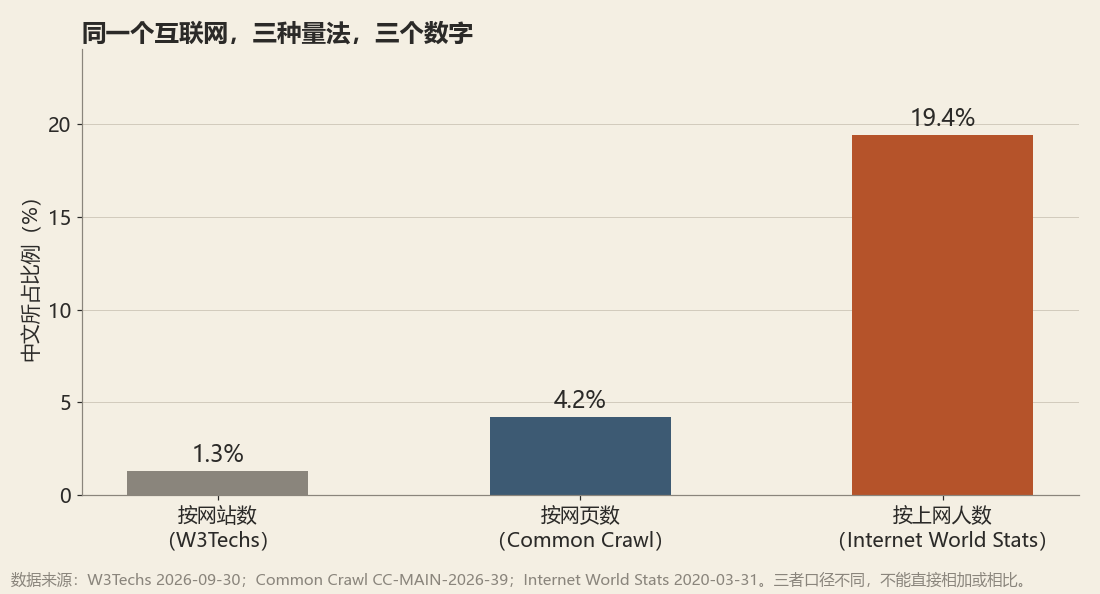
The same internet: 1.3% by number of websites, 4.2% by number of pages. More than three times apart.
The third way: counting people
The third number is people who go online.
Internet World Stats, as of 31 March 2020: English-speaking internet users about 1.19 billion, 25.9%; Chinese-speaking internet users about 0.89 billion, 19.4%.
This figure is already quite old and can give only an order of magnitude: Chinese speakers are roughly one fifth of the world's online population.
Put the three numbers together:
1.3% (websites), 4.2% (pages), 19.4% (users).
Where the content went
So where has the Chinese that is not on "public web pages" gone?
A reasonable guess: into apps like WeChat, Weibo and Douyin. A large part of what these platforms hold can be seen only after logging in, or searched only inside the app, and public crawlers cannot reach it.
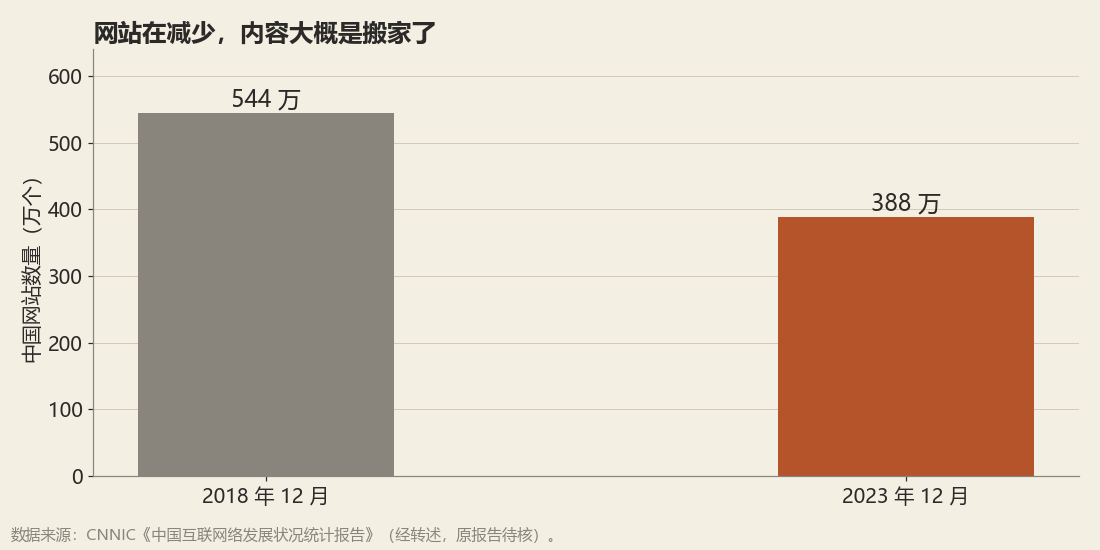
I have not found a study that measures this directly, so it is only a guess. But one piece of data fits it: the China Internet Network Information Center (CNNIC) reports that the number of websites in China fell from 5.44 million in December 2018 to 3.88 million in December 2023, nearly 30% fewer in five years.
Websites are going down while people are going up. The content has probably moved house.
Looking at it the other way
These three numbers do not overturn what I felt in the first place.
Even in the most generous count, 4.2% of pages against 19.4% of users is still a gap of more than four times. What Chinese speakers leave on the public web is far less than their numbers would suggest. That much is solid.
But it also reminds me that the sentence in the preface, "on the world's public internet, you can hardly hear them", was stronger than the data allows. 1.2% is the lowest of the numbers, and it measures "websites", not "voices".
A more accurate way to put it may be this: most of the Chinese-speaking world's voice is behind the wall. It is not absent; it is shut inside the walls of apps, where search engines cannot enter.
So I would like to add a correction to that sentence in the preface. I used to say, "on the world's public internet, you can hardly hear them." What I say now is: the voice of the Chinese-speaking world is not missing; most of it is behind a wall. But precisely because it is behind a wall, people outside it cannot hear it, whether that is you in Tokyo, Seoul or Hanoi, or a friend in Toronto or Melbourne. This hurts me more than "the voice is small": a person has said a great deal, has written long essays with great care, and the neighbours outside the wall cannot read a single word.
A word for the neighbours. Nearly 900 million people who speak Chinese go online, yet Chinese makes up only 4.2% of public web pages; most of what they say is behind the wall. One reason I write on this site is to carry some of it out. You, in Tokyo, in Seoul, in Hanoi, may be thinking right now about Qingming, ancestral halls, Chinese characters, how a civilisation stays alive. I want you to know that on the other side of the wall there are people thinking about the same things; you just cannot read them. I want to read what you write too, even if I have to translate, even if it is slow.
How much of what you have written can a search engine find? Do you mind?
References
- For comparison: the English edition of Yigui: the same question, how far the Chinese-speaking world is heard in other people's languages
- W3Techs, "Usage statistics of content languages for websites": June 2026, English 49.7%, Japanese 5.0%, Chinese 1.2%; page of 2026-09-30, English 49.5%, Japanese 4.9%, Chinese 1.3%
- Common Crawl language statistics, CC-MAIN-2026-39: English 41.86%, Russian 6.70%, German 5.73%, Japanese 5.17%, Spanish 4.74%, French 4.68%, Chinese 4.23%
- Internet World Stats, "Internet World Users by Language", 2020-03-31: English 1,186,451,052 (25.9%), Chinese 888,453,068 (19.4%)
- CNNIC, Statistical Report on Internet Development in China: number of websites about 5.44 million in December 2018, about 3.88 million in December 2023 (second-hand; check the original report before publication)