An eye
In Tây Ninh, in southern Vietnam, there is a great hall that looks nothing like an East Asian temple.
The most striking thing inside is an enormous eye. It is called the "Divine Eye" (Thiên Nhãn).
This is the holy see of Caodaism (Cao Đài). The two words "Cao Đài" mean literally a high platform, used for the highest place where God dwells.
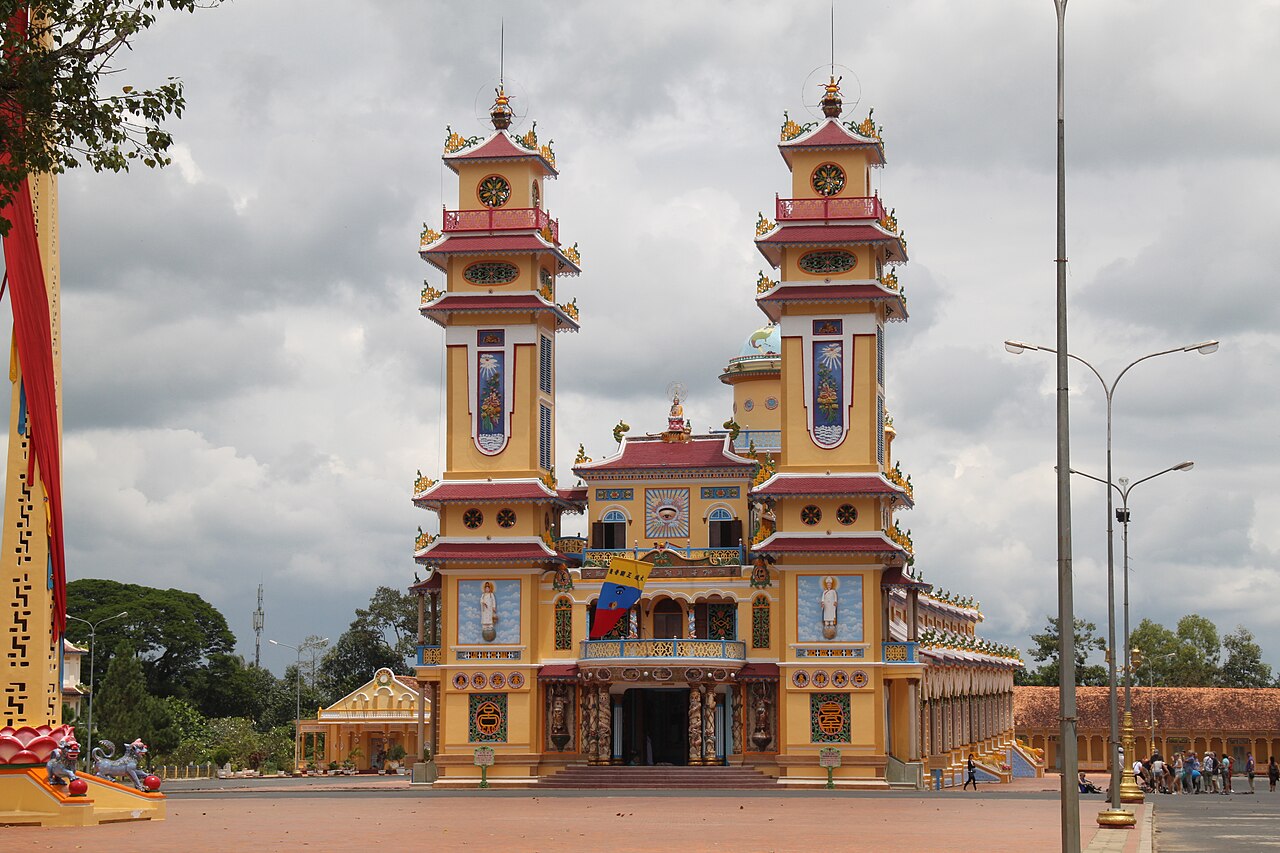
The Cao Đài Holy See in Tây Ninh, Vietnam. Source: Wikimedia Commons, photographed by Gary Todd, CC0

Grown out of séances
The founder, Ngô Văn Chiêu, was a civil servant in the colonial government of French Indochina. He was fascinated by spirit communication.
It is said that in 1921, on the island of Phú Quốc, he saw the "Divine Eye": an eye appearing in the sky.
In July 1925 a series of séances began in Saigon. The mediums who took part were also minor colonial clerks. They said that through the mediums a god who called himself "Cao Đài" had begun to speak to them.
Think of those people: Vietnamese clerks on small salaries, ruled by someone else's state, who after work sat around a table in the evening waiting for a voice. What they were waiting for was perhaps not only a god, but a place where their own land and their own ancestors could be put back in the sky.
On 7 October 1926, led by Lê Văn Trung, twenty-eight prominent Vietnamese together with 245 followers submitted a Declaration to the government of French Indochina announcing the founding of this religion. Lê Văn Trung became the first "Interim Pope". Ngô Văn Chiêu himself did not sign the declaration.
On 18 November 1926 the opening ceremony was held in Tây Ninh; fifty thousand people are said to have attended.
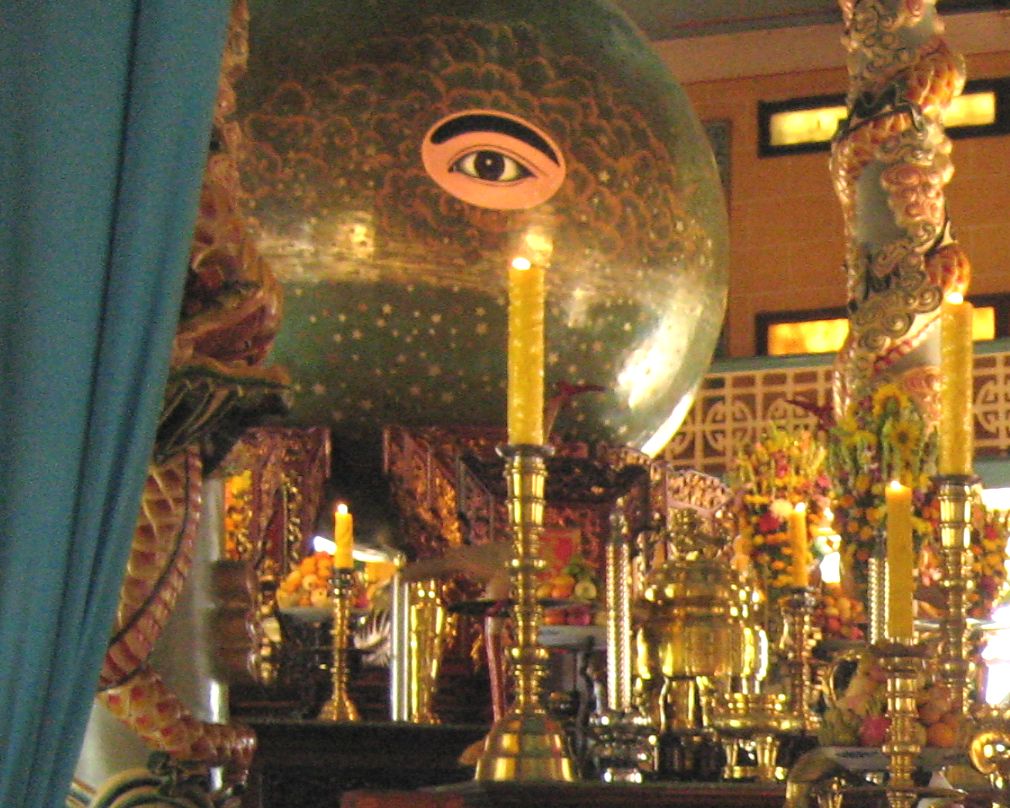
The "Divine Eye" of Caodaism. Source: Wikimedia Commons, Toirelb, Public domain

A little of everything
Caodaist doctrine divides the history of human religion into three periods: the Buddha, Confucius, Jesus and Muhammad belong to the second period; the third is now, when God speaks directly to people.
It combines the Buddhist ideas of karma and rebirth, Confucian ethics, Daoist spirit communication, and the organisational structure of the Catholic Church: a pope, cardinals, archbishops, a full set of ranks. It advocates vegetarianism, non-violence and ancestor veneration.
Its list of saints is surprisingly long: the Buddha, Jesus, Muhammad, Confucius, Caesar, Pericles, Joan of Arc, Sun Yat-sen, Victor Hugo, Thomas Jefferson.
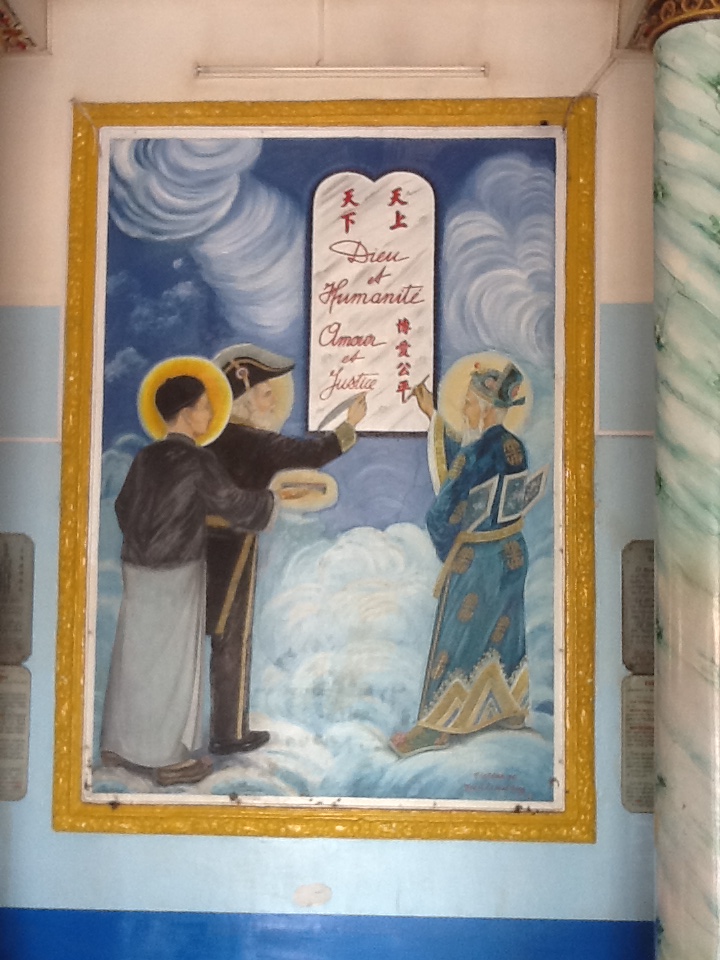
A painting at the front gate of the Holy See, showing three "saints": Sun Yat-sen, Victor Hugo and Nguyễn Bỉnh Khiêm of Vietnam. Source: Wikimedia Commons, Nic saigon, CC BY-SA 3.0

Politics, and after
Caodaism was soon drawn into politics.
In 1943, during the Japanese occupation of Indochina, Caodaism formed its own armed force. Until 1975 it had considerable political influence in South Vietnam.
After the reunification of north and south in 1975, Caodaism was suppressed. In 1997 the Vietnamese government gave it legal status.
Today nobody can say for certain how many believers there are: figures from two million to six million have been given. The Vietnamese government's estimate is about 4.4 million for the Tây Ninh Holy See lineage. It has split into about six officially recognised branches. In Western countries it is said to have around thirty thousand followers.
Who it resembles
Reading this far, I am reminded of a familiar shape.
Korea's Donghak, in 1860, was born against "Western Learning" and mixed Confucianism, Buddhism, Daoism and folk belief; it later became Cheondogyo and tied itself to politics, with the Declaration of Independence at one end and the Ilchinhoe at the other.
Caodaism, in 1926, was born under French colonial rule and mixed Confucianism, Buddhism, Daoism and Christianity; it later had its own armed force and was suppressed after 1975.
Both are East Asian "three teachings in one" new religions. Both were born under foreign pressure. Both paid a price in politics.
And the Confucian Association, a "pure Confucian" movement, was rejected in parliament in both 1913 and 1916.
Three examples: two mixed ones survive to today, one pure Confucian one did not. This is only three samples, not a rule, but it makes me want to ask: should the religionisation of Confucianism take the "pure" road or the "mixed" road?
Looking at it the other way
First, let me be clear: Caodaism is not a Confucian religion.
Confucianism is only one of its three teachings, and it is not the heaviest one at the centre of the doctrine. So it is not appropriate to treat it as a success story of "making Confucianism a religion".
There is one more layer: this "survived" also needs a discount. Within a hundred years it split into several branches, its membership figures are vague, it was suppressed politically for more than twenty years, and it was recognised again only on the state's terms. Whether that counts as "success", I am not sure.
Then the samples. In a comparison of three examples there are many uncontrolled variables: different countries, colonial and non-colonial settings, different eras. The pure Confucian Association failed in parliament, while the mixed Donghak and Caodaism lived among the people; that may be only a difference in "where it was done".
Is Tiandao the "pure" road, or the "mixed" road? My answer: the root must be pure, the gate must be wide. The root must be pure: Tiandao, the First Teacher, ancestral rites; I do not want these mixed, because a thing that enshrines everything is often nothing, and in the end is easily taken by someone and made into what they want. But the gate must be wide: I do not ask anyone to tear down their own temple before coming in. A person who keeps Guanyin, Mazu and Guan Yu at home and at Qingming also burns incense to the ancestors is in no contradiction. What I want is a thing with an axis in the middle, not a great hall that invites in all the saints but has no centre.
I do not want to laugh at Caodaism either. To put Sun Yat-sen and Hugo in the same temple sounds a bit comic at first. But think of those people: ruled by someone else's state, pressed down by someone else's gods, they said, never mind, we will invite all the good people and let them guard us together. That is not a lack of conviction; it is a very deep loneliness and a very great kindness. They were willing to believe that all the good in the world can be put together. I have respect for that.
To my Vietnamese friends. On 18 November 1926 the opening ceremony was held in Tây Ninh, and fifty thousand people are said to have come. Those were the years of French rule. A few minor clerks, after work, sat around a table waiting for a voice; later twenty-eight prominent figures and 245 followers handed in the Declaration. They invited Sun Yat-sen, Victor Hugo and your own Nguyễn Bỉnh Khiêm into the same hall, beneath that eye. I saw that eye in photographs. That a people ruled by others would still keep a place for itself in the sky: that makes me feel more respect than any great hall.
A religion that invites in all the saints and enshrines them: is that inclusiveness, or lack of conviction?
References
- For comparison: Yigui, "Who Chose the Two Characters Shangdi?" (another response that grew under the impact of a foreign religion); "Korea Really Did Have a 'Religion of the Heavenly Way'" in this series (Donghak, the same hand of cards)
- Caodaism (Cao Đài): 1921, Ngô Văn Chiêu sees the "Divine Eye" on Phú Quốc; July 1925, séances in Saigon; 7 October 1926, Declaration (signed by twenty-eight prominent figures and 245 followers, led by Lê Văn Trung); 18 November 1926, opening ceremony; 1943, armed force; suppressed after 1975; legal recognition in 1997; believers estimated at 2–6 million (Vietnamese government estimate: about 4.4 million for the Tây Ninh Holy See); about 6 recognised branches; about 30,000 in Western countries
- Korean Donghak–Cheondogyo, see "Korea Really Did Have a 'Religion of the Heavenly Way'"
- Confucian Association: petitions rejected in 1913 and 1916, see "Why the Confucian Association Failed"
- Image sources are given in each caption