Why look to the south
What this series has written about so far is China, the Korean peninsula, Japan and Vietnam. All of them once lived under the Confucian Heaven.
Southeast Asia is not like that. In Thailand, Laos, Myanmar and Cambodia the mainstream is Theravada Buddhism; in Indonesia and Malaysia it is Islam. The Confucian Heaven is not these countries' own Heaven.
But a group of people carried it there. They are the Chinese.
They arrived in other people's countries, with no country of their own to speak for them, and sometimes were not even allowed to use their own language. At that point, what does a community still use to say "us"?
The word yigui ("a belief to rely on and return to") was asking exactly this in the first place.
My position, and its range
In the preface to this series I set out my own inclination: to make Confucianism a religion, and give all East Asians one shared religious belief to rely on and return to, a force that pulls toward a centre. I provisionally call this idea "Tiandao", to tell it apart from Korea's Cheondogyo.
A position has to be tried on actual people. "East Asians" in this series is just a way of speaking; it means those in the pan-Confucian cultural sphere who are willing to think deeply. By that range:
- Thai, Lao, Burmese and Khmer people are not in it;
- Chinese, and Vietnamese, are in it.
So these pieces do not put any position to "Southeast Asians". They take it and put the question to two groups only: the Chinese, and the Vietnamese.
A few rules: each piece answers five questions
Every piece answers these five:
- History: how they arrived and how they were treated;
- Morality: what this community uses to say "ought" and "ought not": temples, charitable halls, ancestors, or something else;
- Discipline: when no state protects them, what governs them: clan and native-place associations, schools, or gang rules;
- Present: how many there are today, what they believe, what they can do;
- Future: how much is left for the next generation.
Each piece also has two fixed sections:
- What my position says here: this section I leave for myself to write;
- Looking at it the other way: the hardest counter-argument to my position, not written as a straw man.
A table
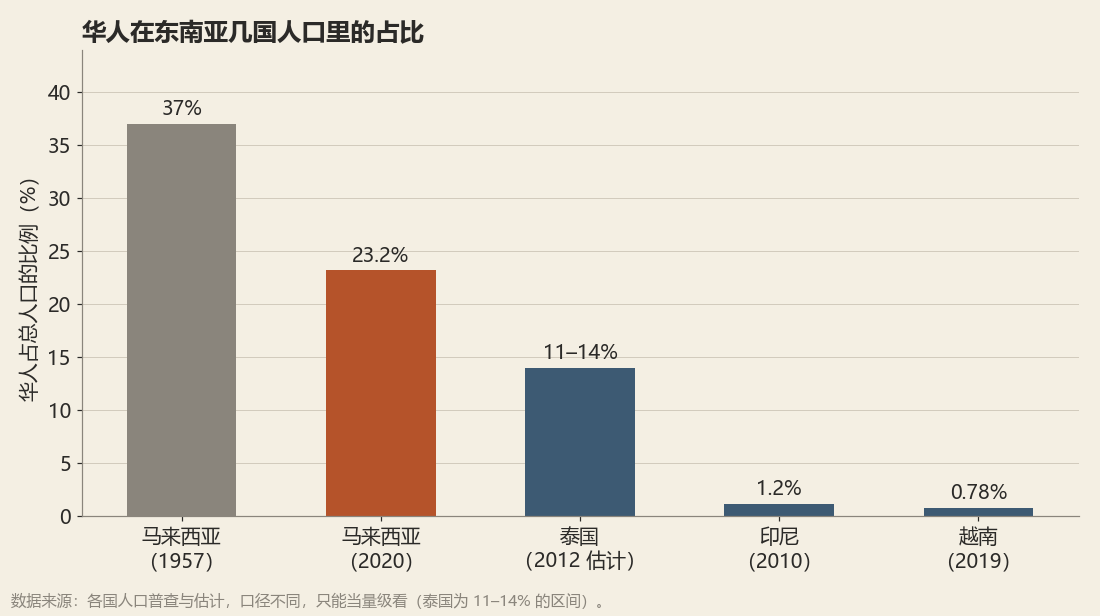
The way numbers are counted differs from country to country and should be read only as orders of magnitude.
| Country | Chinese population | Share | Notes |
|---|---|---|---|
| Malaysia | — | about 23.2% in 2020 (37% in 1957) | the most complete Chinese-education system |
| Thailand | about 9.5 million (2012 estimate) | 11–14% | the highest degree of assimilation |
| Indonesia | 2.83 million (2010 census) | about 1.2% | 1967–2000: public belief and customs restricted |
| Vietnam | 749,466 (2019 census) | 0.78% | outside estimates are much higher; about 450,000 left in 1978–79 |
| Cambodia | estimated 300,000 to 700,000 | — | about 430,000 in 1975; by 1979 about half had not survived |
| Myanmar | not listed | — | figures differ too widely |
The hardest counter-argument, put here first
One question will follow every piece. I want to say it at the start.
The heaviest accusation the Chinese in Southeast Asia have met is not "what you believe is wrong", but "your heart is not here".
In the early twentieth century King Vajiravudh (Rama VI) of Thailand wrote articles under a pen name calling the Chinese "the Jews of the East". In 1967 Indonesia's New Order government required Chinese to change their names, closed Chinese schools, and shut their rites inside the home. In the same year anti-Chinese riots broke out in Yangon, Myanmar, set off by the spread of the influence of the Cultural Revolution in China.
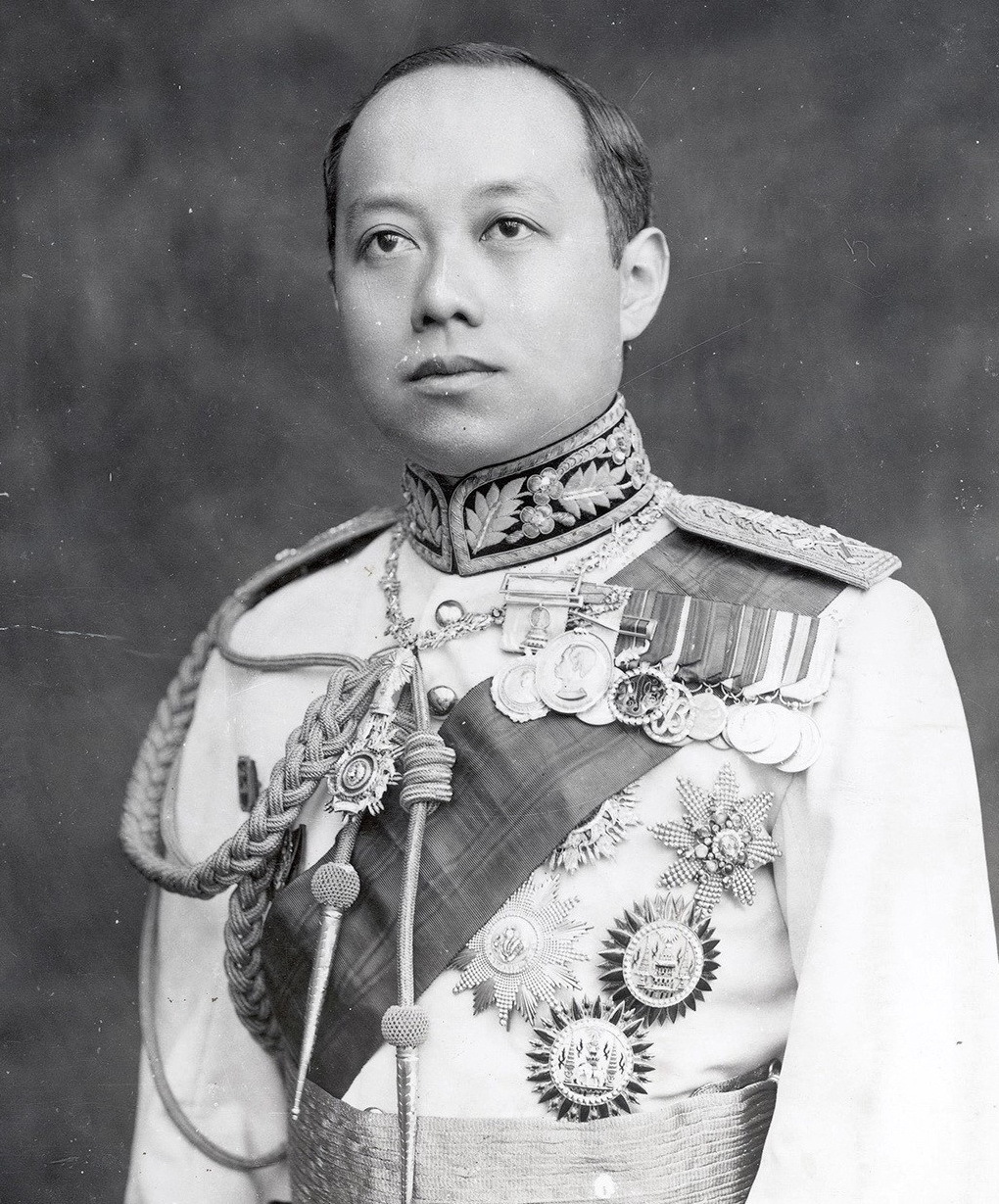
King Vajiravudh (Rama VI) of Siam (1881–1925). Source: Wikimedia Commons, unknown photographer, Public domain

What these have in common: the host country believed that these people had a "heart" abroad.
And my position, of all things, is precisely to give them a force that pulls toward a centre.
So the first wall is here: in a country afraid of a "fifth column", is a force that pulls toward a centre a medicine, or a reason?
In 1955, at Bandung, the People's Republic of China and Indonesia signed a Dual Nationality Treaty that made Chinese with dual nationality choose one. One way of reading it is that this was meant to dispel a neighbour's suspicion; another is that it was abandonment. The two readings are left to the Indonesia piece.
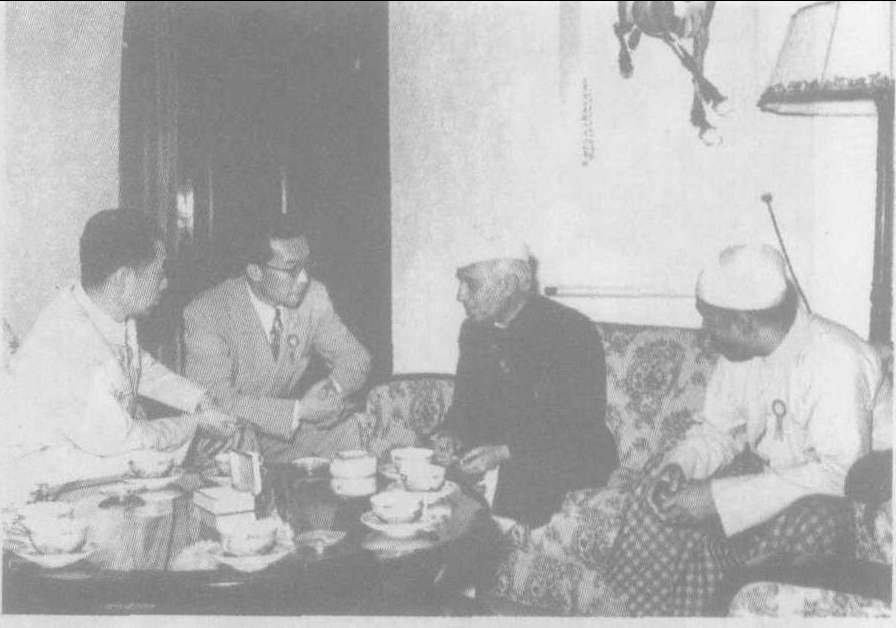
Zhou Enlai, Nehru and U Nu talking during the Bandung Conference, April 1955. Source: Wikimedia Commons, unknown photographer, Public domain

My answer to this wall
My answer is two roads, only two.
One: be strong enough. If a religion is strong enough, it can, like the expansion and rule of Islam, form a new centripetal force. At that point the accusation "your heart is not here" no longer holds, because the people here are themselves a "heart".
The other: not strong enough. Then there is only assimilation.
(The Philippines piece will set a problem for "only two".)
For "enough" I have set four criteria: numbers, organisation, wealth, doctrine. All four are needed; with one missing, the centripetal force cannot stand. "Rule" here means cultural leadership, not political power.
| Criterion | What to ask |
|---|---|
| Numbers | How many people does this community have, and is it still growing? |
| Organisation | Does it have its own temples, halls, schools, charitable halls, and can it govern itself? |
| Wealth | Does it have the resources to sustain the first two? |
| Doctrine | Does it have a "Heaven" that depends on no single country, so that people know why they should turn toward this centre? |
Each piece measures against these four. What cannot be measured is left blank, and I say that it is left blank.
This answer has to be tested against history, not just stated here. The pieces after this each put the same question:
- Indonesia, Thailand, Myanmar: the second road is already something that has happened;
- Malaysia: the "enough" the first road needs; the Chinese share of the population has fallen from 37% to 23.2%;
- Cambodia: when a community has half of it taken away, what does the word "enough" mean?
Here I need to say things clearly so as not to hurt anyone. When I say "there are only two roads: be strong enough, or be assimilated", I am not saying who ought to be assimilated, and I am certainly not judging the descendants of Chinese who have blended into local society, speak Thai or Indonesian, and use local names. Their days are their own days, and not a failure. What I am saying is a cold historical observation: for a community with no state and few people, to keep its language and its ancestors' rites has, in history, often had only these two endings. What I want to ask is: is there a third road? Could a community with neither numbers nor a state hold itself together by other things, by small things done every day, without being taken as "heart not here"? This is what I really want to ask.
Coming next
- Cambodia: half of the people
- Vietnam: after the boat people
- Indonesia: what was allowed, and what was taken
- Thailand: the most successful assimilation; does it count as a kind of yigui
- Myanmar: the neighbour Qianlong did not defeat, and the people who stayed
- Malaysia: Chinese education, a community kept alive by its schools
- Thai, Lao and Zhuang, Dai, Hmong: one language family, each with its own Heaven
- Singapore: the state pushed Confucianism once, then took it back
- The Philippines: becoming the nation's elite; are the Chinese still Chinese
- Hong Kong: registered, but not banned
Looking at it the other way
One can ask back about the direction of this series: why use the word yigui at all?
For most Southeast Asian Chinese, what fills the day is tomorrow's business, not "where do I belong". Is that question something only people who write essays have?
To my neighbours to the south. You may have grown up in Bangkok, Jakarta, Kuala Lumpur, Phnom Penh, Yangon or Manila; the old people at home may speak Teochew, Hakka or Hokkien that I cannot understand, and perhaps you yourself can no longer speak a word of it. That is all right. You have probably heard people say it: your hearts are not here. Let me ask you one thing. Every Qingming, when you stand before your ancestors' graves, or before the shrine at home, where is your heart? It is in the place where you are standing, isn't it. So what I want to ask you is not whether you are still Chinese, only these few things: how your grandparents came ashore from that dock, whom the shrine in your house honours, how your family spends Qingming each year. These are truer than any grand talk of yigui. I want to write them down, so that more people, including your own children, can read them.
When a community has no state to speak for it, what does it still use to say "us"?
References
- Rama VI, "the Jews of the East": written under a pen name; scholars dispute what it meant
- The 1955 Treaty between China and Indonesia on the Question of Dual Nationality (Zhou Enlai and Sunario; in force 20 January 1960)
- Image sources are given in each caption