A person who can't speak Chinese
I know a colleague of Cambodian descent. I had always assumed he was from a Cantonese-speaking region.
Later he said that his mother's grandfather was Chinese, a refugee. He himself does not speak a word of Chinese.
He has been back to Cambodia to see relatives.
I didn't ask what was left in his family.
The numbers
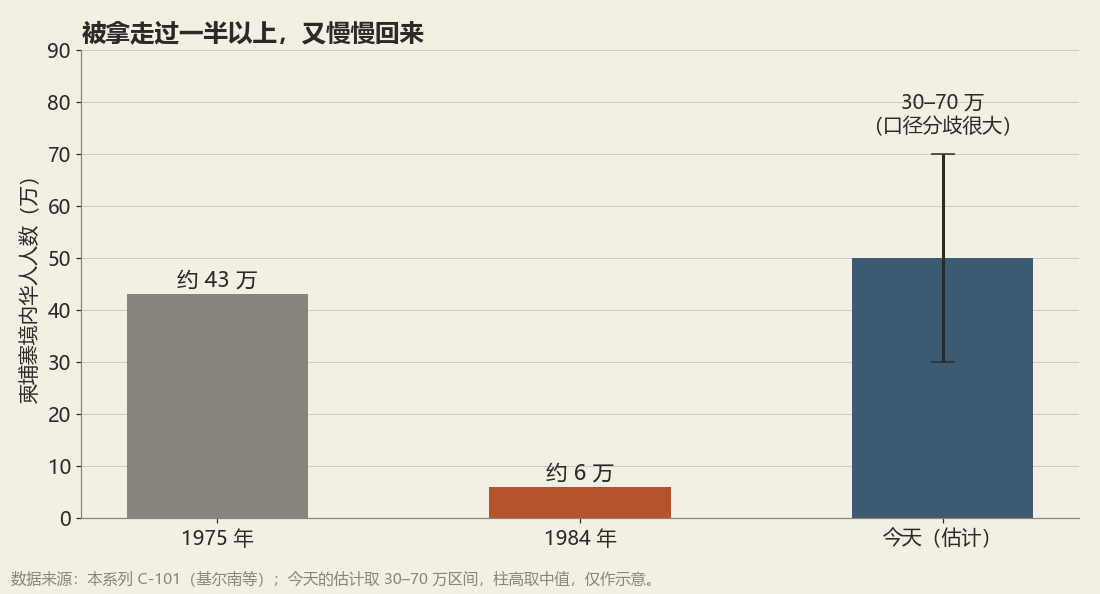
In 1975, when the Khmer Rouge took power, there were about 430,000 ethnic Chinese in Cambodia. The common estimate among historians is that by 1979, when the regime was overthrown, about half of them had died of disease, hunger, exhaustion or execution.
The scholar of Cambodia Ben Kiernan wrote that Democratic Kampuchea was the greatest catastrophe any Chinese community in Southeast Asia has met.
In comparison: the Cham Muslims, about 250,000, lost about 36%; the country's whole population lost about 21% (Kiernan estimates about 1.67 million people). The ethnic Chinese had the highest proportion.
My colleague once said "more than half". I did not ask more, and I don't know whether he meant the Chinese or the whole country. If the Chinese, it fits. If the whole country, the common estimate is much lower: about 21% of the nation (Kiernan's 1.67 million; the estimates of the demographic experts at the UN-backed tribunal cover a wider range, about 1.2 million to 2.8 million).
Why them
Kiernan holds that the Chinese were killed not mainly because of race but because most of them lived in cities.
The Khmer Rouge emptied the cities. Those who lived in cities were the "old people". Many Chinese did business in cities, so many of them were among those emptied out.
This has to be said first. What it means is that this was not entirely an "anti-Chinese" campaign. The banning of language and culture was real; but the criterion that decided "who you are" was class, not only ethnicity.
Before that, another door had closed earlier still.
In 1970 the Lon Nol government came to power and closed all Chinese schools, Chinese shops and temples. This state of affairs lasted until the early 1990s.
That is, by 1975 the "organisation" of Cambodia's Chinese had already been taken away for five years.
Afterwards
In 1984 the Chinese of Cambodia were estimated to number only about 60,000.
After 1993 the number grew again. The present estimate is 300,000 to 700,000, with wide disagreement about how to count. Chinese schools have reopened; some say nearly a hundred, many with subsidies from the Chinese government.
The Chinese of Cambodia have traditionally often married Khmers. That has not changed.
Morality and discipline: after three things were taken away
A community with no state to protect it holds itself up with three things: temples, clan and native-place associations, schools. Temples govern "ought", associations and schools govern "what to do".
For the Chinese of Cambodia, all three of these were taken away between 1970 and 1979.
With all three gone, what remains is the family. What is passed down in a family is often very little: a surname, a festival, a sentence from a grandfather.
I don't know which one remains in my colleague's family.
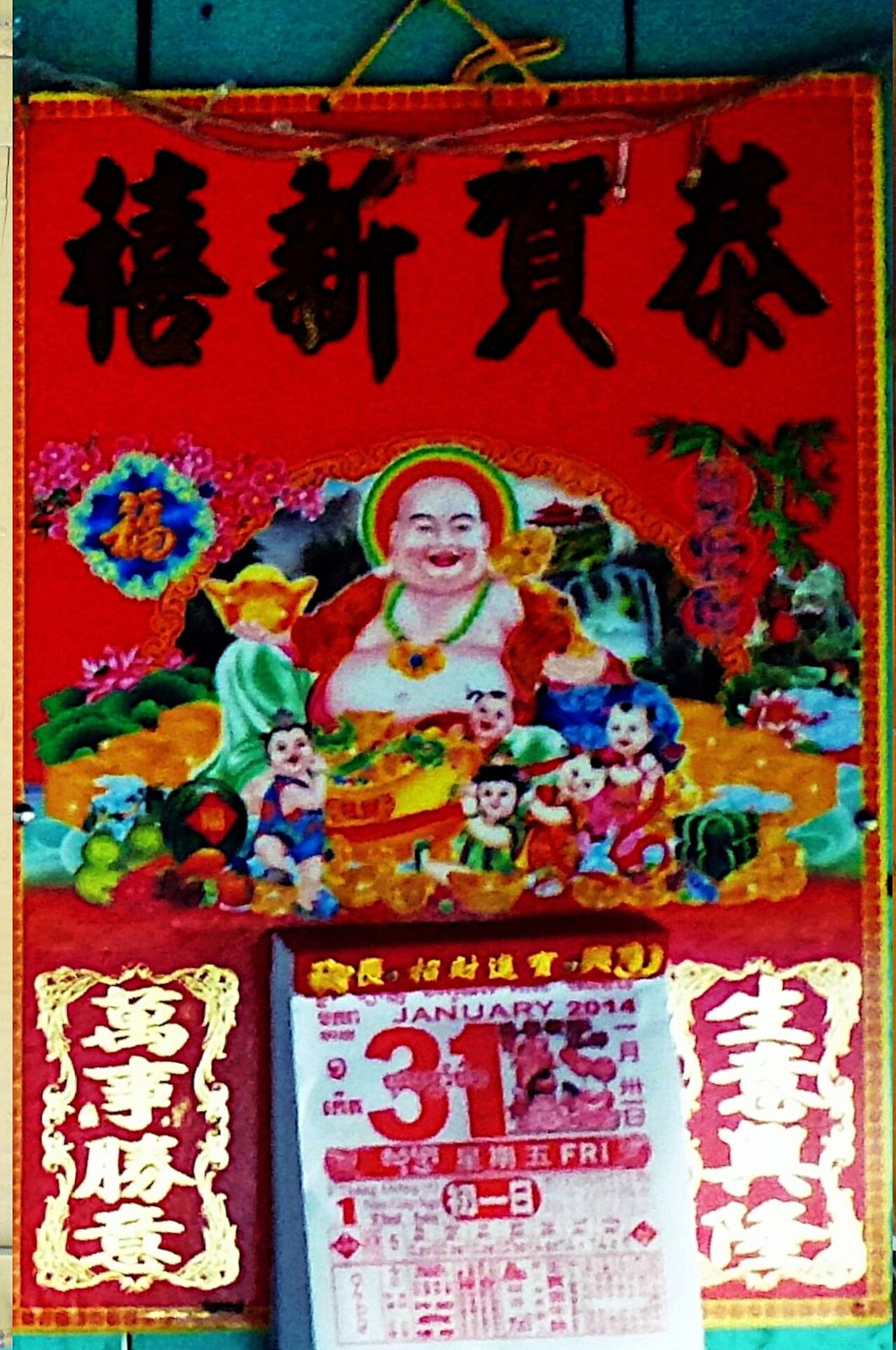
Lunar New Year decorations in Phnom Penh (2014, Year of the Horse). The Chinese of Cambodia can celebrate the new year openly again today. Source: [Wikimedia Commons](https://commons.wikimedia.org/wiki/File:Lunar_New_Year%27s_31-01-2014_(cheval_(%E9%A6%AC)_Phnom-Penh_Cambodia.jpg), Pierre André Leclercq, CC BY-SA 4.0

A "heavenly kingdom from the West"
The Khmer Rouge's ideas came from Marxism-Leninism, by way of Paris, and then by way of Mao.
It stands in the same place as the Taiping Heavenly Kingdom: a heavenly kingdom from the West, replacing the old "Heaven" with a new one.
I want to make this comparison more concrete and give it a test. A "heavenly kingdom", I find, has four things. One, an end of the world: the old world is rotten through and must be pulled down whole. Two, a chosen people: one group is "pure", another is to be cleared away. Three, a "new person": the old people are to be remade, or destroyed. Four, a holy place: there is a place, a person, that is the truth itself. The Taiping had all four, and so did the Khmer Rouge: on a blank sheet of paper they meant to make a "new person" and wipe the "old people" from the earth, those who lived in cities, who had read books, who did business, who believed in other gods. When an idea has all four things at once, it is no longer a proposal; it is a religion, and a religion that does not allow any other "Heaven" to exist.
Scholars already have a name for this: political religion (Voegelin, Aron). The piece on political religion in Duoshe covers it, so I won't repeat it here.
Four criteria, measured
- Numbers: about 430,000 in 1975, about 60,000 in 1984, now estimated at 300,000 to 700,000. More than half was taken away; recovering;
- Organisation: temples, Chinese schools, chambers of commerce, closed from 1970 and reopened in the early 1990s; after the reopening there were seventy or eighty Chinese schools (media report of 2012), and a 2017 count gave 55 schools with about 50,000 students, many with Chinese government subsidies;
- Wealth: I did not find a reliable figure, so I do not write one;
- Doctrine: I did not find material on a "religion" of the Cambodian Chinese themselves; left blank (to be supplemented).
Of the four, two have been taken away, one is recovering, and one is blank.
What my position says here
In writing this section I must first be honest with myself: this position in my hands is almost useless here. To a person who has only a surname left, is it not too light for me to speak of a "unified centripetal force"? What he wants may be only that nobody knocks on the door at night to ask who he is. So I will not put forward a position first; I will ask three questions. First, for a person who has only a surname left, where does a centripetal force connect from? I think not from grand principles but from that one surname: his surname is his grandfather's name, the last thread between him and someone who has gone far away. Second, does he want it himself? I don't know; that has to be asked of him. Third, who will ask him? I think it should not be me, and not any "religion", but someone willing to sit down and listen to him say who his grandfather was. If this position is of any use, I think it should at least be like this: not telling him "who you are", but letting him know that, if he wants to know, there is a door that is open.
Looking at it the other way
The hardest counter-arguments are two.
One: for a group that has just had half of it wiped out, is talk of a "unified centripetal force" a luxury? What they want may be only not to be asked again "who are you".
The other: Kiernan says they were killed because they lived in cities, not because they were Chinese. If that is so, a yigui centred on "ethnicity" cannot explain this, and cannot prevent the next time.
I accept both. The second is especially important: I never wanted a yigui centred on "ethnicity". I said in the preface that what I want is a shared cultural faith, not an ethnic identity. This stretch of Cambodian history makes that point as clearly as it can be made: a person was killed not because of what was in his veins but because a "heavenly kingdom" wanted to clear away everyone who did not belong to it. So what can prevent the next time is not a stronger "ethnicity" but something that, from the root, does not let any person or any idea define "who you are" for everyone.
To my friends in Cambodia, whether you are Khmer, Chinese, Cham or Vietnamese. From 1975 to 1979, someone in your family may not have come back. Of 430,000 Chinese, nearly half did not survive; more than a third of the Cham died; the country as a whole lost a fifth of its people. Whenever I read these numbers I think of my colleague: he cannot speak a word of Chinese, and what is left in his family may be only a surname, a festival, a sentence from his grandfather. I have no way to say anything grand about this. All I can do is write the people behind the numbers here, one by one. Today Phnom Penh can celebrate the Lunar New Year openly again; those who did not come back in those years did not live to see this day.
A person's great-grandfather was Chinese and he himself cannot speak a word of Chinese. Is he still "us", and who decides?
References
- For comparison: the piece on political religion in Duoshe; Neighbours to the South in this series (preface)
- The Chinese of Cambodia and the Khmer Rouge: about 430,000 ethnic Chinese in 1975, about half did not survive to 1979; Kiernan: Chinese killed mainly because of urban-resident status, not race; Cham (about 250,000, 36% died), Khmer (21%); in 1970 the Lon Nol government closed Chinese schools, businesses and temples, until the early 1990s; about 60,000 in 1984; now estimated at 300,000–700,000; Chinese schools 70–80 (2012 report; 55 in 2017)
- Russell, Voegelin, Aron (political religion)
- Image sources are given in each caption