1955, Bandung
On 22 April 1955, in Bandung, Zhou Enlai and the Indonesian foreign minister Sunario signed a Dual Nationality Treaty. Chinese with dual nationality had to choose one of the two. The treaty came into force on 20 January 1960.
How should this treaty be read?
One reading: with it China showed its neighbours in Southeast Asia that it did not regard the ethnic Chinese as "a hand overseas". This was goodwill, and also self-protection.
Another reading: in law, China gave up its position of speaking for these people.
Both readings have people who say them. I have no way to decide for them. What I can do is lay out what came afterwards, one thing at a time.
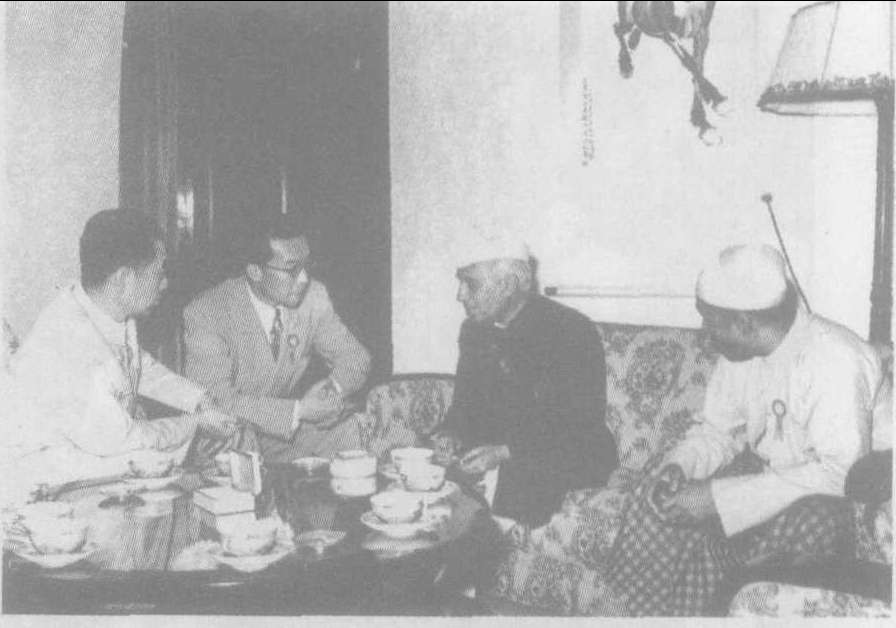
Zhou Enlai, Nehru and U Nu talking during the Bandung Conference, April 1955. Source: Wikimedia Commons, unknown photographer, Public domain

One thing at a time
- 1959: Sukarno issued Presidential Regulation No. 10, forbidding foreign nationals from doing retail trade in rural areas. Chinese who had not chosen Indonesian nationality were treated as "foreign nationals".
- December 1959: Radio Beijing announced that China would receive its nationals. About 100,000 people were brought back to China, and about 200,000 had applied. (Another count gives about 119,000; the way of counting differs.)
- 1966: Decision No. 127 of the Cabinet Presidium required the adoption of "Indonesian-style names", which amounted to abolishing traditional Chinese surnames.
- 1967: Presidential Instruction No. 14. Chinese characters were banned, Chinese schools were gradually closed, and Chinese religion and customs could be practised only at home.
- 1977: The Suharto government downgraded Confucianism to a "belief stream" (aliran kepercayaan).
- 18 November 1978: A circular of the Minister of the Interior stated that Indonesia had five religions: Islam, Protestantism, Catholicism, Hinduism, Buddhism. A presidential decision of 2000 repealed this circular together with the 1967 instruction.
- May 1998: Riots in Jakarta and Surakarta (Solo). The official Joint Fact-Finding Team recorded more than a thousand deaths and 85 cases of sexual violence, of which 52 were rapes. The team said it could not give the actual number of victims.
- 2000: President Wahid issued Presidential Decision No. 6, repealing the 1967 instruction.
- 2006 and 2008: The Ministry of Home Affairs and the Ministry of Religious Affairs recognised Confucian marriages, and the Ministry of Education issued a curriculum standard for Confucian instruction.
In the 2010 census, the Chinese numbered 2.83 million, 1.2%. Those registered as Confucians: 117,091.
The two numbers differ by more than twenty times.
Morality: how Confucianism was taken away
"Confucianism on the Indonesian ID card" in Duoshe wrote about Confucianism in Indonesia. I add only a little here.
This needs to be said separately: the 1967 instruction restricted public activity; the "downgrading" of Confucianism happened in 1977. This difference still needs checking.
The Confucian association (Matakin) was founded in 1955. After 1977 Confucians had to register as Buddhists or Christians.
A community's "morality" was forced to be kept inside a name that someone else gave.
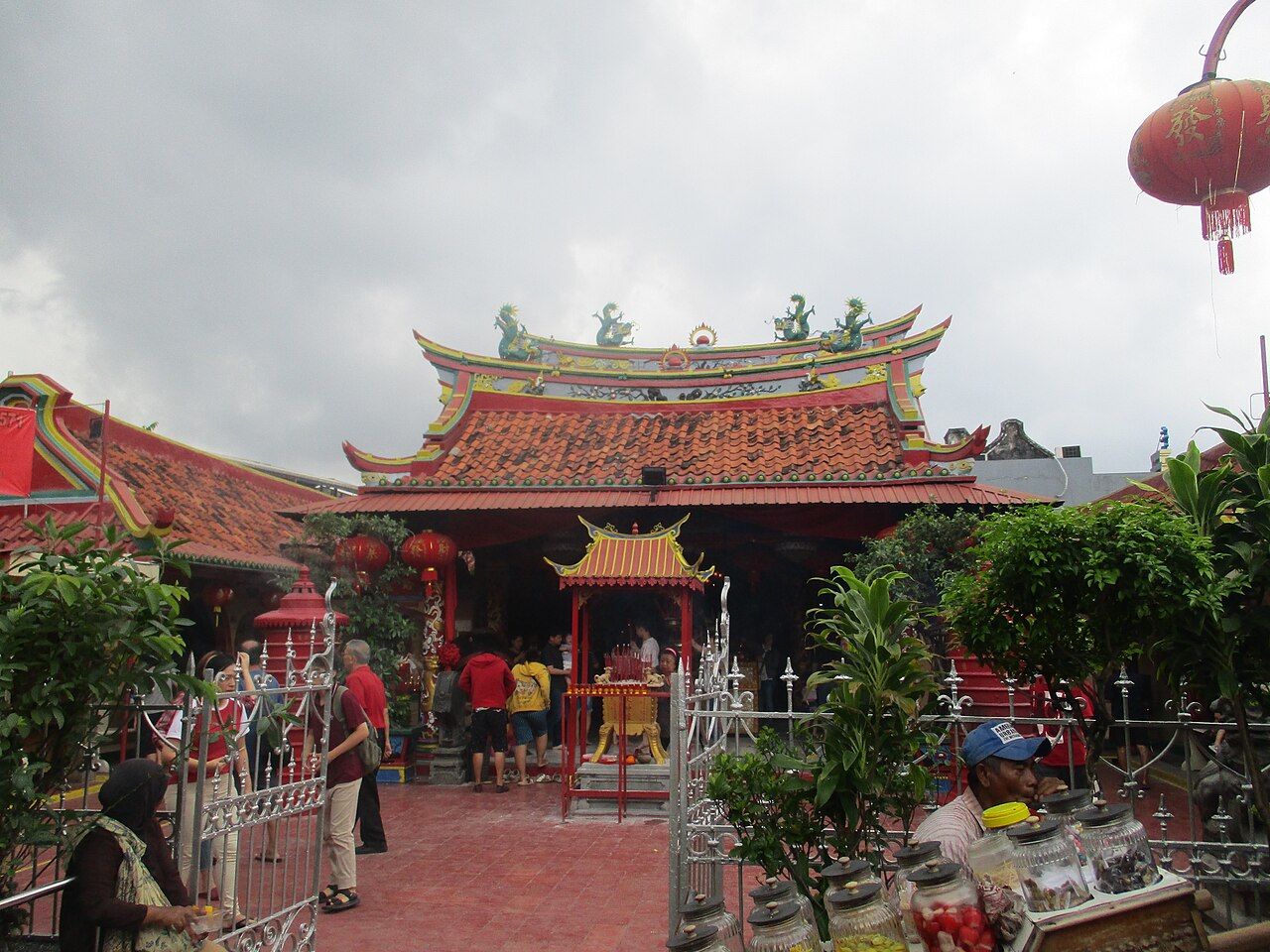
Boen Tek Bio temple in Tangerang, Banten, Indonesia, said to be the oldest Chinese temple in the area. Source: Wikimedia Commons, Cun Cun, CC BY-SA 4.0

Discipline: what was taken away was "organisation"
The schools were closed, the temples could not openly hold festivals, names had to be changed.
What was taken was not "belief" but "organisation". Belief can stay at home; organisation cannot.
Think of a Chinese-Indonesian child: at home he is called by the name his grandmother gave him; outside he must use a new Indonesian-style name; at home he hears his grandfather say a few words of Chinese, and at school he cannot learn it. A small child, in one day, has to become two people.
Present and future
After Wahid, in April 2002, President Megawati signed a decree and the Lunar New Year became a national holiday in Indonesia. Confucianism had a place on the identity card.
When a community has had something taken away for forty years, what is given back is not necessarily the original. How many of the young Chinese in Indonesia today can speak Chinese, I have not found a reliable figure.
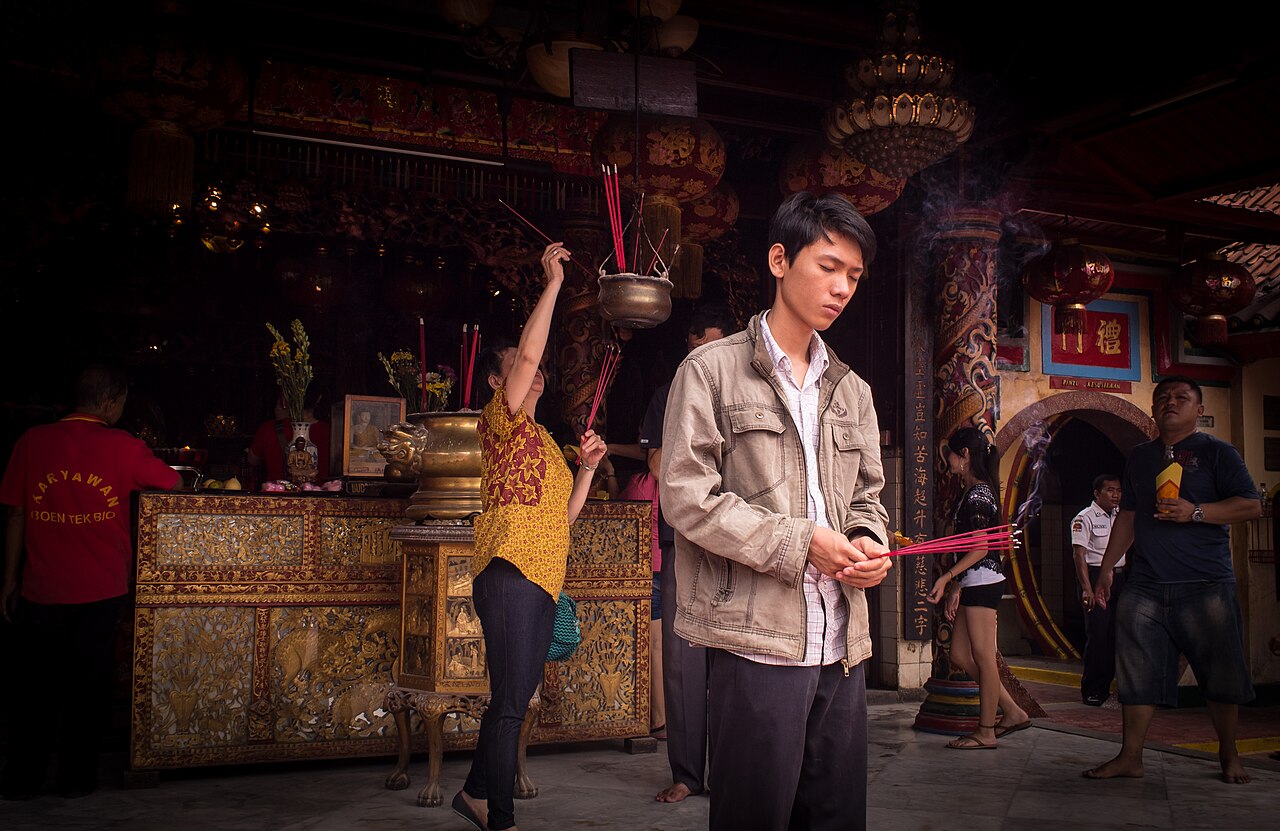
People burning incense in an Indonesian Chinese temple. Source: Wikimedia Commons, Cuncun Wijaya, CC BY 2.0

My judgment: Bandung was an abandonment
My judgment is this: in 1955, at Bandung, the Chinese Communist Party led by Zhou Enlai abandoned the Chinese of Indonesia and the Malay region; one can also say betrayed them, even stabbed them in the back. The Chinese who stayed there became "discarded pieces".
This judgment I want to state more exactly, because it is the heaviest sentence I have. The parties to that treaty in 1955 were China and Indonesia; Malaya was not yet independent and was not a party, so when I say "Indonesia and the Malay region", I mean the position China expressed at that conference toward the Chinese of all Southeast Asia: from now on, we no longer regard you as Chinese nationals; please go and be citizens of the places where you live. I do not necessarily oppose that position itself: for a new country it may even have been right. What I call "a stab in the back" is what came after: after 1955 China said this and yet did not speak for those who stayed. After the receiving of nationals in 1959, those who stayed faced the ban on rural retail; in 1966 and 1967, those who were told to change their names and close their schools faced bans; in 1998 people died. In May 1998, asked how Beijing would protect the Chinese there, the Foreign Ministry spokesman answered that China had no hold over them and hoped the situation would calm down soon; only in August did Beijing express "grave concern," and a People's Daily editorial demanded a full investigation of the rapes of Chinese women. Apart from that one protest the Chinese government made to Indonesia in 1959, I have not read of anyone speaking loudly for them on the international stage.They became "discarded pieces": on the board, the piece that is left where it stands, that nobody looks at any more.
Of course I know the other side: this was "putting down roots where one stands", a major turn in policy, meant to reassure the neighbours. I have no way of proving what was in people's minds at the time; what I can do is lay out both sides, and also write down my sorrow.
The other side of this judgment has a name among scholars: "luodi shenggen", putting down roots where one stands. At Bandung Zhou Enlai proposed that overseas Chinese should acquire the nationality of the countries where they lived and blend into local society. For China itself this was a major turn in policy: until then China had followed the Kuomintang's position of treating all overseas Chinese as Chinese nationals.
One event, two names: one is "abandonment", the other is "putting down roots".
Here is what is on the table.
- For "abandonment": the 1955 treaty made Chinese choose one of two; in 1959–60 more than 100,000 went back to China; China and Indonesia broke off diplomatic relations in October 1967 and restored them only in August 1990; in 1998, whether the Chinese government's reaction to the events was "restrained" is told differently by different sides. (The May statement and the August "grave concern" are given above.)
- Against "abandonment": the purpose of the treaty was to make the Chinese into local citizens and to remove the neighbours' suspicion of a "hand overseas", not to make them foreigners; the receiving of nationals was a response to the 1959 rural retail ban, when the Chinese government protested to Indonesia (on 9 December 1959 Foreign Minister Chen Yi wrote to Indonesian Foreign Minister Subandrio; Ambassador to Indonesia Huang Zhen then became China's chief representative on the joint committee of the two countries); China's own situation at home in the same period also belongs in the background. (The origin and negotiation of the treaty and the background of the 1960s I have not checked item by item.)
Four criteria, measured
- Numbers: 2.83 million, 1.2% (2010). Of the four, this one is short to begin with;
- Organisation: Chinese schools were gradually closed from 1967, public temples and festivals were restricted, and Confucianism was downgraded in 1977. Organisation was taken away one piece at a time;
- Wealth: I have no reliable figures. People often say what share of Indonesia's wealth the Chinese hold; I have not found the original data for such claims and do not write them. The 1959 rural retail ban was aimed at wealth;
- Doctrine: 117,091 Confucians, more than twenty times fewer than the Chinese total. On doctrine, a name was forced to change, and then taken away.
Of the four, one was short from the start and three were taken away.
What my position says here
If there is a "unified centripetal force", is its "centre" in Beijing, or in a religion? My answer: it cannot be in Beijing. If it is in Beijing, it is exactly what the Indonesian government feared in 1967, and exactly what the people abandoned at Bandung would least wish to be pulled back into. It must be in a religion, and a religion that any country can hold: one that does not demand loyalty to any state, is not approved by any state's government, and does not speak for any state. If your nationality is Indonesian, it is Indonesian; that you burn incense to your ancestors at Qingming should not conflict with it. This is what I want, and I think it is also the only thing worth getting in exchange for the price the Chinese of Indonesia paid for forty years: a "centre" that belongs to no state.
Looking at it the other way
The hardest counter-argument is the logic of 1967 itself: what a state wants is that the Chinese have no "heart outside".
It took the Chinese of Indonesia forty years, and the price of their names, schools, temples and the dead of 1998, to be allowed to be without this "heart". To give them a unified centripetal force now, they may not take it as medicine.
To my friends in Indonesia, whether you are Chinese or of any other group. In May 1998, more than a thousand people did not see the next day. Reading the words "cannot give the actual number of victims" in that investigation report, I stopped for a long time. Before that, there was a child: at home called by the name his grandmother gave him, outside the door obliged to use a new Indonesian-style name; hearing his grandfather speak a few words of Chinese at home, but not allowed to learn it at school; having to become two people in one day. This country once made some people afraid, in their own homes, to say their own names; in 2002 it was also this country that wrote the Lunar New Year into the national calendar. I want to record both: one so that it is not forgotten, the other so that those who come after know that a turn can be made.
A state asks you to choose once; you chose, and it still took your name. On whose account does this go?
References
- For comparison: "Confucianism on the Indonesian ID card" in Duoshe; "The Dusk of the Clan Associations" in Yigui; "Why the Confucian Association Failed" in this series
- Indonesia: Dual Nationality Treaty of 1955-04-22 (Zhou Enlai, Sunario; in force 1960-01-20); Presidential Regulation No. 10 of 1959; December 1959 reception of about 100,000 (about 200,000 applied; another count about 119,000); Decision No. 127 of 1966; Instruction No. 14 of 1967; Confucianism downgraded in 1977; TGPF of 1998; Presidential Decision No. 6 of 2000; 2006 and 2008; 2010 census: Chinese 2.83 million (1.2%), Confucians 117,091; Bandung "luodi shenggen" (putting down roots)
- Indonesia's Presidential Decree of 1965 etc. (see Duoshe, "Confucianism on the Indonesian ID card")
- Lunar New Year as a national holiday: Presidential Decision No. 19 of 2002 (2002-04-09, signed by Megawati), Indonesian Wikisource https://id.wikisource.org/wiki/Halaman:Keputusan_Presiden_Republik_Indonesia_Nomor_19_Tahun_2002.pdf/1 🟢
- Presidential Instruction No. 14 of 1967 (1967-12-06): https://id.wikisource.org/wiki/Instruksi_Presiden_Republik_Indonesia_Nomor_14_Tahun_1967 🟢; Presidential Decision No. 6 of 2000 (2000-01-17): https://peraturan.bpk.go.id/Details/57713/keppres-no-6-tahun-2000 🟢
- China–Indonesia diplomatic relations broken off 1967-10-30 and restored 1990-08-08: Chinese Ministry of Foreign Affairs, "China's relations with Indonesia" https://www.mfa.gov.cn/web/gjhdq_676201/gj_676203/yz_676205/1206_677244/sbgx_677248/ 🟢
- Chen Yi's letter of protest to Subandrio of 9 December 1959, and Huang Zhen as chief representative on the joint committee: article in the Our China Story series https://www.ourchinastory.com/cn/7711 (secondary) 🟡
- Image sources are given in each caption