A king's father
In 1767 the kingdom of Ayutthaya was destroyed by Burma. The following year a man called Taksin (Zheng Xin) re-established Siam at Thonburi.
Taksin's father was a Teochew man from Chenghai, and worked as a tax collector in Siam; his mother was Thai. After Taksin came the Chakri dynasty, the Thai royal house of today, and its founder, Rama I, is said also to have had Chinese blood.
So in Thailand "Chinese" and "royal house" are not two completely separate words.
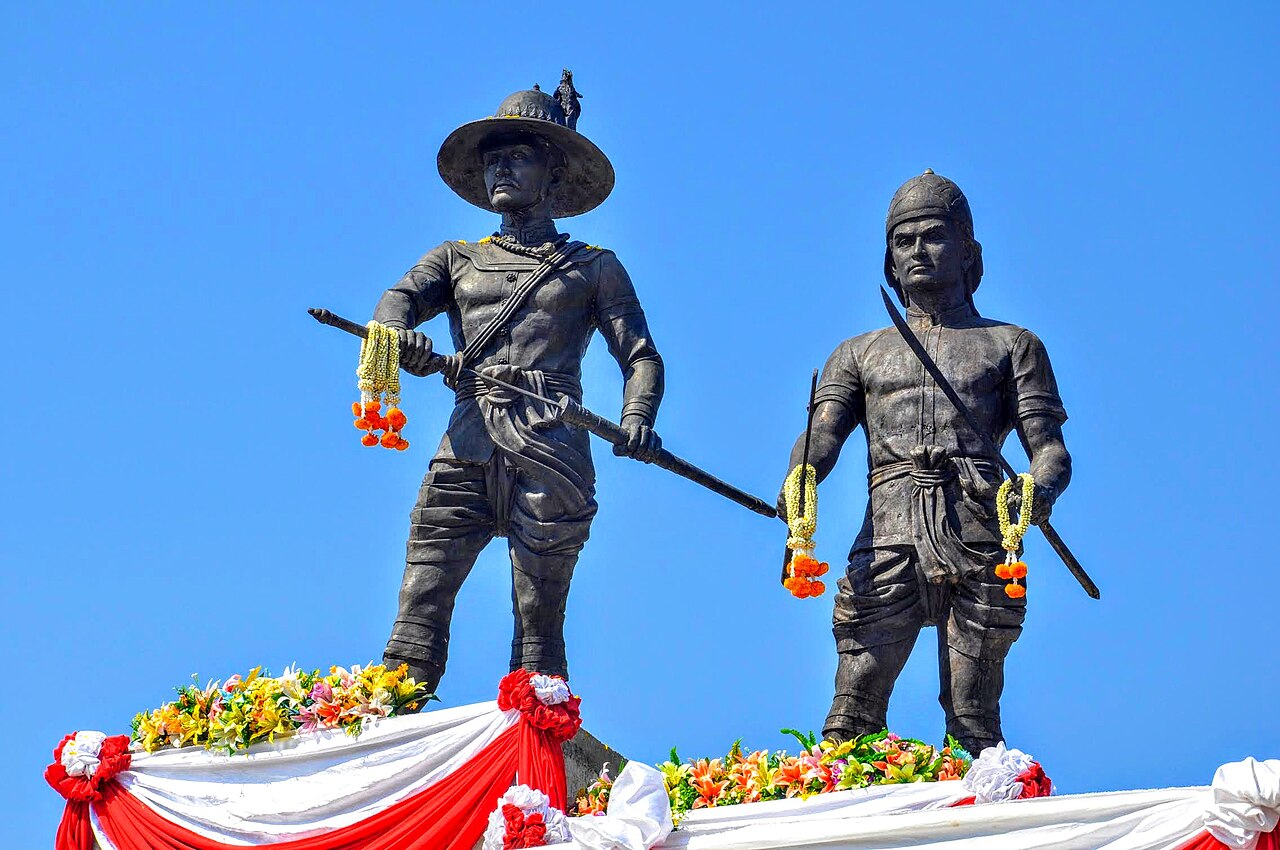
Monument to King Taksin the Great and Phraya Phichai at Thonburi. Source: Wikimedia Commons, Tmd, CC BY-SA 4.0

Four generations
The American scholar G. William Skinner studied the Chinese of Thailand. His definition of "assimilation complete" is plain: a person who in almost all situations thinks of himself as Thai, speaks Thai habitually and fluently, and chooses to associate more with Thais.
His judgment was that within four generations the Chinese of Thailand would be completely assimilated.
Today the Chinese of Thailand make up 11% to 14% of the population, about 9.5 million people (a 2012 estimate). A large part of them can no longer speak Chinese and no longer think of themselves as "Chinese".
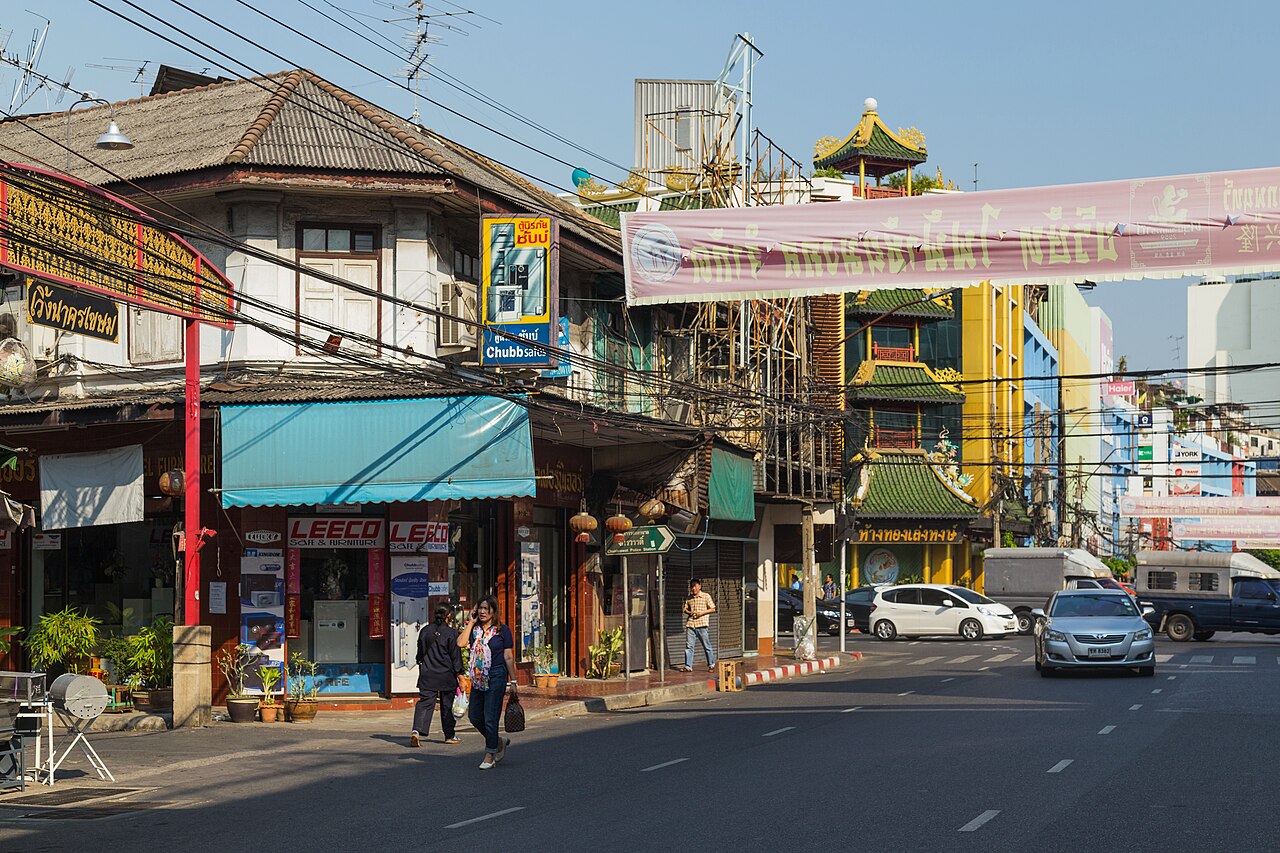
Yaowarat Road in Bangkok, an old street where the Chinese live closely together. Source: Wikimedia Commons, Marcin Konsek, CC BY-SA 4.0

What the state did
In Thailand assimilation did not all happen naturally. The state gave it a push.
In 1914 King Vajiravudh (Rama VI) wrote articles under a pen name (Asvabahu) calling the Chinese "the Jews of the East". How these articles should be read is disputed among scholars: some see racism; others think that what he feared was the spread of republicanism in Thailand.
From 1938 to 1957 (with an interruption of nearly four years), the Phibun government carried out "Thaification". Chinese schools were closed, Chinese books and newspapers banned, Thai-style dress was made compulsory, Chinese businesses were nationalised, sending remittances to China was made a crime, and those who still showed "Chinese characteristics" were harassed.
Phibun did not want to drive the Chinese out. He wanted them assimilated.
The charitable hall
But the Chinese community of Thailand did not disappear. One thing remained.
In 1909 twelve Chinese merchants in Bangkok started a body called the Poh Teck Tung ("Hall of Repaying Virtue"; Baode shantang). What it did was very concrete: collect the unclaimed dead and bury them. Later it became Thailand's best-known rescue organisation, handling the injured in traffic accidents.
A community, with no state to speak for it, still first buried those whom nobody wanted.
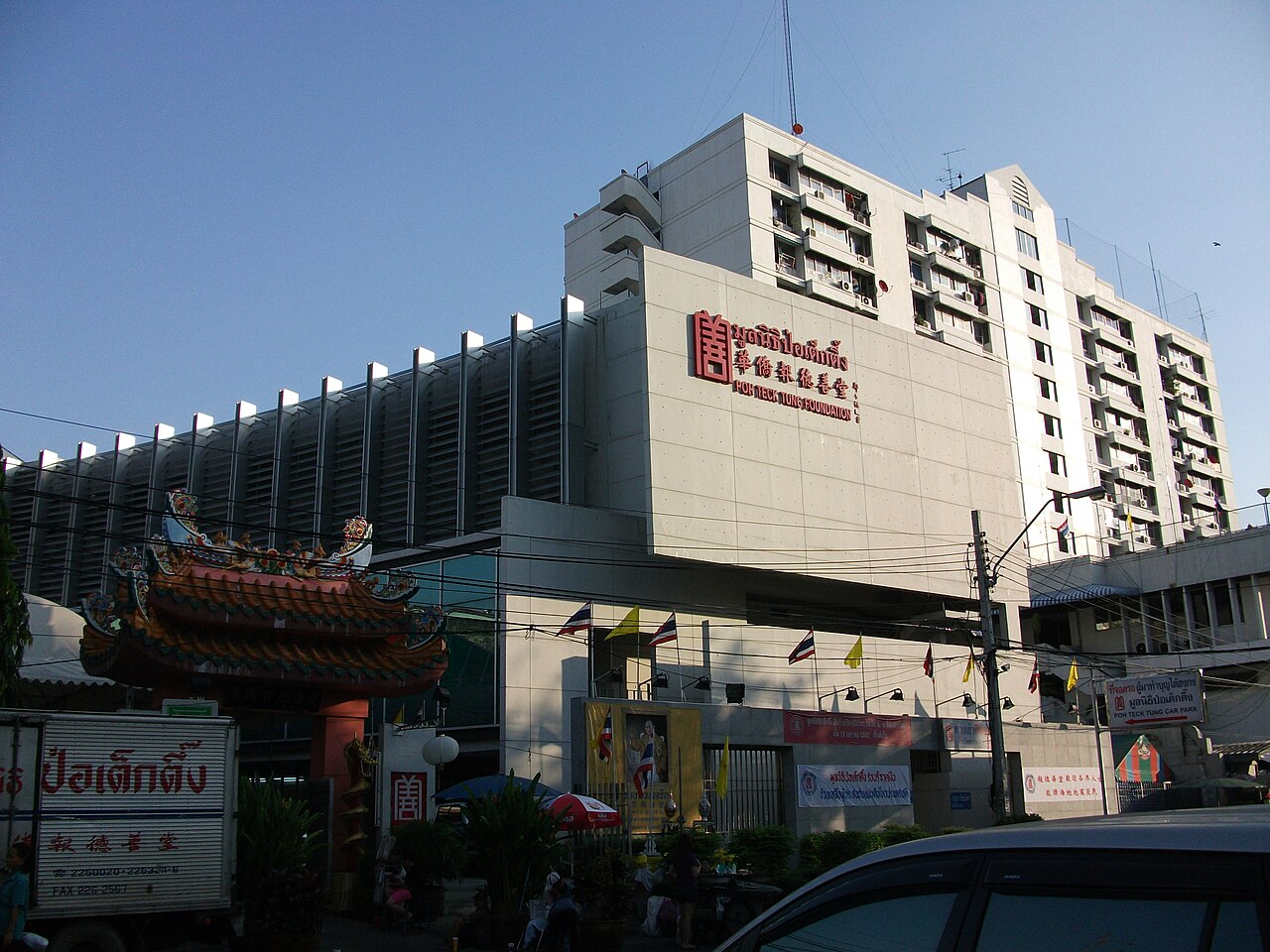
The building of the Poh Teck Tung Foundation in Bangkok, with the sign in Thai and Chinese side by side. Source: Wikimedia Commons, Sry85, CC BY-SA 3.0

Reading this, my nose stings a little. Imagine the scene: people who had left their homes, who had not yet found their own footing, first thought of the people by the roadside whom nobody claimed, whose names nobody knew, and said they could not let them lie there like that. This, I think, comes closer than any definition of "Chinese" to what the word "us" means.
Many Chinese temples remain a mixed tradition of Mahayana Buddhism, Confucianism and Daoism, and have not turned into Thai Theravada temples. But Skinner also notes that second-generation Sino-Thais go less and less to Chinese temples, because Theravada Buddhism already meets their spiritual needs.
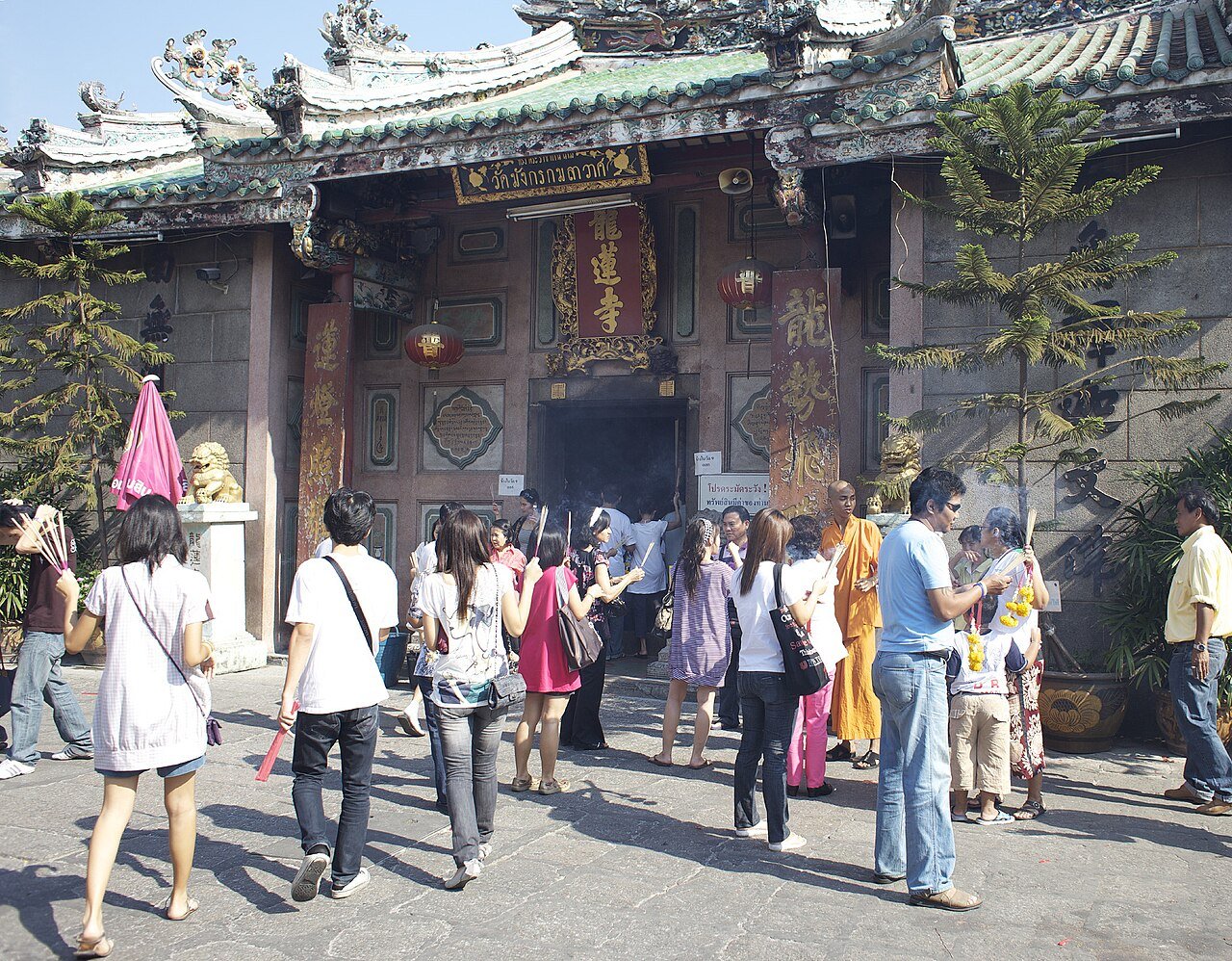
Wat Mangkon Kamalawat in Bangkok's Chinatown, a Chinese Mahayana temple. Source: Wikimedia Commons, Alan Oscroft, Public domain

Present and future
The rate of intermarriage is much higher than in Indonesia and Malaysia.
In Thailand the identity "Chinese" has not been destroyed; it has been slowly diluted.
Who thought of the method
I once guessed: was this Thai "method of assimilation" devised by the Teochew themselves?
I have found no evidence for that claim. What the studies speak of are three things: the tradition of intermarriage, the state's rewards for "Thaification", and the later generations' own choices.
This guess I set aside for now and do not write into the conclusion.
Four criteria, measured
- Numbers: about 9.5 million, 11% to 14% (2012 estimate);
- Organisation: the Poh Teck Tung, from 1909; Chinese temples remain, but Skinner notes that the second generation goes less and less;
- Wealth: I have no reliable figures, so I do not write them;
- Doctrine: Chinese temples are a mixed tradition of Mahayana Buddhism, Confucianism and Daoism, with no unified doctrine; in a country where Theravada Buddhism is the mainstream, the younger generation often turns to the local Buddhism.
Of the four, numbers and organisation are both there; doctrine is the one that has been diluted away. An example like this matters a great deal for my proposal.
What my proposal says here
The Chinese of Thailand, in four generations, bought a place of "not being suspected". If my proposal offers them a unified centripetal force, why would they want it? My answer: they need not. I do not want to tell someone who is already doing well that something is missing. What I want to say is something smaller: if one day you think of your grandmother's household shrine, think of where everyone in the family went on Qingming, and want to find someone to talk about these things with, there is a door there, and it is open. This does not ask you to stop being Thai, does not ask you to speak Chinese, and does not ask you to join any "organisation". It is only some days that you can share with others: ancestral rites, Qingming, the Spring Festival, a little reverence for Heaven. I think this may be the only approach to the Chinese of Thailand that does not disturb them. It is not a "centripetal" force; it is a place where you can "go home".
Looking at it the other way
The hardest counter-argument is just above: Skinner's "four-generation assimilation" is not a failure; it is the way a community chose to live in a country.
For a Thai Chinese, "I am Thai, my ancestors were Teochew, and my home has a household shrine for ancestral rites" is already a complete yigui. If my proposal says "you still lack a centripetal force", he will ask: toward where?
To my friends in Thailand. For many years your country did not drive the Chinese out, and let them, generation by generation, slowly become a part of you. That is not easy. I know the word "assimilation" hurts both sides a little: those assimilated lost something, and those who assimilated may not have noticed. But in 1909 twelve Chinese merchants in Bangkok, who had not yet found their own footing, first thought of the people by the roadside whom nobody claimed, and founded the Poh Teck Tung. Today the sign on its building carries Thai and Chinese side by side. This is something Thais and Chinese made together, and a whole country respects it. I think this too is a kind of yigui: it belongs to those who did this together, whatever their ethnic group.
A community, in four generations, becomes part of a country. Is that "disappearing", or "living on"?
References
- For comparison: "Neighbours to the South" (preface) and "The Neighbour Qianlong Did Not Defeat" (Myanmar) in this series; Yigui "The Dusk of the Clan Associations"
- Thailand: Taksin's father a Teochew man from Chenghai; Rama I "of Chinese descent"; Chinese about 9.5 million, 11–14% (2012 estimate), over 12% in 1932; Skinner's definition of "assimilation" and his judgment of "four generations"; Rama VI's pen-name article "the Jews of the East" (with scholars' dispute); Phibun's Thaification policy 1938–1957; the Poh Teck Tung of 1909 (founded by twelve Chinese merchants); intermarriage higher than in Indonesia and Malaysia
- Ayutthaya destroyed by Burma in 1767 and re-established by Taksin at Thonburi the next year: standard history
- Image sources are given in each caption