Four times
From 1765 to 1769 the Qing dynasty attacked Burma four times.
The first two (1765–1767) were beaten back at the border by the Burmese army. For the third (1767–1768) Qianlong sent his son-in-law Mingrui with 50,000 men, mostly Manchu bannermen, deep into Burma, to within a few days' march of the capital, Inwa (Ava); then tropical terrain and disease wore them down and they withdrew with heavy losses.
In the whole war the Qing army lost more than 70,000 men and four generals. Some call it the most disastrous frontier war the Qing ever fought.
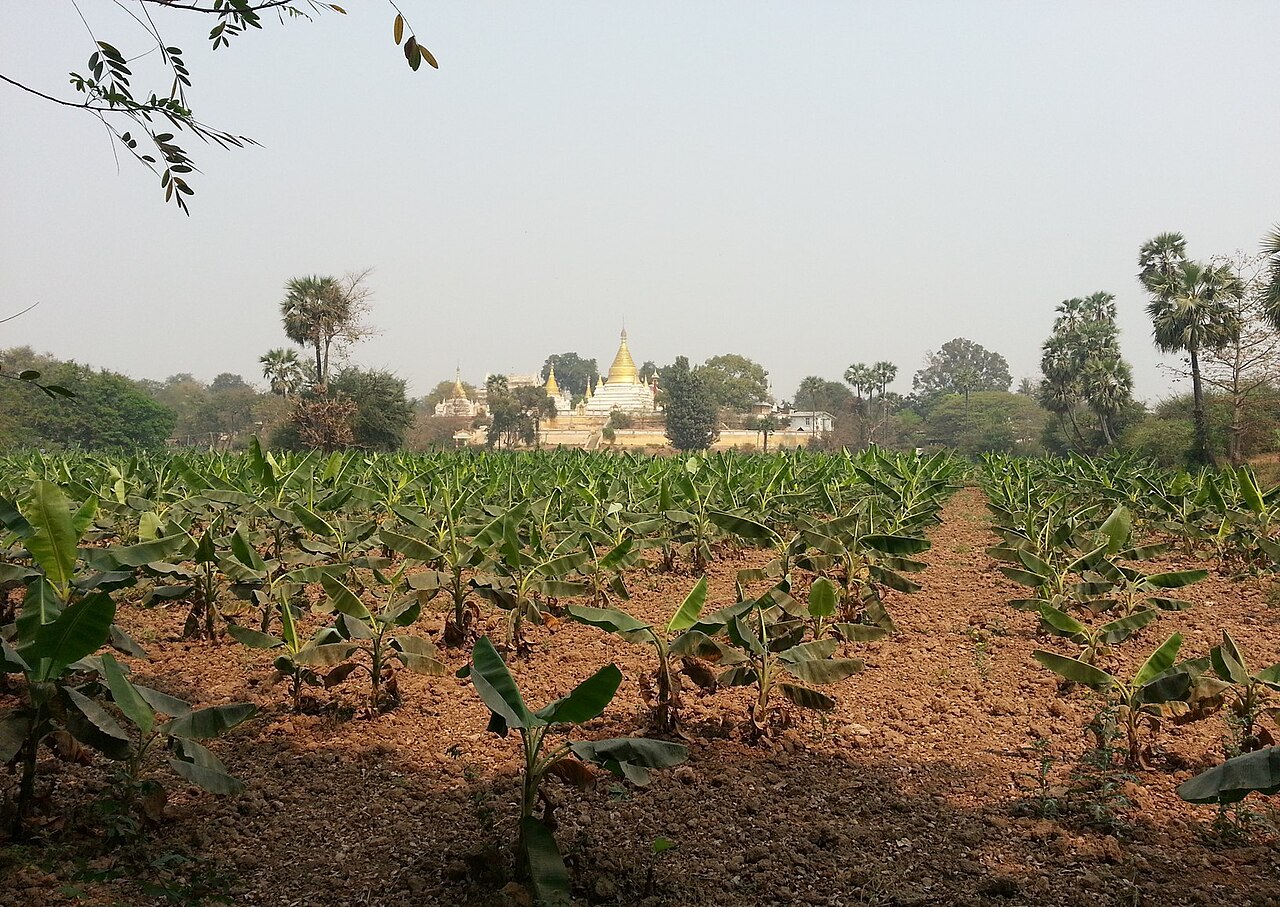
The area around Inwa (Ava), once the capital of Burma. In the eighteenth century the Qing army got as far as a few days' march from here. Source: Wikimedia Commons, Go-Myanmar, CC BY-SA 3.0

In December 1769 the commanders at the front agreed a truce, generally called the Convention of Kaungton. As a result, both Burma and Siam kept their independence.
In the same period Burma also destroyed Siam's capital, Ayutthaya (1767).
So to say that Burma won against Ayutthaya and Qianlong "at the same time" has some truth. But "by itself" needs a question mark: in those years Burma was fighting in two directions at once, and how it divided its troops between the two fronts has not been checked; the fall of Ayutthaya also had internal causes in Siam itself. (To be checked.)
The man who set Siam up again, Taksin, was the son of a Teochew man; see "The Most Successful Assimilation" in this series.
Think of those more than seventy thousand Qing soldiers. Most of them did not go for any grand principle; they were conscripted, and from the mountains of Yunnan and the grasslands of Manchuria they walked on into the miasma. Nobody recorded their names.
Another army
In 1949, when the civil war between the Nationalists and the Communists ended, a part of the Nationalist army did not surrender but fought its way out of Yunnan and into Burma's jungle.
In March 1950, in the area from Kengtung to Tachileik, there were about 1,500. By the end of 1950, on the Thai–Burmese border, about 10,000.
Afterwards the Nationalist troops in Burma gradually broke up. One part, led by Duan Xiwen, was taken in by Thailand in 1961 and settled at Mae Salong in Chiang Rai province. Thailand gave most of the soldiers and their families citizenship, on the condition that they fight for Thailand: in 1971 in Chiang Rai against the communist insurgency; in 1981 in Phetchabun province.
This is the basis on which the descendants of Chinese in Mae Salong today hold citizenship and land rights.
A defeated army, with no country and no home, fought for more than thirty years in the mountains of someone else's country, and what in the end it won was that its children could have a piece of land there and an identity card.
A place called Kokang
Kokang is in northern Shan State, Myanmar, bordering Yunnan. Most of the people there are Han and speak Chinese.
It is said that the Yang family who ruled Kokang descended from loyal officials of the Ming in Nanjing. In 1739 the Yangs formally established the Kokang chieftaincy.
In 2009 Kokang had about 150,000 people, of whom about 100,000 held Burmese nationality, and about 90% of those were Han.
In 2009 the Burmese military demanded that ethnic armed groups already in ceasefire be reorganised as border guard forces, and Kokang's leader, Peng Jiasheng, was forced to flee. This is the "2009 Kokang incident". In 2015 there was another clash.
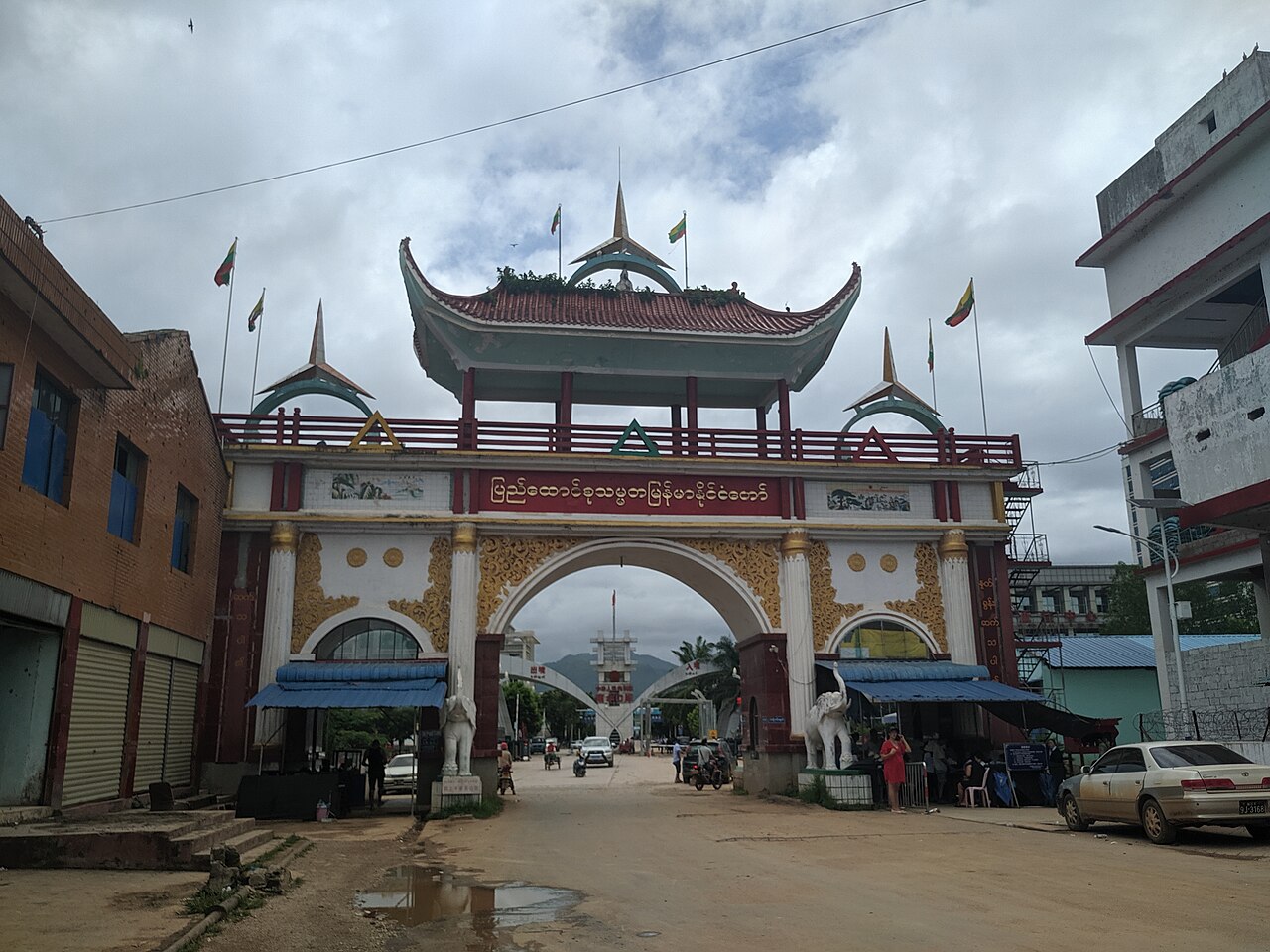
A border gate on the Myanmar–China border (the Kokang area). Source: Wikimedia Commons, Paingpeace, CC BY-SA 4.0

Morality and discipline: the families of 2023
Later some Kokang families ran scam compounds on a vast scale.
On 20 October 2023, at the "Crouching Tiger Villa" of the Ming Xuechang family, guards fired on workers trying to escape, with many casualties, among them fourteen Chinese citizens. In November 2023 Ming Xuechang killed himself when arrested, and died in hospital despite efforts to save him.
In September 2025 the Wenzhou Intermediate People's Court in Zhejiang pronounced judgment on the Ming criminal group: 39 people guilty, on fourteen counts, including fraud, intentional homicide and intentional injury. Eleven were sentenced to death, 5 to death with a two-year reprieve, 11 to life imprisonment, and the rest to fixed terms of five to twenty-four years. The losses in the case exceeded 1.4 billion US dollars. From 19 to 22 September 2025, Bai Suocheng and 20 others were tried in Shenzhen.
I put it in the place of "morality": what does a community's "self-government" use to govern itself?
This section needs one more word, because it is very easily read wrongly. The victims of the scam compounds stand at two ends: at one end the people who were cheated; at the other, the people trapped inside the compounds and forced to cheat, many of whom were themselves young people lured there from China and other countries. Their passports were confiscated, they worked many hours a day, they were beaten, and those who tried to escape were beaten and threatened. In October 2025, when the military closed the KK compound, over a thousand people waded the Moei River to flee, and some drowned.These are the people who most need to be remembered. And those who gave the orders, the few families, are specific people, convicted of specific crimes by a court. I put this in the place of "morality" because I want to ask a very old question: if a community has no bottom line that it holds for itself, what will its "self-government" become one day? I do not think this is a problem of "the Chinese", nor of the Kokang people; it is something that can happen in any place that is governed neither by rules from outside nor by rules from within.
No further material on Kokang's beliefs has been found, so it is left blank. If someone is willing to tell me what the people of Kokang keep on their household altars and how they spend Qingming, I would like to know.
Present, and 1967
For the Chinese of Myanmar there is no figure everyone accepts.
In 1962 Ne Win came to power and began nationalisation. On 26 June 1967 anti-Chinese riots broke out in Yangon, set off by the spread of the influence of China's Cultural Revolution, with students wearing Mao badges. More than thirty Chinese citizens were killed; the Chinese embassy, Chinatown and Chinese schools were attacked.
After the riots many Chinese emigrated again. Those who stayed hurried to take nationality and assimilate, and hid their Chinese identity.
Four criteria, measured
The Chinese of Myanmar are three completely different kinds of people, and no one kind can represent them all. First measure the Kokang kind:
- Numbers: in 2009 Kokang had about 150,000, of whom about 100,000 had Burmese nationality, about 90% Han. As a place, the numbers are enough;
- Organisation: it has a tradition of chieftaincy and its own armed force (MNDAA). The organisation is strong, but it is an armed force, not a temple, not a school;
- Wealth: some families have vast wealth, but the source the verdict identified was crime (fraud losses of over 1.4 billion US dollars). This one cannot count here;
- Doctrine: I found no material on the beliefs of the people of Kokang; left blank (to be supplemented).
Then the descendants of the Nationalist army (Mae Salong):
- Numbers: not large;
- Organisation: an army at the time, later Thai citizens;
- Wealth and doctrine: no material; not written.
Of the four, what Myanmar gives is the most dangerous combination: numbers and arms are there, doctrine is empty, and the source of wealth has been convicted.
What my proposal says here
The Chinese of Myanmar are three completely different kinds of people: old overseas Chinese of several generations, descendants of the Nationalist army, and new immigrants since the 1990s. My proposal's "unified centripetal force": for which of them? My answer: it is "given" to none of them. My proposal is not something issued to a group. To an old overseas Chinese whose family has lived for generations in Yangon I say "ancestral rites at Qingming", and he nods; to a descendant of the Nationalist army in Mae Salong I say the same sentence, and he nods too; to someone newly arrived I say this sentence, and he may be puzzled for a moment, but he will understand. My proposal is only some days; whoever wants to keep them is in them. But I must be honest too: where a group of people end up if they have numbers and arms but no "teaching" that holds a bottom line, Myanmar has already shown me. This is the biggest warning I have for my own idea: a centripetal force without a bottom line is the most dangerous thing there is.
Looking at it the other way
The hardest counter-argument is that one day in 1967: as soon as the Cultural Revolution's "centripetal force" reached Yangon, more than thirty people died.
If a community's "heart" is activated by a foreign country's politics, what it brings to the host country is not yigui but a threat. My proposal must be careful not to become another form of that "foreign politics".
To my friends in Myanmar, whether you are Bamar, Shan, Chinese, or something else. For more than two hundred years your country has been trodden on by many: from 1765 to 1769 Qianlong's bannermen attacked four times; in 1950 the Nationalists' defeated army fell back from Yunnan into the jungle; on 26 June 1967 the badges of the Cultural Revolution reached Yangon, and more than thirty people died; later came the workers shot at in the scam compounds. All of these came from the north. You have probably learned to keep an extra watchful eye on everyone who comes from the north, and I do not blame you. What I cannot let go of are the people in these events whose names nobody recorded: the more than seventy thousand Qing soldiers who walked into the miasma, the people in the compounds who tried to escape. I cannot call a single one of them by name.
Among the Chinese of one country, some took in a defeated army, and some ran scam compounds. What can the two words "the Chinese" still explain?
References
- For comparison: "The Most Successful Assimilation" (Thailand) and "Neighbours to the South" (preface) in this series
- Myanmar: Sino-Burmese war of 1765–1769 (four invasions; Qing dead over 70,000; Mingrui, 1767–68; truce of December 1769); Nationalist army entering Burma in 1949–50 (about 1,500 in March 1950, about 10,000 by the end of the year); Duan Xiwen, Mae Salong in 1961, Thailand granted citizenship, fought in 1971 and 1981; Kokang: the Yang family, chieftaincy founded 1739; population in 2009 about 150,000, about 100,000 with Burmese nationality, about 90% Han; clashes of 2009 and 2015; Yangon riots of 1967-06-26; Wenzhou verdict on the Ming group in 2025; Bai Suocheng case tried in Shenzhen 2025-09-19 to 22
- Burma's destruction of Ayutthaya in 1767: standard history
- Image sources are given in each caption