The numbers
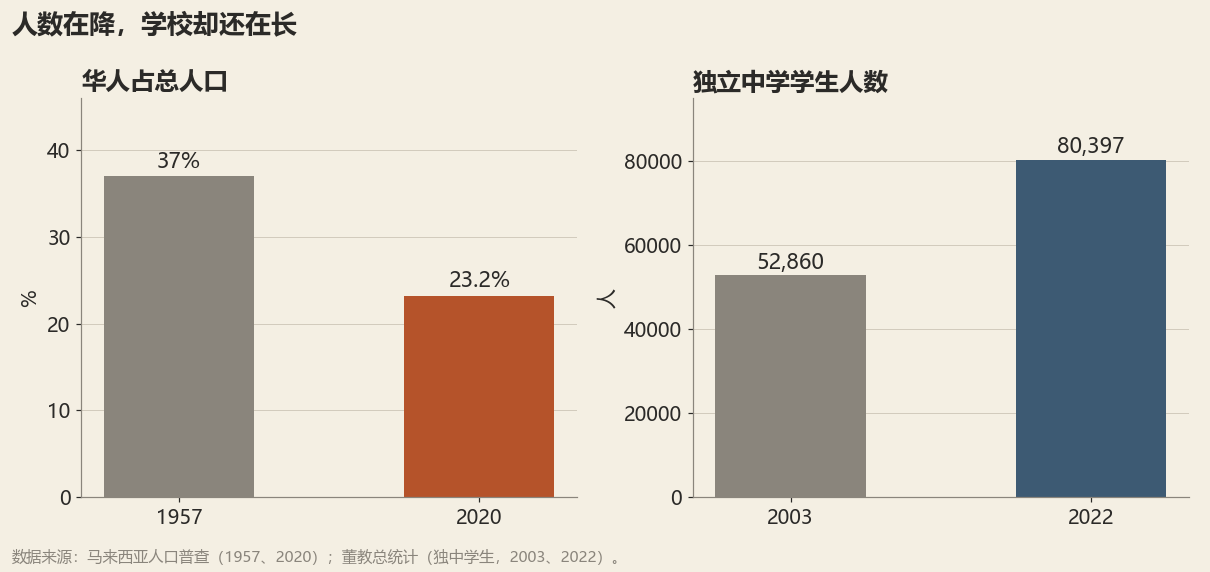
In 1957, when Malaya became independent, the Chinese made up 37% of the population. In 2020 they were 23.2%.
In the same year, 2020, the bumiputera (indigenous) were 69.4%, Indians 6.7%, others 0.7%. The Chinese are not bumiputera, and so do not have the bumiputera preferences.
The Chinese total fertility rate is the lowest of all groups: 0.8 (the Department of Statistics Malaysia figure for 2022; 0.9 for 2023). From 2016 to 2022 the marriage rate in the Chinese community fell by 33%.
A school is an "us"
In Malaysia the Chinese have kept one thing: schools, from primary to secondary, that teach in Chinese.
The Razak Report of 1956 designed a system: primary schools could be in Malay, English, Chinese or Tamil; secondary schools only in Malay and English. The Education Act of 1961 wrote this system into law.
The choice for Chinese secondary schools was: accept government funding and turn into English-medium schools; or stay Chinese, raise their own funds, and become private. Most schools accepted. A few refused and became "Chinese independent secondary schools".
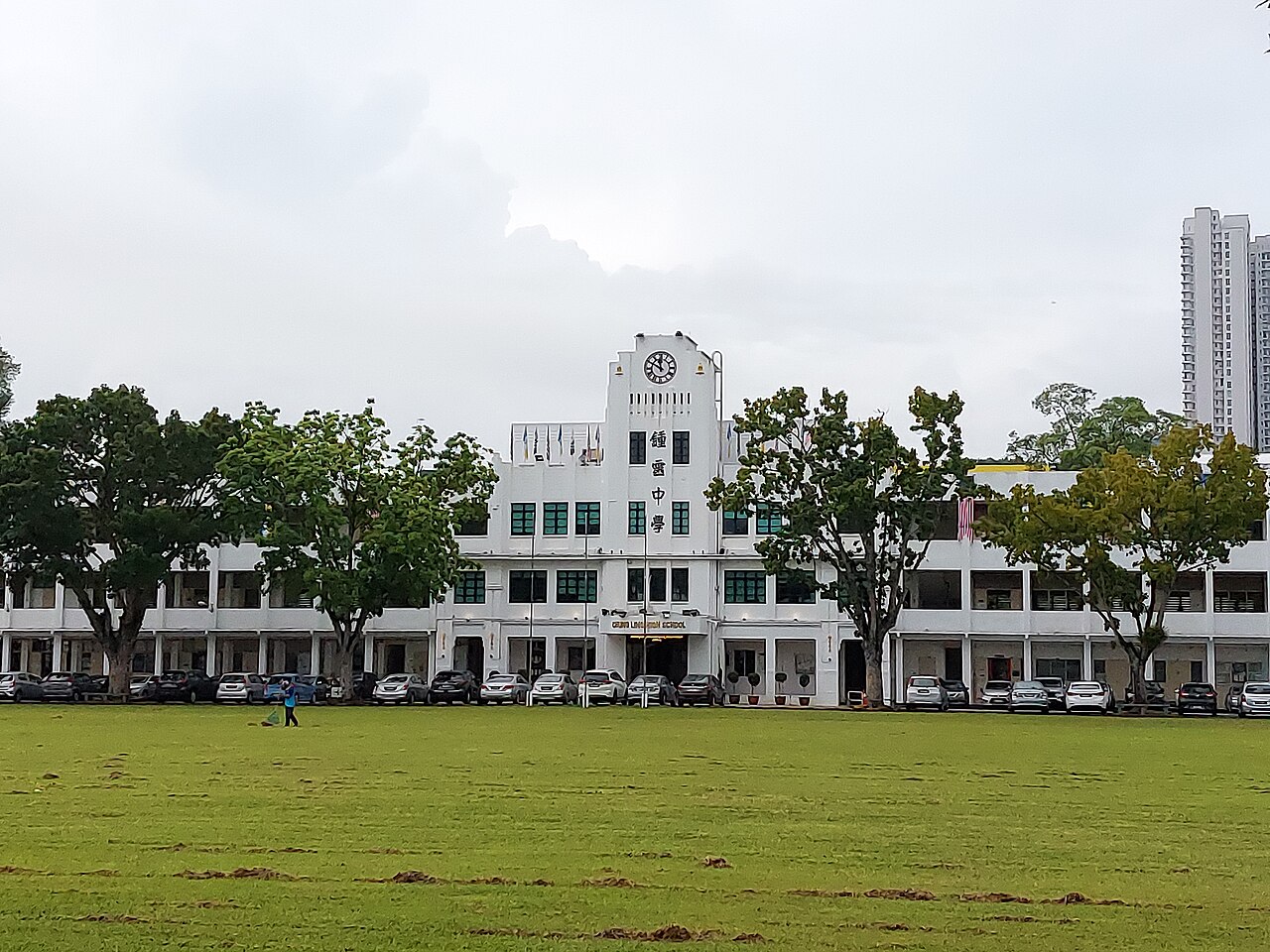
Chung Ling High School in Penang, one of Malaysia's Chinese independent secondary schools. Source: Wikimedia Commons, CW Tan (PenangLion), CC BY-SA 4.0

Today there are about sixty independent schools, more than twenty of them in East Malaysia. Their unified examination (UEC) has been run since 1975 by Dong Jiao Zong (the United Chinese School Committees' Association of Malaysia and the United Chinese School Teachers' Association of Malaysia).
In July 1982 the Federal Court rejected the application to establish an "independent university" (Universiti Merdeka). It was to be a private Chinese-language university, meant to extend Chinese education up one more level.
From 2003 to 2022 the number of independent-school students rose from about 53,000 to nearly 80,000, an increase of about half (Dong Jiao Zong figures: 52,850 in 2003 and 79,694 in 2022, with a peak of about 85,000 around 2017).
Morality and discipline
A Chinese school governs three things: which characters are taught, which stories are told, and what a group of children do together.
With no state to speak for them, the Chinese governed themselves through schools: boards of trustees, alumni associations, a unified examination, fundraising. Having their own examination means having their own path.
There is no need to make it sound too beautiful. The system has costs: the UEC is only partly recognised even now; in Sarawak, Selangor and Penang it can be used to apply for public posts, but a pass in the national language is required.
Think of the people behind this: a small trader, who kept a stall all his life and gave what he earned, bit by bit, to a secondary school he never attended. He himself may not even write Chinese well, but he says: my children must not fail to know their ancestors' characters. In Malaysia there are several hundred thousand people like that.
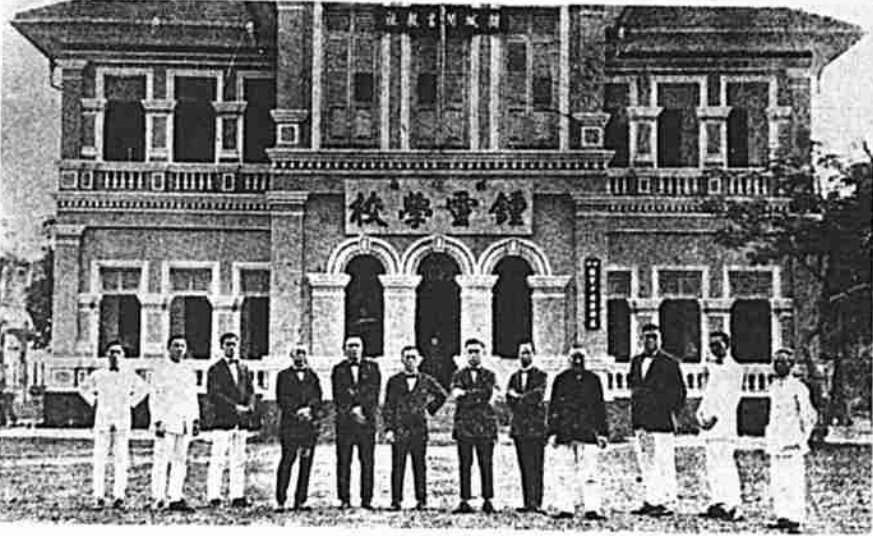
Chung Ling High School, Penang, in 1935. Source: Wikimedia Commons, Chung Ling High School Magazine, Public domain

Belief
In Malaysia in 2020, 63.5% were Muslim, 18.7% Buddhist, 9.1% Christian, 6.1% Hindu.
Among the Chinese, about 83.6% call themselves Buddhists, 11.1% are Christians, and 3.4% are Daoists.
But most Malaysian Chinese in practice hold a mixture of Buddhism, Daoism, Confucianism and ancestor worship. Asked what they believe, they say "Buddhism".
Compared with Indonesia, the direction is the reverse: in Indonesia a mixed thing was forced to choose a name; in Malaysia a mixed thing chose for itself the most convenient name.
The future
The falling birth rate has brought a phenomenon: in Chinese primary schools the number of Malay pupils is increasing. A 2025 article from the ISEAS institute in Singapore describes this as "rescued, and threatened": Malay pupils save some Chinese primary schools from closing, but the "Chinese" character of the schools may also grow fainter as a result.
One response from Dong Jiao Zong has been to open to non-Chinese and to recruit international students.
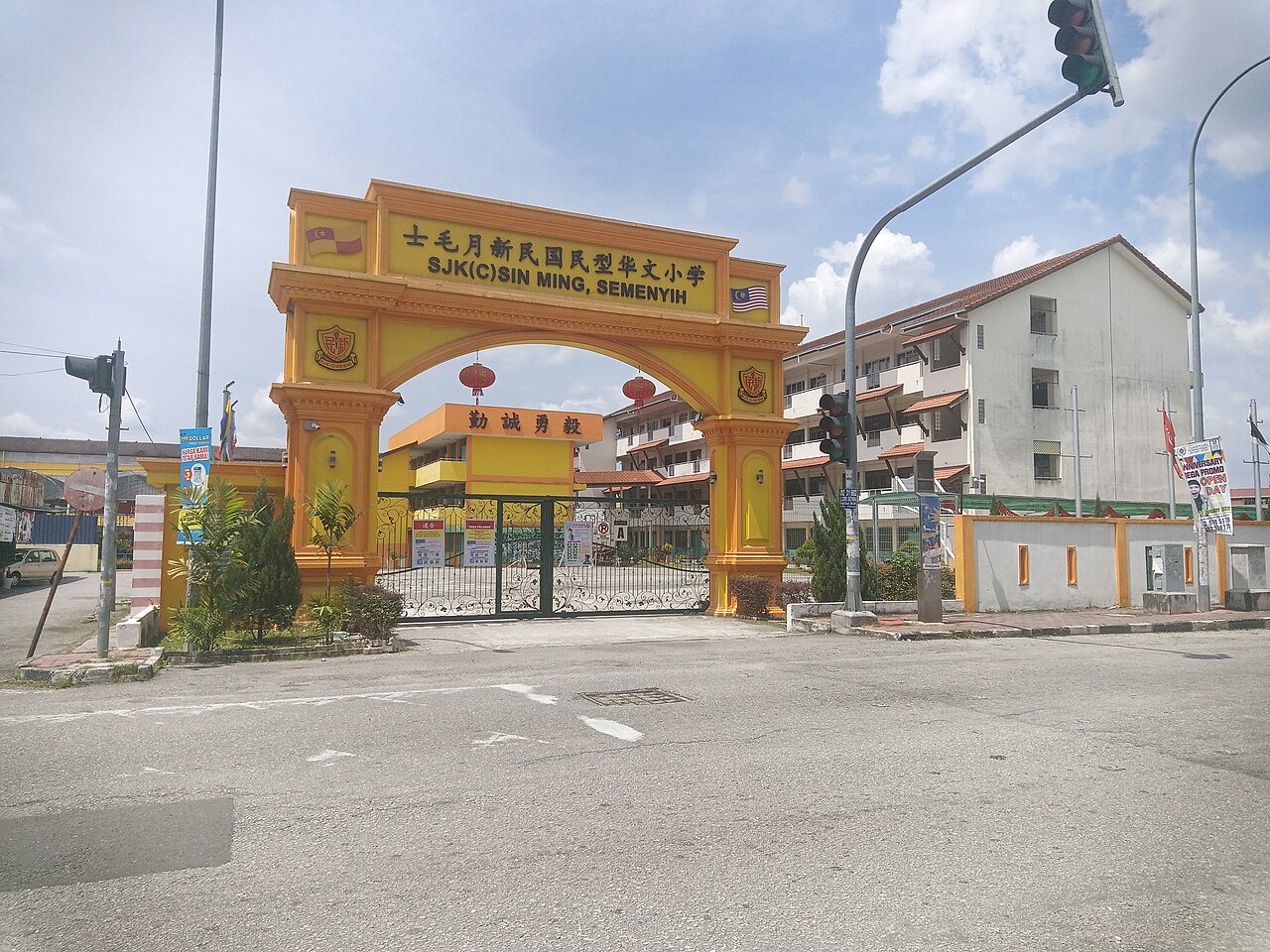
A Chinese primary school in Selangor. Source: Wikimedia Commons, SNN95, CC BY-SA 4.0

Four criteria, measured
- Numbers: 23.2% in 2020, 37% in 1957, falling; Chinese total fertility rate about 0.8, marriage rate down 33% in 2016–2022;
- Organisation: the most complete in Southeast Asia: Chinese primary schools, about 60 independent schools, the unified examination, Dong Jiao Zong. Of the four, this one is the strongest;
- Wealth: I have no reliable figures, so I do not write them;
- Doctrine: about 83.6% call themselves Buddhists, but in practice it is a mixture of Buddhism, Daoism, Confucianism and ancestor worship; no unified teaching.
Of the four, organisation is the strongest, numbers are falling, and doctrine is loose.
What my proposal says here
The Chinese of Malaysia already have the most complete "discipline" in Southeast Asia: schools and examinations. What they lack now is people, not a centripetal force. My proposal cannot give people, and I must say so honestly: the birth rate is not something a religion can solve with a sentence; behind it are housing, jobs, children's school fees, whether young people are willing to marry. What my proposal can give is a very small thing: if these children learn characters at school but do not know why they learn them, then let them know: these characters are so that at Qingming you can read the line on your ancestor's tombstone; so that at the Spring Festival you can read the couplets on the door. Then the school is not only a place "for the examination", but also a place "for going home". I think this is the small thing my proposal can do for Chinese education.
Looking at it the other way
The hardest counter-argument to Chinese schools comes from the other side. In 2018 a state mufti said that recognising the UEC would harm national harmony. That view carries considerable weight in Malay society: if a country has a school system of its own and one ethnic group has another of its own, will the word "citizen" grow thin?
As in the earlier pieces: one community's centripetal force looks, to another community, like a centrifugal force.
To my friends in Malaysia, whether you are Chinese, Malay or Indian. Writing down "one community's centripetal force looks, to another community, like a centrifugal force", I felt a little sad, because I know it is true, and I know each of you lives your days inside that sentence. I do not want to say who is right; I only want to say a small thing: in a Chinese primary school classroom a child is learning to write his own name, and the Malay classmate sitting beside him is learning too. In recent years such classrooms have been growing in number. One learns his ancestors' characters, one learns a new friend's characters, and this is what "living together" looks like in my mind. I hope there will not be fewer of them.
A school needs pupils, and pupils have to be born. What should that rest on?
References
- For comparison: "What Was Allowed, and What Was Taken" (Indonesia) and "Neighbours to the South" (preface) in this series; Yigui "The Dusk of the Clan Associations"
- Malaysia: Chinese 37% in 1957, 23.2% in 2020 (bumiputera 69.4%, Indians 6.7%); Chinese total fertility rate about 0.8; Chinese marriage rate down 33% in 2016–2022; Razak Report 1956; Education Act 1961; about 60 independent schools; UEC run by Dong Jiao Zong since 1975; Federal Court rejects the independent university in July 1982; independent-school students 52,860 in 2003 and 80,397 in 2022; limited recognition of the UEC (Sarawak, Selangor, Penang); 2020 census, religion: Islam 63.5%, Buddhism 18.7%, Christianity 9.1%, Hinduism 6.1%; Chinese 83.6% Buddhist, 11.1% Christian, 3.4% Daoist; ISEAS 2025/34 (James Chai); 2018 state mufti's remarks (as reported by Malay Mail)
- Image sources are given in each caption