An idea
I once had an idea: whether Thailand and Laos are connected with China's Dai, Zhuang and Miao peoples.
They are, and they are not.
The language accounts
Thai, Lao, Shan (Myanmar) and Zhuang all belong to the Tai–Kadai language family. That they are relatives is a linguistic conclusion. The Dai language is in the same family.
The diversity of the Tai–Kadai family is concentrated in southern China, so it is generally held that the family originated in southern China. One branch of it, the "Tai", began moving south around the year 1000.
The Miao are not in this family.
Hmong–Mien is another, independent language family. Whether it is related to Tai–Kadai has not been established. The ancient DNA evidence we have shows that the ancestors of Hmong–Mien speakers and those of Tai–Kadai speakers were two different groups of people on the banks of the Yangtze.
So "Thai, Lao, Dai, Zhuang and Miao are one family" is only half right: the first four are, the Miao are not.
Whose kingdom was Nanzhao
If the Tai moved south from southern China, was the kingdom of Nanzhao in Yunnan (Tang period) built by the Tai?
This question has been argued for a long time.
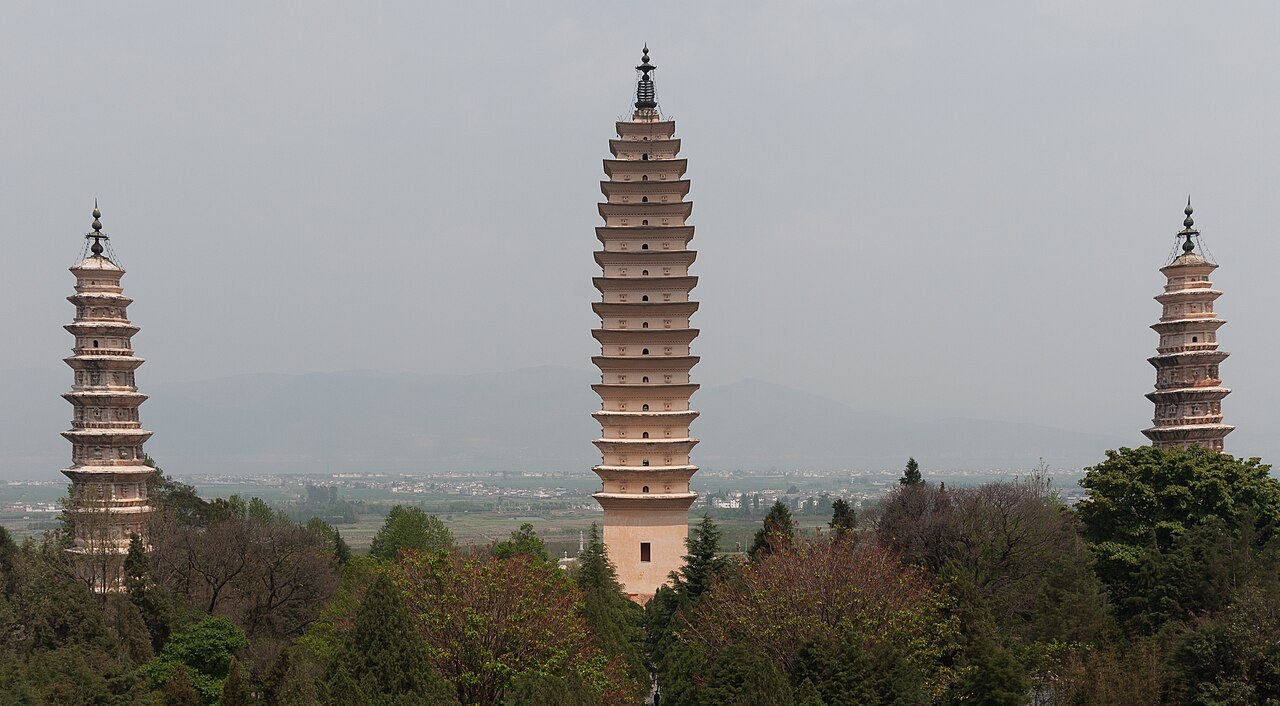
The Three Pagodas of Chongsheng Temple, Dali, Yunnan. Dali was the seat of Nanzhao and of the Dali kingdom that followed. Source: Wikimedia Commons, CEphoto, Uwe Aranas, CC BY-SA 3.0

Among Thai scholars, some hold that Nanzhao was founded by the Tai. This is part of the "migration" account in Thai nationalist narrative: the ancestors came from a great kingdom in the north.
Most Chinese scholars oppose this. They hold that Nanzhao was built by Tibeto-Burman speakers, that its population was mainly Bai and Yi, that the elite spoke a form of Yi, and that Nanzhao's scriptures were written in Bai. Today most scholars take the latter view.
There is politics in this. Around the 1980s Chinese historians concentrated on refuting the claim that "Nanzhao was a Tai state". The Chinese account is that Nanzhao was a "local regime" of China, and it works hard to show that the groups in the sources are the ancestors of today's ethnic minorities of the southwest.
In 1253 the Mongols destroyed Dali (Nanzhao's successor). After that many groups moved away from Yunnan.
I have no way to decide this dispute for either side. What can be said is that a question about "who we are and where we come from" has stakes for both countries.
Each with its own Heaven
Back to "Heaven". People who speak the same language: do they worship the same Heaven?
- The Thai, the Lao, the Dai: mainly Theravada Buddhism, mixed with some animism and ancestor worship. The Dai number a little over 1.2 million in Yunnan (2010 census, provincial bulletin: 1.222 million; I did not find the national figure), concentrated in Xishuangbanna and Dehong.
- The Zhuang: 19,568,546 in the 2020 census, the largest minority in China. Most follow the "Mo religion" (Mojiao), which has a supreme creator god, Buluotuo, and reveres many other gods. The Mo religion is animist; it holds that the universe has three layers and that a person has three souls.
- The Miao (Hmong): 11,067,929 in China in the 2020 census. Their traditional belief is animism and ancestors, mediated by ritual specialists.
One language family, three kinds of "Heaven": Theravada Buddhism, the Mo religion, and an animism in another language family.
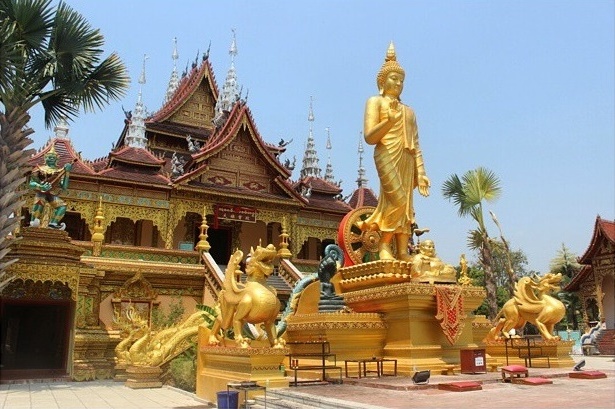
A Dai Buddhist temple in Jinghong, Yunnan. The Dai mainly follow Theravada Buddhism. Source: Wikimedia Commons, Evan Guerra, CC BY-SA 2.0

The Hmong in Laos
Laos has Hmong. Their story is the "Secret War" of 1961 to 1975: the American CIA hired a Hmong force led by General Vang Pao to fight the communists in Laos.
In 1975 Long Tieng fell and the Pathet Lao took power and took revenge on these soldiers and their families. About twenty thousand Hmong fled to Thailand and then to the United States. 1980 was the peak of departures for the US, about 27,000.
After they reached the US the Hmong's beliefs changed again. A rough estimate: up to half of Hmong in the US are Christians, though some still keep ancestor worship and healing by shamans. In Minnesota a considerable number converted under pressure from the churches and agencies that sponsored their resettlement.
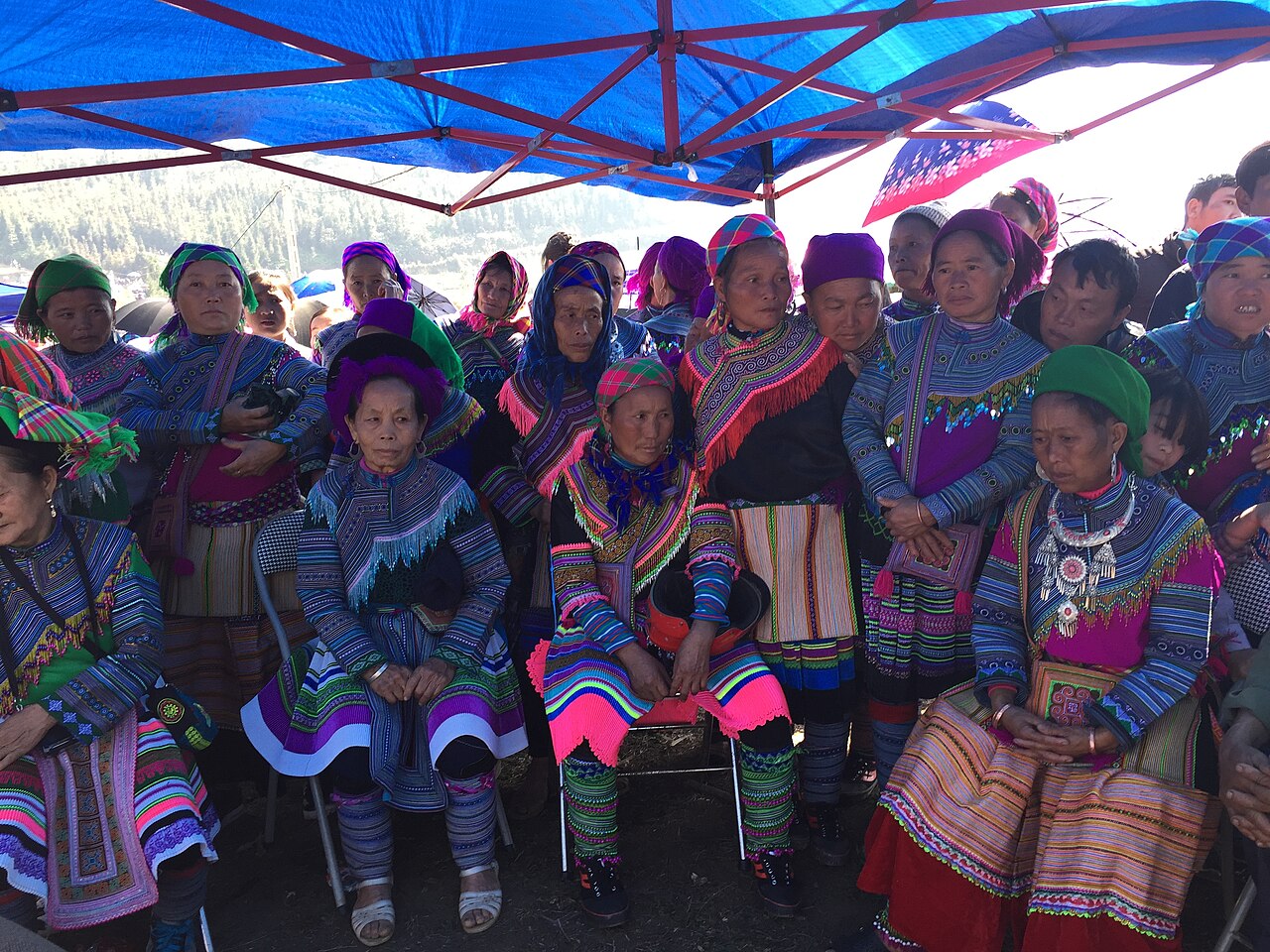
Hmong women in traditional dress. Source: Wikimedia Commons, DTH-BD-NVT, CC BY-SA 4.0

Think of that family: a Hmong farmer in the mountains of Laos, swept into someone else's war; the war was lost, and he fled, crossing the river, passing through refugee camps, and finally reached a place called Minnesota where the winters are very cold, and there his children grew up in church. Does he still keep the ancestral tablet from home? I do not know.
Four criteria, measured
- Numbers: the Zhuang number nearly twenty million, the most in this group;
- Organisation: the Dai have monastic communities and temples; the Zhuang Mo religion is a transmission of ritual masters, with no unified church;
- Wealth: hard to measure; not written;
- Doctrine: the Zhuang have a supreme god, Buluotuo; for the Thai, Lao and Dai the mainstream is Theravada Buddhism.
The Zhuang "highest god" is, in position, a little close to the "highest divinity of Tiandao" that I imagine: personal or impersonal? Revered at a distance, or close? I only ask the question; I do not draw an analogy.
Towards the Zhuang Mo religion my attitude is that I neither "borrow" it nor wish to "replace" it. It is the Zhuang's own; it has a creator god called Buluotuo and a body of ritual masters, passed down through many generations. I respect such a thing. Beliefs in every corner of East Asia, large and small, for which nobody has written a "scripture", are still here, and that shows people always want something greater than themselves, a position over their heads. The "Tiandao" I imagine and Buluotuo stand in different places, but I think they can see each other and not have to replace each other.
What my proposal says here
The Thai and Lao are not in my range, the Zhuang are inside China, and the Miao are in another language family. In this piece, to whom does my proposal speak? My answer: it speaks to nobody. In the preface I said my proposal is only taken to ask the Chinese and the Vietnamese; this piece does not tell the Thai, the Lao, the Zhuang or the Miao "what you should believe". I only want to lay this set of things out: people of one language family can worship different Heavens; people of different language families can worship much the same Heaven. For my own idea this is a very important reminder: I must not think that, because people are "similar", one thing can be used to unify them all.
Looking at it the other way
The hardest counter-argument: one language family is not one Heaven. Zhuang and Thai are relatives, but the lives of the Zhuang today have nothing to do with those of the people of Bangkok. To speak of "the same language family" as "the same yigui" is to read history backwards.
To my friends in Thailand and Laos, and to the Zhuang, the Dai and the Miao. I wrote this piece not to put you on anyone's map. Each of you has your own Heaven: the Dai's Buddhist temples, the Zhuang's Buluotuo and ritual masters, the Hmong's shamans and ancestors. Above all the Hmong. A man farming in the mountains of Laos was swept into someone else's war, fled all the way, crossed the river, passed through refugee camps, and finally reached the snows of Minnesota, where his children grew up in church. Does his family still keep the ancestral tablet from home? I do not know. I have not walked that road and have no right to say anything about it; I only want more people to know that someone did.
Two peoples speak relatives' languages and worship different Heavens. Who owes whom an account of that?
References
- For comparison: "Neighbours to the South" (preface) and "The Neighbour Qianlong Did Not Defeat" (Shan State, Myanmar) in this series
- Tai–Kadai and Hmong–Mien: Tai–Kadai includes Thai, Lao, Shan, Zhuang; Hmong–Mien is an independent family; the dispute over the ethnicity of Nanzhao (Thai scholars' "Tai" view vs. most Chinese scholars' "Tibeto-Burman" view; as reported by an EBSCO Research Starter and an NUS ARI working paper); Zhuang 19,568,546 in 2020, the Mo religion, Buluotuo; Dai 1,329,985, Theravada Buddhism; Miao (Hmong) 11,067,929 in 2020; the Hmong in Laos and the "Secret War" (1961–1975), about 20,000 fleeing to Thailand in 1975, about 27,000 going to the US in 1980, about half of US Hmong Christian (rough estimate)
- Image sources are given in each caption