More than seventy percent
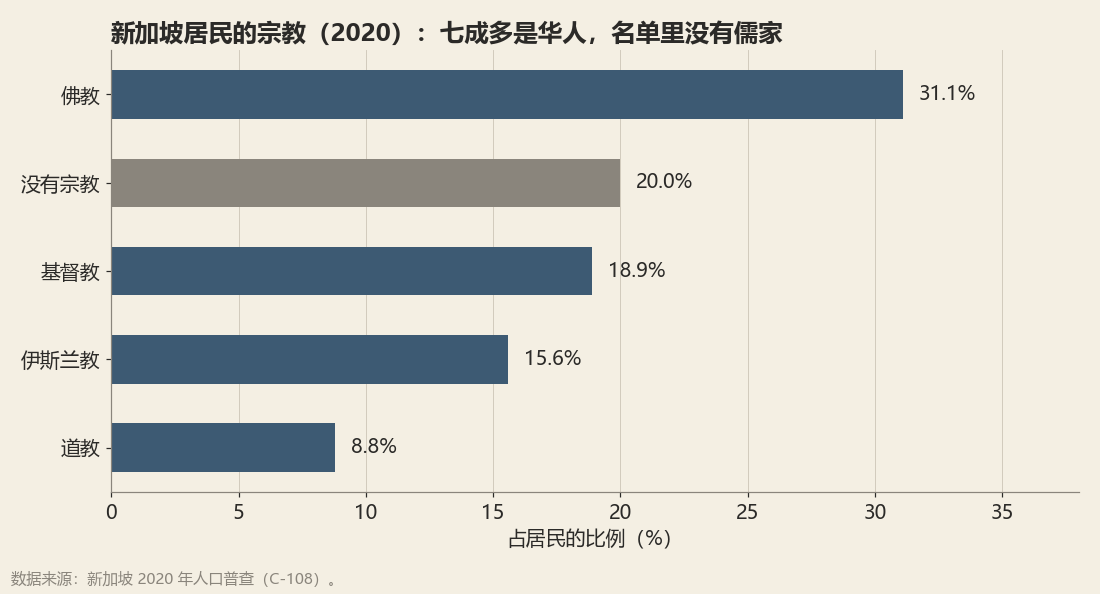
In 2020 ethnic Chinese made up 74.3% of Singapore's residents.
Religion: Buddhism 31.1%, Christianity 18.9%, Islam 15.6%, Daoism 8.8%, no religion 20%.
Among the items I found, there is no Confucianism.
1979: unify the "tongue" first
In 1979 Lee Kuan Yew launched the "Speak Mandarin Campaign", with the slogan "Speak more Mandarin, less dialect". It had two aims: to give Chinese who spoke different dialects one common tongue; and to encourage Singaporeans to learn their mother tongue well and pass Chinese culture on to the next generation.
I put this under the heading of "discipline": a state, by a campaign, pushed Teochew, Hokkien, Cantonese and Hakka from outside the door back into the home.
Think of it landing in one particular home: a grandmother who has spoken Hokkien all her life suddenly finds, in front of her grandson, that the language she speaks is not wanted at school. The grandson is learning Mandarin and the grandmother cannot follow it; the grandson's Mandarin cannot talk with the grandmother. This country, so that everyone would share one tongue, left many homes with one fewer language in which to say what is in the heart.
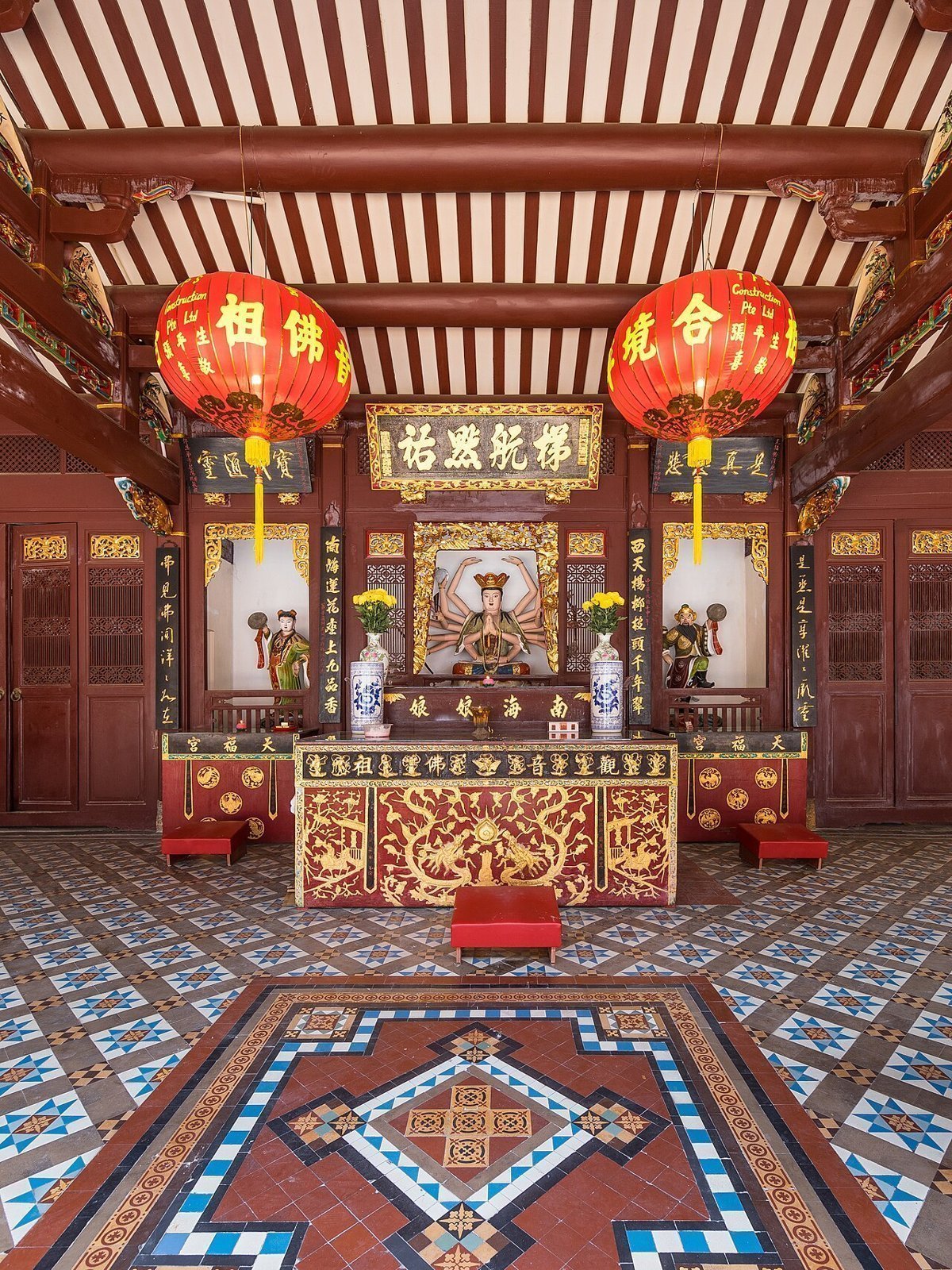
Thian Hock Keng Temple in Singapore, a Hokkien temple built in 1821–1822. Source: Wikimedia Commons, photographed by Basile Morin, CC BY-SA 4.0

1982: a course
In January 1982 a Schools Council meeting settled the decision to introduce Religious Knowledge, and early in the year five religious subjects were announced. Confucian ethics entered the classroom in 1984: first as a pilot in 33 schools (15 Chinese-medium, 18 English-medium), and in 1986 it was extended to all schools.
One detail: Goh Keng Swee had not meant to put Confucianism in. He saw Confucianism as a secular system of ethics, and it was at the prompting of the Prime Minister, after "losing sleep for several nights", that he announced its inclusion.
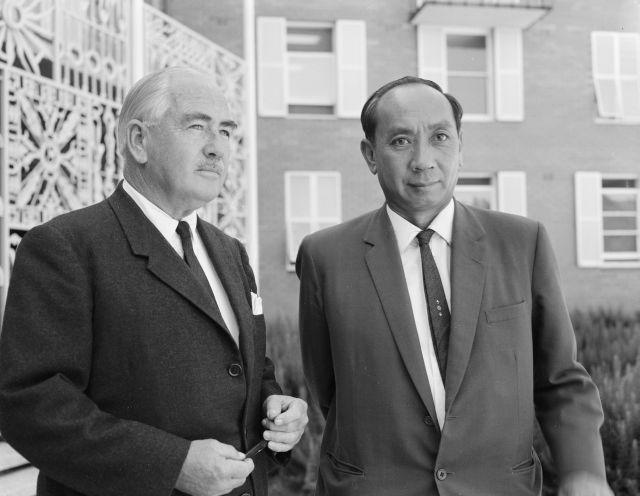
Goh Keng Swee (1918–2010), in 1967. Source: Wikimedia Commons, J. Crowther, Public domain

From 1984 to 1989 Religious Knowledge became a compulsory course for the upper secondary classes, with these options: Bible Knowledge, Buddhist Studies, Hindu Studies, Islamic Religious Knowledge, Sikh Studies, and later Confucian Ethics was added.
In 1987 Singapore held a conference titled "Confucian Ethics and the Industrial Modernisation of East Asia". Tu Weiming edited the proceedings, which the Institute of East Asian Philosophies published in 1991.
The withdrawal
In January 1989 the government issued the White Paper on the Maintenance of Religious Harmony; in 1990 the government decided to withdraw its support for the Religious Knowledge course; in the same year Parliament passed the Maintenance of Religious Harmony Act.
In 1987 the Ministry of Community Development commissioned a study on religious revival which raised two worries: aggressive proselytising, and the politicisation of religion. Some studies link the withdrawal with these worries; the official item-by-item account I have not checked against the original text.
What I did check is two things that followed:
- 1990: Parliament passed the Maintenance of Religious Harmony Act, in force from 31 March 1992. It empowers the Minister for Home Affairs to restrict the activities of religious leaders and others if those activities threaten religious harmony, or, in the name of religion, promote political causes, carry out subversion, or incite disaffection against the President or the government.
- 1991: Parliament adopted the white paper Shared Values. Five points: nation before community and society before self; the family as the basic unit of society; community support and respect for the individual; consensus, not conflict; racial and religious harmony.
From "course" to "law" to "values": a state kept religion and politics apart, and turned Confucian ethics into a set of values that does not call itself Confucian.
Four criteria, measured
This is the first "state experiment" my position runs into:
- Numbers: more than seventy percent;
- Organisation: the state itself is a very strong organisation;
- Wealth: I have not found figures; not written;
- Doctrine: the state itself does not put forward a teaching.
Numbers and organisation, the state has; doctrine, the state itself took away.
Morality
This example makes me think of the piece in this series on "teaching through the way of the divine": How long can a religion live that the elite don't believe and the masses do?
"Teaching through the way of the divine" is the state using religion to govern society. Singapore's approach goes the other way: the state does not let religion govern politics.
Both approaches are the state managing religion, only in different directions.
What my position says here
Singapore is seventy percent Chinese, its state has organisation, and it has a Maintenance of Religious Harmony Act. How does my position speak here? My answer: not one word needs changing. What that law guards against: the politicisation of religion, aggressive proselytising, using religion to stir up discontent with the government: the Tiandao I want does none of these. I do not ask for state recognition, nor for any special legal position; I speak for no political party, and I do not go out to "spread" anything. What I want is only that on the day of Qingming a family goes to burn incense for the ancestors, and that at the Spring Festival the family gathers: days like these, whether or not they are Confucian, whether or not they have a name. If the state is willing to call it "values", let it be called values; if it is willing to call it "custom", let it be called custom. As long as the days remain, I do not mind what it is called.
Looking at it the other way
The hardest counter-argument is the law itself: in a multi-ethnic, multi-religious country, is a religion whose aim is "cultural leadership" not exactly what the state is guarding against?
In Singapore, more than seventy percent Chinese, the answer the state gave is: no.
To my friends in Singapore. Your country, in a very small place, governs many kinds of belief, many kinds of speech, many kinds of dinner table. After the Speak Mandarin Campaign of 1979, in how many homes did a grandmother speak the Hokkien of her whole life while her grandson learned Mandarin at school, and the two could not say what was in their hearts to each other? I often think of that. Your country had its reason then: to give everyone one common tongue. Later came Goh Keng Swee. He had not meant to put Confucianism into the classroom, and he lost sleep for several nights, alone, over whether it should go in. The course was withdrawn in the end, but I feel those nights were not wasted. To seat so many kinds of speech and so many kinds of dinner table at one table is not common in East Asia.
A state has the people and the organisation, yet will not take a religion. Whom is it guarding against: others, or itself?
References
- For comparison: "Teaching Through the Way of the Divine" in this series; Duoshe "How New Religions Survive"
- Singapore: Chinese 74.3% of residents in 2020; religion: Buddhism 31.1%, Christianity 18.9%, Islam 15.6%, Daoism 8.8%, no religion 20%; Speak Mandarin Campaign of 1979 ("Speak more Mandarin, less dialect"); Confucian ethics course in 1982; Goh Keng Swee originally not intending to include it; Religious Knowledge 1984–1989 (compulsory); the 1987 conference "Confucian Ethics and the Industrial Modernisation of East Asia", proceedings edited by Tu Weiming (1991); Maintenance of Religious Harmony Act 1990 (in force 1992-03-31); the five points of the white paper Shared Values of 1991
- Image sources are given in each caption