
Temples
The earliest Tua Pek Kong temple in Malaysia is at Tanjong Tokong in Penang, built, according to sources, no later than 1792, when it was still a fishing village. The belief in Tua Pek Kong spread from here to Malaysia, Singapore and parts of Indonesia.
In legend there was a Tua Pek Kong named Zhang Li, a Hakka, who set out from Sumatra and whose ship was blown by wind and waves to Penang. That is a legend.
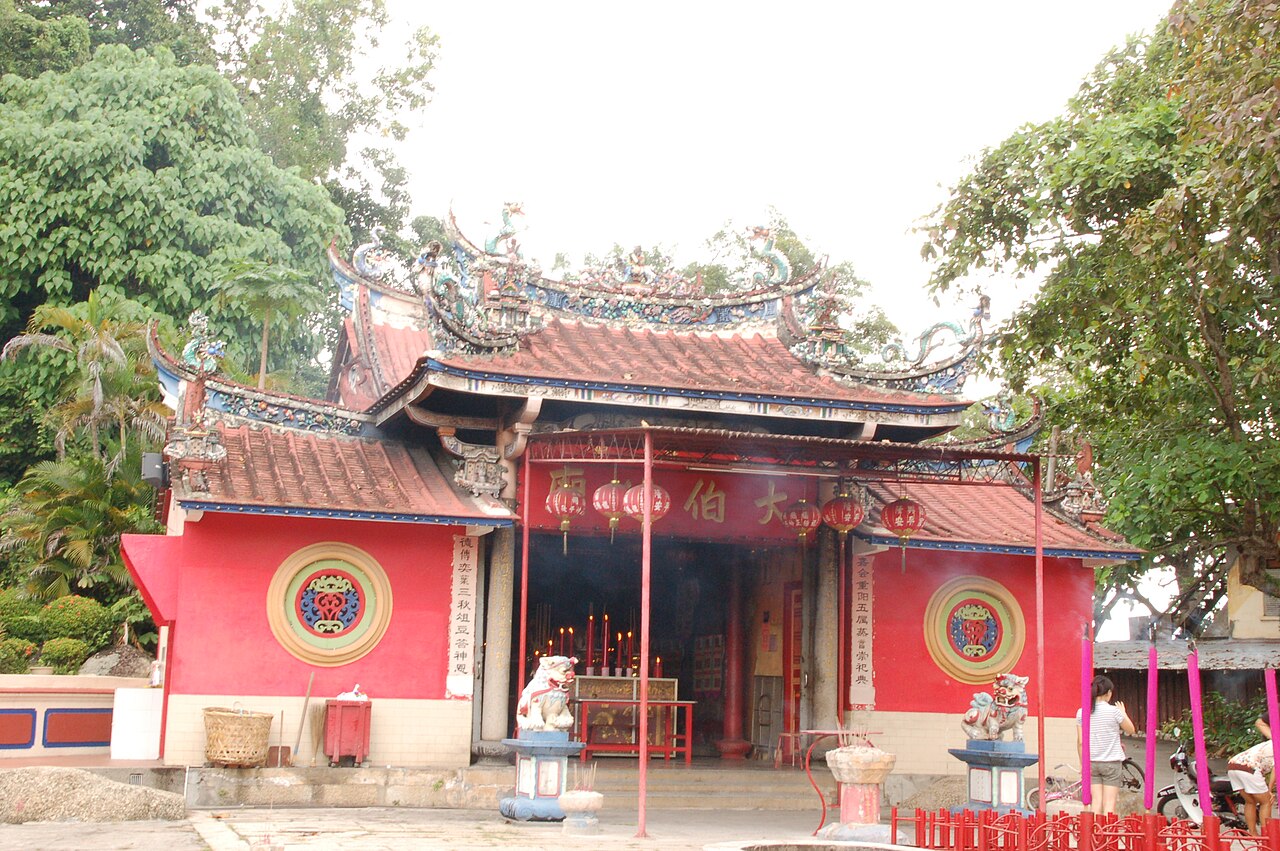
The Tua Pek Kong temple at Tanjong Tokong, Penang, which according to sources is the earliest Tua Pek Kong temple in Malaysia. Source: Wikimedia Commons, marufish, CC BY-SA 2.0

Penang's Kuan Yin Teng honours both Guanyin and Mazu, one a god of compassion, the other a god of those who go to sea. According to sources it is one of the oldest Chinese temples in Penang.
Malaysia also has a Datuk Kong. "Datuk" is the Malay word for grandfather; "gong" is the Chinese word for grandfather. According to a study of 2022, he is a fusion of the Malay keramat (holy shrine) and the Chinese earth god, with local animism and Islamic elements. The Chinese usually treat him as a Malay: they speak Malay to him, offer Malay food, and use no pork.
In these three examples the god was brought from China, the temple was built locally, and some gods became something else locally.
I like the example of Datuk Kong. A group of Chinese, in a strange country, met an old local god. They did not say "this belongs to someone else". They said: "this is grandfather." And then they prepared for him a meal without pork.
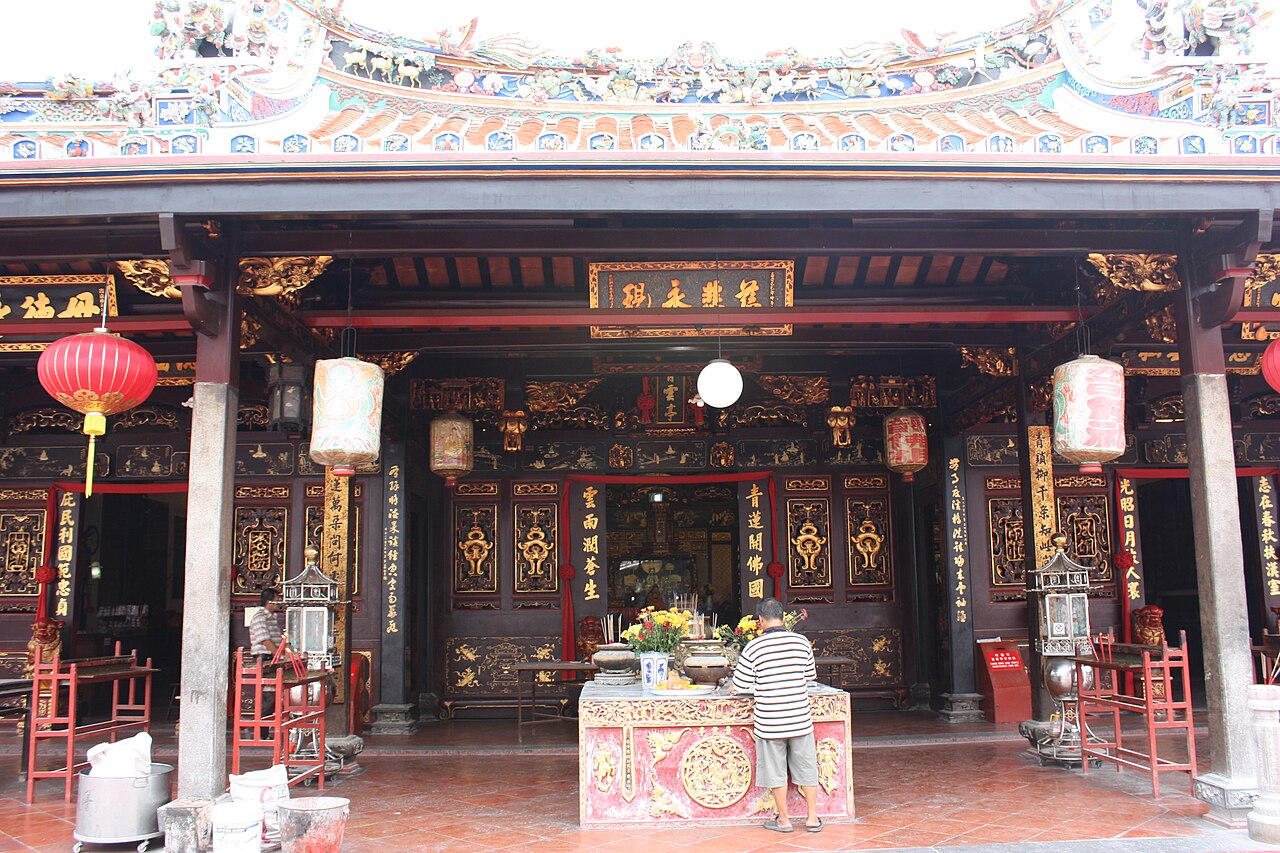
Cheng Hoon Teng in Malacca, known as the oldest Chinese temple in Malaysia. Source: Wikimedia Commons, photographed by Irwan Shah Bin Abdullah, CC BY-SA 4.0

Native-place halls and chambers of commerce
The Singapore Chinese Chamber of Commerce was founded in 1906. According to sources its original English name was the General Chinese Trade Affairs Association; it was set up by local Chinese leaders to do three things: look after the trade of Chinese merchants, resolve differences between dialect groups, and represent the Chinese community. It was the first Chinese business body to cross dialect and trade lines. According to sources, by 2022 it had over 4,000 corporate members and over 150 trade associations.
One thread in its origins comes from the homeland. According to sources, the Qing court established a Ministry of Commerce in 1903 with the aim "to open up trade, unite associations, and promote industry", and chambers of commerce were set up at home and abroad; in 1904 the Qing court appointed the rich Nanyang merchant Zhang Bishi as "Commissioner for Investigating Commerce Overseas", to oversee the setting up of chambers of commerce across Nanyang.
The Nationalist government had something similar. The Overseas Chinese Affairs Commission was founded in Guangzhou in 1926; in 1929 a working conference of the Nationalist Party centre passed organisational regulations making it subordinate to the Party.
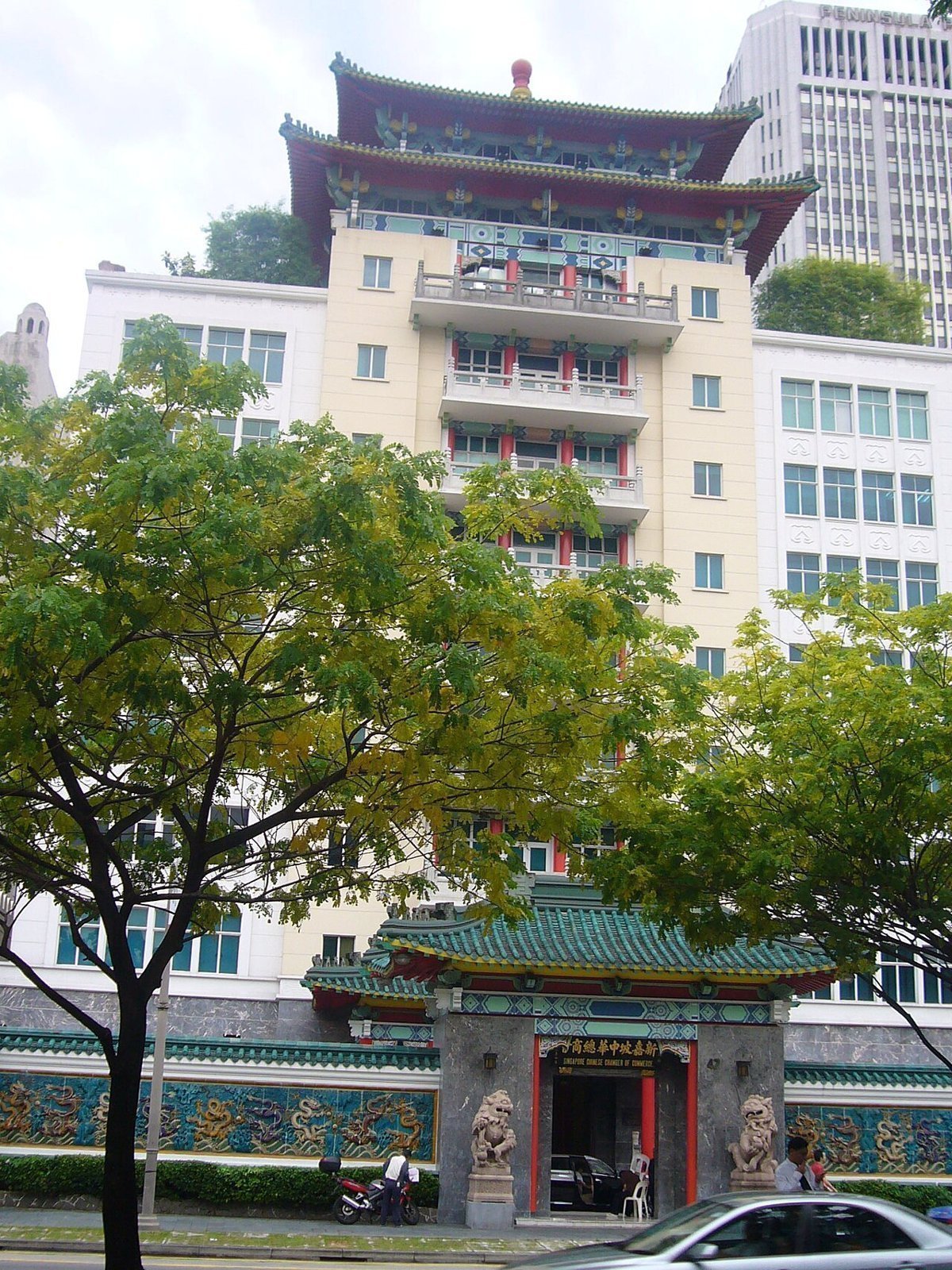
The building of the Singapore Chinese Chamber of Commerce. Source: Wikimedia Commons, Jordiferrer, CC BY-SA 3.0

Nationality
Also in 1929 the Nationalist government promulgated the Nationality Law. It followed the principle of descent: if the father was a Chinese national at the time of the child's birth, the child was a Chinese national.
According to sources, both the Qing government and the Nationalist government declared that ethnic Chinese at home and abroad were Chinese nationals; and colonial governments also regarded locally born Chinese as their own subjects. The Netherlands East Indies' Dutch Subjects Act of 1910 treated locally born Chinese as Dutch subjects. This is the origin of the problem of dual nationality for the Chinese.
The host countries' biggest accusation against the Chinese is "your heart is not here" ("Neighbours to the South" in this series). These things are its material: chambers of commerce partly pushed by the homeland; an overseas affairs body belonging to a political party; nationality reckoned by descent.
Think of the person caught in between: born in Penang, speaking Malay with a Hokkien accent, with Tua Pek Kong at home, and on his birth certificate perhaps two nationalities. The Qing court said he was mine, the colonial government said he was mine, and he himself was perhaps thinking only of tomorrow's business. He never chose either of the two "mine".
Business
The chambers of commerce are tied to business. Did Southeast Asian Chinese merchants succeed because of a shared culture and network?
Since the 1980s there has been a notion called the "bamboo network": Chinese business success comes from shared cultural values and personal networks. In 2003 Jomo and Folk edited a book, Ethnic Business: Chinese Capitalism in Southeast Asia, which examined these claims one by one: official–business relations, family firms, trust and networks, "Asian values". According to the bibliographic abstract, the case studies show considerable diversity among Chinese firms; in the Asian financial crisis of 1998–1999 many Chinese firms collapsed, which was a shock to the view that essentialises Chinese culture and networks. (I have not read the book itself.)
An example in the other direction is Thailand's Charoen Pokphand (CP) Group. According to sources, in 1979 it was the first foreign-invested firm to register in Shenzhen, with registration number "0001", under the name "Zhengda". By the early 1990s it had about 200 subsidiaries in China.
This is Southeast Asian Chinese merchants investing in China. I have not found out what share of China's foreign investment overseas Chinese capital made up at the time.
Four criteria, measured
- Numbers: different in each country. In Malaysia the Chinese were 23.2% in 2020 (see "Chinese Education");
- Organisation: chambers of commerce and native-place halls are the carrier of the "organisation" criterion. The Singapore Chinese Chamber of Commerce: over 4,000 corporate members and over 150 trade associations (according to sources, 2022);
- Wealth: the wealth of Chinese merchants has the "bamboo network" account, and criticism of that account; I have no reliable figures, so I do not write them;
- Doctrine: the temples are mixed. Of the Malaysian Chinese, about 83.6% call themselves Buddhists, but in practice it is a mixture of Buddhism, Daoism, Confucianism and ancestor worship; the temples of the Chinese in Thailand are a mixture of Mahayana Buddhism, Confucianism and Daoism (see "The Most Successful Assimilation").
Of the four, organisation is the one with material. Doctrine is loose, and wealth is not written.
What my position says here
Temples, native-place halls and chambers of commerce are already the Chinese "organisation". If my position's "unified centripetal force" were to be built through them, might the history of homeland promotion be exactly the evidence for "heart not here"? My answer: yes, it might. So the centripetal force I want cannot be "built" through them, and certainly cannot be pushed by any government. Temples grew by themselves, native-place halls were founded by themselves; this I want to hold exactly as it is. What I want to do is something much smaller: in these places that have already grown, to have a few more people willing to ask one question: "Why are we here?" This sentence needs no organisation, no charter, and no approval from any homeland. An old person in a temple telling a child the name of one more ancestor: that is it.
Looking at it the other way
The hardest counter-argument is still the host countries' suspicion: one community's centripetal force may look, to another community, like a centrifugal force. Chambers of commerce partly pushed by the Qing court, an overseas affairs commission belonging to a political party, a nationality law reckoned by descent: put together, these three are exactly the material of the accusation.
One more thing must be kept apart: Mainland Chinese firms going abroad today and the long-settled Chinese communities are two different things. The latter are citizens of the countries where they live. "The same culture" may mean language and trust to a mainland firm, and may be a reason for suspicion to the local Chinese. On this see also Huozhi, "Going Abroad: Is Southeast Asia China's 'Central America'?".
To my friends in Southeast Asia, Chinese and non-Chinese. I know the words "pushed by the homeland" sound like a very heavy accusation. It is true, and I do not defend it. There is another thing that is equally true: nobody sent people from the homeland to build that Tua Pek Kong temple in Penang; and when a group of Chinese met Datuk Kong, the old Malay grandfather, they did not say "this belongs to someone else" but "this is grandfather", and then set out a meal for him without pork. All this was made, bit by bit, by people who had landed by the sea. In this difference I stand on the latter side, on the side of those whom nobody sent, and for whom nobody spoke.
Was the chamber of commerce founded by the Chinese themselves, or by the homeland? Do these two answers sound the same to the host country?
References
- For comparison: "Neighbours to the South" (preface), "What Was Allowed, and What Was Taken" (Indonesia), "The Most Successful Assimilation" (Thailand) and "Chinese Education" (Malaysia) in this series; Huozhi "Going Abroad: Is Southeast Asia China's 'Central America'?"; Yigui "The Dusk of the Clan Associations"
- Tua Pek Kong temple, Kuan Yin Teng, Datuk Kong; the Chinese Chamber of Commerce, the Qing Ministry of Commerce, the Overseas Chinese Affairs Commission, the Nationality Law; the "bamboo network" and Charoen Pokphand (see the source ledger)
- Image sources are given in each caption