A joke
I have heard a joke.
In a museum, in front of an exhibit, stand two people, a Korean and a Chinese. The Korean cannot read the characters on the exhibit, and the Chinese explains them to him.
I found no source for this joke, so I cannot say it happened. I can only say that it has some true parts.
An apology in 2022
In August 2022 a shop in Korea posted a notice saying it was "deeply sorry". The notice used a Sino-Korean word meaning "very deep, very sincere".
Some netizens read it as another word: "boring". They criticised the shop: an apology, and why "boring"?
Around the same time someone took the word for "today" to mean Friday.
These are words with Chinese characters behind them. Those who know the characters understand at a glance. Those who do not see only a string of sounds, and the sounds collide with other words.
The numbers
How much of the Korean vocabulary is Sino-Korean differs by source: 57%, sixty percent, seventy percent, and none of them states how it is counted. Of the several figures, even the lowest is over half.
In 2007 Sungkyunkwan University surveyed 384 new students, and the Chosun Ilbo reported the result: 93% could not read the word for "ambition", 96% the word for "honour", 99% the word for "compromise". This is a second-hand report, the sample is the new students of a single university, and I have not obtained the characters actually tested.
Translated by 2062
The Seungjeongwon Ilgi (Diaries of the Royal Secretariat) is the diary kept by the secretariat at the Joseon king's side, written from 1623 to 1894: 271 years, more than 3,200 volumes, about 240 million characters. At the end of 2023, 37.4% had been translated into modern Korean. It is expected to be finished in 2062.
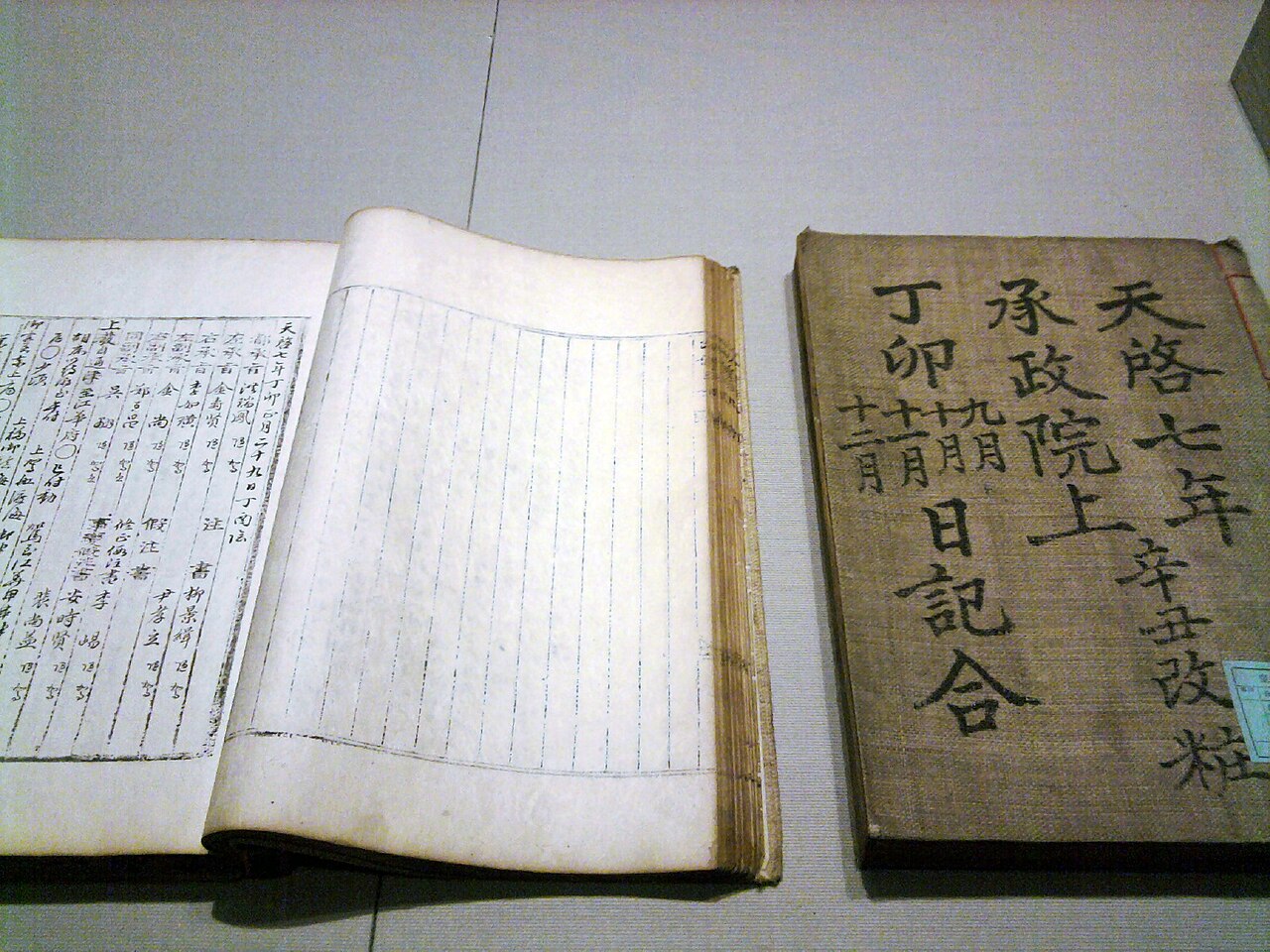
The Diaries of the Royal Secretariat, kept by the secretariat at the side of the Joseon kings. Source: Wikimedia Commons, Salamander724, Public domain

The Annals of the Joseon Dynasty were translated once between 1968 and 1993. They are being translated again, because the Korean of that version has grown old.
In 2017 the head of the Institute for the Translation of Korean Classics said that the experts in this trade have a high average age, and that there are not enough people in their thirties.
Think of the scene: in a quiet office, some grey-haired people turning, character by character, the writing of their ancestors into the speech of their grandchildren. They know they will not live to 2062, yet every day they carry on translating. I would very much like to say to them: thank you.
How it came about
In 1948 the law required official documents to be written in Hangul. In 1970 Chinese characters were taken out of textbooks, and afterwards they were only an elective in middle and high school. The earlier requirement, 900 characters in middle school and 1,800 in high school, is no longer enforced.
In 2015 a government wanted to add Chinese character annotations to textbooks and gave up because of strong opposition from schools. In April 2026 the National Education Commission said it might consider strengthening character education, and the chair of the committee in charge of reading and writing said the matter was "the most contested".
Opponents worry that it would harm Korean identity, and that it would add to cram-school work and deepen inequality. A professor emeritus of linguistics said that understanding the meaning of characters does not necessarily improve reading and writing. Among supporters, a professor of law said that character education is necessary for the correct understanding and use of Korean.
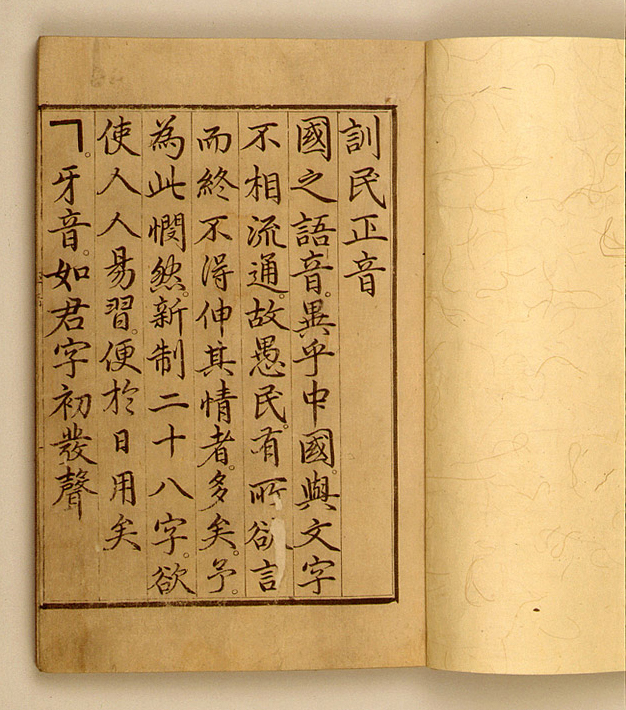
The Hunminjeongeum (Haerye edition). King Sejong created Hangul so that common people who did not know Chinese characters could read and write. Source: Wikimedia Commons, King Sejong, Public domain

Hangul is a magnificent invention. King Sejong made it so that people who could not read could write their own words. Putting the characters down has pride in it, and reasons; it is not a "mistake". I only want to ask what price is paid on the other side of this pride.
Gwanghwamun
Gwanghwamun is the main gate of Gyeongbokgung Palace.
In 1395 it had a plaque in Chinese characters. In 1968 it was replaced with a Hangul plaque in Park Chung-hee's own hand. In 2010, after restoration, the character plaque was put back. In 2023 it was changed to gold characters on a black ground.
In January 2026 the Minister of Culture proposed adding a Hangul plaque beneath the character plaque. Seventy-five groups supported it, including the Hangul Society. Historians and heritage experts opposed it, and a professor at Sungkyunkwan University said that keeping the original appearance is the principle.
A plaque: one generation hangs it up, the next takes it down, and the one after puts it back.
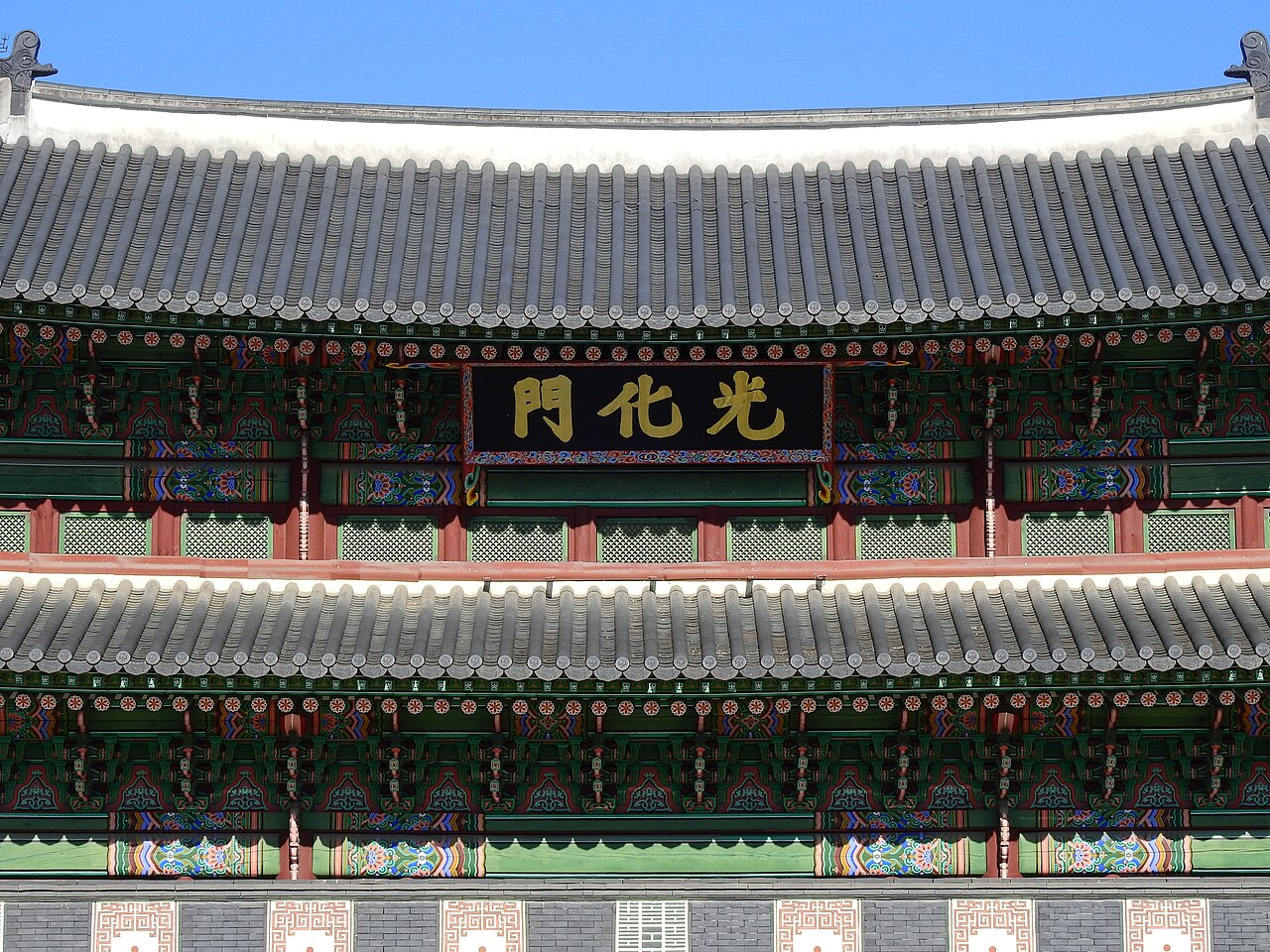
The plaque under the eaves of Gwanghwamun, Gyeongbokgung. Source: Wikimedia Commons, Huntsmanleader, CC0

What I think
I have no "ought" about this. A country has the right to decide which characters to read. The generation of 1970 had their reasons: a new country needed a script everyone could learn. They did not mean to throw anything away; they meant to put a country's reading and writing into the hands of every child. That I respect.
It was that generation that decided. It is the later ones who pay. They open their ancestors' diary, recognise every sound, and cannot understand the whole sentence. Not understanding is not their fault. But thinking of this, my heart aches a little: a child stands at the gate of Gyeongbokgung, looks up at that gold plaque, and does not know what is written on it. Those three characters are the name his own country gave this gate more than six hundred years ago.
Looking at it the other way
First, not being able to read does not mean not having. The Annals have a Korean translation, and the king's diary is slowly being translated. It is not only Koreans who cannot read the original: English readers cannot read Beowulf, and we cannot read oracle bones.
Second, the Chinese should not laugh too soon either. On the mainland, after the simplified characters, ordinary people also struggle with traditional-character ancient books. The unified six-year primary-school textbooks include 132 classical poems and prose pieces (another report says 124), in the new edition in use since 2016, about eighty percent more than the old one. That is catching up on a missed lesson.
Third, that joke can be told the other way round: a Chinese person can read the three characters on the plaque, but can he read the meaning behind them?
What my proposal says here
If the "core" is to be set up on a shared set of writing and classics, what does Korea's lesson show? A country that on its own initiative drops Chinese characters: is it putting down a burden, or tearing up its own foundation? My answer: a bit of both. A burden: the characters are too hard to learn, and for more than a thousand years literacy was the privilege of a few; to put them down was to let millions of children read books. A foundation: the thousand years that the ancestors wrote down, once the writing changed, became something that can be read only through a translation. I do not think everyone should learn the characters again. What I think of is another way: keep a small number of characters, a few dozen, a few hundred, that everyone needs to know at the yearly Qingming, the New Year and the ancestral rites: the ancestors' names, a few words of the sacrificial text, the couplets on the door. The characters need not be many; one generation need only remember them.
To my Korean friends. I am not here to say "you should take the characters back"; I only want to say: thank you, for writing down every day of a country in a diary of 271 years. The Seungjeongwon Ilgi records whom the king saw today, what he said, what he ate, what rain fell. A country that would take such patience to record its days: I think that is rare. I would like it to be read by more people, even if we must wait until 2062.
Translated by 2062: by then, how many people will be left to read the original?
References
- For comparison: in this series, "A Thousand Years of Script" (Vietnam), "The Characters Are All There, but Cannot Be Read" (Japan), "The Characters Weren't Lost; the Fight Is Over How Much" (Taiwan); in Yigui, "The Confucian Temple of Empty Rooms", "Counting the Years"
- Timeline of Korean policy on Chinese characters (1948, 1970, 1972, 2015, 2026); Share of Sino-Korean words, the 2007 Sungkyunkwan survey, the 2022 "deep apology" incident; Seungjeongwon Ilgi 37.4%, 2062; the Institute for the Translation of Korean Classics; the plaque of Gwanghwamun; classical poetry and prose in the unified textbooks
- Image sources are given in each caption