Eighty-two stelae
The Temple of Literature in Hanoi, built in 1070, honours Confucius. In 1076 the Quốc Tử Giám, the National University, was set up beside it: Vietnam's first university.
In its courtyard stand eighty-two stone stelae on the backs of stone tortoises. They are carved with the names and home districts of those who passed the doctoral examinations from 1442 to 1779. In 2010 they were entered in the UNESCO Asia-Pacific Memory of the World register, and in 2011 in the Memory of the World register.
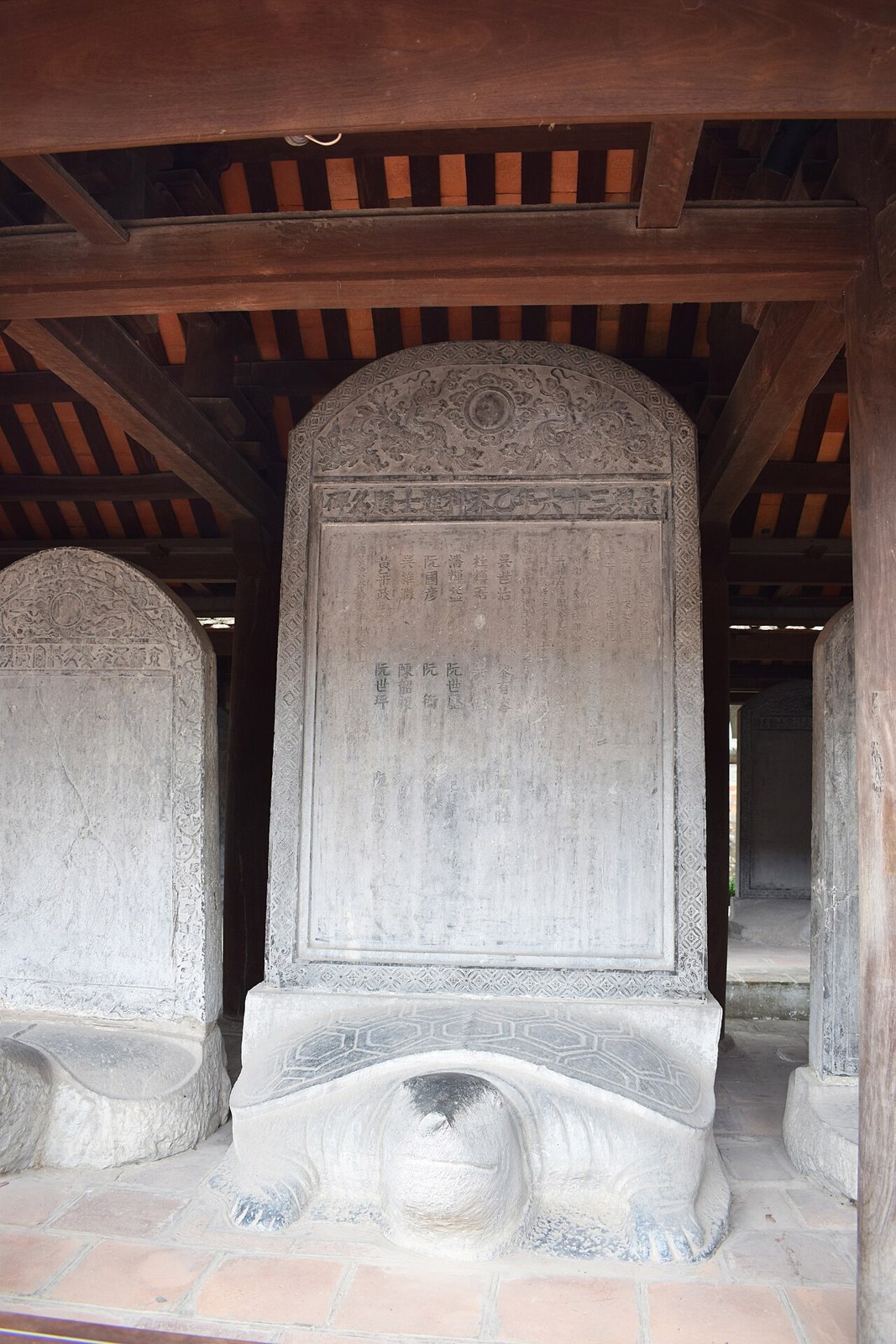
The doctoral stelae standing on stone tortoises in the Temple of Literature, Hanoi. Source: Wikimedia Commons, Mig Gilbert, CC BY-SA 2.0

How many doctoral graduates are named on the stelae, the several sources I found do not agree on, and I do not write a number.
Every year tens of thousands of people walk into this courtyard, and most of them cannot read the characters on the stelae.
Think of that scene: a young Vietnamese stands before a stele, photographs it with a phone, and sends it to a friend. On the stone is the name of a man who passed the doctoral examination five hundred years ago. He photographs it with great care, but he cannot read the name. That name was his ancestors' neighbour.
Spring couplets
In 2016 the English-language newspaper Viet Nam News wrote a piece: at the Lunar New Year, at the gate of the Temple of Literature, people write spring couplets and sell them. Many people buy. Most buyers cannot read what is written on them, and do not know what it means.
The couplets are about fortune, rank, long life and the like. They recognise the pictures, they recognise the red, they recognise that it is the New Year.
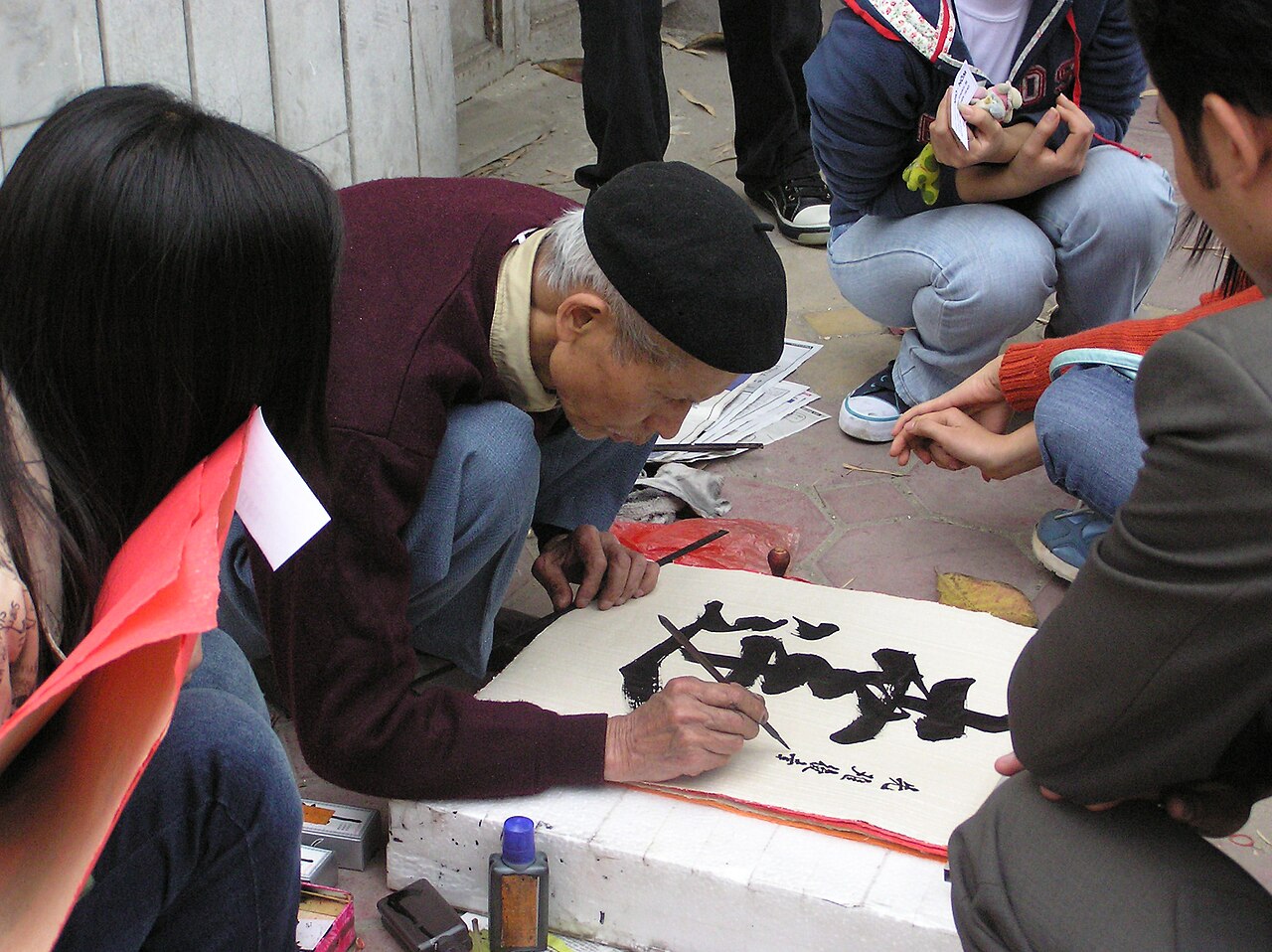
An old scholar-calligrapher (ông đồ) writing calligraphy at the Temple of Literature, Hanoi. Source: Wikimedia Commons, Rungbachduong, CC BY-SA 3.0

In 1936 the Vietnamese poet Vũ Đình Liên wrote a poem, "Ông đồ" ("The Old Scholar"): each year when the peach blossom opens, the old scholar sets out his brush and ink and writes spring couplets by the roadside. Each year fewer people pass. That was more than eighty years ago. (I do not quote the poem; it is a modern work.)
How it came about
Vietnam is not like the Korean peninsula: here the country did not put the characters down by itself.
Vietnam used Chinese characters for nearly a thousand years. From the tenth century official documents were in classical Chinese. From the thirteenth and fourteenth centuries there was also Nôm, which used the parts of Chinese characters to write Vietnamese. From the fifteenth to the nineteenth century educated people used Nôm to write popular works.
Chữ Quốc ngữ came in the seventeenth century, when Western missionaries used the Latin alphabet to transcribe Vietnamese sounds. The French pushed it in the first two decades of the twentieth century. In 1910 chữ Quốc ngữ was required (second-hand source); in 1919 the last imperial examination was held at Huế, and Emperor Khải Định issued an edict abolishing Confucian education.
After that, what schools taught was chữ Quốc ngữ.
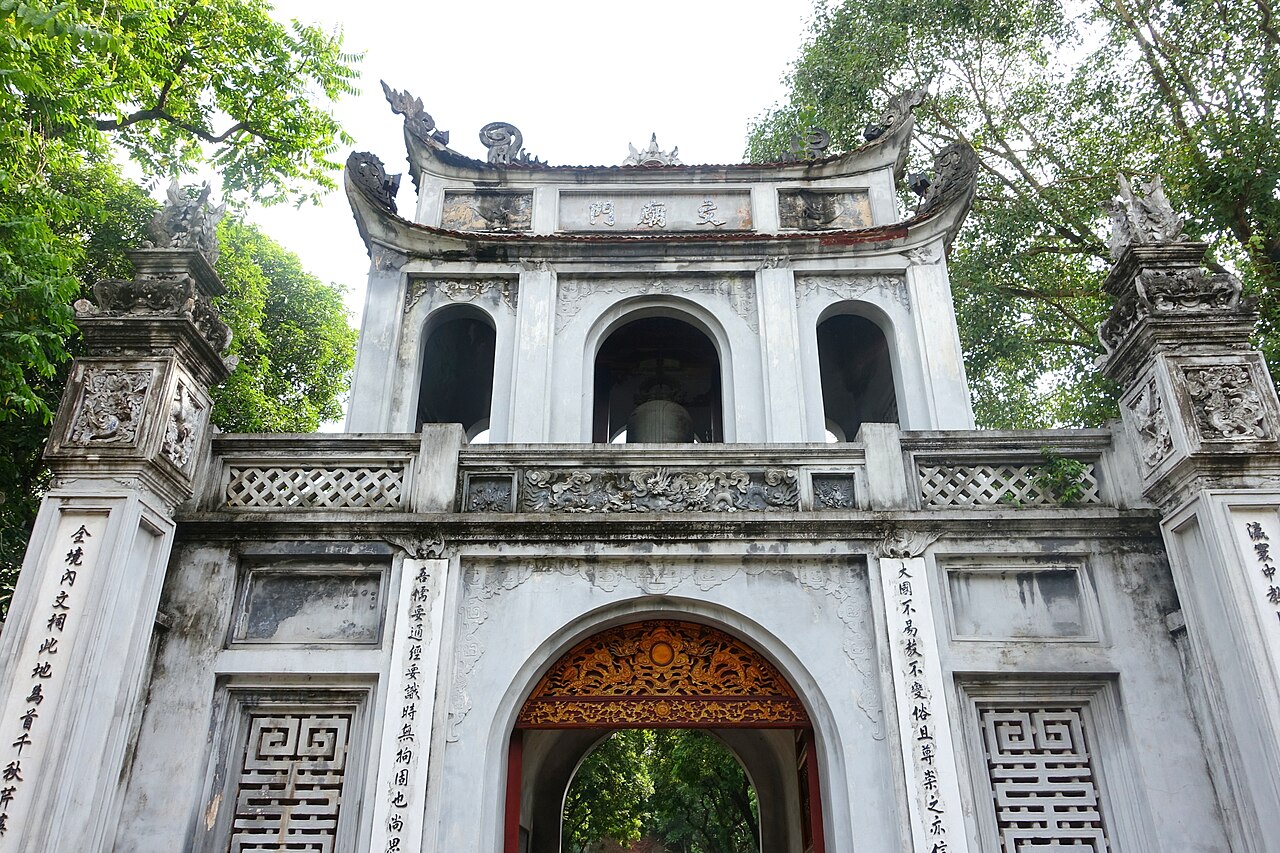
The main gate of the Temple of Literature, Hanoi. Source: Wikimedia Commons, Daderot, CC0

The numbers
"Fewer than a hundred scholars in the whole world can read Nôm." This claim comes from the Vietnamese Nôm Preservation Foundation (founded 1999) and a website on endangered scripts. It is about Nôm, not Chinese characters; whether "scholars" means reading fluently or merely being able to read it out is not stated. I have not found the original statistics and can only pass on its words.
The Hán-Nôm Institute in Hanoi grew out of a Hán-Nôm department founded in 1970 and was raised to an institute in 1979. The figures for its holdings differ from place to place: around 2006 about 20,000 volumes, in a 2022 report nearly 35,000; the bases differ, and I can only set them side by side.
An expert at the Institute has said one thing: in schools today, classical literature is taught using chữ Quốc ngữ transcriptions, not the Hán-Nôm originals, and as a result errors have appeared in teaching.
Vietnamese news has also reported that in Vĩnh Phúc province there is a Hán-Nôm class whose students are old people.
What I think
There is something I cannot put clearly. Korea was a country that in 1970 chose a road. Vietnam's road was pushed by others, and later the Vietnamese themselves learned to walk it well. A new script made literacy easy. That is the reason supporters of chữ Quốc ngữ often give; I have not checked the numbers. I do not want to oppose it: a country that taught almost everyone to read, I respect greatly.
And yet the stelae still stand. The names are the ancestors' names, and not being able to read them is another kind of loss: not because people cannot read, but because those characters are not in school. In that Hán-Nôm class in Vĩnh Phúc the people sitting are old. Each time I think of it, I feel a little sour: a group of white-haired people sitting in a small classroom, tracing, stroke by stroke, a character their own grandfather may once have written.
Looking at it the other way
First, what the Vietnamese read is mostly translation. Reading a translation is not the same as not reading. It is one way of reading.
Second, on "adding Hán-Nôm to primary and secondary schools", opinions in Vietnam differ. Supporters say it is for understanding history and the original meaning of words. Opponents say the characters are too hard, the pupils' load is heavy, and there are not enough teachers. A parent said that Hán-Nôm and the Latin letters are two entirely different language systems.
Third, a script that can be learned from sound alone let a country, within a few decades, have almost everyone literate. The gain and loss are hard to count.
What my proposal says here
A thousand years of Chinese characters, in a hundred years, became in Vietnam "something that has to be specially learned". If the "core" is to be built on a shared script and classics, are the Vietnamese outside the door or inside it? My answer: outside, but the door can be opened. The Vietnamese have a thousand years of characters and Nôm, and they are their own, not someone else's. They are outside the door because in a hundred years the schools did not teach them, not because they were unwilling. If one day a Vietnamese wants to know whom some stele in the Temple of Literature in Hanoi names, there are people willing to open that door for him. That "someone" need not be an organisation; it might be an old ông đồ, a teacher, or whoever happens to be sitting beside him in a Hán-Nôm class.
To my Vietnamese friends. In the courtyard of the Temple of Literature in Hanoi stand eighty-two stelae on the backs of stone tortoises, carved with the names of men who passed the doctoral examination five hundred years ago; every year tens of thousands walk in, and most cannot read them. At the New Year an old scholar writes couplets at the gate, and many people buy them: they know the red, they know phúc, lộc, thọ, they know it is Tết. In Vĩnh Phúc there is a Hán-Nôm class, and the people sitting in it are all white-haired. Your ancestors had one more craft: they took Chinese characters apart and, stroke by stroke, put the pieces together as Nôm, to write their own speech, and they wrote it for several hundred years. Such cleverness I want more people to know about.
The stelae still stand. How many people must be able to read them before we can say they are still being read?
References
- For comparison: in this series, "After Boat People" (the origin of chữ Quốc ngữ), "Can't Read Our Ancestors' Characters" (Korea), "The Characters Are All There, but Cannot Be Read" (Japan)
- The Temple of Literature in Hanoi, 82 doctoral stelae, the abolition of the examinations in 1919, chữ Quốc ngữ in 1910, the Hán-Nôm Institute, "fewer than 100" (a foundation, scope unclear), the Viet Nam News piece of 2016 on spring couplets, the Hán-Nôm class in Vĩnh Phúc province, the 1936 poem "Ông đồ"
- Image sources are given in each caption