A near thing
On 16 November 1946 the Japanese cabinet promulgated the Tōyō Kanji List (當用漢字表): 1,850 characters, setting the range of characters for laws, official documents, newspapers and magazines.
That year some in the Occupation authorities thought that Chinese characters were the reason for Japan's low literacy, even the reason for the war. The US Education Mission leaned toward abolishing the characters and adopting the Roman alphabet.
In 1948 a nationwide literacy survey was made. The result: those who could not read at all were about 2% (second-hand; the name of the survey and the exact figures I have not checked). The low literacy that people had assumed did not appear. The plan to abolish the characters was shelved.
In 1981 the Tōyō Kanji List became the Jōyō Kanji List, 1,945 characters. In 2010 196 were added and 5 removed, making 2,136, in use to this day.
The Japanese did not lose the characters, but they very nearly did.

The 2,136 characters of the Jōyō Kanji List (1981–2010). Source: Wikimedia Commons, Tael, CC BY-SA 3.0

The characters are all there
Walk down a street in Japan and characters are everywhere: shop signs, newspapers, stations. A Chinese visiting Japan can read most of them.
The Japanese read classical Chinese by another method: they add marks beside the characters and read them in Japanese word order, backwards (kanbun kundoku, with kaeriten). High-school Japanese classes have always taught it. Research literature says that classical Chinese teaching is now the hardest part of classical education. (This is from an abstract; I have not read the original.)
What can't be read
The characters are still there, but before the Edo period people wrote in another kind of script.
A cursive, abbreviated style is called kuzushiji. A letter, an account book, a diary were written in it. Today's Japanese do not learn it in school, and most cannot read it.
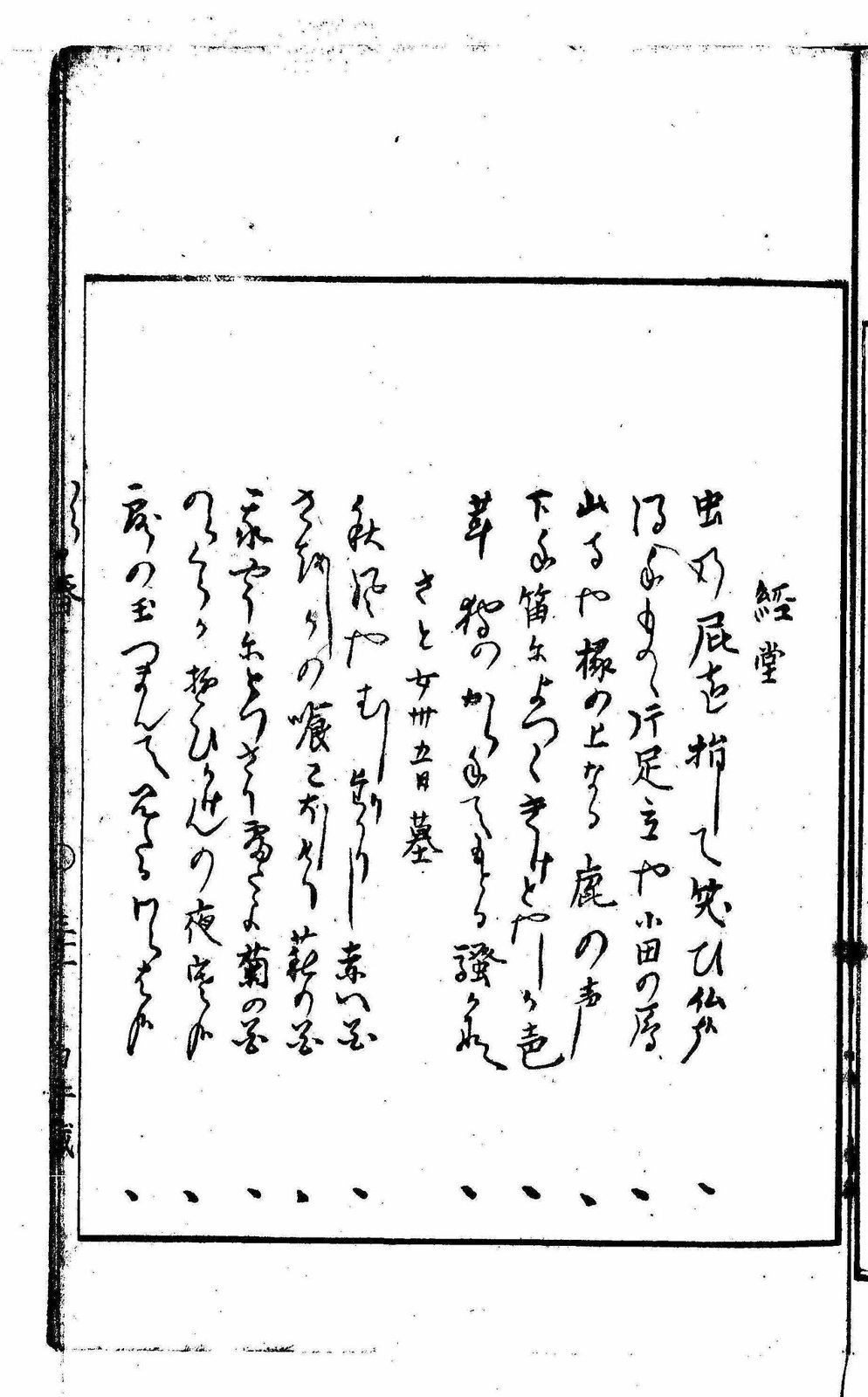
A page from Kobayashi Issa's Oraga Haru (1819): a book of the Edo period written in kuzushiji. Source: Wikimedia Commons, Kobayashi Issa, Public domain

In February 2021 Toppan Printing released a system called "Fumi-no-ha Zemi" (ふみのはゼミ), which uses AI to recognise kuzushiji, with a character-recognition accuracy of over ninety percent. It was developed jointly, from 2015, with the National Institute of Japanese Literature.
A claim is often seen online: only a few thousand people can read kuzushiji, or one in a thousand of the population. I looked, and there is no source. And the two claims differ by tens of times: one in a thousand is a hundred thousand or more, not a few thousand. I do not use them.
Think of the scene: a Japanese person, in the old storehouse at home, turns up a letter his great-grandfather left. The paper has turned yellow, and the writing is line upon line of curves. He knows it is Japanese, recognises a few of the characters, but cannot read the whole letter. He photographs it and uploads it to an AI program, and waits for it to read out for him what his great-grandfather wanted to say.
What I think
This lesson from Japan leaves me with a feeling I cannot quite name. Knowing every character, and not knowing this line of characters. Koreans face: the characters are no longer known. The Japanese face: the characters are known, the way of writing half known, the whole sentence cannot be read. They are two depths of the same thing: a civilisation, with a layer between itself and its past. Yet looking at Japan I also feel a little envy: on their streets, every sign is still in Chinese characters; every child, from the first year of primary school, writes characters every day. This kind of "characters in daily life" is the sturdiest layer of root a civilisation has, and I think all of us should learn from them.
Looking at it the other way
First, this layer in Japan is not a problem of the characters but of handwriting. The English, too, cannot read Middle English manuscripts.
Second, Chinese today who read cursive script and rubbings also need specialists. This is not a Japanese problem; it is something every society with a long writing tradition meets.
Third, Japan kept the characters but did not keep the people who read old books. That the characters are there is a condition, not a guarantee.
What my proposal says here
Japan kept Chinese characters in daily life. If the "core" can be set up by characters, Japan should be the most stable. Yet its birth rate, its religion, its society are also loosening. What layer of the core are the characters? My answer: the characters are the outermost layer, the façade. They are necessary; without them the ancestors' words cannot be heard. But they are not the core itself. The core is the days behind the characters: for whom to burn incense, why, and why a family comes together. The lesson Japan gives me is very clear: a country can keep its characters very well and at the same time let those "days" loosen, bit by bit. So characters and days have to be looked at together; with either one missing, it is not enough.
To my Japanese friends. In 1946 some people argued for abolishing Chinese characters and switching to roman letters; a nationwide literacy survey in 1948 put the idea on the shelf. You very nearly lost the characters, and you did not. So when I walk your streets and look at the signs, the newspapers, the stations, I feel a little warm: these are our shared characters, and you kept them. I also want to say: in your homes there may be a great-grandfather's letter, or a grandmother's account book, written in kuzushiji, the paper turned yellow, the writing line upon line of curves. Perhaps they have simply not been read by anyone yet. I hope that one day you can let them speak.
The characters were not lost; the way of writing was. Which is harder to get back?
References
- For comparison: in this series, "Shrines Are Not Religion" (State Shinto; another reform of the same Occupation period), "Can't Read Our Ancestors' Characters" (Korea), "A Thousand Years of Script" (Vietnam)
- Tōyō Kanji 1946 (1,850 characters), Jōyō Kanji 1981 (1,945), 2010 (2,136); the Occupation-era proposals to abolish characters and the literacy survey of 1948; Toppan's "Fumi-no-ha Zemi" (2021-02-17); the "few thousand / 0.1%" claim has no source
- Image sources are given in each caption