One exam paper
Korean children, after school, go to cram school.
In 2024 Korean households spent 29.2 trillion won on private education, a record, 60% more than ten years earlier. 80% of students take extra classes. In 2025 it fell to 27.5 trillion, the first fall in five years.
In Taiwan the Ministry of Education has 17,710 cram schools registered (I have not checked the year). In Singapore households in 2023 spent 1.8 billion Singapore dollars on out-of-school tutoring, on average 104.8 dollars a month per household, up from 79.9 ten years earlier.
Japan has juku (cram schools), the same thing: a 2015 estimate put Japan's total spending on tutoring at about 12 billion US dollars, of which juku were about 7.8 billion. This figure is old, and I have not found a newer one.
Think of the children behind these numbers: a ten-year-old leaves school at three in the afternoon, is at cram school at five, and comes home at nine, his bag wider than his shoulders. He does not know why his parents do this; his parents may not know either. They know only that everybody does it, and that if you don't, you fall behind.
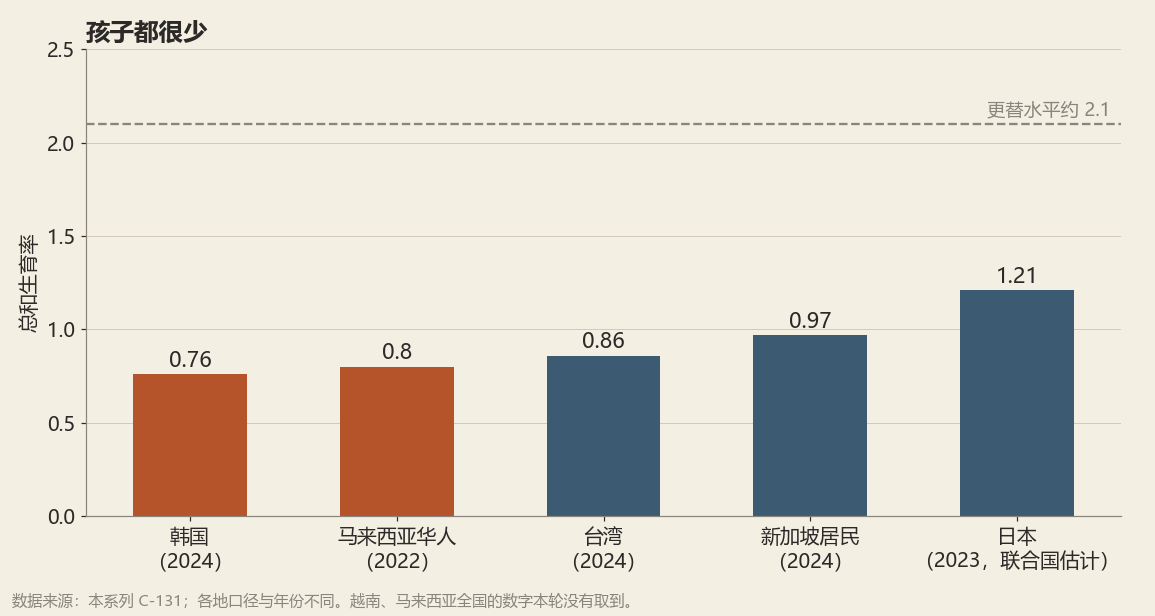
A very low number
| Place | Total fertility rate | Year |
|---|---|---|
| Korea | 0.76 (another official count: 0.75; preliminary 2025: 0.80) | 2024 |
| Taiwan | 0.86 | 2024 |
| Singapore | 0.97 (residents; 0.87 in 2025) | 2024 |
| Japan | 1.21 (UN estimate) | 2023 |
| Malaysian Chinese | 0.8 (0.9 in 2023) | 2022 |
| Vietnam | no figure obtained this round | — |
| Malaysia overall | no figure obtained this round | — |
Replacement level is about 2.1.
Eating alone
In Korea in 2023 there were 7.83 million single-person households, 35.5%; at the end of 2024 they were 36.1%, over 8 million households.
Korea counts separately those who "die alone after long isolation": 3,661 people in 2023, 3,924 in 2024, an increase of 7.2%.
In Japan, single-person households are already over a third, and are predicted to approach forty percent by 2040. Japan's figures on lonely deaths differ from source to source and do not match, so I do not use them.
For single-person households in Taiwan, Singapore and Hong Kong, I did not obtain figures.
Three thousand nine hundred and twenty-four people. They were not without family, not without names. They simply, in a city of many people, one by one went, and were found only after some time.
What I thought
These numbers do not make a "cause"; I only set out that they appear together. The same ground: Chinese characters, Confucian temples, ancestral rites, and examinations. The same result: children going in large numbers to cram school; few children born; more and more people eating alone. My judgment is that this is atomisation under industrialisation, and the trend is very clear. A society has handed the responsibility of "being together" from the clan to the school and the market. The school looks after only examinations; the market looks after only prices. No place looks after "who this child will eat dinner with tonight".
Looking at it the other way
First, it is not unique to East Asia. Low fertility also occurs in southern Europe and in Eastern Europe (I have not taken figures; to be added). To say it is "an East Asian problem" does not hold.
Second, the grouping "Confucian cultural sphere" is itself disputed. After the financial crisis of 1998–1999 some scholars wrote a book (Ethnic Business, edited by Jomo and Folk) whose abstract says: the crisis shook the explanations that attribute Chinese business to cultural essence. I have not read the monograph and cite only the bibliographic abstract.
Third, the reasons for cram schools and low fertility may differ from place to place. I have not checked each one, so I do not write them.
What my position says here
I have said that without a core like Christianity or Islam, East Asians and the Chinese cannot exist stably in the modern world and the future, because atomisation under industrialisation is already clear. Are these figures the evidence for that sentence, or do they merely appear together? My answer: they are not "proof", they are "hints". They cannot show that, with a core, the numbers would improve; what they can show is that a society that has handed everything that keeps people "together" to examinations and prices will find people standing more and more one by one. What I want to ask is not "how to raise the fertility rate"; I have no way to do that; I want to ask an earlier question: these people standing one by one: is there a day each year when everyone stands together? Qingming, the Spring Festival, the winter solstice: days like these are what let a person know he is not alone. The next piece, "One Hand of Cards, Six Ways to Play It", will use Malaysia's figures to test me myself.
To my friends in Japan, Korea, Taiwan and Singapore. Your children get to cram school at five in the afternoon and come home only at nine, their schoolbags wider than their shoulders; your old people eat alone, with a single lamp on. In Korea in 2024, three thousand nine hundred and twenty-four people died alone and were found only after some time had passed. I am also thinking about the same question: how, in a world where everyone is busy hurrying along, to keep a little time so that a family, even once a year, can sit at the same table. I have no answer; I only want to say the question aloud with you.
Children in cram school, few children, many people eating alone. Are these three things one thing?
References
- For comparison, in this series: "One Hand of Cards, Six Ways to Play It" (where the roads fork), "Chinese Education" (Malaysia), "The State Pushed Confucianism Once, Then Withdrew It" (Singapore); the Shishi data ledger
- Cram schools: Korea 29.2 trillion won (2024), 27.5 trillion (2025), participation rate 80%; Taiwan 17,710; Singapore 1.8 billion Singapore dollars (2023); Japan's 2015 estimate; fertility rates; single-person households and lonely deaths; Ethnic Business
- Image sources are given in each caption