The same hand of cards
All of the following exist in all six places: a tradition of Chinese characters, Confucian temples, sacrifices to the ancestors, and an education that prizes examinations.
These have been written about earlier; the references have the links.
The roads, and where they fork
Characters. In Korea, from 1970, characters were dropped from textbooks ("Can't Read Our Ancestors' Characters"); in Vietnam, the examinations were abolished in 1919 and chữ Quốc ngữ entered the schools ("A Thousand Years of Script"); in Japan, in 1946 abolition was a near thing, and 2,136 characters were kept ("The Characters Are All There, but Cannot Be Read"); Taiwan uses traditional characters, and argues over how much classical Chinese ("The Characters Weren't Lost; the Fight Is Over How Much"). In Singapore and Malaysia, the Chinese schools have Chinese on one side, English and Malay on the other ("Chinese Education", and the Singapore piece, "The State Pushed Confucianism Once, Then Withdrew It").
Religion. Each country counts differently; I set out only the numbers:
| Place | Figures | Year |
|---|---|---|
| Korea | No religion 56.1%; Protestant 19.7%; Buddhist 15.5%; Catholic 7.9% | 2015 census |
| Japan | over sixty percent say they have no religion (NHK) | 2018 survey |
| Vietnam | self-reported religious 13.7%; Catholic 6.1%, Buddhist 4.8% | 2019 census |
| Singapore | Buddhist 31.1%; Christian 18.9%; Muslim 15.6%; Daoist 8.8%; no religion 20.0% | 2020 (residents aged 15 and over) |
| Malaysia | Muslim 63.5%; Buddhist 18.7%; Christian 9.1%; Hindu 6.1% | 2020 |
| Taiwan | not obtained this round | — |
The Vietnam row measures organised religion; folk belief and ancestor worship are probably mostly not counted, and I did not read the census explanatory notes.
How the state treats religion. Japan: the state made a "religion that is not a religion", and it was taken apart ("'Shrines Are Not Religion'"); Singapore: the state pushed Confucianism once, then withdrew it and replaced it with shared values ("The State Pushed Confucianism Once, Then Withdrew It"); Indonesia: Confucianism was allowed, then downgraded ("What Was Allowed, and What Was Taken"); Hong Kong: registered, but not banned ("Registered, But Not Banned").
Six candidates for a "core"
Take, in each place, the thing that looks most like a "core" and set it against the numbers:
| Place | Candidate "core" in hand | What the numbers show |
|---|---|---|
| Japan | Chinese characters; formerly State Shinto | State Shinto has been taken apart; over sixty percent say they have no religion; most cannot read Edo-period writing |
| Korea | Christianity (Protestant plus Catholic, about 27.6%); the Sungkyunkwan sacrifice (seokjeon) | TFR 0.76; single-person households 36.1% |
| Taiwan | traditional characters; folk religion, the Confucian sacrifice | the share of classical Chinese has to be voted on; religion figures not obtained |
| Vietnam | chữ Quốc ngữ; the state | few read Hán-Nôm |
| Singapore | the state's shared values | the state itself puts forward no teaching; TFR 0.97 |
| Malaysia | for the Chinese: schools, organisations | numbers falling; Chinese TFR 0.8 |
One table, one test
My words are: without a core like Christianity or Islam, East Asians cannot stand firm in the modern world.
The most direct test is to find a community "with a core" and one "without", in the same country, under the same system.
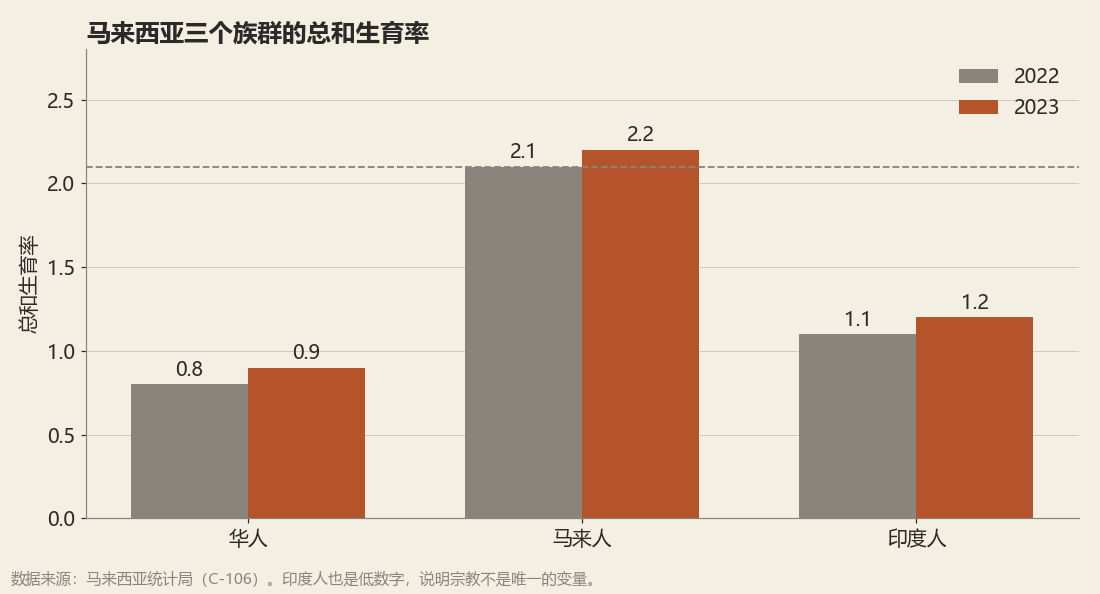
Malaysia is exactly this condition. The official figures: in 2022 the total fertility rate of the Chinese was 0.8, of the Malays 2.1, of the Indians 1.1; in 2023, 0.9, 2.2 and 1.2.
The Malays are Muslim. My words have, here, a piece of evidence.
Looking at it the other way
First, in the same table the Indians are also at 1.1. The Indians are mostly Hindu, a religious community, and their number is as low as the Chinese. Religion is not the only variable.
Second, Korea has a very large Christianity, Protestant plus Catholic, close to thirty percent, and the number is one of the lowest in the world. I might say that Korea's Christianity is foreign, a church's, and not a "core". But how is "core" to be defined so that this does not become circular reasoning?
Third, the difference between Malays and Chinese is not only religion: urban and rural, income, policy, age at marriage all differ. I have not checked them item by item, and draw no conclusion here.
Fourth, Israel's numbers point in the other direction: the total fertility rate of the ultra-Orthodox is about 6.6, of the secular about 2.0 (as relayed from the OECD and Israel's statistics bureau, second-hand). Those with a core are much higher; but the secular are also higher than East Asia. This also involves state policy and security; I have written the limits elsewhere and will not expand here.
Fifth, "atomisation" itself. The data can only give single-person households and lonely deaths ("Six Similar Exam Papers"). Whether they are symptoms of atomisation or atomisation itself is another matter.
What my position says here
I owe answers to three questions. The first: what conditions must the "core" I speak of meet to count as "like Christianity or Islam"? I think of these: one, a highest divinity; mine is "Tiandao", which does not speak, revere it and ask nothing of it; two, a First Teacher, Confucius, one who sets down the rules and hands them on, not one who has received revelation; three, daily rites: ancestral rites, festivals, small things that can be done every day; four, an aim, "take from those who have too much, and give to those who have too little", so that people know why they live this way; five, to design only the "standards of recognition", with no posts and no church. With these five, I think, something counts as a "core".
The second question: does this table from Malaysia count as my evidence; how do I answer India's 1.1 and Korea's Christianity? My answer: they are not evidence, they are a test of me. India's 1.1 shows that religion is not the only variable: cities, income, age at marriage all have a part; Korea's Christianity shows that even a "religion with a church" cannot automatically cure low fertility. I do not want to insist that with a core the numbers would improve. The third question: is the core medicine for low fertility, or medicine for "not standing firm"? My answer is the latter. What I want is not to lift the fertility rate; no religion can guarantee that; what I want is that a person, with or without children, in this world, knows that he is someone "with a place he came from, and a place he goes to". Low fertility is a background that makes this more urgent, not my aim.
To you, in whichever of these six places you live. What your ancestors left and what mine left are much the same characters, much the same Confucian temples, much the same days for the ancestral rites, and much the same set of examinations. We are one hand of cards played as six different games: in some places the characters were taken out of the textbooks; in some the shrines were pried loose from the state; in some people vote round after round on how much to keep; in some a community holds on, school by school. I hope that before the next round we can sit down and turn up the cards in our hands and look.
How hard must a community's core be, to count as standing firm? And how hard is it before it starts to hurt people?
References
- For comparison, in this series: the pieces on writing (Korea, Vietnam, Japan, Taiwan), "State Shinto", "What Was Allowed, and What Was Taken", "Chinese Education", "The State Pushed Confucianism Once, Then Withdrew It", "Registered, But Not Banned"; the author's master outline, "The Way of Heaven in the Tiandao Faith"
- Fertility rates of the Malaysian Chinese, Malays and Indians; fertility rates by place; religion statistics by country; single-person households and lonely deaths; the Shishi data ledger (the Israel item)