A queue
Spring 1903, Tokyo.
From the beam of the students' hall hung a queue that had been cut off.
Its owner was the army students' supervisor sent to Japan by the Qing government. Feng Ziyou writes in Yishi of the Revolution that this supervisor was surnamed Yao, and that he had "an affair of illicit relations, a stench through the student world". That was Feng Ziyou's account; Zhang Taiyan, in the Biography of Zou Rong, also writes only "Yao so-and-so had an illicit affair". All I can say is that this was what the people there at the time said.
That night Zou Rong, with Weng Hao, Wang Xiaozhen, Zhang Ji and one other, five in all, burst into Yao's house, "slapped his cheeks dozens of times, and took scissors to cut off his queue", and then hung the queue from the main beam of the hall.
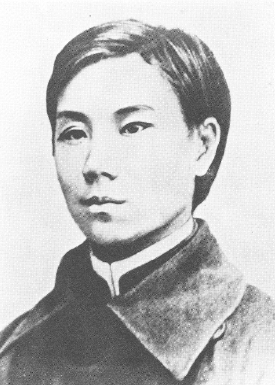
Zou Rong (1885–1905), author of The Revolutionary Army. Source: Wikimedia Commons, unknown artist, Public domain

Afterwards Yao asked the Japanese police to make arrests. Zou Rong and Zhang Ji went back to Shanghai and hid.
Back in Shanghai, Zou Rong wrote The Revolutionary Army.
He was only eighteen or nineteen that year.
The queue was a dividing line among students too
Lu Xun touches on this in his story "The Story of Hair".
In the story "Mr. N" cut his queue while studying abroad, and the reason he gives is slight: "There was no mystery in it; it was simply that it was inconvenient for him." As a result, "several classmates with their queues coiled on top of their heads loathed me; the supervisor too was furious, and said he would stop my official stipend and send me back to China".
A few days later the supervisor "had his own queue cut off and fled", and among those who went to cut it was Zou Rong.
It is fiction, and Mr. N is not Lu Xun. But it shows one thing: in Tokyo the queue was a line, with those who had cut on one side and those who had not on the other. The two sides of the line were not necessarily revolutionaries and conservatives; sometimes it was only a matter of convenience.
Lu Xun has another memoir, "Mr. Fujino", written in 1926. He says that when the cherry blossom at Ueno was in full bloom, under the blossoms were groups of "Qing-dynasty students" in crash courses, "with big queues coiled on their heads, pushing their student caps up into a high peak, forming a Mount Fuji".
That was how the Japanese in Tokyo saw them.
Lu Xun himself cut his queue in March 1903. Xu Shoushang recalled that he was the first in the Jiangnan class of Kōbun Gakuin to cut. After cutting it, he walked into Xu Shoushang's study with a faint look of pleasure. Xu Shoushang said: "Ah, a whole new bulwark!" He touched the top of his head with his hand, and the two smiled at each other. (This passage is quoted in Wang Binbin's article, who notes the page of Recollections of Lu Xun; I have not read Xu Shoushang's original book.)
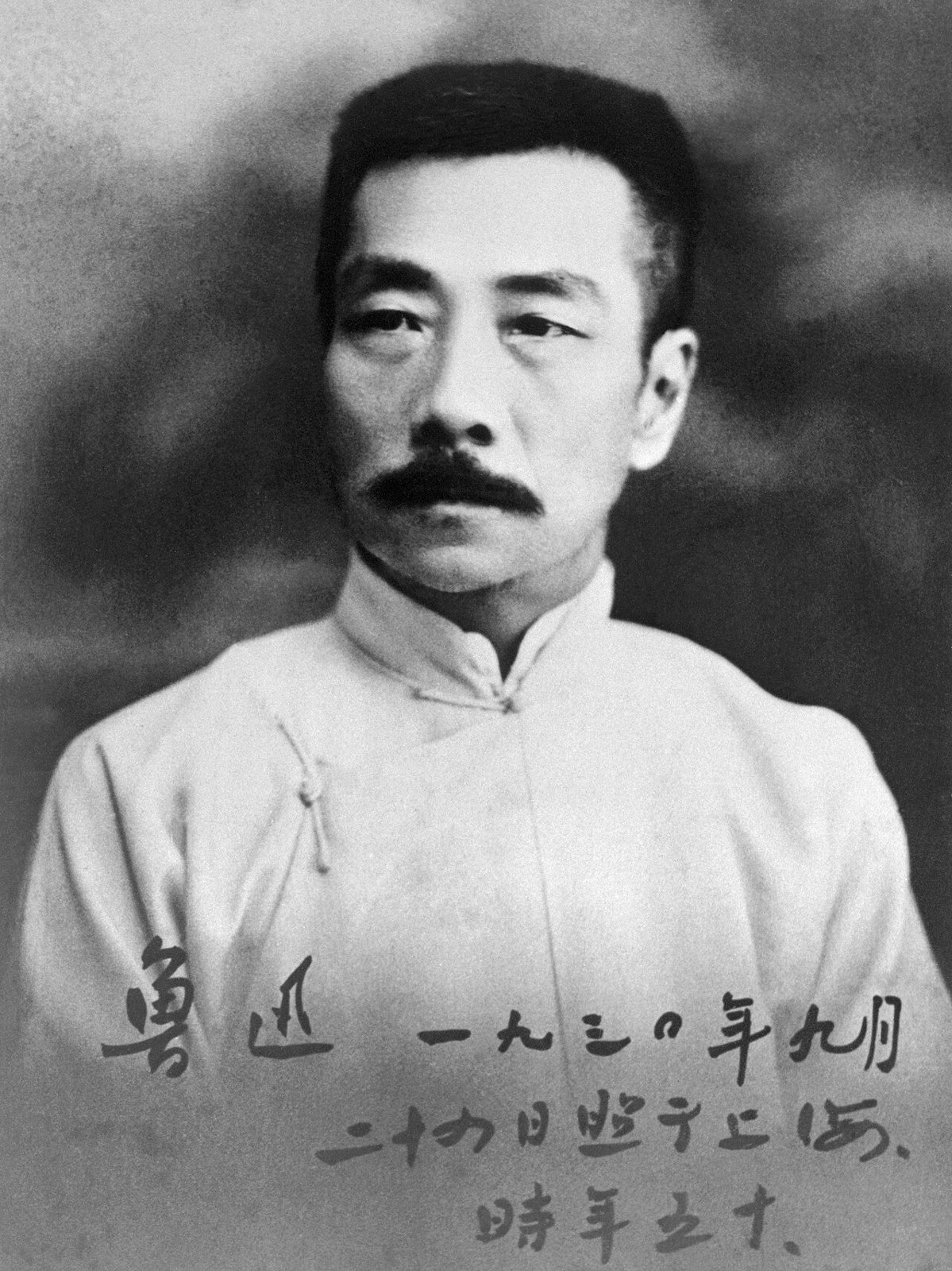
Lu Xun (1881–1936), 1930. Source: Wikimedia Commons, unknown photographer, Public domain

But Lu Xun himself, later, spoke of it lightly. In 1936, in his last writings, he wrote: "My cutting my queue was not because I am from Yue ... and had no revolutionary quality in it at all; in the end it was only for inconvenience: first, inconvenient for taking off my hat; second, inconvenient for gymnastics; third, coiled over the fontanelle it made one stuffy." He also said: "In fact, those without queues, when they came home, quietly let their hair grow again, and became loyal subjects, in great numbers." Huang Xing, when studying at the teachers' college in Tokyo, "never cut his hair at all".
So cutting the queue did not at that time necessarily mean revolution.
Coming home was not easy either. Lu Xun writes in Random Notes after an Illness: "My queue I left in Japan; half went to a maid at an inn to make a wig, and half to the barber." On reaching Shanghai he first had to fit a false queue, "four silver dollars each, no discount". After wearing it for more than a month he thought that if it fell off on the road it would be even uglier, and "simply gave up fitting it". Then, "when I went out the treatment I got on the road was entirely different from before", "the best was staring, mostly it was sneers and curses", "at worst I was denounced as 'in league with foreign countries', what is now called a 'traitor to the Han'".
Later he said that he cherished the Republic of China, "for the most part just so that we might have the freedom to cut our queues".
A young man who only wanted to cut off a queue, returning to his own city, to be sneered at, cursed, called a "traitor". Reading this, I feel tired for him.
Japan cut first
An interesting thing: Japan itself, thirty years earlier, had had its own cut.
In 1871 the Meiji government issued the edict on cutting the topknot and abandoning the sword. It meant: whether to cut the topknot and whether to wear the sword would from now on be free. Note: "free", not compulsory. In 1873 the Meiji Emperor cut his own.
In 1872 the government further provided that officials' formal dress should be changed to Western style. In the same year women were forbidden to cut their hair.
So this round in Japan had three features. Who decided? The government. Was it compulsory? Cutting hair was not; officials' formal dress was. For whom? Men first; women much later; the Westernisation of women's dress came about fifteen years after men's. (These come from abstracts of Japanese web pages; the text of the laws I have not read.)
By comparison, the queue order of 1645, after the Qing army entered the pass, was compulsory for all Han. It was lifted only in 1912.
Once cut, what to wear
This is the most interesting place.
In 1895 Sun Yat-sen and Chen Shaobai had their queues cut at Yokohama. Feng Ziyou's father kept a shop in Yokohama, and they were cut in the shop that day. The clothes were made for them by a Western-tailor named Tan Fa.
Note: in 1895, after cutting the queue, what they changed to was a Western suit, nothing else.
Five years later, in 1900, Zhang Taiyan cut his queue and wrote "Untying the Queue". What he thought of was not only cutting it. He said that he himself was "already of age, and yet still wore the dress of the barbarians" (年已立,而犹被戎狄之服), and wished "for gentry to bind up their hair and so go back to the near antiquity" (荐绅束发,以复近古). But "the days did not allow, and clothes could not be had" (日既不给,衣又不可得): there was not enough time, and he could not find the clothes.
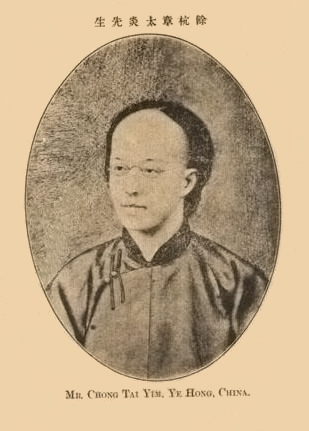
Zhang Taiyan (1869–1936). Source: Wikimedia Commons, unknown photographer, Public domain

So he took a step back and followed the "cut hair" of the people of Wu and Yue in the old books. ("Untying the Queue" is quoted by Lu Xun in "A Few Things Brought to Mind by Mr. Taiyan"; the original I also read from there.)
Clothes could not be had. These words were spoken in 1900 by a man who wanted to restore Han dress. I felt my heart sink when I read them. A person wanted to put his ancestors' clothes back on, and found he could not find a single piece. Not because nobody was willing, but because for more than two hundred years nobody had made that clothing any more.
In Tokyo in 1903, among the students "the proportion in Western suits grew and grew, and more common still was the Japanese student uniform" (this is a summary by a Japanese scholar). In 1912 the Republic issued a new dress code in which the Western suit and the long gown with mandarin jacket stood almost side by side. Han dress was not chosen.
The later Zhongshan suit is said to have combined the Japanese student uniform, the Western military service dress, and Chinese conditions. (Its origin and year are told in different ways; I have not checked.)
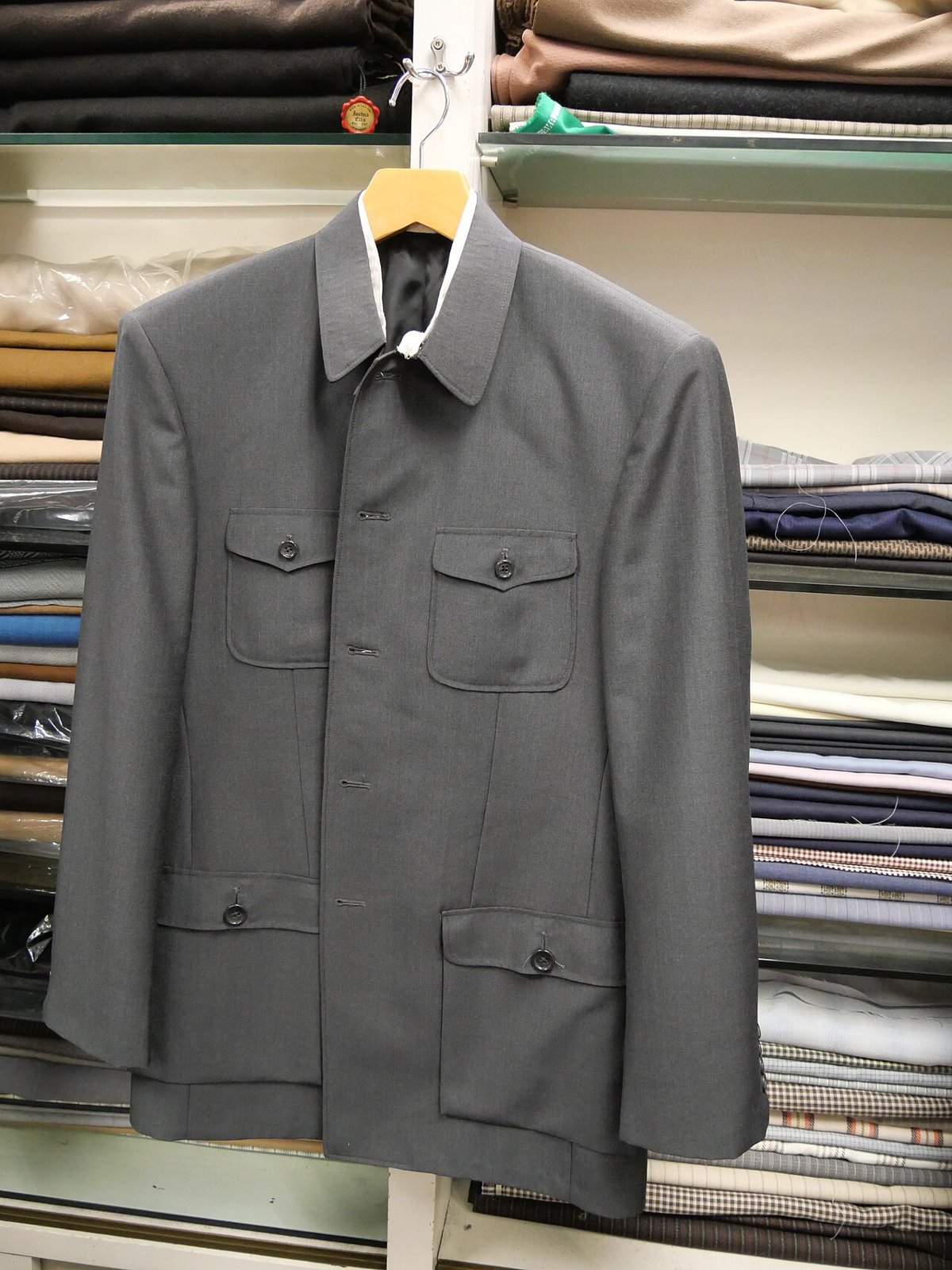
A Zhongshan suit in a tailor's shop in Hong Kong. Source: Wikimedia Commons, Peachyeung316, CC BY-SA 4.0

So the answer, more than a hundred years ago, to "once the queue is cut, what to wear" was: the Western suit, and the Japanese student uniform. The Japanese student uniform itself came from Western military dress. The clothes had passed through two hands.
As for what Chinese students in Japan wore in ordinary life, Zhou Zuoren said. As quoted by one scholar, he and Lu Xun in Tokyo "wore the student uniform to school, and in ordinary times only a kimono with a skirt and wooden clogs", "in clothing, food and housing all lived entirely a Japanese life". They did it on purpose, believing that "without experiencing it in life one cannot know Japanese things deeply". (This is a quotation at second hand; I have not yet found the original chapter in Zhou Zuoren.)
It was not to replace any Han dress; he did it to understand Japan.
How a word came back
The word "revolution" also changed its use in those years.
Feng Ziyou wrote a short piece called "The Origin of the Two Characters 'Geming'". He says that before 1895 the party's people had never used the two characters "revolution" as a name; from the Taiping to the Xingzhonghui, it had been "rebel", "rise", "restore".
In 1895 the Guangzhou uprising failed, and Sun Yat-sen, Chen Shaobai and a few others fled to Japan. As the ship passed Kobe they went ashore and bought a Japanese newspaper, in which was a news item headed "Sun Yat-sen, Leader of the Chinese Revolutionary Party, Arrives in Japan".
Sun Yat-sen said to Chen Shaobai: "The two characters 'geming' come from the line in the Book of Changes, 'Tang and Wu made revolution, in accord with Heaven and in response to men'. The Japanese call our party the Revolutionary Party, and the meaning is very good; from now on let us call ourselves the Revolutionary Party." (「革命二字,出於《易經》湯武革命順乎天而應乎人一語,日人稱吾黨為革命黨,意義甚佳,吾黨以後即稱革命黨可也。」)
Feng Ziyou added that the Japanese were the first to use it to translate the English word "Revolution".
So the word is Chinese; it is in the Book of Changes. But to take it as a party's name, as "a great change in politics and society", it went round Japan and came back. (This is Feng Ziyou's recollection decades later; the dialogue cannot be taken as verbatim history.)
Lu Xun's sentence
Thirty years later, in 1934, Lu Xun wrote a letter to the woodcut artist Chen Yanqiao. In it was a sentence that later was rewritten as "the more national, the more global".
The original words are:
"My advice to mix in still life, landscape, the customs of different places, street scenes, is for this reason. Literature today is the same: what has local colour is rather more easily made global, that is, noticed by other countries. If it is pushed out into the world, that benefits China's activity."
Right after it comes another sentence, rarely quoted:
"Moreover, a good subject alone is no use; technique is still needed; worse is when the content is not strong at all, but has only a fearsome exterior that first frightens off the ordinary reader. For example, the recent album of the Nameless Woodcut Society has on its cover a portrait of Marx, and some people dare not buy it."
(This passage is quoted in Wu Jun's article of 2020; the original letter I have not yet read.)
So what Lu Xun said is in fact a very practical thing: if you want woodcuts to be seen by more people, don't start by frightening them; draw landscape and customs first; "local colour" is an easy way to be noticed by other countries; but the precondition is that the technique must be good.
Between "national" and "global", Lu Xun put one condition: technique.
A hundred years later
On 22 November 2003, in Zhengzhou, an electrical worker walked down the street in Hanfu he had sewn himself. Later this day became "Hanfu Day".
Now Hanfu is a sizeable circle.
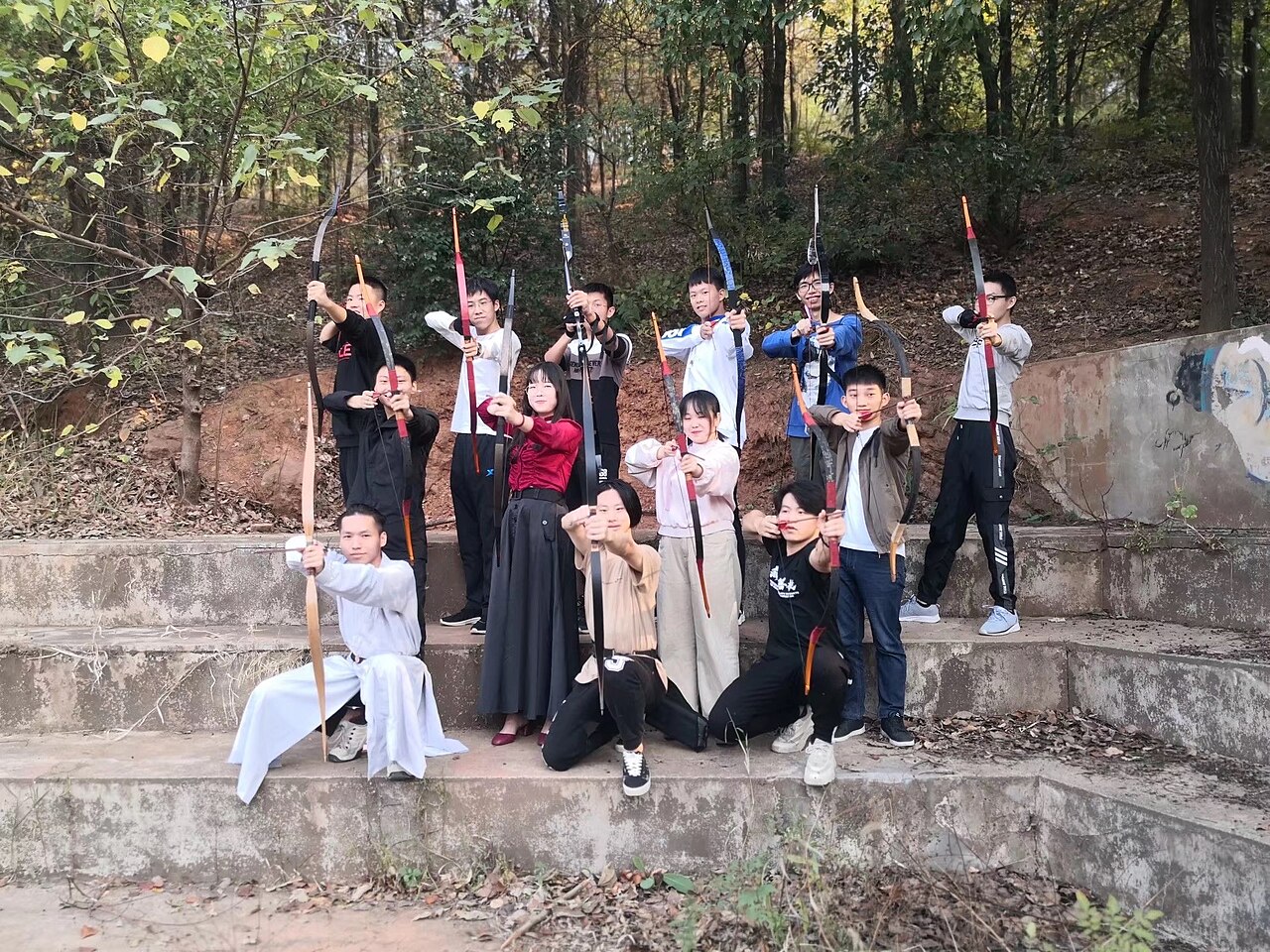
Archery activity of a Hanfu club. Source: Wikimedia Commons, Allervous, CC BY-SA 4.0

Japan has the same phenomenon. The Japanese wafuku (kimono) is today worn mainly at life's rites, coming-of-age ceremonies, weddings, graduations, and little in daily life. I found no reliable national figures for how many young people are interested in the kimono or how large a share of the market rental takes, so I do not give any here.
So this is a second round. A hundred years ago what was longed for was the Western suit. Now, in daily life, what everyone wears is still the Western suit. National dress is for festivals, for rites, for photographs.
Some will say this is "finally waking up". To me it looks more like coexistence.
Take a more extreme example. National dress in the Gulf states, according to scholars' studies, was set as a norm by the state in the oil age and is not the same as what people wore there before oil; in countries where citizens are far fewer than foreigners, dress became the mark that tells "citizens" apart. What has been invented can be a very firm identity too.
What I thought
Joined together, these things ask the same thing: who decides the clothes? In 1645 it was the Qing court, and the means was "whoever does not comply is killed". In 1895 and 1903 it was the people themselves, in Japan, hiding and cutting at once. In Japan in 1871 it was the government, and the means was the two words "free choice". In 2003 it was a worker in Zhengzhou who sewed a garment himself. The person who decides has changed several rounds. I feel the best kind is the last: nobody prescribes, nobody approves, a person wants to wear it, and wears it.
Looking at it the other way
First, Japan's role in the Xinhai Revolution cannot be overstated. That the Tongmenghui was founded in Tokyo in 1905 is true; but the secret societies, the New Army and the constitutionalists at home also played their part.
Second, Japan was not always friendly to the revolutionaries. In 1903 the Japanese government, at the demand of the Qing minister, disbanded the Anti-Russia Volunteer Corps, and Yao Wenfu afterwards also turned to the Japanese police.
Third, be careful with the narrative of "waking up". Nobody has given up the Western suit. Japanese men put on Western dress in 1872 and still wear it today; in China's daily life it is the same. National dress mostly coexists on certain occasions. And a hundred years ago there was also a force going back: the National Essence school, and Zhang Taiyan, also spoke of restoring Han dress and headgear; the Republic's officials simply did not choose it.
Fourth, the Gulf example can be used the other way round too. A "tradition" funded by the state, written into regulations, and tied to benefits is just the most typical form of what critics call an "invented tradition". It is very firm, because of the benefits, not necessarily because of identification.
Fifth, Lu Xun's sentence was about a strategy for woodcuts, not a universal law.
Should national dress become an identity? My answer: yes, but only voluntarily, for festivals, never prescribed. I said in the preface that in the "shared cultural faith" I want there is one part, "regalia" (fuzhang): on Qingming a family puts on tidy clothes to go to the ancestral rites; on the day a young person comes of age, he puts on the look of his ancestors and performs a rite. That is so that a person, on one day, knows whom he stands behind. But I do not want anyone to be looked down on for not wearing it, and I do not want any government to write it into regulations. The Gulf example puts me on guard: once a garment is tied to benefits, it is no longer "regalia"; it is a "document". What I want is the former: not by regulation, but by a person, on one day, being willing.
To my friends in Japan, and to my friends in China. Of your ancestors, one cut off his topknot in 1871, the other cut off his queue in Tokyo in 1903. That young man who cut his queue had, on going home, first to put on a false queue bought for four yuan; he wore it for more than a month, and in the street he was sneered at and cursed as a "traitor". A few years earlier, Zhang Taiyan wanted to put his ancestors' clothes back on, and what he wrote instead was "clothes could not be had". They did not know that more than a hundred years later a worker in Zhengzhou would sew himself a set of Hanfu and walk down the street in it, and that people would, at coming-of-age ceremonies and on festival days, put on their ancestors' clothes again, one piece at a time. What every generation asks is really the same question: whose descendant am I, and am I willing, on a certain day, to let others see it too?
If a garment was decided for you by someone else, would you be willing to put it on again?
References
- Feng Ziyou, Yishi of the Revolution: "Zou Rong, Author of The Revolutionary Army", "Sun and Chen Cut Their Queues and Change Their Dress", "The Origin of the Two Characters 'Geming'" (Wikisource)
- Zhang Taiyan, Biography of Zou Rong, as cited in the notes to "The Story of Hair" in vol. 1 of the Complete Works of Lu Xun
- Lu Xun, "The Story of Hair" (1920), "Mr. Fujino" (1926), Complete Works of Lu Xun (Chinese Marxist Library)
- "Lu Xun's photograph with cut hair", China Writers' Network, after Xu Shoushang's recollections (I did not check Xu Shoushang's exact words in Impressions of My Late Friend Lu Xun word for word; the photo was taken in Tokyo in 1903 after the queue was cut and given to Xu with the poem "Self-Inscription on a Small Portrait")
- Hu Lingyuan, "Remarks on Zhou Zuoren's method of studying Japanese culture", Riben xuekan, reprinted by the China Writers' Network, 2013 (quoting Zhou Zuoren)
- Wu Jun, "Revisiting 'the more national, the more global': from Lu Xun's letter to cross-cultural communication", Wenyi zhengming, 2020 (quoting Lu Xun's letter to Chen Yanqiao of 19 April 1934)
- Japan's edict on cutting the topknot and abandoning the sword (promulgated 9 August 1871; it allowed but did not compel), the imperial rescript on revising dress (September 1871) and Western-style formal dress (1872): abstracts of Japanese web pages 🟡
- National dress in the Gulf states: National Dress in the UAE: Constructions of Authenticity and others (abstracts, originals not read)
- Image sources are given in each caption