
1. Two years
First Korea, which you may know better than I do.
In March 2022 Yoon Suk-yeol was elected with 48.56% against 47.83%, a margin of 0.73 percentage points, the smallest since direct presidential elections began in Korea. Lee Jae-myung, the loser, came forward and said that this was not a defeat for you, nor for the Democratic Party; all the responsibility was his.
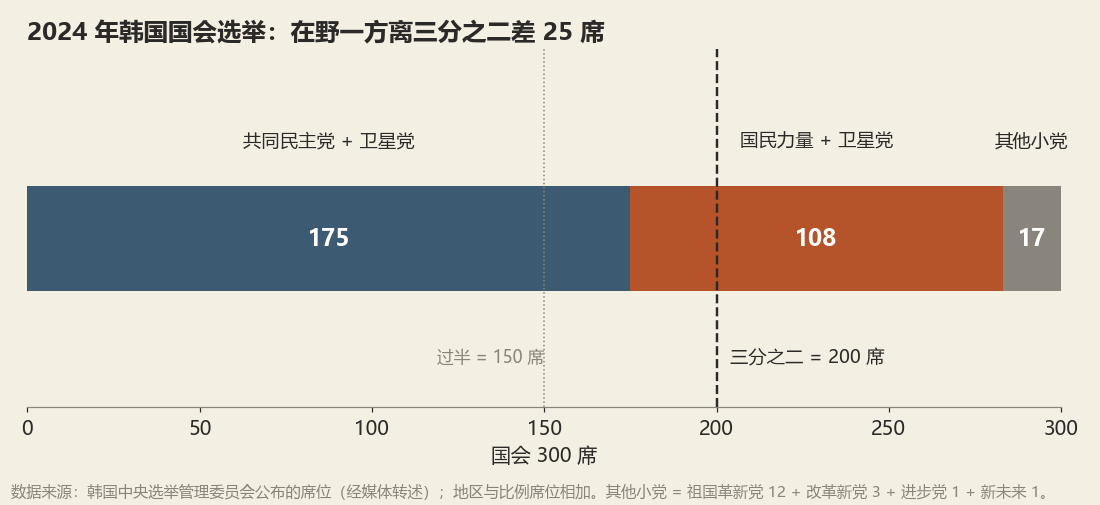
In the National Assembly election of April 2024 the opposition won big: the Democratic Party and its satellite party together had 175 seats, the governing People Power Party and its satellite 108, the other small parties 17. Two-thirds is 200 seats, and the largest opposition bloc was still 25 short.
On the night of 3 December 2024 the president declared emergency martial law, and lifted it about six hours later. On 14 December the National Assembly passed an impeachment by 204 votes to 85; the threshold was 200. On 4 April 2025 the Constitutional Court, eight to zero, removed Yoon Suk-yeol from office. On 3 June Lee Jae-myung was elected with 49.42% to 41.15%. The loser, Kim Moon-soo, said that evening that he "humbly accepted the people's choice".
On 19 February 2026 the Seoul Central District Court, at first instance, sentenced Yoon Suk-yeol to life imprisonment as ringleader of an insurrection; the prosecution had asked for death. He appealed, and as I write the appeal has not been decided.
Then the new president's approval rating fell. Gallup Korea: a high of 67% in March 2026, 42% by August, and on 9 October 37%, with 51% disapproving. In the local elections of June the Democratic Party won the majority, though Seoul's mayor is still from the People Power Party. On 3 October, National Foundation Day, there was a rally at Gwanghwamun demanding the president step down, with an unofficial police estimate of about 28,000.
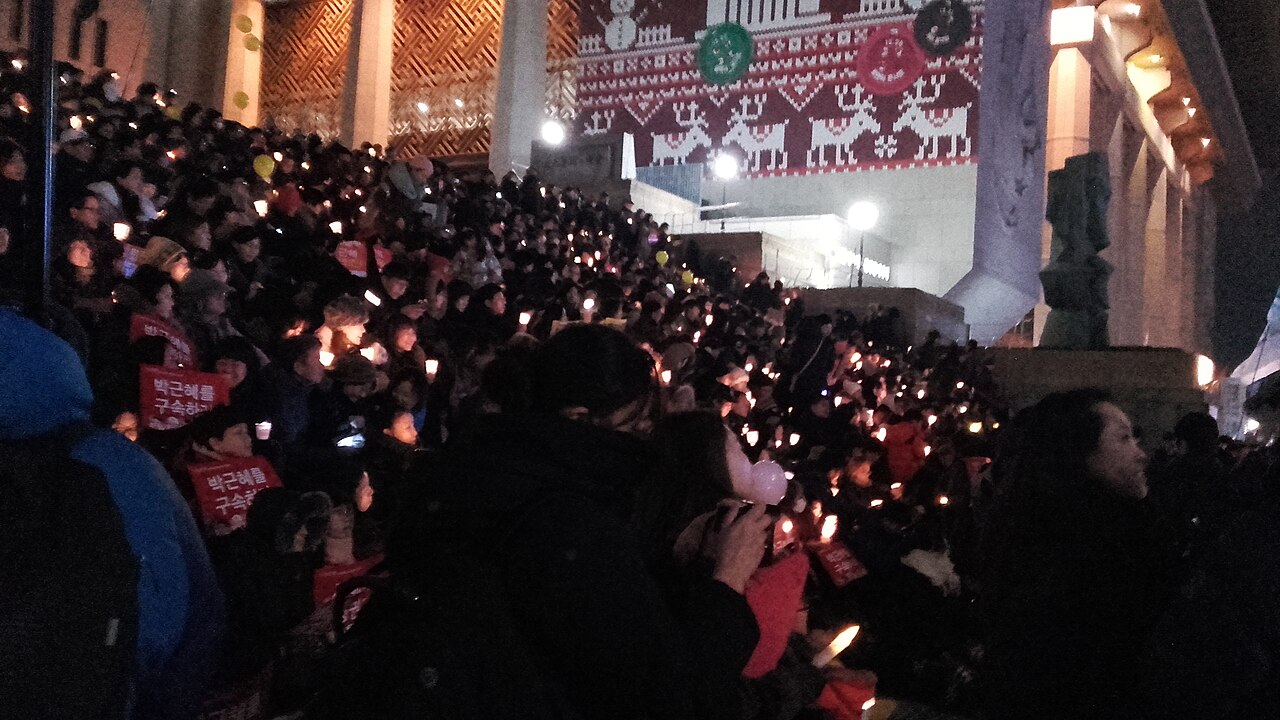
The candlelight rally in front of Gwanghwamun, 31 December 2016. Three months later the Constitutional Court upheld Park Geun-hye's impeachment. Source: Wikimedia Commons, Jirangmoon, CC BY-SA 4.0

Think of the people of this country. In twenty years three presidents were brought before an impeachment: Roh Moo-hyun in 2004, passed by the Assembly and rejected by the Constitutional Court; Park Geun-hye in 2017, upheld; Yoon Suk-yeol in 2025, upheld. Each time someone stood in the square for a long time.
So: is this Korea's own affair, or a kind of fatigue found everywhere?
2. One answer, and what it got right and wrong
Someone online, talking about that mass protest in Seoul, put it very bluntly. Social-media algorithms, a weakening economy and conflict between generations, he said, make voters' bases harder and harder, each side 45%; swing voters have shrunk from thirty or forty percent to ten; politicians no longer fight for the middle but mobilise by the hatred of "they must never get in"; the cycle of alternation in power has shortened from eight or ten years to two. His conclusion: in our lifetimes we may see universal suffrage collapse, replaced by one-man or one-party dictatorship. He himself calls this a "wild claim".
I checked the numbers.
What he got wrong:
- He said the Democratic Party won 180 seats, nearly two-thirds. No. It was 175, 25 short of 200.
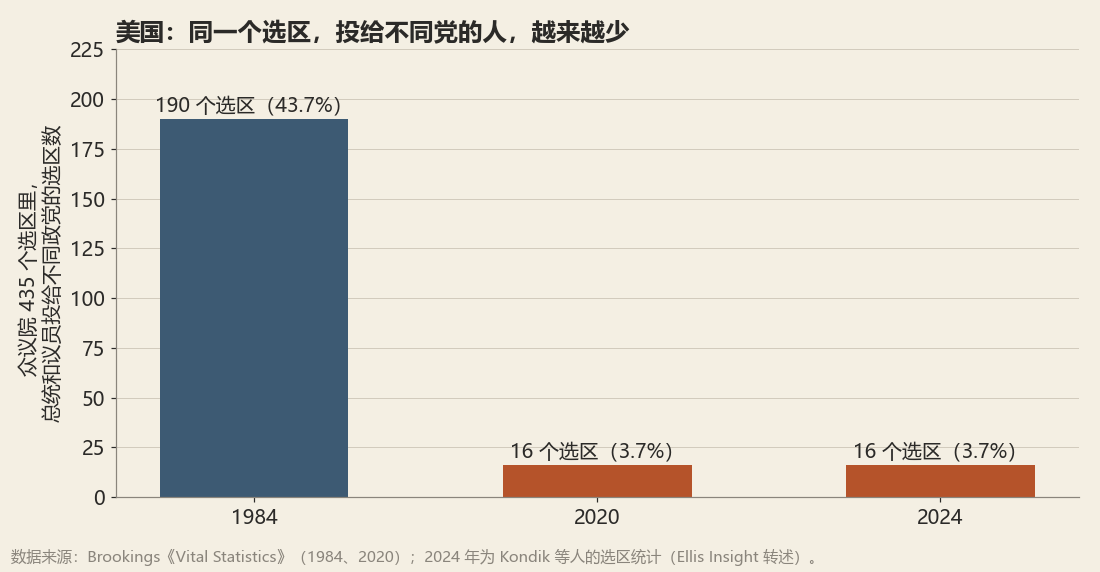
- He said swing voters shrank from 30–40% to about 10%. Two quantities are mixed here. In the US House, the districts where voters chose a president of one party and a representative of another numbered 190 in 1984, 43.7%; in 2020 and 2024 only 16 each, 3.7%. That quantity really did collapse. But "independent voters with no party leaning" have been about ten percent all along, and did not fall from thirty or forty.
- "Mass protests in Seoul against Lee Jae-myung": I found only the one on 3 October, 28,000, and a right-wing one.
What he got right:
- The president's approval really does swing wildly.
- The "locked-in base": the US has only 16 split districts left; Poland's 2025 presidential election was 50.89 to 49.11; the Netherlands in October 2025 had two parties on 26 seats each, separated by a thousand or two votes; in Taiwan in summer 2025 not one of the recall cases against 31 Kuomintang legislators passed, and in the first wave of 24 cases, support for recall was only 37.7% to 48.6%.
What does not hold is "change every two years". The US, Britain (three prime ministers between 2022 and 2024), France and Korea support it. But in Japan, in February 2026, the Liberal Democratic Party alone won 316 seats, a postwar record, over two-thirds; in Argentina's midterms of 2025 Milei's party came out stronger. It is not that change is getting faster everywhere; in some places the vote runs one way.
Among the comments under that answer, two lines struck me as the best, and I put them here:
One says: if there is a 45% locked-in base, how can Lee Jae-myung's approval fall to 37%? I can answer that: the president's rating can fall while the base that votes for a party hardly moves. Gallup's party support in mid-October: Democratic Party 39, People Power Party 25. The president's rating and the party's base are two different things.
Another says: the deeper the division, the more universal suffrage is needed, because it is "the last consensus that keeps one group of people from killing another". This one I think is right, and I will come back to it.
And the algorithm? In 2023 Meta worked with several universities on an experiment on Facebook and Instagram: feeds were changed to chronological order, reshares removed, like-minded content reduced; over three months no significant effect was measured on polarisation, political knowledge or attitudes. The researchers themselves caution that the time was short. It cannot prove that algorithms do not matter, only that a short experiment did not measure it. Another comment's account is governance failure: economy, debt, ageing, with polarisation only the surface. No one has tested that with data.
Finally, "the collapse of universal suffrage". That is a prediction, and I do not write it. The one thing I can check: Freedom House's 2026 report says global freedom has declined for the twentieth year in a row, 54 countries down, 35 up; the share of the world's people living in "free" countries is 21%, twenty years ago 46%. But what Freedom House mostly describes is elected leaders weakening checks and balances, which is not the same as voters changing every two years.
3. How many ways of "replacing" are there
I sort the events of the past two years into five roads.
| Road | Example | What I checked |
|---|---|---|
| Changed from outside: cancelling, postponing, altering terms | El Salvador, July 2025: the legislature voted 57 to 3 to amend the constitution, abolishing presidential term limits and extending the term from 5 to 6 years | the amendment is fact; the Turkey 2028 rumour is only a forecast |
| Hollowed from inside: courts and election commissions decide who can stand | Romania, France, Turkey, Pakistan, Thailand | the hardest evidence is on this road |
| Supplemented from the side: sortition, citizens' assemblies | Ireland, France, eastern Belgium, Paris | real, but small, all advisory |
| Another reason: meritocracy, "whole-process people's democracy" | Singapore, China | an argument, not an experiment |
| AI and algorithms deciding in place of people | Albania appointed an AI "minister"; the UAE has 32 AI assistants | I have not found a single verified case of "AI replacing a political decision"; all are advisory |
On the second road I will say more, because it is the most real and the most important: elections are held as usual, only who may be elected has first been decided by others.
- Romania: in the first round on 24 November 2024, Georgescu came first; on 6 December the Constitutional Court annulled the whole election, on the grounds that campaign methods and funding were not transparent. He and his supporters called it a coup; the court and the later rerun said no. In the rerun in May 2025, Dan was elected with 53.6% to 46.4%. Each side holds to its own account.
- Turkey: in March 2025 the mayor of Istanbul, İmamoğlu, had his diploma annulled (a presidential candidate must have a valid degree) and was then detained; the government says the judiciary is independent, and the opposition and human rights groups say it is a political case.
- Thailand: in August 2024 the Constitutional Court dissolved the Move Forward Party; in August 2025 the court removed Paetongtarn, the fifth prime minister removed by a court in seventeen years.
- France: Le Pen was convicted of misusing European Parliament funds; in July 2026 the appeal court reduced the ban on standing to 45 months, so she can still run in the 2027 election, and she is still appealing to the highest court.
Now the "supplement from the side" road, and how big it is. Ireland, 2016 to 2018: 99 citizens chosen by lot discussed abortion and recommended a referendum; in May 2018 the referendum passed by 66.4% to 33.6%. France's Citizens' Convention on Climate, 2019: 150 people; about a fifth of the recommendations were finally carried out, and more than half more in amended form. Eastern Belgium has a standing assembly of 24 people, whose parliament and government must explain their reasons for accepting or rejecting its proposals, but with no binding legal force. No country has yet made a sortition assembly its legislature.
One more thing has to go in, or this section would be one-sided. On 12 April 2026 Viktor Orbán in Hungary lost the election to Magyar's party, which won two-thirds of the seats; that night he said the result was painful but clear, and congratulated his opponent. A ruler of sixteen years conceded. This exists at the same time as the falling numbers above.
4. The neighbours, with one ruler
For East Asia's neighbours I use the same ruler: who votes, who can be elected, how they are screened, whether the opposition has room, where courts and election commissions stand.
| Who may be elected, and how it is settled before the election | Latest figures | |
|---|---|---|
| Korea | Candidates register freely; the National Election Commission is a constitutional body, outside the government, with nine commissioners, three each named by the president, the National Assembly and the Chief Justice | turnout in the 2025 presidential election 79.4% |
| Japan | Candidates are free; on 26 September 2025 the Supreme Court ruled by three to one that the "value of a vote" in the 2024 lower-house election was constitutional | February 2026: LDP 316 of 465 seats |
| Taiwan | Candidates are free; in summer 2025 the recalls of 31 legislators and one mayor all failed | 2024 Legislative Yuan: KMT 52, DPP 51, TPP 8, the first time in thirty years that no party held a majority |
| Singapore | A presidential candidate needs a "certificate of eligibility", whose conditions are a high post in the public sector or being chief executive of a large company; parliamentary elections have group representation constituencies; the Elections Department belongs to the Prime Minister's Office; the opposition is legal and holds seats | May 2025: People's Action Party 65.57%, 87 of 97 seats; Workers' Party 10 seats; turnout 92.83% |
| Vietnam | The Vietnam Fatherland Front runs three rounds of "consultation", fixing quotas, drafting lists and seeking the views of voters where candidates live; about 93% of official candidates are party members | 15 March 2026: 864 people for 500 seats, turnout about 99.7% |
| Mainland China | County and township people's congresses are directly elected, those above city level indirectly; the law requires a margin: directly elected candidates must outnumber the seats by one third to one times; parties, bodies or ten or more people jointly may nominate | I did not obtain the latest county/township figures |
| Hong Kong | From 2021 candidates pass a Candidate Eligibility Review Committee; the Legislative Council has 90 seats, 40 chosen by the Election Committee, 30 by functional constituencies, 20 by direct geographical election | December 2025: turnout in the direct geographical elections 31.9%; in 2021 it was 30.2% |
A few more words on this table.
In the mainland column there is an example: in 2011, in Xinyu, Jiangxi, Liu Ping announced that she would stand as an independent, but the number of people who jointly nominated her did not reach ten, and she was not recognised. Overseas media reported that on polling day she was held in a guesthouse, cast her own vote through a mobile ballot box, and lost her freedom for five days. These details are in reports by several overseas outlets and by Caijing; the official explanation for her failure was that the number of joint nominators did not reach the legal ten. A spokesman of the Legislative Affairs Commission of the NPC Standing Committee then said that only "formal deputy candidates" nominated by lawful procedure counted. Independent candidates have no place in law.
In the Singapore column, too, two sides must be written: of the "certificates of eligibility" for presidential candidates, the Elections Department refused three in 2023; but the opposition wins seats and is not a decoration.
In the Vietnam column, I did not find the official wording and do not write it; on 19 March 2026, according to the Committee to Protect Journalists, a journalist was arrested for criticising the legitimacy of the election, a single source.
In the Hong Kong column, in 2025 the Candidate Eligibility Review Committee disqualified no one, and all 161 nominations were confirmed valid; that has to be written too.
So the difference is not in whether there are elections, but in who, before the election, decides who may be elected.
The seven places above are seven ways of playing the same hand of cards, following the earlier piece "One Hand of Cards, Six Ways to Play It" (that one had six; here Malaysia is left out, and Hong Kong and the mainland are added).
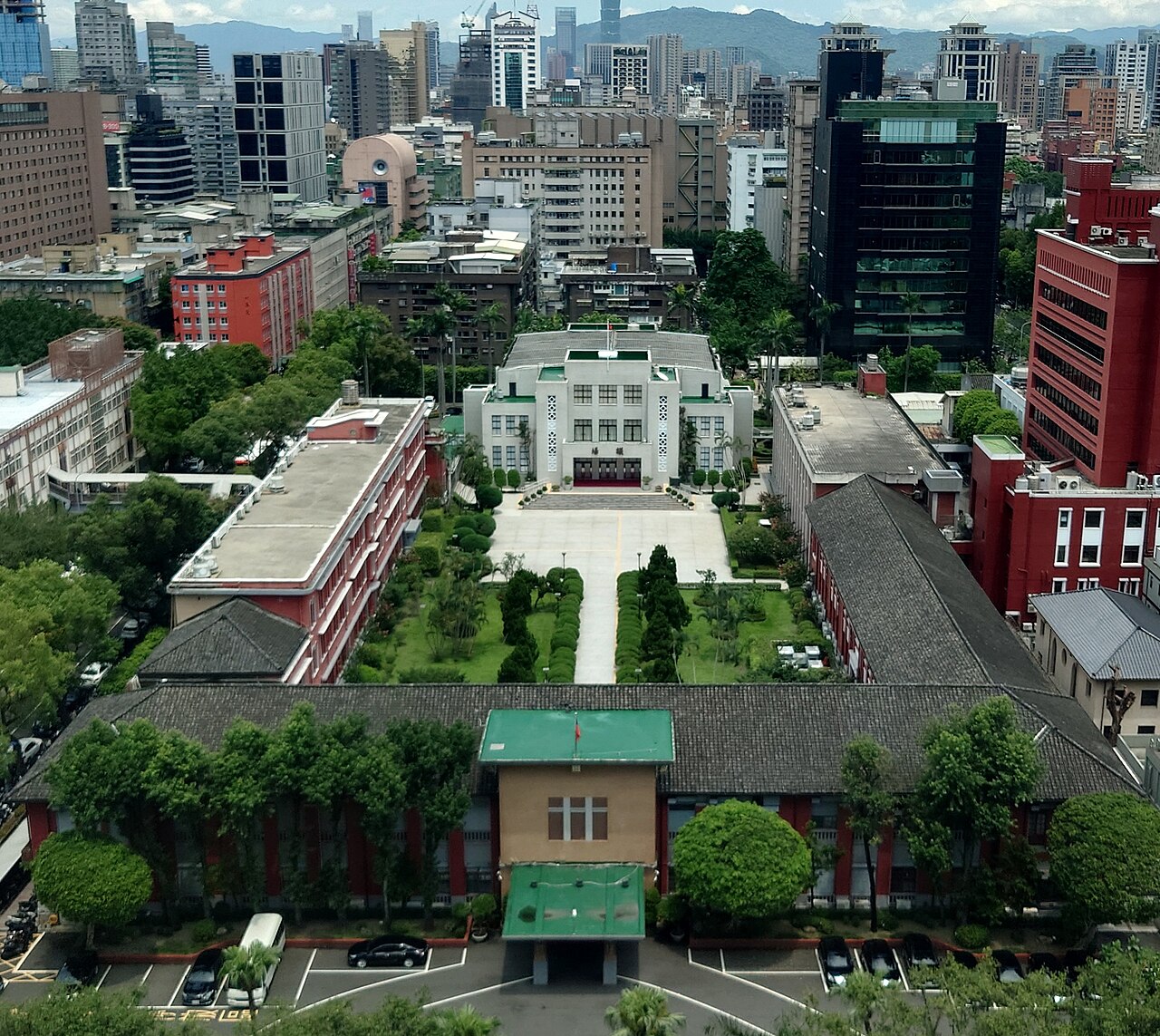
The Legislative Yuan in Taipei. In summer 2025 the recall cases against 31 legislators all failed. Source: Wikimedia Commons, Yu tptw, CC BY-SA 4.0

5. What makes the loser concede
Now back to that comment: "the last consensus that keeps one group of people from killing another".
Why can an election be peaceful? Because the one who loses is willing to step down. Why is he willing?
Scholars have studied this. A book called Losers' Consent (Anderson, Blais and others, 2005) uses surveys from many countries to ask: do people who lose still trust the system? The answer is murky: it depends on each person's circumstances, and on the environment. Another political scientist, Przeworski, has a much-quoted line: democracy is a system in which parties lose elections. The losers are willing to accept because the alternative is worse, and because they believe they will win later.
So conceding rests on a few things. I put the recent examples here:
One, the courts. In Indonesia in 2019 and 2024 the Constitutional Court rejected the losers' suits, and the losers accepted. In Taiwan in 2004 Chen Shui-bian won by under 30,000 votes the day after the shooting, and Lien Chan and James Soong went to court and were rejected three times. In Korea in 2017 and 2025 the Constitutional Court's rulings were both accepted. But on 19 January 2025, after Yoon Suk-yeol's formal arrest was approved, his supporters stormed the Seoul Western District Court and more than 80 were arrested on the spot. The court is one safety net, and it has cracks.
Two, interest, and "there is a next time". Losing is not losing everything, and next time you may win; the richer a society, the higher the cost of overturning the table.
Three, belief that the contest is fair. Gallup in September 2024 in the US: confidence that votes are counted accurately, Democrats 84%, Republicans 28%, the largest gap on record. This one can break.
Four, a shared faith and rites. The sociologist Bellah in 1967 proposed an "American civil religion", and Tocqueville said earlier that Americans had put the spirit of religion together with the spirit of liberty. Later research by Putnam and Campbell says that what works is not theology but the network of friends in the church: people with a religion are three to four times as likely to take part in community activities as people without (the part about cause is my own claim).
Mind you, the evidence for this one comes from America, and it is about the network of friends in the church, not doctrine.
Counter-examples must be set out too. Lebanon: the president is a Maronite, the prime minister a Sunni, the speaker a Shia; this sectarian allocation was something the Taif Agreement of 1989 wanted to remove, and it has not been removed to this day; the presidency was vacant for over two years, from October 2022 to January 2025. Iraq: after the 2021 election one side refused to accept the result, and in 2022 there was fighting in the Green Zone, about thirty dead. Nigeria: after the 2011 election, three days of riots in the north, with more than 800 dead according to Human Rights Watch.
A shared religion does not mean conceding; the more clearly the sects are divided, the harder the opposition sets. So what I mean by "a shared faith" is one faith, not each worshipping separately.
So what does Confucianism say?
In the original texts there is already a way of "handing over", written within the doctrine of Heaven's mandate.
The Book of Documents, "Announcement to Kang", says: "The mandate is not fixed" (惟命不于常). The Book of Songs, Greater Odes, "King Wen", says: "The lords of Shang submit to Zhou; the mandate of Heaven is never constant" (侯服于周,天命靡常). The mandate of Heaven is not fixed to one house. These two lines are earlier than Confucius.
The Mencius has two passages. In one, King Xuan of Qi asks: may a minister kill his ruler? Mencius answers: one who ruins benevolence and righteousness is a "brigand", and a brigand is only a lone fellow; I have heard of the killing of the lone fellow Zhou, I have not heard of killing a ruler. The tyrant is stripped of the status of ruler. In the other, on Yao and Shun: Heaven does not speak; it shows itself by where people go. The lords who came to pay homage did not go to Yao's son but to Shun; those with lawsuits did not go to Yao's son but to Shun; those who sang did not sing of Yao's son but of Shun.
There is also rite. Analects, "Taibo": "Taibo may be said to have attained the highest virtue! Three times he gave up the world, and the people found no way to praise him." (泰伯,其可謂至德也已矣!三以天下讓,民無得而稱焉。) Yielding is written as the highest virtue. In "Bayi" Confucius speaks of archery: the gentleman has nothing to contend over; if he must, it is in archery; bowing and yielding they ascend the hall, and after shooting they come down and drink; this is a contest of gentlemen. Contest is taken into rite.
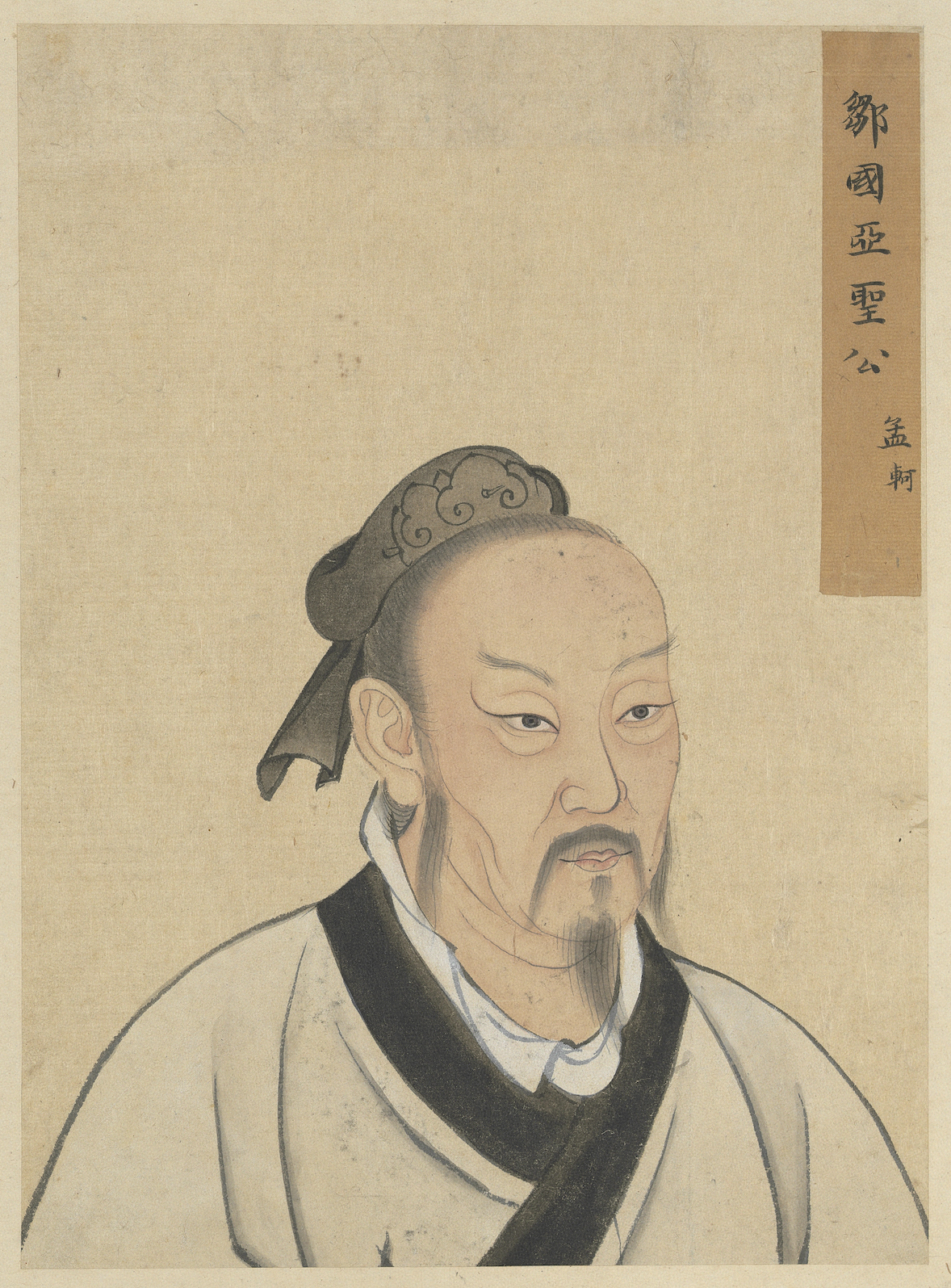
Portrait of Mencius (Meng Ke), from a set of "half-length portraits of the Great Sage and the Virtuous". Source: Wikimedia Commons, unknown artist, Public domain

But the historical record of this method does not look good, and that has to be written too:
- Under Emperor Zhao of Han, Sui Meng (Sui Hong), on the principles of the Spring and Autumn, memorialised that the House of Han descended from Yao and had a destiny of passing the realm on, and that the emperor should seek a worthy man, abdicate in his favour, and himself retire to a fief of a hundred li. His end: he was executed for the crime of deluding the people with sinister talk and of great sedition. Five years later, when Emperor Xuan took the throne, his son was called to serve as a court gentleman.
- Zhu Xi said that if the virtuous rise and the virtueless fall, when the mandate has gone and the people's hearts have left, there should be revolution; but he also said that the great human bonds must be held even by sages; reading how Confucius on one hand praised Taibo and King Wen and on the other said that King Wu's music was "not perfectly good", he held that Confucius's subtle meaning lies in this. The meaning: hand over when the time comes, but do not say it too bluntly.
- In 1339 in Japan, Kitabatake Chikafusa wrote the Jinnō Shōtōki, saying that Japan is a land of the gods whose throne passes in one line; that China had changed its surname thirty-six times was because it "chose the worthy and gave it". He treated "change of surname and revolution" as something to reject.
- In 1902 Kang Youwei used the same Confucian classics to read Yao and Shun as "democracy"; but in the same year he wrote to overseas Chinese merchants urging that China could have only constitutional monarchy and not revolution. The same Confucius could be used to postpone, and to stand up.
Now look at today. On 13 January 2024, Hou Yu-ih lost, and on the stage he said that his own effort had not been enough, that he regretted not completing a change of ruling party, and he congratulated Lai Ching-te. On 4 June 2025, Kim Moon-soo conceded and congratulated Lee Jae-myung.
In these words "Heaven" has gone, and "the people" remain.
In Mencius that sentence has "Heaven" showing itself through the people's conduct, but Heaven itself is not the same as "the people". Once the power of judgment is passed from "Heaven" straight to "the people", the reason for conceding is left with only one: this is the will of the majority. Then, when the majority itself has to be asked "are you right?", who asks?
As for how East Asians usually think about "the loser should accept", no checkable result was found for the relevant items in the Asian Barometer Survey. That part is blank.
What I think now is this: conceding cannot rest on one layer. The court is one layer, interest is one layer, "this contest was fair" is one layer; I trust all these layers, and do not want to swap any of them out. What I want to add is the top layer: something above the majority that no one dares use as a weapon. The name I give it is "Heaven", revere it and ask nothing of it. I am not predicting that universal suffrage will collapse, nor do I want to trade it for anything; I only feel that behind the ballot there must be a place where the loser and the winner can stand together. Others have walked this road before me: in 1902 Liang Qichao wrote an essay that clearly opposed "protecting the religion", saying that Confucius was a philosopher and an educator, not a founder of religion, and asking, too, whether "preserving the race" meant preserving the yellow race or the Chinese race, a boundary very blurred. What he opposed, as I read it, was "protecting" it by power, which is why I say I do not borrow the state's hand; all I want is some days that can be shared and a place for revering Heaven. But I cannot pretend I did not see Lebanon either: a shared faith, if each worships separately, is gunpowder. So the "one" I want must be the same one, and it must be voluntary.
Looking at it the other way
The hardest counter-arguments are three.
First, conceding rests mainly on interest and "there is a next time"; faith is the icing on the cake. The Liberal Democratic Party of Japan, from 1955 to 2009, apart from one short spell in opposition, was almost always in power; in 2009 the Democratic Party won 308 seats and Aso admitted a heavy defeat; in 2012 Noda conceded and resigned as party leader. I have not read any material saying it was faith that made them concede; what I can see is law, the administration of elections, and the next time. And these are only individual cases, not systematic evidence for a "culture of defeat".
Second, this Confucian method of "handing over" was, in history, used more often to forbid: Sui Hong was killed, Zhu Xi held to the great bonds, Kitabatake rejected change of surname, Kang Youwei opposed revolution. That it is in the original texts does not mean it is the half that was handed down.
Third, the evidence I use to support "a shared faith" is the network of friends in American churches, not East Asian and certainly not Confucian. The East Asian version I have not found. I put it in because the question is real, and I do not yet have the answer.
To you in Korea, Japan, Taiwan, Vietnam, Singapore, and all places.
I read about that night of 3 June 2025, about the one who lost stepping onto the stage and saying "humbly accept"; I read about January 2024, when Hou Yu-ih, standing in the hall at Banqiao, bowed to his supporters and apologised. Each time, this is not to be taken for granted. Someone has to swallow what is in their heart before they can step onto the stage, and behind them stand many people who did not want them to concede.
In an age when it is very easy to quarrel past repair, you have done this hard thing again and again.
I also want to say that I do not know how long this method can last, nor do I dare say that replacing it would be better. What I think of is the archery rite Confucius spoke of: the gentleman has nothing to contend over; if he must, it is archery; bowing and yielding they ascend the hall, and when the shooting is done they come down and drink one cup together. Contend, yes; after contending, still share the hall. Your ancestors read this line, and your children may still be able to recite it. I think it may be more like something we share than any constitution.
If the loser is willing to concede, is it the gavel of the court, or the cup of wine after the bowing and yielding?
References
Ratings: 🟢 primary or official page; 🟡 secondary (media, Wikipedia, book-review abstracts); unchecked items marked separately.
- Korea: 2022 presidential election 48.56%/47.83% (🟡, Korea Herald and others; final figures per the NEC, 2022-03-10); 2024 National Assembly election 175/108 seats (🟡, YTN, Newdaily, JoongAng, by NEC figures, nec.go.kr not read); impeachment of 2024-12-14, 204 to 85 (🟡, Al Jazeera, HRW); Constitutional Court of 2025-04-04, eight to zero (🟡, OPB/NPR, IDEA); 2025 presidential election 49.42%/41.15%, turnout 79.4% (🟡, Al Jazeera); Kim Moon-soo "humbly accept the people's choice" (🟡, Hankyung quotation); first-instance verdict in Yoon Suk-yeol's insurrection case (2026-02-19, life, 🟡, JoongAng, Korea Times); appeal suspended in 2026-05 on a recusal motion (🟡); Gallup Korea 2026-10-09: 37%/disapprove 51%/Democratic Party 35% (🟡, Korea Times, JoongAng); 2026-10-03 Gwanghwamun rally about 28,000 (🟡, unofficial police estimate, weak source).
- The answer from someone online, and its comments: material someone forwarded, treated only as a lead; all figures in this piece were checked separately.
- Other countries: Japan 2026-02-08 LDP 316/465 seats (🟡, nippon.com, Wikipedia); Japan's Supreme Court of 2025-09-26 upholding the 2024 lower-house election (🟢, courts.go.jp); Taiwan recalls of 2025 (🟡, CNA citing the CEC); Hungary 2026-04-12 (🟡, OSW, Al Jazeera and others); court and election-commission cases in Romania, Turkey, France, Pakistan, Thailand (🟡, Al Jazeera, HRW, OSW and others); El Salvador 2025-07 (🟡, Al Jazeera); Freedom House, Freedom in the World 2026 press release (🟢, 2026-03-19); US split-district counts (🟡, Brookings table, FiveThirtyEight, Ellis Insight); Meta's 2023 experiment (🟡, news reports only; paper not obtained).
- Sortition and citizens' assemblies: Ireland's Citizens' Assembly 2016–18, France's Citizens' Convention on Climate 2019–20, the standing assembly of eastern Belgium, the Paris citizens' assembly (🟡, government pages and research-institute abstracts); OECD, Government at a Glance 2025 (🟡, abstract).
- East Asian electoral systems: Singapore Elections Department press release 2025 (🟢), Singapore 2025 results (🟡); Vietnam's 2026 National Assembly election (🟡, Wikipedia, Tuoi Tre; official final figures unconfirmed); China's Electoral Law as amended in 2020 (🟢, text reprinted); the Liu Ping case (🟡, overseas media); Hong Kong 2025 Legislative Council election (🟢, government press release, gazette).
- Conceding and faith: Anderson, Blais, Bowler, Donovan, Listhaug, Losers' Consent, Oxford UP, 2005 (🟢, publisher's page; full text not read); Przeworski, Democracy and the Market, 1991 (🟡, quoted at second hand); Bellah, "Civil Religion in America", Daedalus, 1967 (🟢, abstract); Putnam & Campbell, American Grace, 2010 (🟡, reviews); Gallup, September 2024, confidence in vote counting (🟡, reprint); Lebanon, Iraq, Nigeria (🟡; Human Rights Watch's 2011 Nigeria report 🟢); Indonesia's Constitutional Court 2019 and 2024 (🟢/🟡); Taiwan 2004 (🟡, Jurist).
- Confucian sources: Book of Documents "Announcement to Kang", Book of Songs "King Wen" and Analects "Taibo" (as recorded in the author's quotation library, checked word for word against Wikisource, not against the page numbers of a punctuated edition); Mencius Liang Hui Wang II ch. 8, Wan Zhang I, Jin Xin II, Analects "Bayi", Han shu "Biography of Sui Hong", Zhuzi yulei vol. 35 (the Taibo chapter), Liang Qichao, "On the fact that protecting the religion is not the way to honour Confucius" (1902), Kang Youwei, Kongzi gaizhi kao and the letter of 1902 "To the Chinese merchants of North and South America on China's being fit only for constitutional government and not for revolution", Kitabatake Chikafusa, Jinnō Shōtōki (all checked word for word against Wikisource, in paraphrase, 🟢; punctuated editions not checked).
- Unchecked: the official election-commission pages of Korea, Japan and Taiwan; the items in the Asian Barometer Survey on "the loser should accept"; the exact distribution of "Heaven" in contemporary East Asian language of conceding, which is only a reading of two sentences.
- For comparison: in this series, "Korea Really Did Have a 'Religion of the Heavenly Way'" (Choe Je-u), "'Shrines Are Not Religion'", "Why the Confucian Association Failed", "One Hand of Cards, Six Ways to Play It", "The State Pushed Confucianism Once, Then Withdrew It" (Singapore).
- Image sources are given in each caption