1. An answer that pulls away
The usual way of asking is: both are in Southeast Asia, Vietnam counts as part of the Chinese-character sphere, so how come Thailand doesn't?
First, one person's answer online, which probably won't please many people. He says the Han are in fact two peoples, north and south; that the northern half was "barbarised"; that the southern Han and the Tai were originally one family; and that he himself feels nothing for Chinese culture and believes in Theravada Buddhism.
I will not check the blood-lines in this kind of talk, and I will not use it as material. A person saying he feels nothing for a culture is his own business. It reminded me of a word: atomisation. Some people feel a ditch between themselves and a very large "us"; that ditch is real, it just need not be measured by "two peoples". This one I note down as a voice, and I do not argue.
Another person online puts it more plainly, and quite a few agree: the Tai split off from the Hundred Yue of the south, moved west and south, and settled under the influence of the Khmer empire; their script was made on the model of Khmer, their Buddhism came from the Khmer and India; the Central Plain, behind Yunnan and Burma, had only local influence.
This one is broadly right, with two things to change; I say them as I go.
2. First take the "sphere" apart
"The Chinese cultural sphere" is often the sum of several things: Chinese characters, the Confucian classics, Chinese Buddhism, and a system of law and examinations.
Measure Thailand with these four: the script is not Chinese, the classics are not the Four Books and Five Classics, the Buddhism is Theravada not Chinese, the civil service is not the examination system. None of the four.
So if "sphere" means "having all four", Thailand really is not in it.
But I want to go on and ask: which sphere did it enter? And what is its relation with the Han?
3. Where they came from
The Tai speak languages of the Tai–Kadai family. In the piece on the Thai, Lao, Zhuang and Dai I said that this family belongs to southern China.
Where was the homeland? For a long time some said it was Nanzhao in Yunnan. In 1964 the American scholar Frederick Mote wrote an article saying it could not be. In 1966 Gedney studied the Tai dialects of southern Guangxi and placed the homeland of Proto-Tai around the Guangxi–Vietnam border. Later some, using geographic methods, reached a result that also falls in Guangxi and Guizhou.
And when did they go? A study published in 2014 by the Thai scholar Pittayawat Pittayaporn, reasoning from several layers of Chinese loanwords in Proto-Southwestern Tai, puts the branch that went southwest into mainland Southeast Asia at around the eighth to the tenth century.
What is interesting is that the deepest layer of Thai already has Chinese in it. The words were borrowed in Guangxi, before the language set out. Some of them are still in use in Bangkok.
In 1253 the Mongols destroyed Dali, often given as the reason for another wave of southward migration; but that came later.
4. Where they settled
When the Tai went south to the Chao Phraya basin, the place was not empty.
Lavo (today's Lopburi) in the middle and lower Chao Phraya was first a Mon place; from the tenth century Khmer power came in; inscriptions say that under Suryavarman I it was brought into the administration of the Khmer empire.
The Mon and the Khmer already had script, already had the Buddha, already had the rites of kings. The Tai were latecomers.
The name "Siam" is found in Old Khmer inscriptions as early as the seventh century, written syam; its meaning is uncertain, and it appears often in lists of slaves; scholars suppose it was the name of a place in the lower valley. On the gallery of Angkor Wat there is a relief of a marching army labelled "Syam" (Syam Kuk); most scholars take it to refer to the later Tai. Others caution that whether it is a place name or an ethnic name is not certain.
What the Chinese knew were two: Xian (Siam), and Luohu (Lavo). Under the Yuan dynasty both sides had contacts. Later the two merged into one, the Ayutthaya kingdom founded in the mid-fourteenth century, which the Chinese called "Xianluohu" and then shortened to "Xianluo".
So the word "Siam" is half the Chinese name and half the earlier Khmer name.
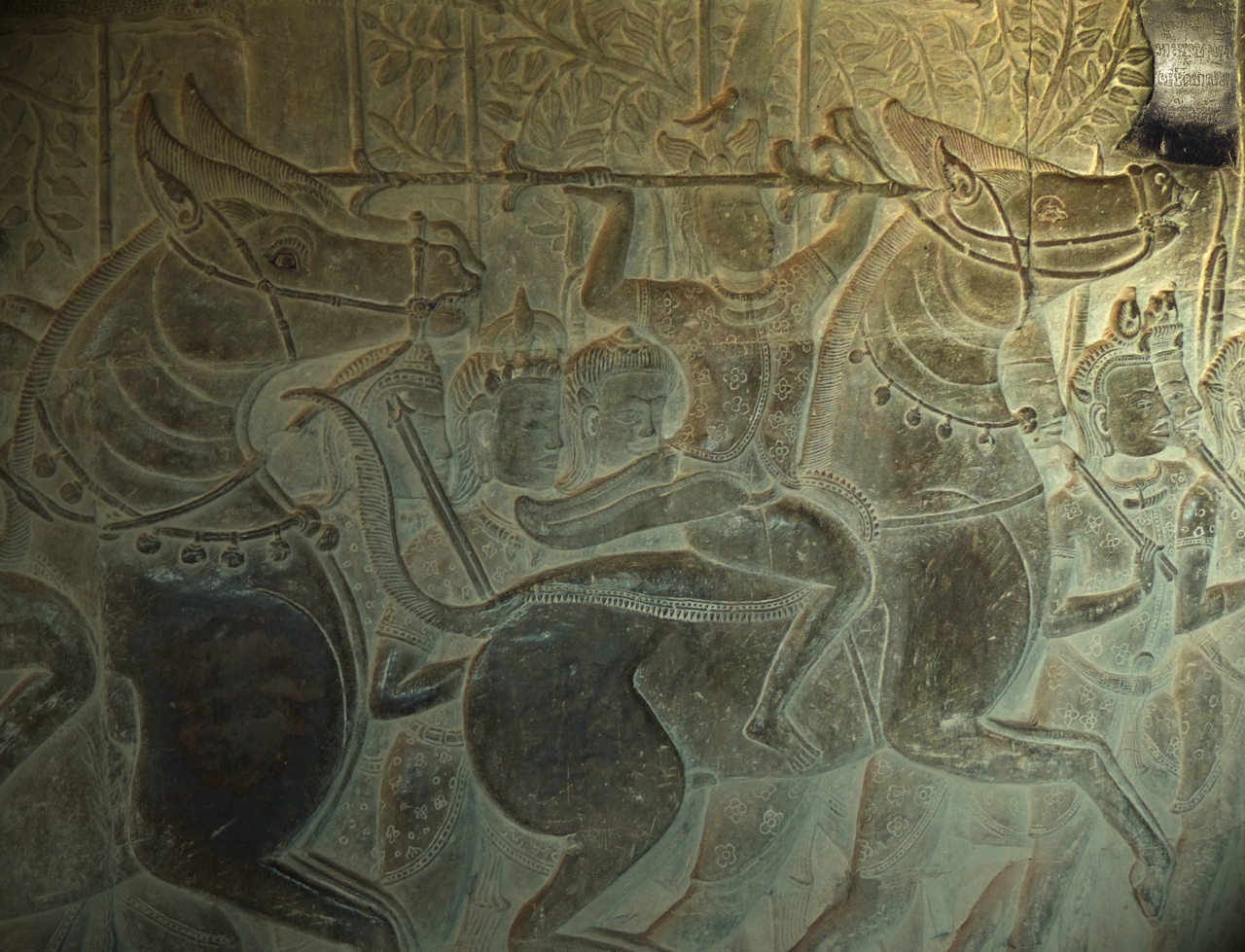
"Syam" (Syam Kuk) soldiers on a relief in the gallery of Angkor Wat. Most scholars read them as forerunners of the later Tai; some think the meaning is uncertain. Source: Wikimedia Commons, CC BY 4.0

5. The script
How did the Thai script come about?
The traditional account: in 1283 King Ram Khamhaeng of Sukhothai created the Thai script. There is a stele dated 1292, kept in the National Museum in Bangkok, the earliest "complete" text in Thai.
This stele has been argued over for decades. In 1987 the American scholar Vickery published an article asking whether it was "the Piltdown skull of Southeast Asian history" (the Piltdown skull being a famous forgery in the history of science); later an art historian held that King Mongkut (Rama IV) had forged it; in 1990 an electron-microscope analysis said its age matched four other Sukhothai steles; the argument has no settlement to this day. There is also a stele at Wat Bang Sanuk in Phrae, and some think the Thai script could go back to 1219.
What is interesting is that, whichever dynasty the stele belongs to, both schools accept that this script was adapted from a cursive form of Old Khmer. In adapting, some letters were simplified, new ones added, and tone marks added.
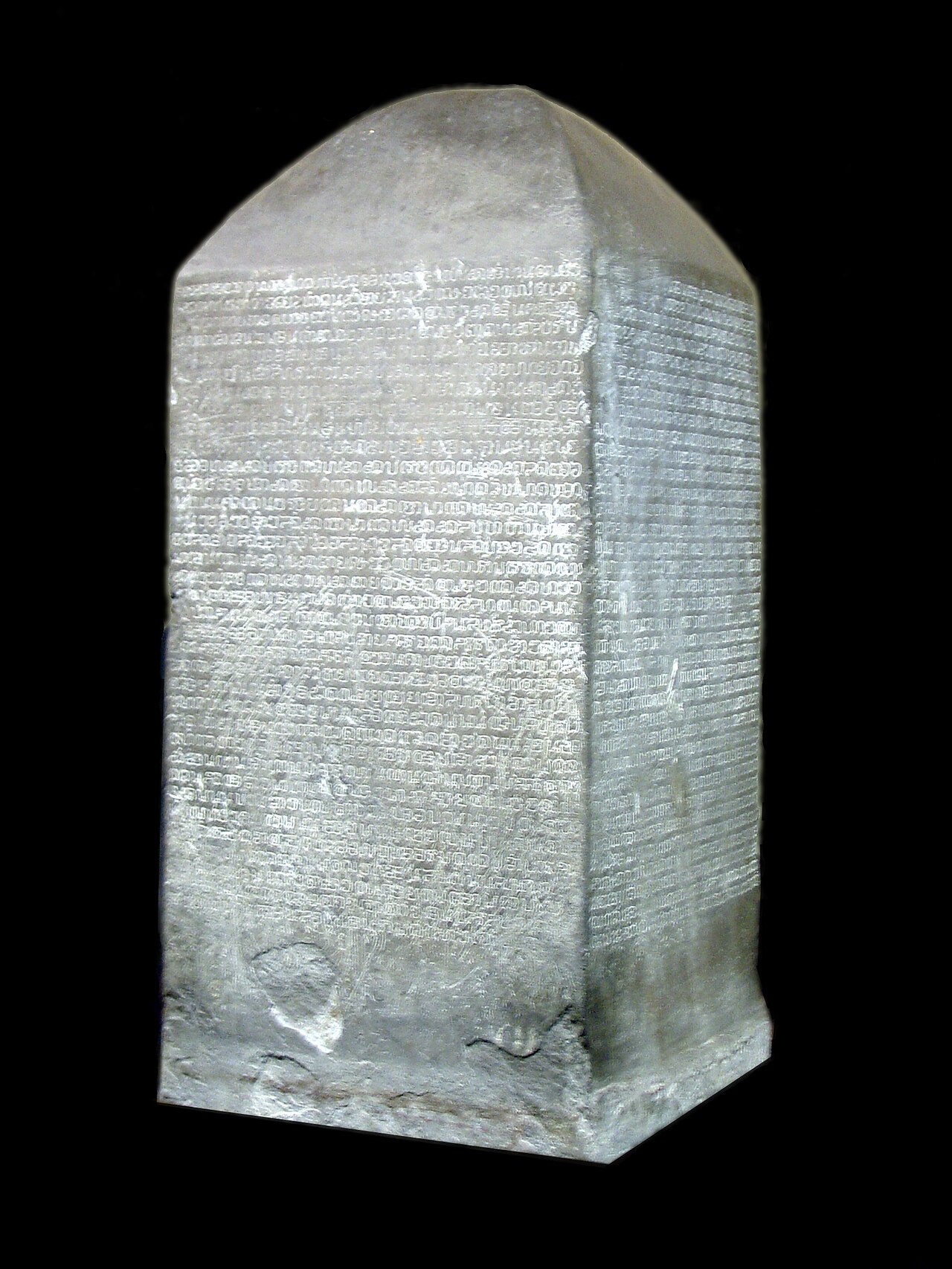
The Ram Khamhaeng stele in the National Museum, Bangkok, bearing the date 1292. Scholars still dispute whether it is a thirteenth-century object. Source: Wikimedia Commons, Michael Gunther, CC BY-SA 4.0

Think of the scene: a group of people who spoke their own language, settled in someone else's place, saw someone else's script, found it beautiful, and wanted to use it to write down their own speech. They did not copy it; they changed it, and added marks, because their speech had tones.
6. The Buddha, and the king
How did Buddhism come?
In the thirteenth century the king of Sukhothai invited a group of monks. They came from Nakhon Si Thammarat in the south of the peninsula, belonging to a lineage called Lankavamsa, "the Ceylon line", which was Theravada. The king gave the leading elder the title of supreme patriarch. Among later Sukhothai kings was Lithai, who read more than thirty Pali scriptures and treatises and wrote the Traibhumikatha ("Three Worlds"), spoken of as the first "scholarly" work in Thai history.
Note: this line runs from Ceylon, through the peninsula, to Sukhothai. It did not come from Angkor. Angkor at that time was mainly Hindu and Mahayana, and turned to Theravada only later.
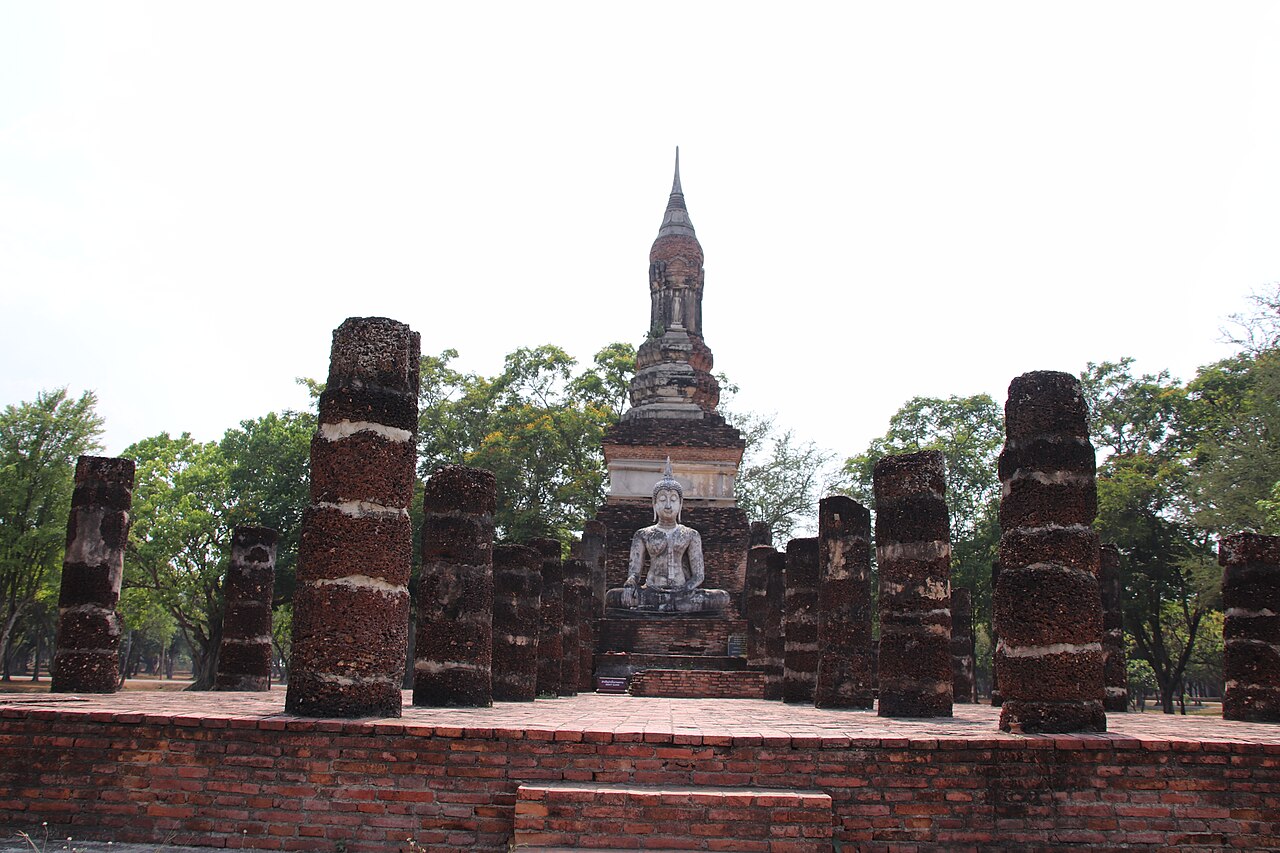
Wat Mahathat in Sukhothai, the largest temple in the old city. In the second half of the thirteenth century Sukhothai received a Theravada sangha of the Ceylon line. Source: Wikimedia Commons, Gary Todd, Public domain

And the king? After Ayutthaya rose it took Angkor three times: 1369, 1388 or 1389, and 1431. One account says that Ayutthaya brought back a group of Khmer court talents. From the Khmer the kings of Ayutthaya learned court ritual, the idea that "the king is a god", and perhaps also court dance. A study from Chulalongkorn University, comparing royal language, finds that the royal vocabulary of Sukhothai and early Ayutthaya was influenced in form and word-building by the royal vocabulary of Angkor-period Khmer.
So the script came from the Khmer, the Buddha from Ceylon, the court learned from Angkor, and of Chinese characters, the Four Books, Chinese Buddhism and the examinations there was not one. That is the gist of what that person said, and it is right. What needs changing is the Buddhism.
7. But the Chinese were always there
If the story stopped here, you would get a conclusion: Thailand and China have no connection.
But that is not so.
In 1371 an envoy from Ayutthaya came with an envoy of the Ming to Nanjing, bringing trained elephants, a six-legged turtle and some local products. This was the first tribute mission; one account says that from 1369 to 1439 Ayutthaya sent 68 missions in all, more than any other tributary state. The figure comes from an article by Lockard (2010); I did not check it against the Ming Shilu.
Tribute was politics, and also business, and people came along on the ships. In 1767 Ayutthaya was destroyed by Burma, and the following year Taksin of Thonburi set Siam up again; his father was a Teochew man. All this was told in the piece on the assimilation of the Chinese of Thailand.
Surnames. In 1913 King Rama VI ordered that everyone should have a surname. Many Chinese families changed theirs into a Thai shape. Thaksin's family took the surname Shinawatra in 1938, its first syllable "Shin" coming from "Qiu"; in the surname of Banharn (Banharn Silpa-archa), archa means "horse" in Thai, said to translate his Han surname "Ma" into Sanskrit. (From Wikipedia and Thai-language sources.)
Festivals. Qingming, the Spring Festival and the Mid-Autumn Festival have always been kept in Bangkok and Phuket. Phuket's Nine Emperor Gods festival, which the Hokkien call "the birthday of the Nine Emperor Gods", falls in the ninth lunar month, with nine days of vegetarian eating. Legend has it that an opera troupe from Fujian caught malaria in the mining district and, remembering that they had not worshipped the Nine Emperor Gods, fasted and prayed; they recovered and have held it every year since. The date in the legend is "about two hundred years ago". The date in the legend is usually put around 1825, by oral tradition with no documents; some say the sickness was cholera, others malaria.
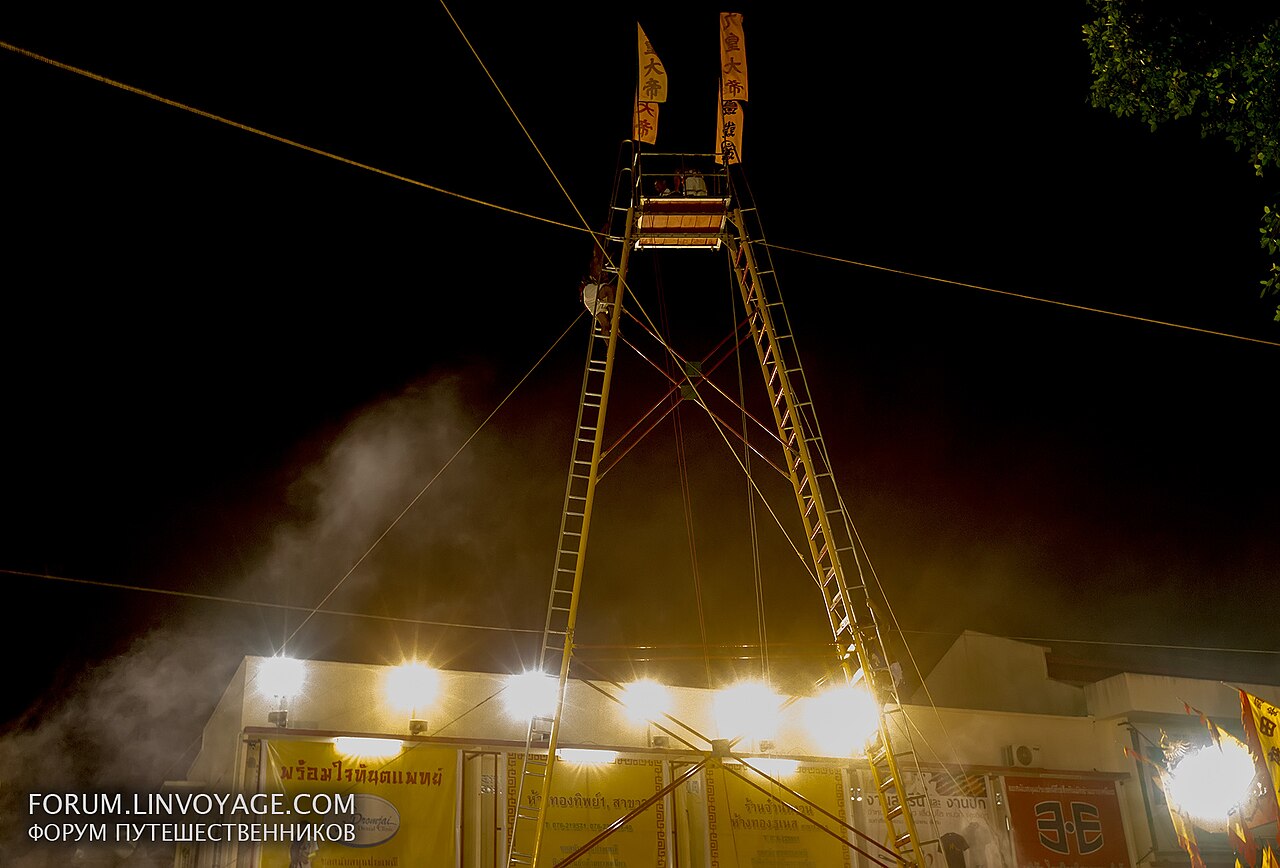
The streets at night during Phuket's Nine Emperor Gods festival (the Vegetarian Festival). A festival brought by the Hokkien and Teochew, said to have been kept in southern Thailand for about two hundred years. Source: Wikimedia Commons, Phuket@photographer.net, CC BY 2.0

And the numbers. The Chinese in Thailand are estimated at 10% to 14% of the population: a report of 2018 by a minority-rights organisation says about 10% to 12%, six to seven million; an estimate of 2012 says 11% to 14%, about 9.5 million. Among them the Teochew are the largest branch. But in the 2000 census, only some hundred thousand people still spoke Chinese at home; the figure is quoted differently in different places and I did not find the original table, and it measures language, not people.
Put these two numbers side by side and you understand: they have not disappeared, they just no longer speak the language. Their "China" is not in the mouth; it is in the festivals, in the household shrine, and in the first syllable of a surname.
8. A picture
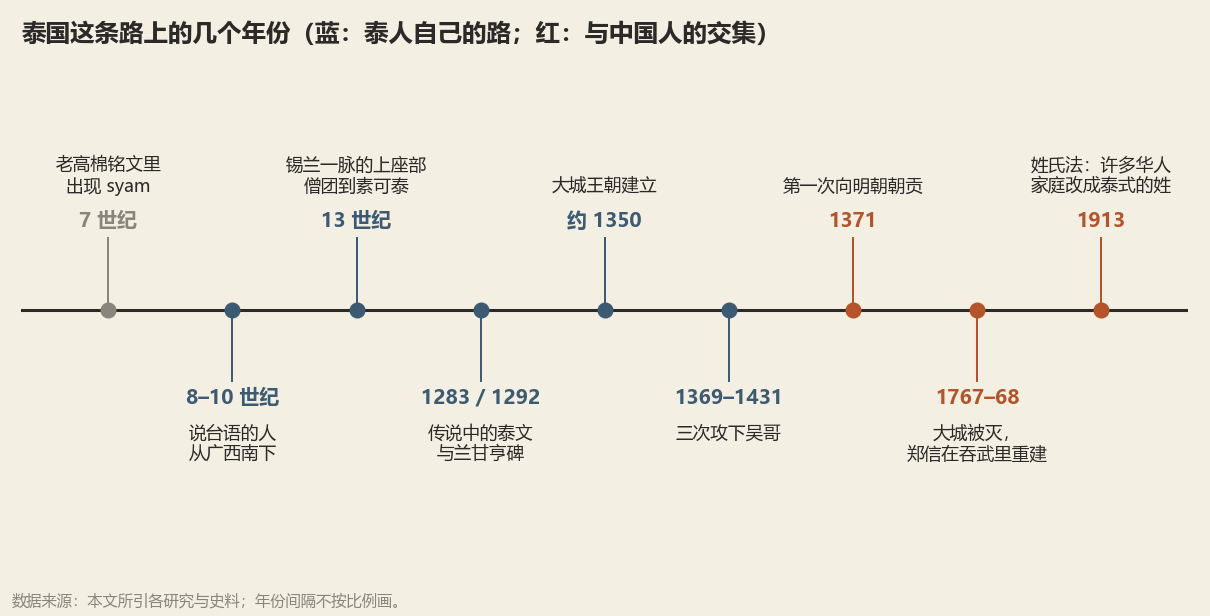
Set these years side by side:
The language took shape in Guangxi; the people went south between the eighth and tenth centuries; the script was adapted on the base of Khmer; the Buddha came from Ceylon in the thirteenth century; the court learned from Angkor in the fourteenth; and the Chinese, from 1371 on, have always been present.
So it is right to say that Thailand has not become a "country of the Chinese cultural sphere"; but its road has never left the Chinese. It walked another road, and the Han and the Chinese have always walked beside it.
9. What I think now
I have written many pieces asking the same question: what keeps East Asians together. In this Thai piece there is one place where I stopped for a long time.
Thailand has a very strong core of cohesion: a king, a kind of Buddhism, a script of its own. It is not Chinese characters and not Confucianism, yet it has taken in a community of several million descendants of the Han, about a tenth of the population. These people were not driven out, and did not become a separate "people"; they are Thais, and not a few of them, on Qingming, still go to sweep their ancestors' graves.
I used to think that if the Chinese were to have a core of cohesion, it would probably have to be bound up with Chinese characters. Thailand made me think it over again. What I think now is that the script may not need to be one set, but the days can be one set. Qingming, the Spring Festival, the Mid-Autumn Festival, the fasting in Phuket: people who do not write Chinese characters keep them too. The "shared cultural faith" I want may not require everyone to write it in the same script. I am not sure, which is why I call it "what I think now".
Looking at it the other way
The hardest counter-arguments are three.
First, the very word "sphere" is a view from outside. The Thais themselves do not necessarily feel that they "have not got in". A country whose script it made itself, whose Buddha it chose itself, whose court is its own: why should it become a member of someone else's "sphere"? To a Thai, this question may be strange.
Second, tribute is not culture. The missions from 1371 (one account says 68) were rites and business between states, not the arrival of script and scriptures. They are in this piece to show that "this country has always been in contact with the Chinese", not to say "so Thailand was influenced by Chinese culture"; that is another matter.
Third, the festivals and surnames I cite were brought in by the Chinese community and do not necessarily belong to the Thais. Phuket's Nine Emperor Gods festival is a festival of the Hokkien and Teochew; whether a Thai Buddhist takes part is another matter. "Thailand has Qingming" and "Thais keep Qingming" are not the same sentence.
To my Thai friends, and to friends whose forebears were Teochew and who now speak Thai.
I want to say thank you first. You have kept a very large country with your own script, your own Buddha, your own king, and not been swallowed by anyone's script. Reading the story of your ancestors adding tone marks to someone else's script, I felt it was a very gentle and very decided way of doing things.
To those among you whose ancestors came from Teochew, Hokkien, Hakka, Hainan: I do not want to ask why you do not speak Chinese. I want to ask another thing: on Qingming, where do you go? Does your child know why you go that day?
A country whose script is its own, whose Buddha is its own, whose king is its own; a family whose ancestors' graves are in another country. Can these two things sit together quietly in one person?
References
Ratings: 🟢 primary source or academic publisher's page; 🟡 secondary (encyclopaedia, media, lecture abstracts); unchecked items marked separately.
- Origins of the Tai: F. Mote, "Problems of Thai Pre-history", 1964 (🟡, academic paper at second hand); W. Gedney, "Linguistic Diversity Among Tai Dialects in Southern Kwangsi", 1966 (🟡); P. Pittayaporn, "Layers of Chinese Loanwords in Proto-Southwestern Tai as Evidence for the Dating of the Spread of Southwestern Tai", Manusya, 2014 (🟢, catalogue record; full text not obtained, the 8th–10th century dating is from the abstract).
- Lavo, Syam, Siam: the history of Lavo (🟡, Wikipedia and its mirrors, contradicting one another in many places; only "early Mon-dominated, Khmer from the 10th century, separate from the end of the 13th century" is taken); Xian and Luohu as two polities in Chinese sources, later called "Xianluohu" together (🟡, National University of Singapore Southeast Asia database); syam in 7th-century Old Khmer inscriptions and the "Syam Kuk" relief (🟡, abstract of Ferlus 2007, a Southeast Asian archaeology site; Ferlus in full not obtained).
- Script: the Sukhothai script from a cursive form of Old Khmer, the traditional dates of 1283 and 1292 (🟡, Wikipedia); the dispute over the Ram Khamhaeng stele: Vickery 1987, Piriya 1988, the 1990 electron-microscope analysis, Chamberlain 1991 collected volume (🟡, via Wikipedia; Vickery's article in JSS vol. 83, catalogue record 🟢, full text not read); the Wat Bang Sanuk stele (C.107) (🟡).
- Buddhism: the Lankavamsa line and Sukhothai (🟡, abstracts from Thai academic journals and a Buddhist library); Lithai's Traibhumikatha (🟡).
- Court: Ayutthaya's three attacks on Angkor (1369, 1388/9, 1431, 🟡, catalogue record of a paper by Briggs, Wikipedia); the idea of the "god-king", court ritual, royal vocabulary (🟡, abstract of a Chulalongkorn University paper).
- With China: Ayutthaya's tribute to the Ming in 1371 (🟡, abstract of a Siam Society lecture; catalogue record of a paper by Ishii Yoneo); about 68 times (🟡, Lockard 2010, via the encyclopaedia).
- The Chinese: the Chinese in Thailand 10–12% (🟡, 2018 report of a minority-rights organisation); 11–14%, 2012 (🟡); the 2000 census 231,350 (🟡, Wikipedia); the surname law of 1913 and the Chinese origin of surnames (🟡, Wikipedia); the celebration of Qingming, the Spring Festival and Mid-Autumn in Bangkok and Phuket (🟡, Wikipedia); the Phuket Nine Emperor Gods festival (🟡, a Thai foundation, travel sites, mostly legend).
- The two answers from people online: material someone forwarded, treated only as a lead; the factual claims in them were checked one by one.
- For comparison: in this series, "The Most Successful Assimilation" (Thailand), "One Language Family, Each with Its Own Heaven" (Thai, Lao and Zhuang, Dai, Miao), "Temples, Native-Place Halls, Chambers of Commerce", "One Hand of Cards, Six Ways to Play It".
- Image sources are given in each caption