
First, why I'm curious
My interest in India has ordinary reasons, three of them.
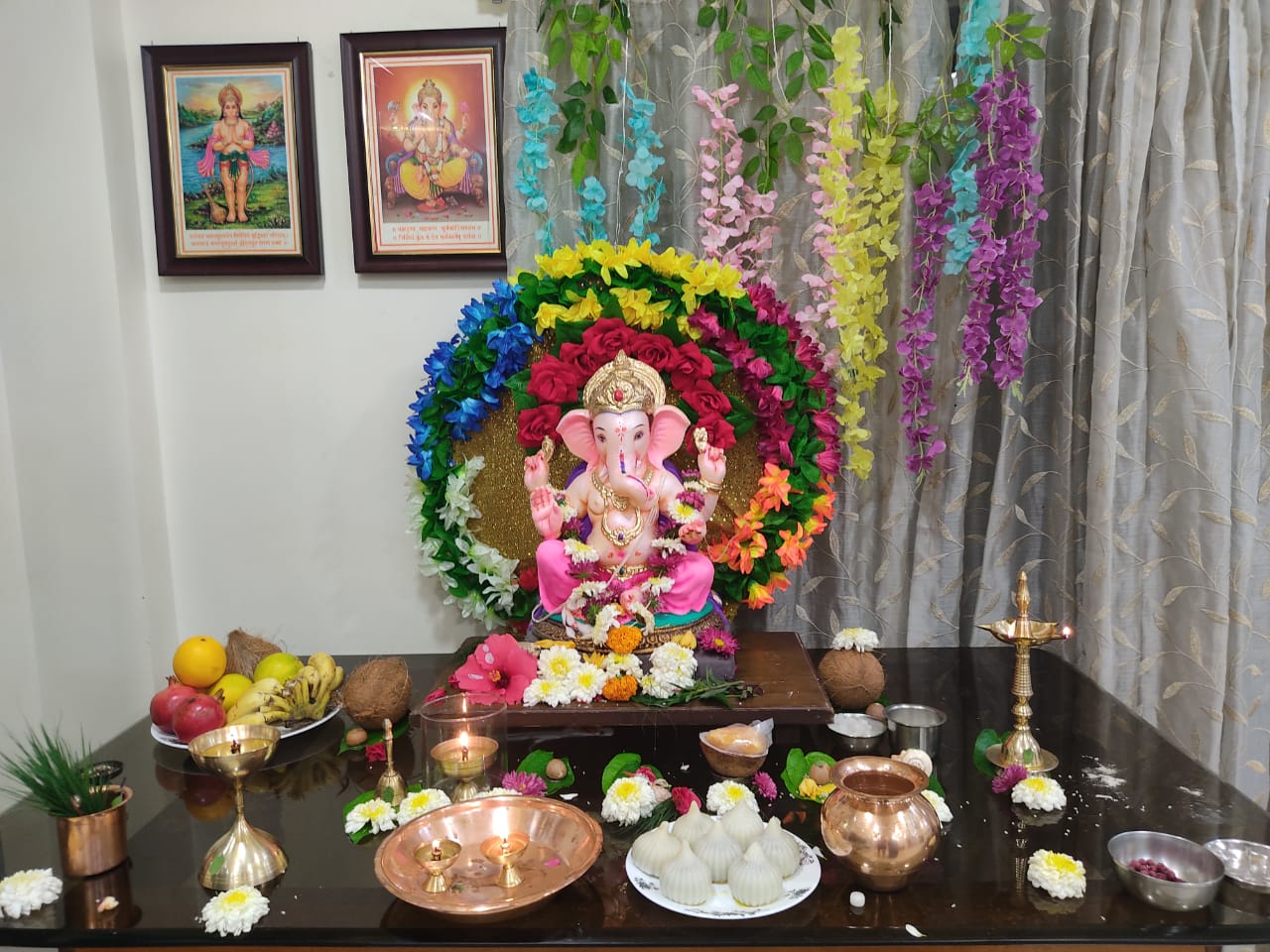
A household's Ganesh during Ganesh Chaturthi, 2021. Hinduism has no unified church; festivals, home shrines and temples hold more than a billion people together. Source: Wikimedia Commons, TheMacGuy2005, CC BY-SA 4.0

The first is people. In April 2023, the UN Population Fund's State of World Population estimated India's population at about 1.429 billion and China's at about 1.426 billion: India had overtaken China and become the most populous country. The UN itself says it can't pin down which day: India's last census was in 2011, and the next has kept being postponed. But the direction isn't in dispute; since the UN began counting in 1950, this is the first time India has ranked first.
The second is talent. You can rattle off a list of names: Nadella at Microsoft, Pichai at Google and Alphabet, Narayen at Adobe, Krishna at IBM, Banga at the World Bank. In politics too: Sunak was British prime minister (October 2022 to July 2024), and Varadkar was Taoiseach of Ireland. Almost all are of Indian origin, and quite a few grew up in India and finished university there before leaving.
Many people's impression of these executives is that they're good at slides and good at talking. But a young engineer I know isn't like that: he grew up in Singapore, from a Brahmin family, and his work is reliable. He's also vegetarian, and I have never worked out how he copes with heavy code development plus debugging of product hardware, work that is draining on both mind and body. Of course one person proves nothing. It just made me want to find out: how big is the gap between the impression and the reality?
As for why this happens, I don't want to answer "Indians are naturally smart"; that's the lazy answer, and wrong too. A later piece covers it in detail: the channels of study abroad and visas, big-company hiring, English, and who didn't make it into that channel.
The third is Hinduism. A Pew Research Center report of June 2025 says that Hindus worldwide number nearly 1.2 billion, about 14.9% of the world's population, with about 95% of them living in India. By headcount it is the fourth-largest religious category, behind Christianity, Islam and the religiously unaffiliated.
What I find remarkable is its shape. It has no commonly acknowledged founder, no single scripture, no unified church to manage everyone. And yet it has held nearly twelve hundred million people inside one name, for a very long time. A religion that can live like this without a centre: I've always wanted to know how it does it.
There's another reason, tied to my own thinking. In The Neighbours' Heaven I said my leaning is that the future of East Asia may depend on Confucianism becoming a religion. But East Asian religiosity is the "diffused" kind that C. K. Yang described: spread through the family, the clan and festivals, with no church of its own, so when urbanisation scatters families, it scatters with them. On this point Hinduism looks a lot like it: no unified church either. But it didn't scatter. Is it the temples, the festivals, caste, or something else that holds people together? And what price does it pay? Caste can't be avoided.
So for me Hinduism is a point of comparison. I'm not going to learn by copying it; I want to set it beside the East Asian case and see where they're alike and where they differ.
In my Duoshe series, I wrote about how old caste is, why Buddhism disappeared from India, and why Jainism shrinks as it gets wealthier, all starting from India. As I wrote, I found the India material never ran out, and decided to open a series of its own.
This series isn't here to praise India
Curiosity is not worship.
India's other side is just as plain: poor, crowded, caste still alive, women's lives hard, infrastructure always a half-beat behind. I'll write all of that, and no less than the flattering parts.
This series leans toward the present and the future. History, religion and caste are all there to answer one question: why is India the way it is today, and where might it go next.
Roughly, these blocks:
- Money and growth: can India's gods solve India's poverty; why it didn't become the next China; is the IT story brilliance or a bubble; why is it so hard to build a factory;
- Society: is caste dead or not; why is it so hard to be a woman in India; generic drugs; and the question of sexual violence in India, illusion or reality;
- State and politics: is India a country; how Hindu nationalism rose; the seven states of the Northeast; Sikhs; the defence industry;
- Daily life: films, English, railways, food, Ganges water, Mumbai's slums and the mansions beside them;
- The last piece: the Indian century, or the Indian illusion.
Twenty-three pieces in all, in this order for now.
Why "Slow Train"
India's railway is huge: at one end they're building high-speed rail, at the other the unreserved cars are packed with people. It isn't fast, but it keeps running.
I think the country is a bit like its railway, running at several speeds at once. What this series wants to see is who is on this train, where it's going, and whether it will speed up. One piece is devoted to the railway, and I'll go into detail there.
A few rules
- Every number comes with a source. India's statistics are often contested; where the sources differ, I'll put the different versions side by side.
- No "blood" or "nature" to explain any group, and no grading of a living religion as a whole.
- Every piece has a section called "Looking the Other Way," the strongest argument against me.
- I'm a writer in Chinese, looking at India from the outside, and there are things I can't see. If you have lived or worked in India, please tell me where I've got it wrong or slanted.
One question
Where did your first impression of India come from? A film, a colleague, a news story, a trip?
Was that impression ever changed?
References
- UNFPA, State of World Population 2023 (published 19 April 2023; India about 1.4286 billion, China about 1.4257 billion; the UN notes the data are uncertain); Al Jazeera report of the same day, "India to have 2.9 million more people than China by mid-2023: UN"
- Pew Research Center, How the Global Religious Landscape Changed From 2010 to 2020, June 2025 (Hindus nearly 1.2 billion, 14.9% of the world's population, about 95% in India, the fourth-largest religious category)
- UK prime-ministerial term (25 October 2022 – 5 July 2024), Irish Taoiseach terms (June 2017 – June 2020, December 2022 – April 2024): Wikipedia, "List of heads of state and government of Indian origin"
- C. K. Yang, Religion in Chinese Society, 1961 ("diffused religion"); for my own leaning see the preface of The Neighbours' Heaven
- Official leadership pages of the companies and the World Bank (Nadella, Pichai, Narayen, Krishna, Banga, still in post in 2026)