
First, two sets of numbers
In late 2019 and early 2020, the Pew Research Center ran a major survey in India: nearly thirty thousand people interviewed in person, in 17 languages. The result: 97% said they believe in God, and 84% said religion is very important in their lives.
For opinion polls, that degree of agreement is already a wonder.
Now another set. By the estimates of the International Monetary Fund and other institutions, India's GDP per head in 2024 was between 2,500 and 2,700 US dollars (the sources differ slightly), and in 2025 about 2,800 (the IMF's October 2025 figure is 2,818). At the same time, China's was over 13,000.
Put the two side by side, and a thought comes easily: such a devout country, so poor? Do the gods not work?
There are two common answers: one says "it's the gods that held it back"; the other says "the gods are the poor's last comfort." Both have something to them, and both are only half.
The first answer: religion held it back
One of the earliest sources of this view is the German sociologist Max Weber. In the early twentieth century he studied the religions of India (The Religion of India, published 1916 to 1917). The gist: karma, rebirth and caste make people content with their place and don't encourage breaking the order and climbing, so India didn't grow what Weber had in mind as the "spirit of capitalism." That is the crudest summary; Weber's own words are far more complex, and many have argued against him since.
There is a popular version of this view with a famous name, "the Hindu rate of growth."
The phrase was coined in 1978 by the Indian economist Raj Krishna. It refers to the long period from independence to the 1980s when economic growth hovered around 3.5% (some sources put it closer to 4%). Population then grew a little over 2% a year, and GDP per head only about 1%, painfully slow.
From the name it sounds as if Hinduism slowed the economy. But Krishna's own explanation was that the state controlled too much: import substitution, layers of approvals, a licence needed for everything. This system had a nickname, the "Licence Raj." To open a factory, you first had to collect a full set of permits, and by the time you had them the factory had probably changed industries.
So "Hindu" in that phrase is only a label, and the cause has little to do with the gods.
A very useful comparison
The most convincing counter-example is in India itself.
In 1991, India hit a balance-of-payments crisis. Foreign-exchange reserves were nearly gone, enough for only a few weeks of imports, and it was about to be unable to pay for oil and grain.
That year, India used gold to buy its life. In May, the government first handed 20 tonnes of confiscated gold to Union Bank of Switzerland, nominally a sale with an agreement to buy it back later, for about 200 million dollars. In July, the newly installed Rao government pledged another 46.91 tonnes of gold to the Bank of England and the Bank of Japan, for about 405 million dollars; they did not accept paper receipts, and the gold was physically flown to London in several consignments. (Sources differ on details: some merge the two operations into "47 tonnes," and some say the previous government started it.) An ancient civilization having to load the bars from its treasury onto planes to get a loan was, in India at the time, a deep humiliation. More than thirty years later, in 2024, the Reserve Bank of India brought 100 tonnes of gold home from vaults in Britain, and the press wrote about it with considerable pride.
The crisis forced reform: loosen the licences, cut tariffs, open to foreign capital. Then growth took off. By India's statistics office, GDP growth in fiscal 2025–26 (April 2025 to March 2026) was 7.7% (provisional estimate; the earlier estimate was 7.6%).
From 3.5% in the 1970s to around 7% now, did Indians swap their gods in between? No. The temples are the same temples, the gods the same gods. What changed was the number of licences.
If "believing in God" were really the cause of poverty, there should have been no change before and after; but the numbers changed. So at least we can say that believing or not doesn't decide whether a country is poor. When policy changes, results change.
Now look at poverty. In June 2025 the World Bank moved the international extreme-poverty line to 3 dollars a day (at 2021 purchasing power parity). By this new standard, India's extreme-poverty rate fell from 27.1% in 2011–12 to 5.3% in 2022–23, and the number of people from 340 million to about 75 million. (The country brief from April used the old line, with numbers of 16.2% falling to 2.3%, so when you cite it, check which line is being used.) In a decade or so, most of the extreme poor were gone.
And in those ten years, Indians did not become less religious.
The second answer: God as the last comfort
Then the other way round: could God "solve" poverty?
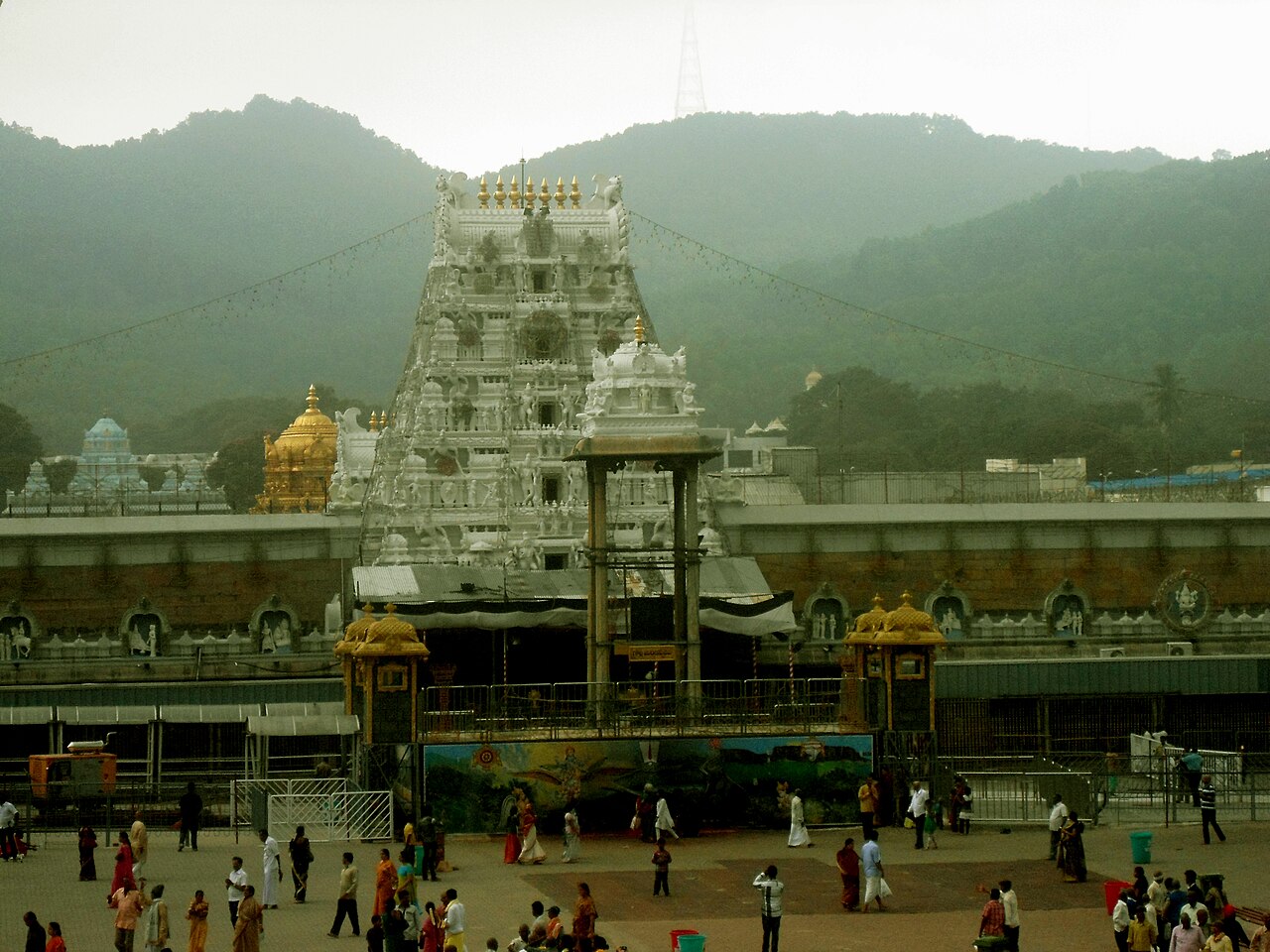
The Venkateswara temple at Tirumala, Andhra Pradesh, visited by about 25 million people a year; its managing body's annual budget is 5,258 crore rupees. Source: Wikimedia Commons, Adityamadhav83, CC BY-SA 3.0

If "solve" means: you fall ill, go to the temple to pray, and get better, that is very hard to verify. But from another angle, temples really do solve some very concrete problems.
First, money. In India a temple is a real industry. The Tirumala–Tirupati temple in Andhra Pradesh gets about 25 million visitors a year; the body that runs it (TTD) had a board-approved budget for 2025–26 of 5,258.68 crore rupees (about 52.6 billion rupees), employs thousands of staff, and runs its own hospitals, schools and guest houses. That's less like a temple and more like a small conglomerate with an idol.
In Ayodhya in Uttar Pradesh, after the Ram temple opened in January 2024, according to the state tourism department, about 164.4 million visits were recorded in the whole of 2024, against about 6 million in 2020. These are official figures; I haven't seen how "visits" were counted, so don't take them as rigorous statistics.
Some commentaries online cite National Sample Survey data to say India's "temple economy" is worth 3 trillion rupees a year. I couldn't find the original survey, so I don't use that number. Whatever the exact figure, the livelihoods of a whole ring of people, flower sellers, offering makers, homestay owners, barbers, really do hang on the temple.
Then, protection. Where social insurance is thin, religious organisations often play several roles: funerals, weddings, free meals, relief, job introductions. The Sikh "langar," the community kitchen that feeds everyone who comes, every day, is the best-known example. For many poor people, that's far more real than "God bless you."
So "God can solve poverty" splits into two meanings:
- Can God make a country rich? It seems not; at least the before-and-after comparison around 1991 doesn't support it.
- Can God's organisations help specific poor people? Yes, and sometimes quite a lot.
There is a pattern, but don't misuse it
In cross-country comparison there is a rather common pattern: the richer the country, the less devout the people. India sits at "high devotion, low income," in line with the pattern. (The political scientists Pippa Norris and Ronald Inglehart discussed this systematically in Sacred and Secular in 2004; their argument is that the less secure the conditions of life, the more people need religion.)
But correlation is not causation. "More devout because poorer" and "poorer because more devout" use the same curve with opposite directions. Researchers lean towards the former: the more uncertain the days, the more people need something to rely on. That is also why, in India, those with no medical cover and no stable income depend on the temple all the more.
The same gods, different wealth
There's an even more direct comparison inside India.
Hindus are the majority of India's population, yet the states differ greatly in wealth. By the Multidimensional Poverty Index published in 2023 by NITI Aayog, the government's think tank, the poverty rate in northern Bihar is about a third, while in southern Kerala it is under 1% (NFHS-5, 2019–2021: Bihar 33.76%, Kerala 0.55%).
The same mythology, the same festivals, and yet a gap bigger than between many countries. What explains the difference looks more like education, public health, land systems and the capacity of state governments; it's hard to credit the gods, and not easy to blame them either.
My view
I accept this piece's conclusion: the gods don't decide rich or poor; what does is licences, schools and state governments. But my curiosity about India's gods has always been of another kind.
The four religions that grew out of the subcontinent, Hinduism, Buddhism, Jainism and Sikhism, are grand, subtle and deep, and I sincerely admire them. Set beside the monotheisms that grew out of the desert, I'll say it honestly: in building social ethics, fixing contracts and mobilising on a large scale, the desert line has been more efficient, and the base of today's international order and law was mostly laid by them. But I increasingly feel that humanity, going forward, may rely more on the Indian line: not exclusive, able to hold many gods, and also able to hold those who believe in none.
What strikes me most about Hinduism is exactly this: no church, no single scripture, and still more than a billion people held inside one name, not scattered when they were poor, and not scattered once they got richer. What East Asia lacks is something like that, which doesn't rely on a state to prop it up and can live on its own. Did it make India rich? No. But what holds a people together is, in the first place, not a question GDP can answer.
Looking the other way
"The gods have nothing to do with poverty" may also be said too firmly.
Some scholars think religious ideas really do influence saving, marriage, fertility and attitudes to risk, and through them a society's economic behaviour; it's just that the effect is smaller than policy and slower than institutions, and hard to separate from other factors. The limits caste puts on occupational mobility, for instance, are bound up with religious ideas (the piece "Is Caste Dead or Not" will deal with it).
Another doubt: using the 1991 reform as the proof that "the gods don't matter" is also a bit too neat. In those thirty years, India's urbanisation, education and demographic structure were all changing, and the face of religion was changing too, for example with more emphasis on ritual and a more political colour. We can't say religion "changed nothing" in those thirty years.
If a person, in a place with no protection at all, can only hand his sense of safety to God, is "believing" the result of his poverty, or the reason he can't get out of it?
References
- Pew Research Center, Religion in India: Tolerance and Segregation, June 2021 (29,999 people, 17 languages)
- World Bank, June 2025 poverty data update ($3 a day, 2021 PPP; extreme poverty 27.1% → 5.3%; 340 million → 75 million); and the April 2025 Poverty & Equity Brief: India (old $2.15 line, 16.2% → 2.3%)
- IMF, World Economic Outlook, October 2025 (India GDP per head 2,818 dollars); India's statistics ministry (MoSPI), provisional estimate at the end of May 2026 (FY2025–26 GDP growth 7.7%, second advance estimate 7.6%)
- Business Standard; Wikipedia, "Hindu rate of growth" (Raj Krishna, 1978)
- Tirumala–Tirupati Devasthanams (TTD) 2025–26 budget of 5,258.68 crore; Uttar Pradesh tourism department Ayodhya visitor statistics (164.4 million visits in 2024, as relayed by Outlook Traveller and others)
- Max Weber, The Religion of India, 1916–1917; Pippa Norris & Ronald Inglehart, Sacred and Secular, 2004
- NITI Aayog, National Multidimensional Poverty Index: A Progress Review 2023 (Bihar 33.76%, Kerala 0.55%)
- The 1991 gold pledge: Wikipedia, "1991 Indian economic crisis"; retrospectives in BullionVault, inkl and others (20 tonnes to UBS, 46.91 tonnes pledged to the Bank of England and Bank of Japan, about 405 million dollars; details differ between sources) 🟡; the RBI's repatriation of 100 tonnes of gold from Britain in 2024 (DT Next, The News Minute) 🟡