
A car that was never built
In 2006 the Tata group wanted to build a factory at Singur in West Bengal to make the "cheapest car in the world," the Nano. The West Bengal government acquired about 997 acres for Tata, under the Land Acquisition Act of 1894 left by the British.
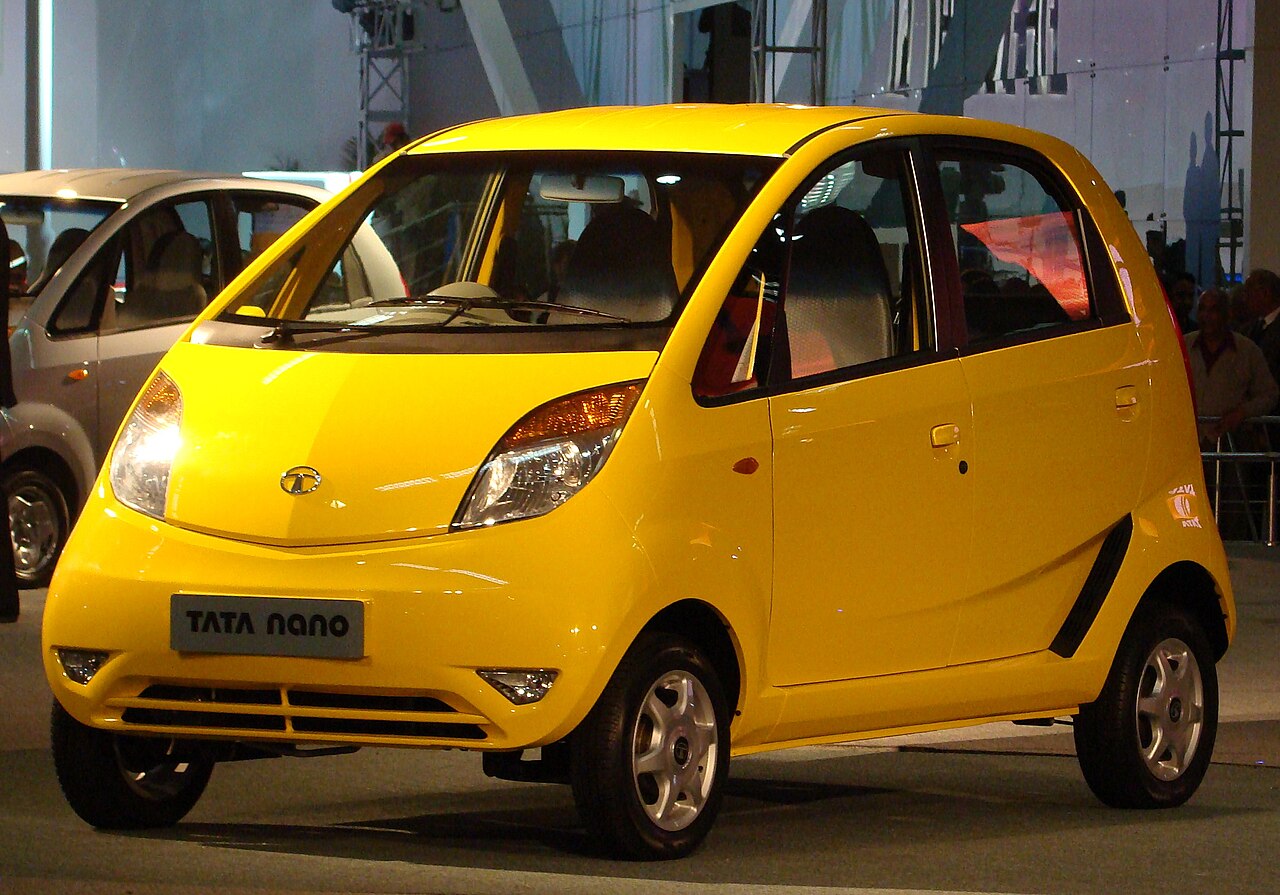
The Tata Nano. It was to be built at Singur in West Bengal, and in 2008 moved to Gujarat because of the land conflict. Source: Wikimedia Commons, the original uploader was Nikkul at English Wikipedia, CC BY-SA 2.0

About 400 of those acres were taken from farmers who did not want to sell. Protests, road blockades and violent clashes followed one after another. On 3 October 2008 Tata announced its withdrawal from Singur, and on 8 October announced that it would move the Nano plant to Sanand in Gujarat.
The consequences were far larger than one factory:
- It is considered an important reason the Left Front ended 34 years in power in the 2011 state election;
- It directly influenced later legislation: in 2013 India passed the Right to Fair Compensation and Transparency in Land Acquisition, Rehabilitation and Resettlement Act, which requires that for land acquired by government for private companies, the consent of 80% of the affected families is needed; for public-private projects, 70%.
Singur had a sequel: on 31 August 2016 the Supreme Court ruled the entire acquisition process of that time illegal and ordered the land returned to the farmers within 12 weeks (farmers who had received compensation did not have to repay).
Since then Indian industry and politicians have remembered this.
First, the land itself
The most notable feature of India's land is that it is fragmented.
According to the national agricultural census of 2015–16:
- The average operational holding is only 1.08 hectares;
- Marginal holdings (under 1 hectare) are about 68.5% of all holdings (operational units), averaging only 0.38 hectares each and together holding only about a quarter of cultivated land;
- Small and marginal holdings (under 2 hectares) together are 86.2% of holdings but have only 47.3% of cultivated land;
- The average area of marginal holdings has hardly changed in forty years.
That is to say, the land of a village is divided into countless narrow strips, each belonging to a different family, and still being divided further by inheritance. This is a system that lowers the area per person continually by having children.
For someone who wants to build a factory, this means: a block of 100 hectares may stand behind several hundred households and several hundred titles. Each person has the right to agree or not. The negotiating table has to be very large, the agenda very long.
One more number shows how "hard" India's land is: the courts. A national survey by the research body DAKSH in 2016 found that about two thirds of the civil cases in district courts relate to land and property. A policy report of the Centre for Policy Research (CPR) cites data that a land-acquisition dispute, from the beginning to the Supreme Court, takes on average twenty years. If for the land a factory needs even one plot's title is unclear, it may lie in court for half a lifetime.
Why farmers do not want to sell
From the farmers' side, not selling has several very practical reasons:
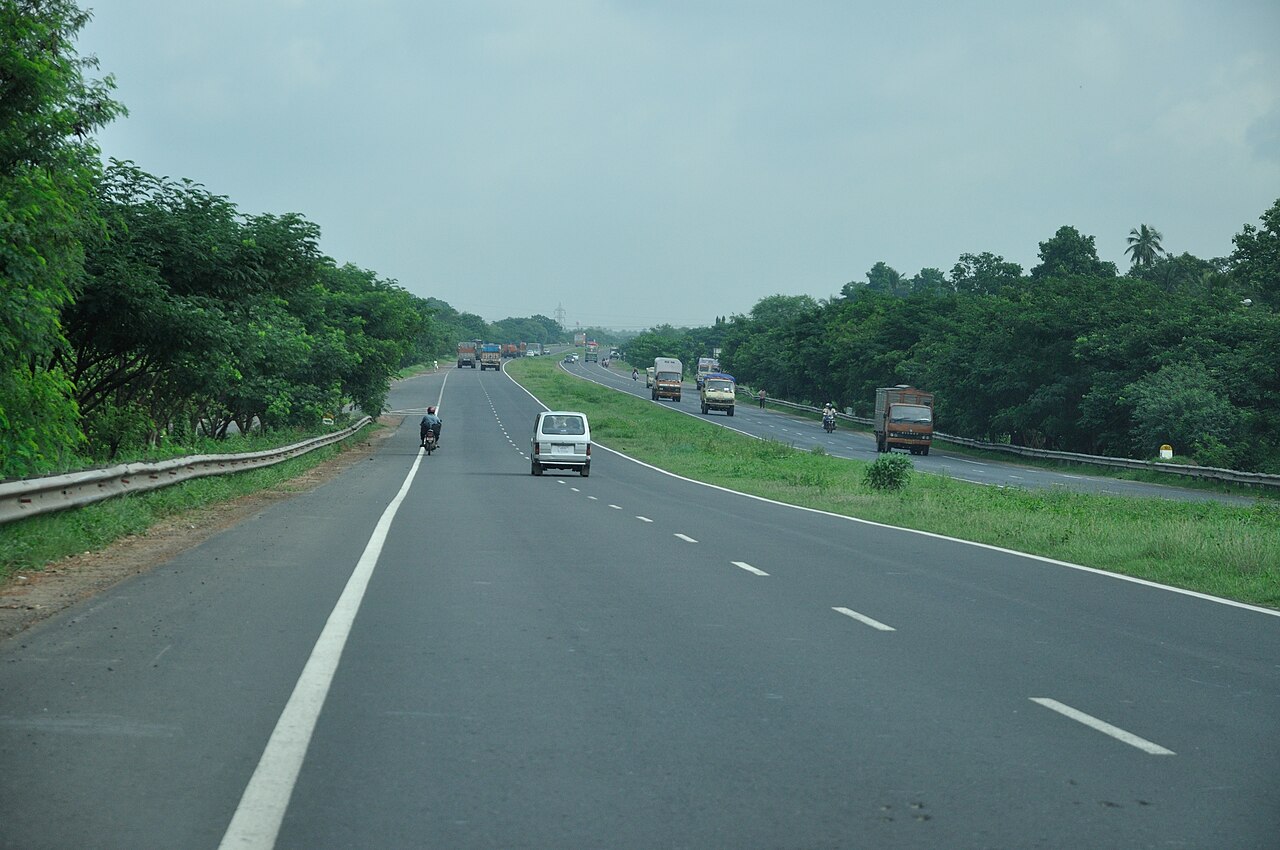
Singur in 2014, with Asian Highway 1 passing through. Source: Wikimedia Commons, Biswarup Ganguly, CC BY 3.0

One, the land is the only security. Rural social security in India is thin; land is the means of production and also pension, insurance and identity. Once sold and the money spent, there is nothing left.
Two, the factory may not give them work. After farmers sell, they may not have the skills the factory asks for when it hires; some projects in the end employed few local people.
Three, the gap between compensation and real value. In some historical projects land was taken cheaply and then resold at high prices to developers, and such things built up a deficit of trust.
Four, unclear title. For most land in India the title record is "presumptive title": the registration record does not fully prove who owns the land, only provides preliminary proof. This makes "selling land" itself complicated and prone to disputes.
Other things that make factories hard to build
Land is only one door.
Labour law. For a long time India's labour law was complicated, with 29 relevant central laws. One provision required government approval for layoffs in a factory with over 100 workers. This made many firms prefer to stay small to avoid crossing that line. Some factory heads' highest goal was to stop at 99.
On 21 November 2025 four new labour codes took effect together, merging these laws, and one change was raising the threshold for government approval of layoffs from 100 to 300. By an estimate from the Annual Survey of Industries data for 2017–18, only about 7% of factories (employing about 16% of workers) remain above the line; that is, about 93% of factories no longer need approval to lay off. Unions and some critics say this weakens workers' rights; supporters say it will make firms more willing to grow and to hire more.
Differences between states. Under the Indian constitution, land is a matter for the states. This means that the speed of approvals a company can enjoy in Gujarat may be completely different from West Bengal.
Infrastructure. Power, water, ports, roads are also problems, but they are beyond this piece, or this piece would never be finished.
But some places succeed
To say "India can build nothing" is not right either.
The Apple example. In 2025 Apple assembled about 55 million iPhones in India, about a quarter of global output; India already has five iPhone factories, three of Tata's and two of Foxconn's. A new Foxconn plant of about 2.6 billion dollars on the outskirts of Bengaluru had begun making models such as the iPhone 17 by the second half of 2025. (See "The Stolen Thirty Years" for details.) These factories are mostly in states like Tamil Nadu and Karnataka, whose method is for the state government to prepare "industrial parks" in advance, packaging land, power and water for the firm in one go (Tamil Nadu's state-owned industrial park developer SIPCOT is one example).
The "land pooling" method. In 2015 Andhra Pradesh, to build its new capital Amaravati, had farmers voluntarily put their land in as "shares"; the government developed it as a whole and then returned a proportion of the developed land to the farmers. By reports, the consent of farmers for 33,000 acres was obtained by March 2015. This was an attempt to bypass compulsory acquisition; the project later went back and forth with changes of government, and I have not checked its progress today.
That is to say, the problem is not "completely impossible" but that it is either slow or needs a state government able to coordinate several hundred households.
A reform that was not completed
One more political memory.
When the Modi government first came to power in 2014, it wanted to amend the 2013 land acquisition law to exempt some projects (defence, rural infrastructure and so on) from the "consent" requirement. It was introduced as an ordinance in December 2014, then failed to pass in both houses of Parliament, and the ordinance lapsed in August 2015.
In September 2020 the government introduced three agricultural reform laws, which farmers (especially in Punjab and Haryana) thought would weaken their protections; they protested around Delhi for more than a year, and in 2021 the government repealed the laws (mentioned in the piece on the forgotten minority).
Both times show that in India, once "reform" touches farmers' land, the political cost is very high.
Turning it around
First, "hard to acquire land" has its legitimacy. Since independence, big dams, mines and industrial zones have made many people lose their land, many of them tribal and poor farmers, with compensation and resettlement often inadequate. This history has made "consent" a protection, not an obstacle.
Second, some hold that the root of the problem is not "needing consent" but "no alternative." If farmers who sell could get a stable job, reasonable compensation and a new place to live, far more would be willing to sell. That is, what is lacking is jobs, not the consent system.
Third, "fast" has risks too. When a country transfers farmers' land to industry by fast methods, plenty goes wrong, for example the Nandigram conflict in West Bengal in 2007, also over acquiring land for a chemical special economic zone: on 14 March 2007 police opened fire and, the official account says, 14 villagers died.
If a country's farmers actually rely on a small plot as "insurance," then before there is something better to protect them, how do you persuade them to give up their land?
References
- India Agriculture Census 2015–16 (average holding 1.08 hectares; marginal holdings 65.45%)
- Right to Fair Compensation and Transparency in Land Acquisition, Rehabilitation and Resettlement Act, 2013
- Reports on Singur and the Tata Nano (Finshots, The Wire, Open magazine)
- India's Ministry of Labour and Employment and media on the four labour codes (in force 21 November 2025) (Deccan Herald, India Briefing, Kotak MF and others); the critics' view (Janata Weekly)
- Counterpoint / Asymco / ETV Bharat / Business Today: iPhone output and exports in India
- DAKSH, Access to Justice Survey, 2016 (relayed by Bar & Bench, 2017); CPR, Policy Challenges 2019–2024, paper on land disputes 🟡