
The answer first
If you are asking "if I scoop up a ladle of Ganges water right now and drink it, is that all right?", the answer is simple: not advisable. There is no river anywhere with a large population living along it that people would advise you to drink from directly, and the Ganges is no exception. Other rivers simply do not have this many people pressing you for an answer.
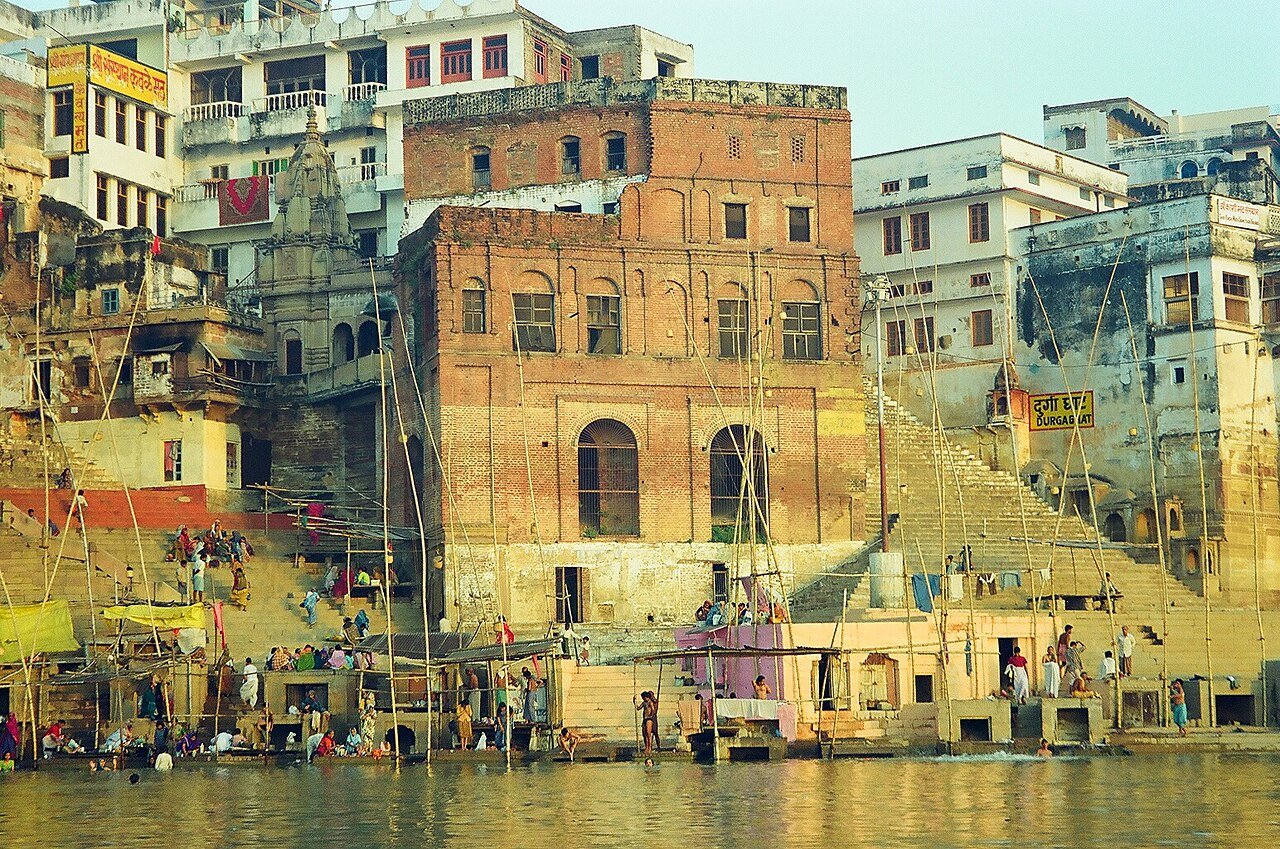
People bathing at the ghats of Varanasi (October 2000). Many know the water is not clean and go in all the same. Source: Wikimedia Commons, Dialog Center Images, CC BY-SA 2.0

But the question is rarely asked this way. The more common version is: can this river called "Mother" be clean again? Is it safe for the believers who go down to bathe in their thousands every year, even take a sip?
For that we need some numbers.
A test during the Maha Kumbh
From January to February 2025 India held the Maha Kumbh at Prayagraj, with officially hundreds of millions of visits to bathe.
On 3 February 2025 the Central Pollution Control Board (CPCB) submitted a report to the National Green Tribunal, whose core figures were:
- On 20 January 2025 the faecal coliform of the Ganges at the confluence (Sangam) was 49,000 MPN (most probable number) per 100 millilitres;
- On the same day the Yamuna before the confluence was 33,000;
- By CPCB's standard, the permissible upper limit for "bathing water" is 2,500, and the "desirable" level is 500.
That is, the number was nearly 20 times the permissible limit and nearly 100 times the desirable level. The report's conclusion: the water quality did not meet the primary standard for bathing.
Later, though, things became interesting:
- Around 19 February 2025 the CPCB submitted another report to the Green Tribunal, saying that after statistical treatment, the "medians" of pH, dissolved oxygen, biochemical oxygen demand and faecal coliform at the eight concentrated bathing points at the confluence during the Maha Kumbh were within the permissible range and the water was "fit for bathing";
- On 10 March 2025 the Union Environment Minister, answering a question in Parliament, cited that report and said the Ganges water during the Maha Kumbh was fit for bathing.
One body, one river, one festival, two statements. The visible difference: the first records the sampled value at a specific point on a single day, 20 January; the second is the median of eight points across the whole festival period. Water quality changes with water volume, release schedules and crowds, and "passing" depends on how many points were taken and how they were averaged. But whichever way, the public saw two mutually contradictory reports, and that is itself a problem of trust. (I did not obtain the originals of the two reports; the above is as relayed by Indian media.)
Why it is dirty
To understand why the Ganges is dirty, it is best to go through the sources of pollution one by one.
One, domestic sewage. This is the largest part. Along the river are hundreds of towns, each discharging large amounts of sewage every day, and part of it flows into the river untreated.
Two, industrial effluent. A typical case is the roughly 400 tanneries at Jajmau in Kanpur, whose effluent contains heavy metals such as chromium; treatment capacity has long failed to keep up, while tannery output has kept up very well.
Three, agriculture. Fertiliser and pesticide run into the river with the rain.
Four, religious activity itself. Cremated remains and ashes, flowers, offerings and plastic all enter the river. How large a share this is, I found no data.
Five, water volume. Dams upstream divert much water for irrigation, so the downstream volume is smaller and its capacity to dilute pollutants is weaker.
How much was spent, how many treatment plants built
The Indian government launched the "Clean Ganga Mission" (Namami Gange) from 2014 as a dedicated programme. By data from parliamentary replies and media relays:
- From fiscal 2014–15 to fiscal 2025–26 the total allocation was 30,096 crore rupees (about 300.96 billion rupees); by March 2025 18,842 crore (about 188.4 billion rupees) had actually been spent, an execution rate of about 63% (69% the year before);
- In the basin, 219 sewage projects had been approved with a total investment of 35,970 crore rupees, planned treatment capacity 6,610 MLD (million litres per day), of which 146 had been completed; as of June 2026 the treatment capacity actually built was 4,263 MLD, and 25 sewage treatment plants began operating in 2025; (another source gave a target of 7,000 MLD by December 2026.)
- An earlier analysis (June 2024) said the sewer network was 86% laid but treatment capacity only 52% complete. That is, the sewage was collected but there were not enough plants to treat it; collecting half is like moving dirty water neatly from one place to another.
These numbers show both progress and gaps. Over sixty percent of the money was spent; how much cleaner the water got has to be counted separately.
Some places are getting better
Not all stretches are the same. By CPCB's 2025 assessment of rivers nationwide, the stretches judged "polluted" (biochemical oxygen demand above 3 mg per litre) fell from 351 in the 2018 baseline to 296, with the most severe category down to 37. The Ganges follows roughly such a pattern: the further upstream, the closer to the Himalaya, the better the water; the densely populated middle and lower reaches are under the greatest pressure. I did not check the changes state by state and stretch by stretch this time, so I do not list them.
So why do many still drink it
This goes back to faith.
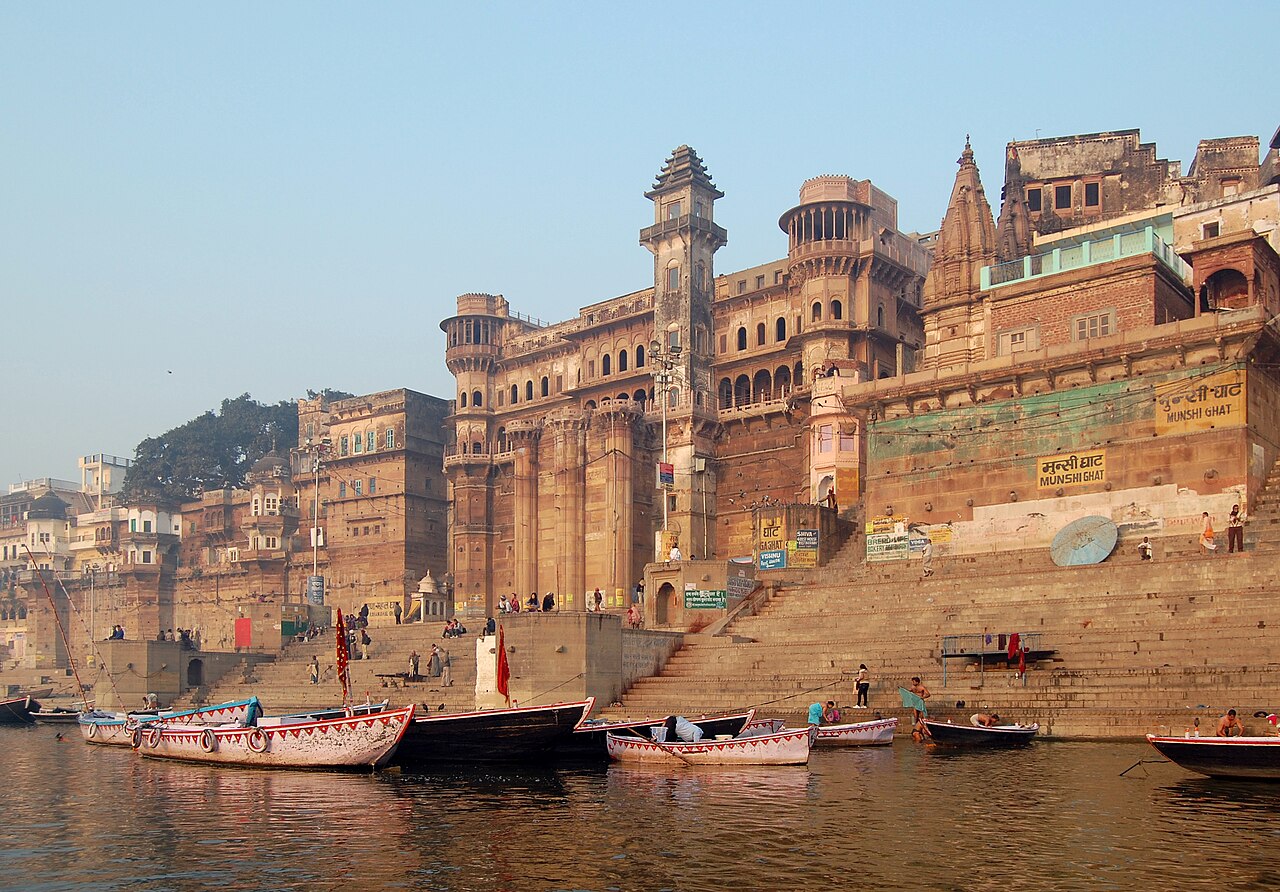
The ghats of Varanasi seen from the Ganges. Source: Wikimedia Commons, Marcin Białek, CC BY-SA 3.0

In Hinduism Ganges water is called "Gangajal," holy water. Many families fill small bottles with Ganges water, take them home and put them on the household shrine; a dying person is fed a sip of Ganges water. Many believe Ganges water can "wash away sin," even that it "never spoils."
There is an interesting scientific background here: in 1896 the British bacteriologist Ernest Hankin observed that Ganges water could kill cholera vibrios. Later researchers suggested this might be because the water contains viruses that infect bacteria, bacteriophages (bacteriophages were discovered only in the 1910s). This is a hypothesis, and the conclusions of studies are not uniform. Some studies have also discussed other properties of Ganges water such as its oxygen content and minerals.
But caution is needed: a phenomenon of several decades ago, or some properties of one stretch of water, cannot show that the water of the whole river in every month is safe today. If the water contains large amounts of sewage and pathogens at the same time, bacteriophages cannot save you.
So for the believer, "taking a sip" is a ritual, not a hygienic act. The two can coexist: God is God, a lab report is a lab report, and doctors generally deal only with the latter.
Turning it around
First, "Ganges pollution" is sometimes treated as a simple story. In fact it is a basin more than 2,500 kilometres long, passing through several states, and problems, responsibilities and progress differ in different places.
Second, there is a mutual incomprehension between "numbers" and "faith." To a believer, asking "is this river clean?" may be the same as asking "is your god not effective?" In that case the data from the environmental authority are taken by some as an affront to faith, and the government also tends to "stress that the water is up to standard during big festivals." This is only my observation; I found no systematic study, and it must be treated with caution.
Third, improvement is slow also because it involves infrastructure, regulation, funding, population and behaviour at once. Building treatment plants alone is not enough; someone must operate and maintain them, someone must supervise them, and someone must be willing to pay.
If a river is both a country's centre of faith and its environmental problem, then when data and faith conflict, who tells everyone "the truth"? And how can it be believed?
References
- CPCB report to the National Green Tribunal (3 February 2025; relayed by Deccan Herald, Moneylife, Climate Fact Checks and others); Rajya Sabha written reply of 13 March 2025
- Namami Gange allocation and expenditure data (IMPRI, Tribune, NBMCW and others); CPCB's 2025 assessment of polluted river stretches
- Ernest Hankin, observation on the bactericidal property of Ganges water (1896)
- Down To Earth: "Maha Kumbh 2025: Ganga, Yamuna's long-term sustainability depends on continuous monitoring..."